A Life in the Theatre
A stage veteran, Robert, and a younger actor, John, appear together in a series of productions. As their work and careers unfold, the relationship between the two men gradually changes.
Loading credits…
A stage veteran, Robert, and a younger actor, John, appear together in a series of productions. As their work and careers unfold, the relationship between the two men gradually changes.
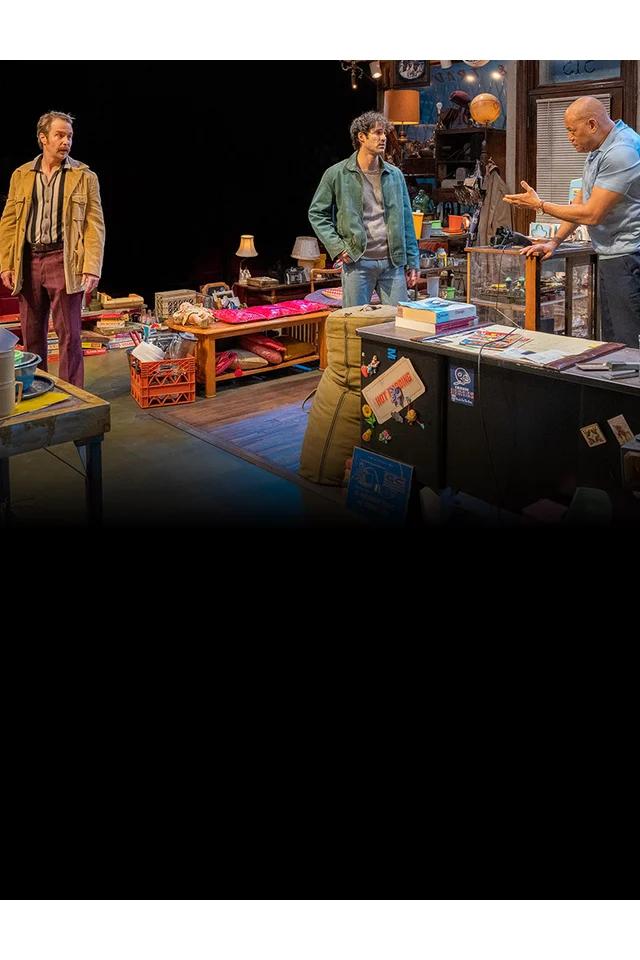
Act I takes place at about 11 a.m. Don, who owns the junk shop where the entire play takes place, has sold a buffalo nickel to a customer for $90 but now suspects it is worth considerably more. He and his young gofer, Bob (sometimes called Bobby), plan to steal the coin back. Bob has been keeping watch on the customer's house and reports that he has left for the weekend with a suitcase. Teach, a poker buddy of Don's, arrives and learns of the scheme. He persuades Don that Bob is too inexperienced and untrustworthy for the burglary, and proposes himself as Bob's replacement. Teach suggests they steal the whole coin collection and more. Don insists on their poker buddy Fletcher going with Teach. Teach continues to argue that he can do the job without Fletcher. Act II takes place a little before midnight on the same day. Teach and Don make final preparations for the burglary while waiting for Fletcher, who is late. Teach tells Don that Fletcher is a liar and a cheater at cards, and prepares to go commit the burglary on his own. Don tries to persuade him not to take his gun with him when Bob appears at the store. He attempts to sell Don a buffalo nickel, similar to the one Don had sold the customer. When asked where he got the coin, Bob is evasive. Teach suspects that Bob and Fletcher have organized and completed their own burglary behind Don and Teach's backs. He asks Bob where Fletcher is. Bob tells him that Fletcher was mugged by "some Mexicans" and is in a hospital, but when Don calls the hospital, they have no record of his admission. Bob claims that he must have been mistaken about the name of the hospital, but the suspicious Teach strikes him on the head with a metal object. Another friend calls, corroborating Bob's story and naming the correct hospital. Don calls the hospital and confirms that Fletcher has been admitted with a broken jaw. Bob confesses that he made up the story about the customer leaving with a suitcase, and that he bought the second nickel from a coin dealer in order to make up with Don for his failure to keep tabs on the customer. Don admonishes Teach for wounding Bob and orders him to get his car so they can take him to the hospital.
After his death, film executive Bobby Gould is questioned in Hell by an irritable interrogator about whether he was a bad man.
In turn-of-the-century Boston, Anna and Claire navigate their intimate relationship and Claire's new love while Anna's maid Catherine witnesses their sharp exchanges.
Retiring political fixer Mickey Ross’s planned $5 million tax-saving purchase of a Swiss jet unravels after his fiancée is detained in Canada. Suspecting a political rival, Mickey tries to protect himself from federal charges, while his assistant Carson prepares to negotiate separately.
After a fortune-teller visit, white-collar worker Edmond leaves his wife and wanders through New York's underworld. Violence and escalating alienation lead him to murder, prison and a charged relationship with his cellmate, while the play examines fear, race, sexuality, faith and destiny.
After critics dismiss his latest work, a married young scientist and philosopher makes a demonic bargain with an eccentric party entertainer called Magus.
Setting: a Chinese restaurant Scene 1: Shelly Levene tries to convince office manager John Williamson to give him some of "the Glengarry leads" (names and phone numbers of promising potential clients for expensive properties). Williamson is willing to sell some of the prime leads, but demands cash in advance. Levene cannot come up with the cash and must leave without any good leads to work with. Scene 2: Dave Moss and George Aaronow hate the pressure management has put on them to succeed. Moss tells Aaronow that they need to strike back by stealing all the Glengarry leads and selling them to another real estate agency. Moss's plan would require Aaronow to break into the office, stage a burglary, and steal all the prime leads. Aaronow wants no part of the plan, but Moss intimidates him, claiming that he is already an accomplice simply by listening to Moss's pitch. Scene 3: Ricky Roma delivers a monologue to James Lingk. Roma does not bring up the real estate he wants to sell to Lingk until the very end. Instead, Roma preys upon Lingk's insecurities, and his sense that he has never done anything adventurous with his life. Setting: a real estate sales office The burglary is discovered. Williamson has summoned a police detective. Shelly Levene is happy, because he has finally sold a large plot of land to a couple named Nyborg. James Lingk enters the office, looking for Ricky Roma. Lingk's wife has ordered him to cancel the sales contract he signed with Roma. Roma attempts to smooth-talk Lingk into not canceling the contract, informing Lingk that his check has not yet been brought to the bank; this begins to have its intended calming effect on Lingk, who is clearly agitated. Levene supports the ruse, but Williamson, thinking Lingk is worried about the safety of his check, accidentally ruins Roma's ploy when he tells Lingk that his check has just been deposited. Lingk abruptly leaves, telling Roma he's sorry for letting him down. Roma is furious at Williamson, who has blown a big sale. Levene picks up where Roma left off, and begins insulting Williamson. Mid-rant, Levene accidentally reveals his knowledge that Williamson made up the claim about the check being cashed, information he could not have known unless he had been in Williamson's office. Williamson accuses Levene of robbing the office. Levene quickly folds and admits that he and Dave Moss were the thieves. Levene tries to bribe Williamson, offering half of his future sales. Williamson reveals that the Nyborg sale is worthless, as the couple is elderly, mentally ill, and just like talking to salesmen because they're so lonely. Levene asks why Williamson wants him turned in, and why he wouldn't give him the leads in the first place. Williamson simply states he doesn't like Levene, for the years of verbal abuse, and the old man's flippant nature. Roma comes back from his interrogation and Williamson goes in the back room to speak with the detective. Alone with a devastated Levene, Roma proposes the two men work together. The door opens and the detective demands to speak with Levene, shoving him into the back room. Roma, unaware of Levene's fate, reveals his true intentions behind the partnership. Roma orders Williamson to not only continue to hand him the best leads, but to add half of Levene's commissions. Williamson tells Roma not to worry about it but Roma won't listen. (This exchange is omitted in both the published play script and film adaptation.) Aaronow enters the office, desperate to know if they found the perpetrators. Roma says no and heads out to the restaurant.
College student Dale Katzman takes a summer job as a cook aboard a Chicago steel company’s lake freighter. Through conversations with the crew, including veteran sailor Joe Litko, he learns about their shipboard lives and the violent fate of his predecessor.
November is a play written by David Mamet which premiered on Broadway in 2008.
In three acts, a university student and her professor meet privately after she struggles with his course. Her complaint of sexual harassment threatens his tenure; as their arguments over power and academic speech intensify, the confrontation ends in violence.
On a night train from Chicago to Duluth, a storyteller recounts a murder with supernatural undertones to a listener while two other passengers play gin. The gin player suspects cheating, and a violent altercation brings the separate pairs together.
A racially charged sex crime takes place which leads to charges being made against Charles Strickland, a wealthy resident in his town. He quickly goes to his friend Jack Lawson, a criminal attorney, and retains him to defend his case. Lawson agrees and begins to rely on help from a young black attorney he calls Susan working in his three-lawyer office. As evidence and police reports begin to accumulate for the preparation of the defense of the case, Jack begins to suspect deep flaws in the police investigation of the crime scene. He notes that although the crime reports clearly identify the crime victim as having worn a red sequin dress on the night of the sex crime that something is wrong with the details in the police reports. From his personal experience, he explains to his fellow law office partners (Susan and Brown) how fragile sequin dresses are in general, and how even the slightest incident of jarring or simple out-on-the-town wearing of a sequin dress inevitably leads to sequins popping and falling off almost without any provocation whatsoever. However, the police reports, although otherwise seeming to be thorough, do not mention red sequins being missing or lying around the victim's room in question where an apparent extensive struggle had taken place. The other law partners are impressed by the startling omission, and all three partners come to the conclusion, with increasing and visible confidence before each other, that this omission by the police is very deeply flawed. They are convinced that the credibility of the police reports cannot withstand questioning in the courtroom. All three lawyers feel that their client will be exonerated. The next day, however, news come to the lawyers that a maid in the hotel has "remembered" that she saw sequins under the bed. In the process of further interviews with his client, discussions with his partner, and with Susan, Jack becomes aware of even further complications in the case. The ethnic prejudices of his old friend whom he is defending turn out to be highly suspect and pejorative. More importantly, he begins to suspect that Susan's hand in the activities taking place in the law office after receiving the case may be tainted. Susan turns out to have strong feelings about racially motivated sex crimes and she is far from unbiased in the representation of the case. As Jack continues to quiz her and challenge her on her own beliefs it becomes clear that Susan had come to play a part in the statement of the maid materialising overnight and invalidating the fragile sequin theory the partners were planning to use. It becomes clear by the final curtain that Susan had leaked the information concerning the basis of Jack's planned defense, the fragile sequin theory, to the police and/or DA. It becomes clear that Susan had done this in order to influence the outcome in a matter of justice involving a question of bigotry and of race.
In a courtroom, a drowsy then manic judge presides over a volatile trial involving the prosecutor and his boyfriend, a defense attorney and his client, and a defendant who proposes a solution to the problems in the Middle East.
Two Chicago men and two women trade caustic views about sex and relationships; the romance between Danny and Deborah deteriorates under their inability to communicate.
Hollywood producer Bobby Gould and associate Charlie Fox hope to secure a film project, while Gould bets that he can seduce his secretary Karen. Karen urges him to back a challenging book adaptation, but Fox later exposes her own ambition, and Gould returns to the commercially safe project.
Hack writer Arthur has spent fifteen years on the opening line of a story about a man and a squirrel. His young secretary and collaborator Edmond develops competing scenarios, while their cleaning lady offers ideas that also descend into banality.
In a prison parole office, an officer questions a former domestic terrorist who killed two police officers. Their argument turns on the prisoner’s lack of remorse and the officer’s decision about parole.
On the night before a boy's camping trip with his father, adult silences and a cryptic message unsettle his understanding of his family.
Two elderly men meet on a park bench and discuss the ducks in a nearby lake. Their speculative conversation about ducks unfolds into reflections on leadership, purpose, friendship, law and death.
Mamet retells the traditional tale of a haughty prince transformed into a frog, who can return to human form only if someone willingly kisses him.
In three linked playlets, middle-aged Bobby Gould returns to Chicago and revisits old relationships: two school friends argue over their shared past, siblings confront the effects of their parents’ divorce, and Bobby reconnects with a former love while his marriage falters.
A psychiatrist, Charles (Chris Bauer), has his career and life become derailed after he refuses to testify on behalf of a former patient who had become clinically violent and unstable, resulting in the deaths of multiple people following a tragic breakdown of his mental complications. The patient then claims that Charles will not testify in court or to the police because the patient is openly part of the LGBT community. Further, the patient claims that Charles has recently gone through a religious conversion in his own personal identity which has resulted in a fully prejudiced reassessment of the gay community as a whole. Charles claims that the basis of these accusations are false and due to a misunderstanding. The misunderstanding resulted from an innocent mistyping of the title of an article that Charles wrote years ago about homosexuality where the title was "Homosexuality as an Adaptation," though the published version was released by the editor as the mistyped "Homosexuality as an Aberration." The resulting recriminations put Charles's entire career at risk and threaten to end his practice permanently.
Miss A seeks advice from John, an amateur psychic, about her late mother’s inheritance. John and his ambitious protégé Charles plan a séance to deceive her, but Miss A exposes their tricks; John then reveals an unexplained detail about her childhood and a red shawl that may be genuine psychic insight.
Charles Lang works at a menial job at a factory and lives with his blind sister Rita in an apartment in Chicago during the 1934 Century of Progress world's fair. He is also an amateur inventor, and the play centers around a machine he designs that can create electricity from distilled water. Seeking to patent his idea, he finds a lawyer, Morton Gross, in the phone book and shows him the machine, but Gross's motivations seem to differ from Lang's. Gross recruits another lawyer, Lawrence Oberman, and together they menace Lang and eventually his sister. It is heavily implied that the two of them serve the corporate establishment whose profits Lang's engine threatens. By the time Lang realizes he is being taken advantage of, the lawyers have him trapped. He attempts to contact a newspaper reporter, but Gross and Oberman hold his sister hostage to prevent him from telling his story. He then meets a barker at the World's Fair right before it closes for the night who tells him of a chain letter he has just received, which gives him an idea. The lawyers try to force Lang into giving them his plans, but he says he no longer has them; the audience finds out from a scene in the newspaper reporter's office that he and Rita have been killed. The play ends with Bernie, a young friend of the family who has previously shown mechanical aptitude, receiving the plans for the Water Engine in the mail.
The play is about a couple, Nick and Ruth, spending a night at a house in the country. They push their relationship to the breaking point in a night of stories and fights, only to rediscover their need for one another in the morning. The play takes place on the front porch of Nick's family's summerhouse, where he and Ruth are spending the night. The Woods ends with a bed-time story, but the final reconciliation remains uncomfortably tempered by the violent core we now know to be hiding beneath the soothing words.
Civil servants pass time by playing vint with personal files; when an official hears his wife's name, he takes an unexpected action.
A stage veteran, Robert, and a younger actor, John, appear together in a series of productions. As their work and careers unfold, the relationship between the two men gradually changes.
Act I takes place at about 11 a.m. Don, who owns the junk shop where the entire play takes place, has sold a buffalo nickel to a customer for $90 but now suspects it is worth considerably more. He and his young gofer, Bob (sometimes called Bobby), plan to steal the coin back. Bob has been keeping watch on the customer's house and reports that he has left for the weekend with a suitcase. Teach, a poker buddy of Don's, arrives and learns of the scheme. He persuades Don that Bob is too inexperienced and untrustworthy for the burglary, and proposes himself as Bob's replacement. Teach suggests they steal the whole coin collection and more. Don insists on their poker buddy Fletcher going with Teach. Teach continues to argue that he can do the job without Fletcher. Act II takes place a little before midnight on the same day. Teach and Don make final preparations for the burglary while waiting for Fletcher, who is late. Teach tells Don that Fletcher is a liar and a cheater at cards, and prepares to go commit the burglary on his own. Don tries to persuade him not to take his gun with him when Bob appears at the store. He attempts to sell Don a buffalo nickel, similar to the one Don had sold the customer. When asked where he got the coin, Bob is evasive. Teach suspects that Bob and Fletcher have organized and completed their own burglary behind Don and Teach's backs. He asks Bob where Fletcher is. Bob tells him that Fletcher was mugged by "some Mexicans" and is in a hospital, but when Don calls the hospital, they have no record of his admission. Bob claims that he must have been mistaken about the name of the hospital, but the suspicious Teach strikes him on the head with a metal object. Another friend calls, corroborating Bob's story and naming the correct hospital. Don calls the hospital and confirms that Fletcher has been admitted with a broken jaw. Bob confesses that he made up the story about the customer leaving with a suitcase, and that he bought the second nickel from a coin dealer in order to make up with Don for his failure to keep tabs on the customer. Don admonishes Teach for wounding Bob and orders him to get his car so they can take him to the hospital.
After his death, film executive Bobby Gould is questioned in Hell by an irritable interrogator about whether he was a bad man.
In turn-of-the-century Boston, Anna and Claire navigate their intimate relationship and Claire's new love while Anna's maid Catherine witnesses their sharp exchanges.
Retiring political fixer Mickey Ross’s planned $5 million tax-saving purchase of a Swiss jet unravels after his fiancée is detained in Canada. Suspecting a political rival, Mickey tries to protect himself from federal charges, while his assistant Carson prepares to negotiate separately.
After a fortune-teller visit, white-collar worker Edmond leaves his wife and wanders through New York's underworld. Violence and escalating alienation lead him to murder, prison and a charged relationship with his cellmate, while the play examines fear, race, sexuality, faith and destiny.
After critics dismiss his latest work, a married young scientist and philosopher makes a demonic bargain with an eccentric party entertainer called Magus.
Setting: a Chinese restaurant Scene 1: Shelly Levene tries to convince office manager John Williamson to give him some of "the Glengarry leads" (names and phone numbers of promising potential clients for expensive properties). Williamson is willing to sell some of the prime leads, but demands cash in advance. Levene cannot come up with the cash and must leave without any good leads to work with. Scene 2: Dave Moss and George Aaronow hate the pressure management has put on them to succeed. Moss tells Aaronow that they need to strike back by stealing all the Glengarry leads and selling them to another real estate agency. Moss's plan would require Aaronow to break into the office, stage a burglary, and steal all the prime leads. Aaronow wants no part of the plan, but Moss intimidates him, claiming that he is already an accomplice simply by listening to Moss's pitch. Scene 3: Ricky Roma delivers a monologue to James Lingk. Roma does not bring up the real estate he wants to sell to Lingk until the very end. Instead, Roma preys upon Lingk's insecurities, and his sense that he has never done anything adventurous with his life. Setting: a real estate sales office The burglary is discovered. Williamson has summoned a police detective. Shelly Levene is happy, because he has finally sold a large plot of land to a couple named Nyborg. James Lingk enters the office, looking for Ricky Roma. Lingk's wife has ordered him to cancel the sales contract he signed with Roma. Roma attempts to smooth-talk Lingk into not canceling the contract, informing Lingk that his check has not yet been brought to the bank; this begins to have its intended calming effect on Lingk, who is clearly agitated. Levene supports the ruse, but Williamson, thinking Lingk is worried about the safety of his check, accidentally ruins Roma's ploy when he tells Lingk that his check has just been deposited. Lingk abruptly leaves, telling Roma he's sorry for letting him down. Roma is furious at Williamson, who has blown a big sale. Levene picks up where Roma left off, and begins insulting Williamson. Mid-rant, Levene accidentally reveals his knowledge that Williamson made up the claim about the check being cashed, information he could not have known unless he had been in Williamson's office. Williamson accuses Levene of robbing the office. Levene quickly folds and admits that he and Dave Moss were the thieves. Levene tries to bribe Williamson, offering half of his future sales. Williamson reveals that the Nyborg sale is worthless, as the couple is elderly, mentally ill, and just like talking to salesmen because they're so lonely. Levene asks why Williamson wants him turned in, and why he wouldn't give him the leads in the first place. Williamson simply states he doesn't like Levene, for the years of verbal abuse, and the old man's flippant nature. Roma comes back from his interrogation and Williamson goes in the back room to speak with the detective. Alone with a devastated Levene, Roma proposes the two men work together. The door opens and the detective demands to speak with Levene, shoving him into the back room. Roma, unaware of Levene's fate, reveals his true intentions behind the partnership. Roma orders Williamson to not only continue to hand him the best leads, but to add half of Levene's commissions. Williamson tells Roma not to worry about it but Roma won't listen. (This exchange is omitted in both the published play script and film adaptation.) Aaronow enters the office, desperate to know if they found the perpetrators. Roma says no and heads out to the restaurant.
College student Dale Katzman takes a summer job as a cook aboard a Chicago steel company’s lake freighter. Through conversations with the crew, including veteran sailor Joe Litko, he learns about their shipboard lives and the violent fate of his predecessor.
November is a play written by David Mamet which premiered on Broadway in 2008.
In three acts, a university student and her professor meet privately after she struggles with his course. Her complaint of sexual harassment threatens his tenure; as their arguments over power and academic speech intensify, the confrontation ends in violence.
On a night train from Chicago to Duluth, a storyteller recounts a murder with supernatural undertones to a listener while two other passengers play gin. The gin player suspects cheating, and a violent altercation brings the separate pairs together.
A racially charged sex crime takes place which leads to charges being made against Charles Strickland, a wealthy resident in his town. He quickly goes to his friend Jack Lawson, a criminal attorney, and retains him to defend his case. Lawson agrees and begins to rely on help from a young black attorney he calls Susan working in his three-lawyer office. As evidence and police reports begin to accumulate for the preparation of the defense of the case, Jack begins to suspect deep flaws in the police investigation of the crime scene. He notes that although the crime reports clearly identify the crime victim as having worn a red sequin dress on the night of the sex crime that something is wrong with the details in the police reports. From his personal experience, he explains to his fellow law office partners (Susan and Brown) how fragile sequin dresses are in general, and how even the slightest incident of jarring or simple out-on-the-town wearing of a sequin dress inevitably leads to sequins popping and falling off almost without any provocation whatsoever. However, the police reports, although otherwise seeming to be thorough, do not mention red sequins being missing or lying around the victim's room in question where an apparent extensive struggle had taken place. The other law partners are impressed by the startling omission, and all three partners come to the conclusion, with increasing and visible confidence before each other, that this omission by the police is very deeply flawed. They are convinced that the credibility of the police reports cannot withstand questioning in the courtroom. All three lawyers feel that their client will be exonerated. The next day, however, news come to the lawyers that a maid in the hotel has "remembered" that she saw sequins under the bed. In the process of further interviews with his client, discussions with his partner, and with Susan, Jack becomes aware of even further complications in the case. The ethnic prejudices of his old friend whom he is defending turn out to be highly suspect and pejorative. More importantly, he begins to suspect that Susan's hand in the activities taking place in the law office after receiving the case may be tainted. Susan turns out to have strong feelings about racially motivated sex crimes and she is far from unbiased in the representation of the case. As Jack continues to quiz her and challenge her on her own beliefs it becomes clear that Susan had come to play a part in the statement of the maid materialising overnight and invalidating the fragile sequin theory the partners were planning to use. It becomes clear by the final curtain that Susan had leaked the information concerning the basis of Jack's planned defense, the fragile sequin theory, to the police and/or DA. It becomes clear that Susan had done this in order to influence the outcome in a matter of justice involving a question of bigotry and of race.
In a courtroom, a drowsy then manic judge presides over a volatile trial involving the prosecutor and his boyfriend, a defense attorney and his client, and a defendant who proposes a solution to the problems in the Middle East.
Two Chicago men and two women trade caustic views about sex and relationships; the romance between Danny and Deborah deteriorates under their inability to communicate.
Hollywood producer Bobby Gould and associate Charlie Fox hope to secure a film project, while Gould bets that he can seduce his secretary Karen. Karen urges him to back a challenging book adaptation, but Fox later exposes her own ambition, and Gould returns to the commercially safe project.
Hack writer Arthur has spent fifteen years on the opening line of a story about a man and a squirrel. His young secretary and collaborator Edmond develops competing scenarios, while their cleaning lady offers ideas that also descend into banality.
In a prison parole office, an officer questions a former domestic terrorist who killed two police officers. Their argument turns on the prisoner’s lack of remorse and the officer’s decision about parole.
On the night before a boy's camping trip with his father, adult silences and a cryptic message unsettle his understanding of his family.
Two elderly men meet on a park bench and discuss the ducks in a nearby lake. Their speculative conversation about ducks unfolds into reflections on leadership, purpose, friendship, law and death.
Mamet retells the traditional tale of a haughty prince transformed into a frog, who can return to human form only if someone willingly kisses him.
In three linked playlets, middle-aged Bobby Gould returns to Chicago and revisits old relationships: two school friends argue over their shared past, siblings confront the effects of their parents’ divorce, and Bobby reconnects with a former love while his marriage falters.
A psychiatrist, Charles (Chris Bauer), has his career and life become derailed after he refuses to testify on behalf of a former patient who had become clinically violent and unstable, resulting in the deaths of multiple people following a tragic breakdown of his mental complications. The patient then claims that Charles will not testify in court or to the police because the patient is openly part of the LGBT community. Further, the patient claims that Charles has recently gone through a religious conversion in his own personal identity which has resulted in a fully prejudiced reassessment of the gay community as a whole. Charles claims that the basis of these accusations are false and due to a misunderstanding. The misunderstanding resulted from an innocent mistyping of the title of an article that Charles wrote years ago about homosexuality where the title was "Homosexuality as an Adaptation," though the published version was released by the editor as the mistyped "Homosexuality as an Aberration." The resulting recriminations put Charles's entire career at risk and threaten to end his practice permanently.
Miss A seeks advice from John, an amateur psychic, about her late mother’s inheritance. John and his ambitious protégé Charles plan a séance to deceive her, but Miss A exposes their tricks; John then reveals an unexplained detail about her childhood and a red shawl that may be genuine psychic insight.
Charles Lang works at a menial job at a factory and lives with his blind sister Rita in an apartment in Chicago during the 1934 Century of Progress world's fair. He is also an amateur inventor, and the play centers around a machine he designs that can create electricity from distilled water. Seeking to patent his idea, he finds a lawyer, Morton Gross, in the phone book and shows him the machine, but Gross's motivations seem to differ from Lang's. Gross recruits another lawyer, Lawrence Oberman, and together they menace Lang and eventually his sister. It is heavily implied that the two of them serve the corporate establishment whose profits Lang's engine threatens. By the time Lang realizes he is being taken advantage of, the lawyers have him trapped. He attempts to contact a newspaper reporter, but Gross and Oberman hold his sister hostage to prevent him from telling his story. He then meets a barker at the World's Fair right before it closes for the night who tells him of a chain letter he has just received, which gives him an idea. The lawyers try to force Lang into giving them his plans, but he says he no longer has them; the audience finds out from a scene in the newspaper reporter's office that he and Rita have been killed. The play ends with Bernie, a young friend of the family who has previously shown mechanical aptitude, receiving the plans for the Water Engine in the mail.
The play is about a couple, Nick and Ruth, spending a night at a house in the country. They push their relationship to the breaking point in a night of stories and fights, only to rediscover their need for one another in the morning. The play takes place on the front porch of Nick's family's summerhouse, where he and Ruth are spending the night. The Woods ends with a bed-time story, but the final reconciliation remains uncomfortably tempered by the violent core we now know to be hiding beneath the soothing words.
Civil servants pass time by playing vint with personal files; when an official hears his wife's name, he takes an unexpected action.