A Dance of the Forests
Using dead characters and flashbacks, Soyinka examines Nigerian society across precolonial and postcolonial histories and warns against idealizing the past as the country approaches independence.
8284 shows
Clear filtersUsing dead characters and flashbacks, Soyinka examines Nigerian society across precolonial and postcolonial histories and warns against idealizing the past as the country approaches independence.
A daughter opposes her mother's plan to remarry.
There is little incident in the play, which is a study of the various characters rather than a narrative. It is set in and near the Dorset country house of Laura Anson, a brisk and sensible elderly woman, determined to keep the family home going, though worried that once she is dead nobody will succeed her in this. Her son, Julian, is a workaholic diplomat who abruptly realises that his obsession with his work has left him without a personal life. He attempts to interest the widowed, emotionally damaged Frances, but after two disastrous marriages she cannot face another deep personal relationship. David Anson, Julian's uncle, is an octogenarian who muses on the transitory nature of life. The governess, Miss Mathieson, despairs of finding a husband and makes an unsuccessful attempt to engage the affections of the bibulous but shrewd Dr Farley. While the characters are having a picnic on the beach a Foreign Office official comes to tell Julian he is no longer required in the embassy in Paris and must return to London.
A Day in Turkey is a 1791 comedy by the English author Hannah Cowley. It premiered at the Theatre Royal, Covent Garden in London on 3 December 1791. The original cast included Joseph George Holman as Ibrahim, William Farren as Orloff, John Fawcett as A La Greque, Joseph Shepherd Munden as Mustapha, William Cubitt as Azim, Charles Incledon as Selim, William Macready as Muley, Charles Farley as Ismael, James Thompson as Old Man, Jane Pope as Alexina, Harriet Pye Esten as Paulina, Isabella Mattocks as Lauretta and Margaret Martyr as Fatima. The Irish premiere took place at the Crow Street Theatre in Dublin on 16 May 1792
The play centres on a British couple, Bri and Sheila, who are struggling to save their marriage whilst trying to raise their only child, a small girl named Josephine, who has cerebral palsy. She uses a wheelchair and is nonverbal, which her parents see as unable to communicate. Caring for her has occupied nearly every moment of her parents' lives since her birth, taking a heavy toll on their marriage. Sheila gives Josephine as much of a life as she can, while Bri wants the child institutionalised and has begun to entertain chilling fantasies of killing himself and Josephine.
In 1911 London, insurance agent Frederick Dyson and his wife share their house with lodger Miss Lummus, an elderly woman who hides her money there. After she is murdered, Dyson is charged with the crime.
A Delicate Balance is a three-act play by Edward Albee, written in 1965 and 1966. Premiered in 1966, it won the Pulitzer Prize for Drama in 1967, the first of three he received for his work. The uneasy existence of upper-middle-class suburbanites Agnes and Tobias and their permanent houseguest, Agnes's witty and alcoholic sister Claire, is disrupted by the sudden appearance of lifelong family friends Harry and Edna, fellow empty nesters with free-floating anxiety, who ask to stay with them to escape an unnamed terror. They soon are followed by Agnes and Tobias's bitter 36-year-old daughter Julia, who returns home following the collapse of her fourth marriage.
Gary Barlow tells the story of his life in his own words, reflecting on his career, friendships and personal life.
Ramanujan first attracted Hardy's attention by writing him a letter in which he proved that where the notation indicates a Ramanujan summation. Hardy realised that this confusing presentation of the series 1 + 2 + 3 + 4 + ⋯ was an application of the Riemann zeta function with. Ramanujan's work became one of the foundations of bosonic string theory, a precursor of modern string theory. The play includes live tabla playing, which "morphs seductively into pure mathematics", as the Financial Times review put it, "especially when... its rhythms shade into chants of number sequences reminiscent of the libretto to Philip Glass's Einstein on the Beach. One can hear the beauty of the sequences without grasping the rules that govern them." The play has two strands of narrative and presents strong visual and physical theatre. It interweaves the passionate intellectual relationship between Hardy and the more intuitive Ramanujan, with the present-day story of Ruth, an English maths lecturer, and her husband, Al Cooper, a globe-trotting Indian-American businessman "to illuminate the beauty and the patterns – the mystery – of mathematics." It also explores the nature and spirituality of infinity, and explores several aspects of the Indian diaspora. Ruth travels to India in Ramanujan's footsteps and eventually dies. Al follows, to get closer to her ghost. Meanwhile, 100 years previously, Ramanujan is travelling in the opposite direction, making the trip to England, where he works with Hardy on maths and contracts tuberculosis. Partition (as a maths concept) is explored, and diverging and converging series in mathematics become a metaphor for the Indian diaspora.
Just prior to Christmas, Nora Helmer returns from shopping carrying many packages and presents. Her husband, Torvald, is working in his study. He playfully rebukes Nora for spending so much money on Christmas gifts, calling her his "little squirrel". He teases her about how, the previous year, she had spent weeks making gifts and ornaments by hand because money was scarce. Torvald has been recently promoted at the bank where he works, so Nora feels that they can now let themselves go a little. The maid announces two visitors: Mrs. Kristine Linde, an old friend of Nora's, who has come seeking employment; and Dr. Rank, a close friend of the family, who is let into the study. Kristine explains that she has fallen into poverty following her husband's death. Nora is empathetic, recalling her own past troubles: Torvald became very sick, and they had to travel to Italy for a rest cure. Nora promises to talk to Torvald about finding her a job. Kristine gently tells Nora that she is like a child. Nora is offended, so she tells her that she got money from "some admirer" so they could travel to Italy to improve Torvald's health. She told Torvald that her father gave her the money, but, in fact, she illegally borrowed it without his knowledge (women were forbidden from conducting financial activities such as signing cheques without a man's endorsement). Since then, she has been secretly working and saving up to pay off the borrowed money. Krogstad, a lower level employee at Torvald's bank, arrives and goes into the study. Nora is uneasy when she sees him. Dr. Rank leaves the study and mentions that he feels wretched, though like everyone he wants to go on living. In contrast to his physical illness, he says that the man in the study, Krogstad, is "morally diseased". After the meeting with Krogstad, Torvald comes out of the study. Nora asks him if he can give Kristine a position at the bank and Torvald is positive about this, saying that this is a fortunate moment, as a position has just become available. Torvald, Kristine, and Dr. Rank leave the house, leaving Nora alone. The nanny returns with the children, and Nora plays with them for a while until Krogstad creeps through the ajar door into the living room and surprises her. Krogstad tells Nora that Torvald intends to fire him from the bank and asks her to intercede with Torvald to allow him to keep his job. She refuses, and Krogstad blackmails her about the loan she took out from him for the trip to Italy; he knows that she obtained this loan by forging her father's signature after his death, a serious offence. Krogstad leaves, and, when Torvald returns, Nora tries to convince him not to fire Krogstad. Torvald refuses to hear her pleas, explaining that Krogstad is a liar and a hypocrite and that, years before, he had committed a crime: he forged other people's signatures. Torvald feels physically ill in the presence of a man "poisoning his own children with lies and dissimulation". Kristine arrives to help Nora repair a dress for a fancy-dress party that she and Torvald plan to attend the next day. Torvald returns from the bank, and Nora pleads with him to reinstate Krogstad, claiming she is worried Krogstad will publish libelous articles about Torvald and ruin his career. Torvald dismisses her fears and explains that, although Krogstad is a reasonable worker and seems to have turned his life around, he must be fired because he is too personally familiar with Torvald in front of other bank personnel due to their past friendship, then retires to his study to work. Dr. Rank then arrives. Nora teases him and builds up to ask him for a favour, but Rank responds by revealing that he has entered the terminal stage of his disease and that he has always been secretly in love with her. Nora tries to deny the first revelation and make light of it but is disturbed by his declaration of love. She then clumsily attempts to tell him that she is not in love with him but loves him dearly as a friend, and never discloses the nature of the favour she had in mind to ask him. Having been fired by Torvald, Krogstad arrives at the house. Nora convinces Dr. Rank to go into Torvald's study so he will not see Krogstad. When Krogstad confronts Nora, he declares that he no longer cares about the remaining balance of Nora's loan but that he will instead preserve the associated bond (or ’IOU’) to blackmail Torvald into not only keeping him employed but also promoting him in future. Nora explains that she has done her best to persuade her husband, but he refuses to change his mind. Krogstad informs Nora that he has written a letter detailing her crime (forging her father's signature of surety on the bond) and will put it in Torvald's letter box, which is locked. Nora tells Kristine of her difficult situation, gives her Krogstad's card with his address, and asks her to try to convince him to relent. Torvald enters and tries to retrieve his mail, but Nora distracts him by begging him to help her with the dance she has been rehearsing for the costume party, feigning anxiety about performing. She dances so badly and acts so childishly that Torvald agrees to spend the whole evening coaching her. When the others go to dinner, Nora stays behind for a few minutes and contemplates killing herself. Kristine tells Krogstad that she only married her husband because she had no other means to support her sick mother and young siblings and that she has returned to offer him her love again. She believes that he would not have stooped to unethical behavior if he had not been devastated by her abandonment and in dire financial straits. Krogstad changes his mind and offers to take back his letter to Torvald. Kristine, however, decides that Torvald should know the truth for the sake of his and Nora's marriage. Torvald drags Nora home from the party, and Rank departs, conveying obliquely to Nora that this is a final goodbye, as he has determined that his death is near. Torvald retrieves his letters. As he reads them, Nora prepares to run away for good, but Torvald confronts her with Krogstad's letter. Enraged, he declares that she is now completely in Krogstad's power; she must yield to Krogstad's demands and keep quiet about the whole affair. He berates Nora, calling her a dishonest and immoral woman and telling her that she is unfit to raise their children. He says that from now on their marriage will be only a matter of appearances. A maid enters, delivering a letter from Krogstad to Nora, which Torvald demands to read himself. Torvald then exults that he is saved, as Krogstad has returned the incriminating bond, which Torvald immediately burns along with Krogstad's letters. He takes back his harsh words to his wife and tells her that he forgives her. Nora realizes that her husband is not the strong and gallant man she thought he was, who would protect and defend her, and that he truly loves himself more than he does Nora. Torvald remarks when a man has forgiven his wife it makes him love her all the more since it reminds him that she is totally dependent on him, like a child. He preserves his peace of mind by thinking of the incident as a mere mistake that she made owing to her foolishness, one of her most endearing feminine traits. Disillusioned, Nora tells Torvald that she is leaving him because the pair have become strangers to each other and she has been treated like a doll all her life by both her father and husband. She reveals that she had hoped and expected that he would want to sacrifice his reputation for hers in this scandal and that she had planned to kill herself to prevent him from doing so. Torvald insists that she fulfill her duty as a wife and mother, which he says is more important than knowing herself, but Nora says that she has duties to herself that are just as important and that she cannot be a good mother or wife without learning to be more than just a plaything. She says she cannot return unless both she and Torvald are so changed that they are no longer strangers, which would be "the most wonderful thing of all." Nora leaves her keys and wedding ring; Torvald breaks down and begins to cry, completely baffled by what has happened. After Nora leaves the room, Torvald, for one second, still has a sense of hope and exclaims to himself "The most wonderful thing of all—?", just before the door at the entrance to the building is heard closing. Ibsen's German agent felt that the original ending would not play well in German theatres. In addition, copyright laws of the time would not preserve Ibsen's original work. Therefore, for it to be considered acceptable, and prevent the translator from altering his work, Ibsen was forced to write an alternative ending for the German premiere. In this ending, Nora is led to her children after having argued with Torvald. Seeing them, she collapses, and as the curtain is brought down, it is implied that she stays. Ibsen later called the ending a disgrace to the original play and referred to it as a "barbaric outrage". Virtually all productions today use the original ending, as do nearly all the film versions of the play.
Fifteen years after Nora left her family, she returns to finalize her divorce. A judge threatens to expose her hidden marriage and destroy her career unless she publicly recants her feminist writing; as Nora confronts Torvald, her daughter Emmy, and the family’s nursemaid, Torvald ultimately agrees to divorce her to protect his reputation.
A communal Ecotheater work built from Hinton residents’ oral histories and improvisations. One scene follows the town’s economic decline after the railroad replaced steam locomotives with diesel engines.
Indra’s daughter descends to Earth and encounters human suffering, including poverty, cruelty, and the strains of family life. After a dreamlike sequence of shifting scenes, she returns to Heaven.
An aged, widowed woman, Sybille von Bismarck, mourns Prussia's defeat at the end of World War II. Her monologue draws on Euripides' The Trojan Women, Kleist's The Prince of Homburg and Goethe's Faust: Part II.
A Duke and No Duke is a 1684 comedy play by the Irish writer Nahum Tate. It was originally staged by the United Company at the Drury Lane Theatre in London with a cast including John Wiltshire as Lavinio, Thomas Gillow as Barberino, Joseph Williams as Alberto, Anthony Leigh as Trappolin, Thomas Percival as Mago, Elizabeth Currer as Isabella and Susannah Percival as Prudentia.
During Brazil’s Vargas dictatorship, teacher Bolívar Bueno introduces dangerous ideas to students at the Wolfgang Schubert school. His influence over them unfolds alongside romantic attachments to fellow teachers and intrigue involving the school’s religious authorities.
In 1987, Gil Burgess is an archeologist, working in Mexico. His estranged mother, Patrice, visits him, and he recalls the past events. In 1977, a teenaged Gil is living with his mother and father, Harry, in Durban, South Africa. Harry is a U.S. Information Officer. Harry wants to leave because of the political unrest, and when his son Alec visits, he sees his chance. Harry is offered a job in the Hague if he will reveal his son Alec's associates in the anti-apartheid underground.
Captain Ager challenges a colonel after an insult to his mother, then discovers the family secret that complicates the duel. In a linked plot, Jane's father falsely imprisons her lover to force a richer match, while Jane gives birth to their child; both conflicts resolve through confession, reconciliation, and marriage.
A Far Country is a play by Henry Denker. The work premiered on Broadway at the Music Box Theatre on April 4, 1961, where it closed on November 25, 1961, after 271 performances. Produced by Roger L. Stevens and Joel Schenker, the production was directed by Alfred Ryder and used sets by Donald Oenslager and costumes by Ann Roth. Lead actress Kim Stanley (Ryder's wife at the time) was nominated for a Tony Award for her portrayal of Elizabeth von Ritter.
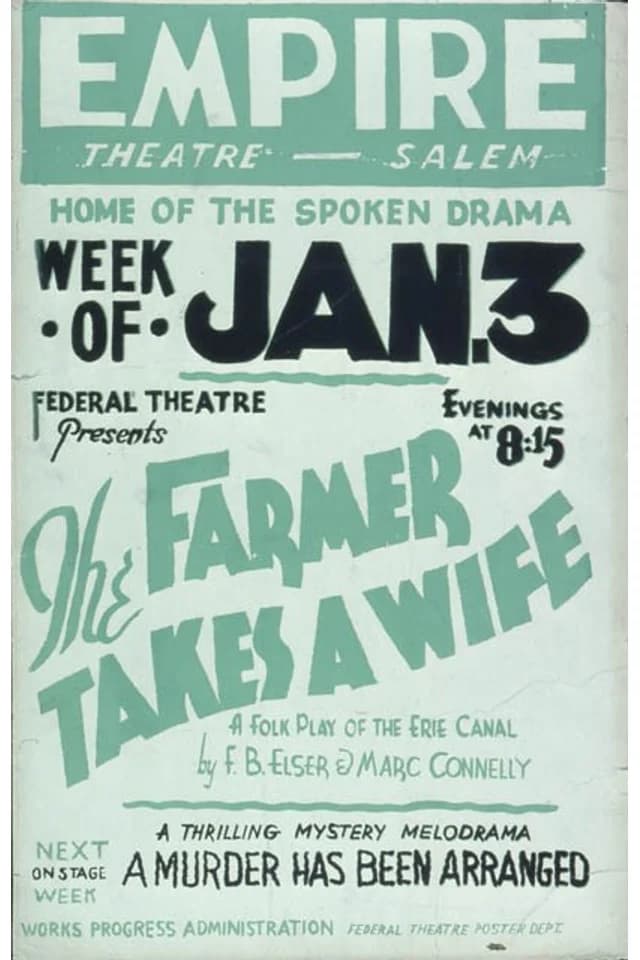
The Farmer Takes a Wife is a 1934 play by Frank B. Elser and Marc Connelly based on the 1929 novel Rome Haul by Walter D. Edmonds. It was well-received upon its opening night on Broadway on October 30, 1934, at the 46th Street Theatre. The production was directed by Marc Connelly, used set designs by Donald Oenslager, and starred Henry Fonda as Dan Harrow and June Walker as Molly Larkins. It ran for 104 performances, closing on January 16, 1935.
At a banquet during a plague, the central figure taunts Death with a toast to the plague’s reign.
Private William Santiago, a United States Marine at the United States Navy's Guantanamo Bay Naval Base, on the south shore of the island of Cuba is a weak Marine who has a hard time physically keeping up and gets along poorly with his fellow Marines and has gone outside the chain of command to the Naval Criminal Investigation Service (NCIS) to request a transfer. Although Lieutenant Colonel Matthew Markinson requests that Santiago be transferred, his senior Base Commander Colonel Nathan Jessep instructs Lieutenant Jonathan James Kendrick, Private Santiago's platoon commander, to "train" Santiago. Soon afterward, Santiago dies. He was murdered, and the two Marines Lance Corporal Harold Dawson and Private First Class Louden Downey who broke into Santiago's dorm room and attacked him and stuffed a rag into his mouth / throat, will stand trial. United States Navy's United States Navy Judge Advocate General's Corps (JAG Corps) investigator and lawyer Lieutenant Commander Joanne Galloway believes Dawson and Downey may have carried out an illegal "code red" order: a brutal extrajudicial punishment that in recent years has been outlawed by military regulations. Santiago was ostensibly killed in retaliation for naming Cpl. Dawson in a fenceline shooting into adjacent Cuban sovereign territory, but Lt. Cmdr. Galloway believes Santiago was killed as part of a premeditated plan or even conspiracy. Galloway wants to represent them, but the case is assigned to fellow Navy officer and lawyer Lieutenant (junior grade) Daniel Kaffee, a bumbling attorney who enjoys accepting plea bargain deals and avoiding drawn-out trials / courts martial. Lt. Kaffee's casual attitude bothers the intense, driven Galloway, while Galloway annoys Kaffee with her meddling and her overbearingness. At Guantanamo Bay, Kaffee and Galloway interrogate base commander Marine Corps Colonel Nathan Jessep and others. Jessep asserts that Santiago was supposed to be transferred off the base and sent back to America the following day. Marines Dawson and Downey reject their lawyer Lt. Kaffee's offer to enter into a plea agreement and receive a short six months sentence with government prosecutor U.S. Marine Captain Jack Ross, claiming that Kendrick gave them the "code red" order, that they never intended for Santiago to die and did nothing wrong. Cpl. Dawson thinks it is dishonorable and a violation of the Marines' strict code of honor for Kaffee to opt for a plea agreement rather than stand their ground in court. Kaffee in disgust and unable to understand their sense of morals, wants to be terminated from his position as counsel because he believes the case is worthless, that if they're found guilty, that they'll both be sentenced to long prison terms. Kaffee suddenly submits a not guilty plea on behalf of the accused at the arraignment. He explains to Galloway that the reason he was selected to handle the case was because of his reputation for quickly settling cases out of court with as little fuss as possible, that it was anticipated that he would take a fast plea deal and the case would then be closed, and swept away under the rug. Lt. Col. Markinson tells Kaffee, during their secretive covert meeting in Kaffee's car, that the code red order was actually given, then hidden, and that Col. Jessep never requested Santiago be transferred. According to the defense, Cpl. Dawson was passed up for promotion because he had given food secretly to another Marine who had been on punishment and ordered to go without meals. The defense Kaffee now presents is a favorable picture of Dawson and shows that "code reds" had previously been authorized through Pvt. Downey. On the other hand, Downey claims under oath and cross-examination that he was not present when Dawson allegedly received the "code red" instructions. Lt. Col. Markinson then kills himself before he can testify because he feels guilty about not protecting a fellow Marine under his charge and being an informer / whistle-blower. Kaffee thinks the case has been lost without Markinson's testimony. He complains that he fought the case rather than accepting a settlement as he returns home drunk. Galloway urges Kaffee to summon and get Jessep to testify on the stand under oath despite the possibility of facing court-martial for defying a superior officer. When Kaffee brings up a discrepancy in Col. Jessep's testimony in court at the court-martial at the Washington Navy Yard—that his Marines never disobey orders and that Santiago was to be relocated for his own safety—he is disturbed. Jessep spars under Kaffee's interrogation. Considering that Jessep had told his men to leave Santiago alone, Kaffee wonders why he was still in danger. Jessep, disgusted by Kaffee's behavior, praises the military's contribution to national security as well as his own. Finally, Jessep admits with disdain and intense anger that he really did give the "code red" command. Then while attempting to leave the courtroom thinking he's above reproach or questioned, Jessep is then arrested by order of the observing military judges. The murder and conspiracy charges against Dawson and Downey are dropped, but they are found guilty of lesser offenses of "conduct unbecoming" and will be dishonorably discharged. Dawson explains to his confused and non-comprehending friend that they failed to stand up for people who were too helpless to defend themselves, like Pvt. Santiago, while Downey is unsure what they did wrong. Lt. Kaffee tells Dawson that having honor does not require wearing a patch on one's arm. Dawson then snaps to attention, barking "there's an officer on deck" and smartly snaps off a salute to Lieutenant Kaffee and recognizes him as an officer to be respected (unlike his earlier contempt). Before prosecutor Ross leaves to arrest Kendrick, Kaffee and Ross give each other compliments as friends.

During India's 1975 Emergency, four people share a Bombay apartment that doubles as an illegal garment factory. As political repression intensifies, the unlikely household forms a bond amid growing uncertainty.
Disinherited Aurelio and his lover Valeria face separation, while Aurelio’s brother Careless squanders the family inheritance and tries to marry Aemilia. Disguises and schemes eventually secure the couples’ marriages and restore the family fortunes, alongside comic subplots about tavern companions and confidence games.
Holocaust survivors Tevye and Zelda travel toward Palestine with David, a younger survivor. After Zelda dies, the Angel of Death comes for Tevye; three Jewish soldiers urge David to join their fight for a homeland. David crosses into Palestine with Tevye's prayer shawl raised as a flag.
The play is set in Paris at the turn of the 20th century. Raymonde Chandebise, after years of wedded bliss, begins to doubt the fidelity of her husband, Victor Emmanuel, who has suddenly become sexually inactive. Raymonde is unaware that his behaviour is due to a nervous condition. She confides her doubts to her old friend Lucienne, who suggests a trick to test him. They write him a letter, in Lucienne's handwriting, from a fictitious and anonymous admirer, requesting a rendezvous at the Hotel Coq d'Or, an establishment with a dubious reputation, but a large and prominent clientele. Raymonde intends to confront her husband there, and she and Lucienne leave to do so. When Victor Emmanuel receives the letter he has no interest in such an affair and believes the invitation from the mysterious woman was meant for his best friend Tournel, a handsome bachelor. Unknown to Victor Emmanuel, Tournel has his eye on Raymonde and eagerly exits to make the appointment. Camille, the young nephew of Victor Emmanuel, is overjoyed to have his speech impediment corrected by a new silver palate from Dr Finache. In celebration, he and the household cook, Antoinette, also hurry to the Hotel Coq d'Or, followed by Etienne, Antoinette's jealous husband. Dr Finache decides to go to the hotel in search of his own afternoon rendezvous. Victor Emmanuel shows the letter to Lucienne's husband, Carlos Homenides de Histangua, a passionate and violent Spaniard. Carlos recognises Lucienne's handwriting and assumes that she is trying to start an affair with Victor Emmanuel. He runs off to the hotel, vowing to kill her. Victor Emmanuel, hoping to prevent the threatened murder, hurries off in pursuit. The various characters arrive in search of their goals: Finache for fun; Raymonde for Victor Emmanuel; Tournel for Raymonde; Camille with Antoinette, followed by Etienne; Carlos for Lucienne; and Victor Emmanuel to stop Carlos. Carlos, attempting to kill his wife, shoots at anything that moves. Victor Emmanuel sees Raymonde talking with Tournel and believes she is unfaithful. Victor Emmanuel is believed to be insane when Poche, an alcoholic porter at the hotel who is a dead ringer for Victor Emmanuel, is mistaken for him. Camille loses his palate, and Tournel tries very hard to seduce Raymonde. The confusion persists even after all are reunited again at Victor Emmanuel's house. Things begin to clear up when Carlos discovers a rough copy of the letter written by Lucienne on Raymonde's desk, this one in Raymonde's handwriting. The owner of the hotel comes by to return an article left behind by a member of the household and clears up the confusion between his porter and Victor Emmanuel. Finally, Raymonde tells Victor Emmanuel the cause of her suspicions, and he assures her that he will put an end to her doubts—tonight.
In Renaissance Florence, merchant Simone finds his wife Bianca with Prince Guido Bardi. After pretending to welcome the visitor, Simone challenges him, disarms and strangles him; Bianca and Simone then reconcile.
A Fond Husband; Or, The Plotting Sisters also known as The Fond Husband is a 1677 comedy play by the English writer Thomas D'Urfey. It was first staged by the Duke's Company at London's Dorset Garden Theatre with a cast that included William Smith as Rashley, Henry Harris as Ranger, James Nokes as Peregrine Bubble, Anthony Leigh as Old Fumble, Samuel Sandford as Sir Roger Petulant, Thomas Jevon as Sneak, John Richards as Spatterdash, Thomas Percival as Apothecary, Elizabeth Barry as Emillia, Rebecca Marshall as Maria and Margaret Hughes as Cordelia. The published version was dedicated to the Irish statesman James Butler, Duke of Ormonde. It was a popular work and was revived on a number of occasions.
A Fool's Preferment; Or, The Three Dukes Of Dunstable is a 1688 comedy play by the English writer Thomas D'Urfey. It is a reworking of John Fletcher's Jacobean work The Noble Gentleman. It was first performed by the United Company at the Dorset Garden Theatre in London. Henry Purcell composed the play's incidental music. It was his first major work composing for the theatre in seven years since Sir Barnaby Whigg. The original cast featured James Nokes as Cocklebrain, Anthony Leigh as Justice, William Mountfort as Lyonel, Edward Kynaston as Clermont, George Powell as Longevile, John Bowman as Bewford, Thomas Jevon as Toby, Martin Powell as Usher and Elizabeth Boutell as Aurelia.
A Free Man of Color is a play written by John Guare. The play is set in New Orleans in 1801 as the United States is attempting to purchase Louisiana from France, as well as some scenes taking place in Haiti and France. The story follows main character Jacques Cornet, "a new world Don Juan" and the wealthiest colored man in New Orleans. Cornet gains all of his money from his father who is a wealthy plantation owner. With extreme wealth comes much responsibility for which Cornet is not quite ready. Cornet spends his time searching for maps of the New World and sleeping with women all over the city who find Cornet's money very attractive. During the time of the play New Orleans lacked any true law and order and the city is a parade of young men and women. Guare directs the play through the actions of Cornet as he is able to meet with characters Thomas Jefferson and Napoleon Bonaparte throughout the play. By showing these confrontations the reader is able to learn about significant historical data such as the Yellow Fever, Napoleonic tactics, and the slave rebellion that nearly took over Santo Domingo's government. Cornet deals with a significant amount of adversity as the city goes through rapid expansion. His world changes as racism enters the city.
A Full House is a farce in three acts by Frederick J. Jackson. A comedy of errors, the play centers around the theft of a ruby necklace and relies heavily upon slapstick and physical comedy. It premiered on Broadway at the Longacre Theatre on May 10, 1915. It closed at that theatre in August 1915 after 112 performances. The production was produced by Harry Frazee, directed by Edward MacGregor, and starred Edgar Norton as Parkes, May Vokes as Susie, Ralph Morgan as Ned Pembroke Jr., Elizabeth Nelson as Ottilie Howell, Maude Turner Gordon as Mrs. Winnecker, Claiborne Foster as Daphne Charters, Herbert Corthell as Nicholas King, George Parsons as George Howell, Bernice Buck as the show girl Vera Venon, and Hugh Cameron as the policeman Jim Mooney.
A chess match allegorizes the conflict between Protestant England and Catholic Spain amid the failed Spanish Match negotiations. The White and Black pieces scheme, deceive, and capture one another until the White side wins.
The play's setting is Washington, D.C., where corrupt Senators are attempting to profit off a planned naval base in Mississippi. William Langdon (played by Wise), the junior senator from Mississippi, decides to fight the scheme, assisted by his private secretary Bud Haines (played by Fairbanks).

Brunhilde Pomsel looks back on her life in Germany, including her work as a secretary to Nazi propaganda minister Joseph Goebbels. Drawing on her testimony, the play examines her choices and recollections of the Nazi era.
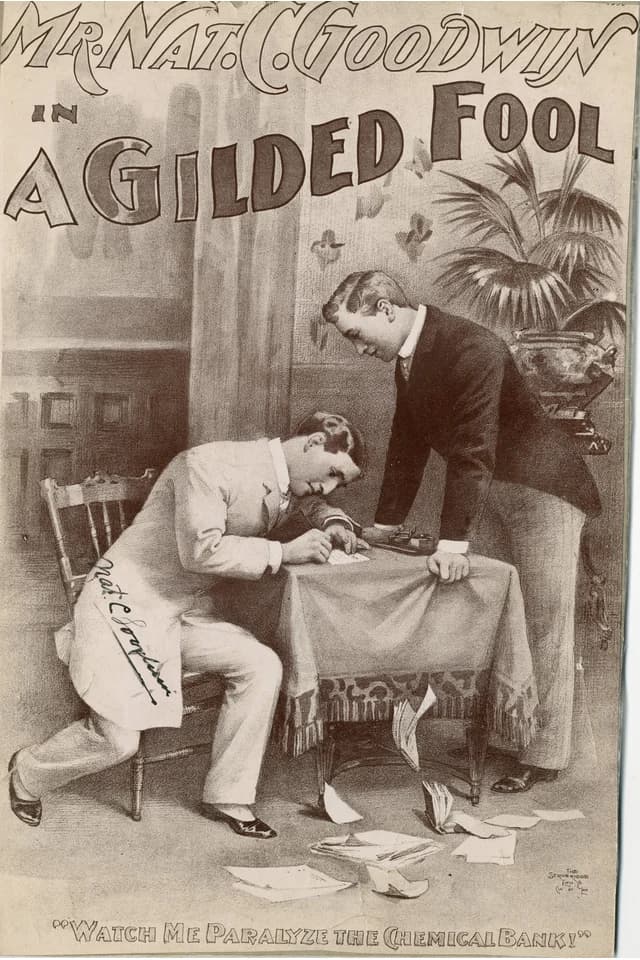
Chauncey Short, a friendly but unworldly young man, inherits a large fortune. He is romantically interested in Margaret Ruthven. The business run by Margaret's father, Matthew, is failing due to the manipulations of Bannister Strange. Strange tries to prevent Chauncey from helping the Ruthven firm by convincing him that Margaret is no longer interested in him. Suspicious, Chauncey asks for help from detective Jacob Howell, who disguises himself as a preacher to investigate Strange. Upon learning that Strange is lying, Chauncey decides to do the opposite of everything Strange recommends. By defying Strange's misleading advice, Chuancey builds an even bigger fortune and is able to save the Ruthvens from bankruptcy.
A generous American visiting England to sell a gold mine falls in love with a widow and sells the mine for half its value to pay her younger relative's debts; the widow protects him from the consequences of his generosity.
Civil War veteran Wes Bigelow has raised Robert, the orphaned son of the woman he once loved. When Robert loses the local veterans’ money in speculation, Bigelow struggles between shame and paternal devotion, sacrificing his property and pleading in court to save the young man’s future.
A Hand Is on the Gate is a collection of Black poetry and song that had a limited run on Broadway in 1966. The production marked the directorial debut of actor Roscoe Lee Browne, who also arranged the material and served as the show's emcee. It was produced by Ivor David Balding and Stephen Aaron; its music was arranged by Bill Lee and Stuart Scharf, and its lighting design was by Jules Fisher. The cast of eight also included Josephine Premice—who received a Tony Award nomination as Best Featured or Supporting Actress in a Musical for her performance—as well as Leon Bibb, Gloria Foster, Moses Gunn, Ellen Holly, James Earl Jones and Cicely Tyson.
Russell and Wendy return to Australia and discover that their filmmaker friend Mark has released a movie whose characters appear to caricature them. The perceived betrayal stirs long-standing resentments among the friends, leading to brief violence, reconciliation, and hindsight.
In 1946 Sydney, the Cassidy brothers and their wives, an Irish-Australian working-class family, struggle with faith and the hardships of everyday life. Their family story is counterpointed by a brief relationship between two teenage boys.
During Christmas in a deteriorating Mississippi home, Cornelius McCorkle pressures his wife Bella to reveal inherited money soon after their eldest son’s burial. Their negligent son Charlie returns with a pregnant, zealously religious fiancée as family tensions rise through a storm.
A completed version of John Vanbrugh's unfinished four-act drama, prepared by James Saunders and staged in Greenwich in 1975.
Steward Springlove joins a band of beggars, followed by his employer’s daughters and their suitors, who seek freedom from conventional life. Their adventures and a play-within-the-play reveal hidden family ties and an old injustice, leading to reconciliation and restored property.
After thirty years in a coma caused by encephalitis lethargica, middle-aged Deborah wakes with the mind of a sixteen-year-old and must confront an unfamiliar adult body and changed world. Her sister Pauline and devoted doctor Hornby gently guide her back toward reality while withholding its most painful facts.
Arbaces returns from war intending to marry his sister Panthea to the defeated king Tigranes, but finds himself in love with her. A plot to resolve the succession reveals Arbaces is not Panthea’s brother; he marries her but relinquishes the throne. A cowardly courtier’s subplot provides comic relief.
In First World War London, German Zeppelin raids are going on. Mr Bodie, a middle-aged artist of independent means, is visited in his studio by a policeman who wants to admonish him about showing a light in the blackout and to ask about suspicious activities on the part of his cleaning girl. She is in her teens, and her name is apparently Jane Thing, but Bodie renamed her Cinderella for her bravery and sweetness amid the drudgery of her job. She had not heard the story of Cinderella before Bodie so named her, but has now read it and identifies with the character; she thinks Bodie has called her that for her small feet. The policeman suspects her because she collects wooden boards, asks questions about the royals and knows German words. He observes her from hiding when she comes in, then emerges and talks to her. He is diverted from his suspicions by her talk, and ends by addressing her contention that she is a nobleman's daughter by giving her his "infallible" test; it proves her to be "common clay", because a lady hides her treasures in her bodice and a common girl puts hers in her pocket. When she leaves to go home, he follows her. On a snowy night, in Cinderella's poor street, she is in her room. She earns pennies from her neighbours by sewing, healing and morale-bolstering jobs. She used her boards to build boxes which are fastened to the wall several feet up. The policeman finds out that these are the safe havens for four little children, war orphans of various nationalities, one of whom is German, hence her learning the words. He leaves satisfied. Cinderella believes that this is the night when she will go to the ball – she has arbitrarily decided this because it has to be some time – and, after putting the awed children to bed, she steps outside so that her fairy godmother will not miss the house. The fairy godmother duly arrives, wearing a Red Cross uniform, and grants Cinderella's three wishes: to go to her ball, to help nurse the wounded, and to gain the love of the man of her heart. The ball follows. It is a working-class girl's vision of utmost splendour: everything is gilded and ceremonious, but everyone from the King and Queen on down speaks and acts informally. The children are there in a special balcony to see Cinderella's triumph. The Prince, who resembles the Policeman but is a bored cad, judges the marriageable girls at the ball in the manner of a horse show, including having their temperatures taken to see who is morally good. When Cinderella arrives, dressed splendidly in a gown of inexpensive fabric, he is still bored and rude as she passes the thermometer test, but when she shows him her feet he is instantly transformed into a true lover filled with all the virtues. They are married by the stuffed penguin in Bodie's studio, who is a bishop, and dance, but midnight strikes and Cinderella's splendour vanishes. The ballroom dissolves, and she is seen to be lying asleep on her doorstep in the snow, near death from freezing. In a country house which has been taken over as a nursing home for wounded soldiers, Bodie's sister, Dr Bodie, tends Cinderella, whom the policeman has found and taken to the hospital and whom Bodie has got into his sister's care. He is looking after her orphans. He comes to see her, and hears from Dr Bodie with dismay that she has little chance of getting well. She is weak and confined to a bed on casters, but is making bandages to help nurse the wounded and is charming all the other patients and nurses. She rejoices in having enough to eat for the first time, and admits that she now, with enough food in her, knows she is not really the Cinderella. She has tea with an orderly who was a plumber in civilian life and a young daughter of the upper classes who is an eager though incompetent nurses' aide; the latter two agree that their friendship is one of the best things in their lives and they will not have as much fun when class separates them after the war. The policeman comes to visit, and Cinderella produces the letter he has written her, which she treasures, from her bodice. He asks her to marry him, and, when she says yes, presents her with a specially made pair of glass slippers instead of a ring. But when he embraces her, he turns his face away because "Dr Bodie has told him something."
A Klingon adaptation of Dickens’s A Christmas Carol recasts Scrooge’s journey toward generosity through Klingon values of courage and honor. A Vulcan narrator introduces the story, performed in Klingon with English supertitles.
A morality comedy follows the dying bailiff of Hexham's four sons as they pursue knavery, only to have Honesty expose and punish their schemes. A parallel plot follows King Edgar's attempt to secure Alfrida for himself through his earl.
A Lady Mislaid is a 1948 comedy play by the British writer Kenneth Horne. It was first staged at the Embassy Theatre. In 1950 it ran for 148 performances at St Martin's Theatre in London's West End. The cast included Hugh Latimer, Raymond Lovell, Derek Blomfield, Joan Sanderson, Gwen Watford and Avice Landone.
A one-actor performance about scientist and eugenics founder Francis Galton, staged largely within a room at center stage. The actor periodically involves the audience as the boundary between Lipson and Galton blurs until one man is both.
A dramatic re-enactment of the 1576 Spanish Fury at Antwerp depicts cruel Spanish commanders and the city's failed defenses. The one-legged Flemish soldier Stump performs acts of gallantry, while the play presents Antwerp's burghers as complacent and unprepared before the sack.
Piet is suspected of being an informer; his wife Gladys struggles after a police raid and the ransacking of her diaries; and Steve, a Colored activist just released from jail, prepares to leave South Africa permanently.
Told in three acts set in Montana and California, the story alternates between two families after a severe incident of spousal abuse leaves all their lives altered until the final collision at an isolated cabin. The two families are linked by the marriage of Jake (son of Lorraine and brother of Sally and Frankie) and Beth (daughter of Baylor and Meg and sister of Mike). The play begins with Beth recuperating in her parents' home after a hospitalization resulting from Jake's abuse. Exploring family dysfunction and the nature of love, the play follows Jake as he searches for meaning after his relationship with Beth and her family as they struggle with Beth's brain damage.
After a terminal diagnosis, Desmond Drumm, a bitterly cynical civil servant, tries to make sense of his life and his estrangement from Mary, the only woman he truly loved.
A stage veteran, Robert, and a younger actor, John, appear together in a series of productions. As their work and careers unfold, the relationship between the two men gradually changes.
Experimental landscape play in six sections, each called a List, using repeated and paired names to create a shifting stage composition. The character pairings suggest strained relationships and a later furtive relationship.
A Little Bit of Fluff is a British farce written by Walter W. Ellis which was first staged in 1915 and went on to have a long original run. Starring Ernest Thesiger, it ran at the Criterion Theatre, London, between 1915–1918, for a total of 1241 performances.
On 9 June 1951, Ben Chifley returns to his Bathurst home to write a speech for the Labor Party conference in Sydney the next day. This one-person play presents Chifley through the work and public life that made him a significant political figure.
In 1812, Shura, a retired major’s ward, disguises herself as a hussar to meet her absent fiancé and learn his view of their engagement. When war begins, she runs away in uniform to fight, joining a partisan detachment where she encounters him again and faces a quarrel that may lead to a duel.
This Elizabethan morality play interweaves the biblical story of Jonah and Nineveh with the corrupt court of King Rasni, an unjust moneylender and his victims, and comic scenes of common vices. The prophet Hosea serves as an onstage chorus applying its lessons to contemporary England; Jonah’s warning finally moves Nineveh’s sinners to repent.
Rainis’s five-act tragedy retells the Turaida Maija story as a love triangle among Maija, gardener Viktor Heils and Jakubovskis, whose desire for Maija leads to her death.
In 1930s St. Louis, civics teacher Dorothea waits for a call from a school principal she imagines will marry her, delaying a Sunday picnic with her roommate Bodey and Bodey's unseen twin Buddy. When her friend Helena reveals that the principal is engaged to someone else, Dorothea abandons plans to move and rushes to catch the siblings at the trolley stop.
Debauched young gentleman George Careless hopes to regain his wealthy uncle’s favor while pursuing his uncle’s wife, his mistress Phebe and a rich widow. A misdirected pair of letters and a series of sexual deceptions expose his schemes; the resolution arranges a future for Phebe and pairs Careless with the equally contrary widow Mistress Crostill.
In a satirical London comedy, spendthrift Follywit repeatedly tricks his wealthy grandfather, while Penitent Brothel schemes to reach the wife of the jealous Harebrain; the plots converge at a feast where Follywit’s final prank exposes his own marriage to a courtesan.
In the first act, American traveler David betrays a talkative widow, Mrs. Honey, at a Corfu inn. Twenty years later, David—now author Daniel Hosani—has become aphasic after a stroke; his guardian Heather knows his bestselling novel distorted what happened and arranges a film deal to fund humanitarian organizations.
In Milan and Florence, Julia becomes pregnant by the Prince of Parma before their marriage, while Stroza's lies drive the court into a series of mistaken accusations and attempted marriages. Banished Lauretta falls in love with the Prince of Florence; a plan to exchange places with Julia exposes Stroza's schemes and brings both couples to their intended partners.
Jewish widow Mrs. Jacoby, travelling to Japan with her daughter and son-in-law, meets Koichi Asano, a Japanese widower who wishes to court her. Her wartime grief and her daughter’s objections to an interracial marriage complicate their relationship.
A Man About the House is a play by the British writer John Perry, adapted from Francis Brett Young's 1942 novel of the same title about an Edwardian English spinster who inherits an Italian villa, and falls in love with and marries the butler who has secret designs on the estate that had once belonged to his family. It premiered at the Grand Theatre, Derby on 15 October 1945 before transferring to the West End. It ran for 100 performances from 27 February to 25 May 1946 at the Piccadilly Theatre. The cast included Flora Robson, Basil Sydney and Ernest Thesiger.
Sir Thomas More refuses to endorse Henry VIII’s effort to divorce Catherine of Aragon and marry Anne Boleyn. As Thomas Cromwell’s inquiry closes in, More’s refusal to compromise his conscience threatens his life, while the Common Man frames the political and legal events around him.
In a single-scene comedy of society, self-made millionaire Mr. Harrisson Crockstead proposes to the impoverished young Lady Aline de Vaux. She refuses, but changes her mind after he makes her an unusual offer.
Two married couples, Douglas and Lily Zweig and Rex and Violet Franklin, navigate their relationships. The play also uses soliloquies addressed to the audience, scene-location graphics, and dialogue directions that describe rather than supply generic lines.
Lomov visits his neighbour Chubukov intending to propose to his daughter Natalya. Before he can complete the proposal, they quarrel over a disputed meadow; after Natalya learns his purpose, they argue again over their dogs. Exhausted, Lomov collapses, but Chubukov presses the pair to accept the match, and they resume arguing.
Job and his wife continue questioning God about suffering and divine inscrutability. God appears beneath a palm tree, explains himself to Job, and apologizes to Job's wife for failing to act when she was accused of witchcraft.
Usurer Bloodhound plans marriages for himself and his children, including his daughter Moll to an elderly suitor, while she loves the young soldier Ancient Young. In a night of masks and mistaken identities, fortune-hunters, servants and thieves pursue their own schemes; revelations disrupt the double wedding, Moll and Ancient Young marry, and Bloodhound reconciles with his elder son.
Eccentric dowager Mrs. Basil lives in one room of her Oxford mansion until her grandson and his friends arrive with a new housekeeper who can levitate, prompting Mrs. Basil to question her disbelief in God.
This Kneehigh stage adaptation of Powell and Pressburger’s film changes June from American to British, replaces the film’s Anglo-American courtroom debate with arguments about war, and lets a coin toss determine Peter’s fate, producing different endings across performances.
A Memory of Two Mondays is a one-act play by Arthur Miller. He began writing the play in 1952, while working on The Crucible, and completed it in 1955. Based on Miller's own experiences, the play focuses on a group of desperate workers earning their livings in a Brooklyn automobile parts warehouse during the Great Depression in the 1930s, a time of 25 percent unemployment in the United States. Concentrating more on character than plot, it explores the dreams of a young man yearning for a college education in the midst of people stumbling through the workday in a haze of hopelessness and despondency. Three of the characters in the story have severe problems with alcoholism. Paired with the original one-act version of A View from the Bridge, the first Broadway production, directed by Martin Ritt, opened on September 29, 1955, at the Coronet Theatre, where it ran for 149 performances. The cast included Van Heflin, J. Carrol Naish, Jack Warden, Eileen Heckart, and Richard Davalos, who won the Theatre World Award for his performance. In 1959, Miller adapted the play for an ITV broadcast starring Alan Bates. Miller adapted the play for a 1971 television movie directed by Paul Bogart, A Memory of Two Mondays. After seven previews, a Broadway revival directed by Arvin Brown opened on January 26, 1976, at the Playhouse Theatre where, paired this time with 27 Wagons Full of Cotton by Tennessee Williams, it ran for 67 performances. The cast included Thomas Hulce, John Lithgow, Tony Musante, Joe Grifasi, and Meryl Streep.
The play presents an unusual evening in the life of Horace Parker, a selfish man. Horace refuses to escort Minnie, his ward and fiancee, to a ball because he would prefer to spend his evening at home reading about new discoveries about the planet Mars. Minnie goes to the ball with another escort, leaving Horace home alone. Horace falls asleep and dreams that he is visited by a man, a messenger from Mars. The Messenger sets out to cure Horace of his selfishness. After a series of visions, the Messenger reduces Horace to a beggar in rags. Having realized the error of his ways, Horace awakens a changed man.
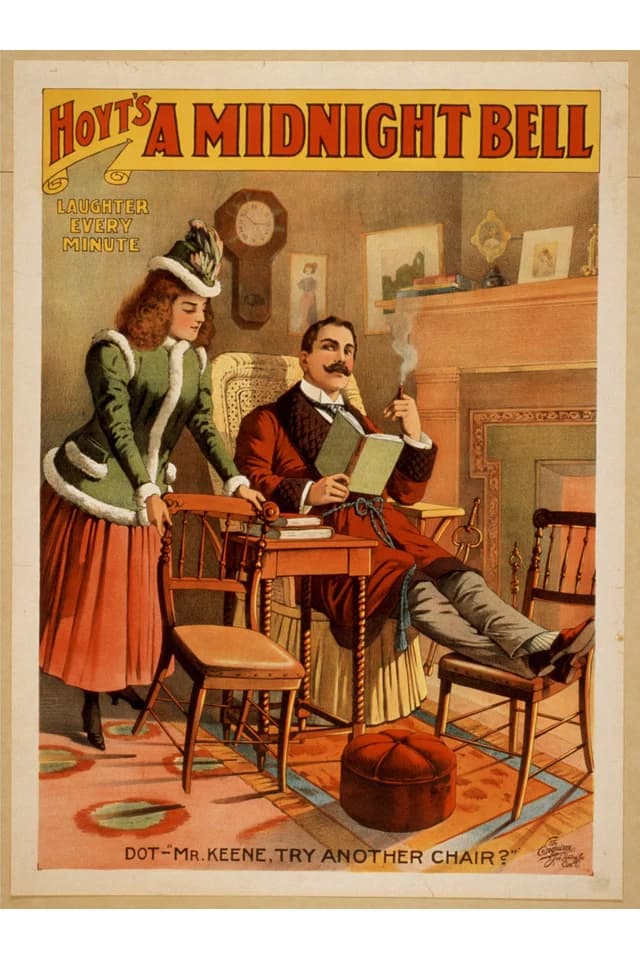
A Midnight Bell is a play written by Charles H. Hoyt. It was featured on Broadway in 1889 and starred Maude Adams. The play was adapted into an American silent film of the same name in 1921. The show ran from March 5 (delayed by one day for final rehearsal) through July 1, 1889.
An immersive, multisensory journey through a macabre dreamworld inspired by Edgar Allan Poe, where audiences explore theatrical rooms and encounter characters drawn from Poe’s stories and poems.
In Athens, four young lovers and a group of amateur actors enter a forest inhabited by fairies. Oberon and Puck use a love potion that misdirects the lovers' affections and causes Titania to fall for the transformed Bottom; the confusion is resolved before the lovers' wedding, where the actors perform Pyramus and Thisbe.
Teenage single mother Amy Aston struggles to bond with her unwanted baby daughter while working at a chicken factory and relying on her grandmother for care. A relationship with a violent, traumatized soldier threatens the baby's safety; the child survives, supplying the play's title miracle.
Thirteen-year-old Conor, whose mother is gravely ill, is isolated by his grandmother’s interference and the avoidance of his schoolmates. At seven minutes past midnight a monster appears, tells him stories, and insists that Conor must tell his own and face his deepest fears.
At a country estate, bored Natalya falls in love with her son's young tutor, Aleksei, while her ward Vera also loves him. Natalya tries to remove Vera as a rival by arranging her marriage to a wealthy neighbor, but the household's entangled affections and misunderstandings drive Aleksei and family friend Rakitin away, returning Natalya to boredom.
Set in a dilapidated Connecticut house in early September 1923, the play focuses on three characters: Josie, a domineering Irish woman with a quick tongue and a ruined reputation, her conniving father, tenant farmer and bullying widower Phil Hogan, and James Tyrone, Jr., Hogan's landlord and drinking companion, a cynical alcoholic haunted by the death of his mother. The play begins with Mike, the last of Hogan's three sons, leaving the farm. As a joke during one of their drunken bouts, Tyrone threatens to sell his land to his hated neighbor, T. Steadman Harder, and evict Hogan. Hogan creates a scheme in which Josie will get Tyrone drunk, seduce him, and blackmail him. Josie and Tyrone court in the moonlight. The scheme falls through when Josie finds out that Tyrone isn't going to sell the land to Harder after all. Tyrone tells Josie the story of how, after his mother died, he traveled back East on the train, and hired a blonde prostitute for $50 a night to overcome his grief. The four-act play ends with James Tyrone leaving for New York to handle his mother's estate, apparently to die soon of complications from alcoholism.
Seven independent vignettes follow characters undergoing transformations associated with possession, madness, and violence. Each scene is punctuated by part of the tragedy of Pentheus, while Dionysos watches unseen; the ensemble returns at the end to describe what followed.
Several centuries in the future, people live on pontoons above a flooded Earth under a tyrannical caste system that bans pleasure and culture. Divers salvage remnants of the twentieth century and debate how people once lived.
The show begins with an image of the Columbia Pictures Lady drenched in a bright light. This first scene takes place in the Now, Voyager set as well as the hospital lobby. It is summer in New York, 1955. The Columbia Pictures Lady sets the scene and talks about suicidal thoughts, loneliness, and marital troubles (all recurring throughout). The scene fades to Clara, an African-American woman in a maternity dress. She longs to be a successful writer as well as find someone she can "...co-exist in a true union" with. The Scene switches to Bette Davis and Paul Henreid on the deck of a liner from Now, Voyager. Bette takes on the thoughts of Clara and expresses her concerns about dying from blood loss in childbirth, as her mother had. She was supposed to be an angel to the family, but she did not bring her family peace. Clara's Mother comes into the picture and explains the difference of living between the blacks and whites in their town. Whites had sidewalks with paved roads, nice bathrooms and water fountains. Blacks had dirt roads, they weren't allowed to sit in restaurants and they had to sit on a separate train. Bette dreams of talking to Jesus; she writes about God often. Clara's father left the family to be with a girl who talks to willow trees. She talks about her forced relationship with her ex-husband, Eddie. The pregnant Clara enters and talks to Eddie about jealousy. She wants to do something with her life like he does. She reads her own story about dragging the dead body of her father through the grass, her is her "blood father". She talks about how her father had attempted suicide. She yearns to fly free like the Owl to be in the Kingdom of God. Dead. In scene two, the lights come up on Clara's entrance into her brother's hospital room and Viva Zapata!. Wally, Clara's brother is in a coma. Jean Peters takes on the story of Clara. Clara's mother enters upset about how her children are unhappy. Clara expresses that she is very happy because she is going to have one of her plays produced. Clara's mother doesn't understand how Clara could be happy without a family of her own. She asks Clara to get back together with Eddie now that she is pregnant. Jean Peters has extreme depression about her divorce from Eddie. She has to borrow money from Eddie because she doesn't make enough money independently, which drives her crazy. Wally is most likely not going to survive. Clara recites a poem about calling to God, but The Owl Answers. Clara's Mother and Father fight about their divorce. Jean Peters recites more from her play, wishing that she could fly away like the Owl to God. In the final scene, it is a flashback where Shelley Winters and Montgomery Clift are rowing in a small boat from the set of A Place in the Sun. Clara is in bed. She is bleeding and writing poems. Kennedy then notes that Clift continues to grow; she says that all three male movie stars are to be mute. Clara is sharing her aspirations of being an African American writer from a very young age. People told her it was unrealistic. Eddie calls her passion for writing an "obsession to write". Eddie says that she has become shy and secretive. Eddie feels like Clara is a spectator of her own life and that her diaries consume her. Eddie doesn't seem the same since he came back from the war in Korea. Jean Peters reads a segment of writing that talks about a bad fight between her mother and father. She again speaks of being an Owl in a fig tree and reaching the Kingdom of God. Jean Peters tells the story of Wally who dropped out of school to be in the army. He committed a crime and was let go from the army and is working in a hospital. He tried to go back to school but dropped out again. He married a girl right before he went to Germany. She graduated cum laude while he was a prisoner in stockade. It is back to current times and Clara cries about her brother being close to death. Her brother will live brain dead and paralyzed. The show closes with a "Brief dazzling image of the Columbia Pictures Lady."
Confined to a wheelchair, businessman Olegário becomes obsessed with controlling his young wife Lídia’s thoughts and fidelity, spying on her through the household staff. His jealous tests turn the home into a claustrophobic world of suspicion; Lídia ultimately flees with the chauffeur, and Olegário faces the collapse of his certainty.
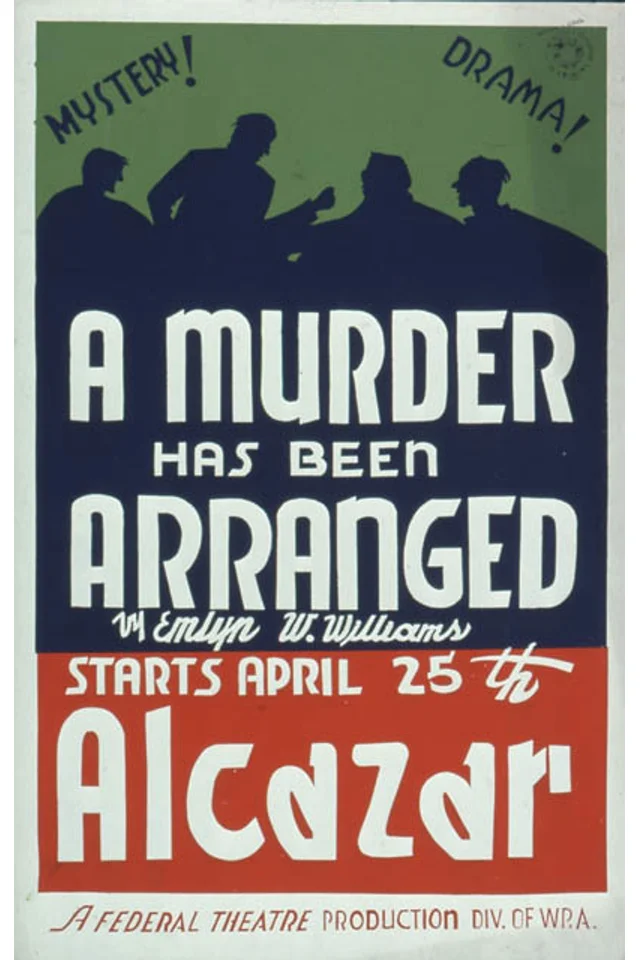
A Murder Has Been Arranged is a 1930 thriller play by the British writer Emlyn Williams. It ran for 77 performances at the St James's Theatre in London's West End between 26 November 1930 and 31 January 1931. The cast included Henry Kendall, Margaretta Scott and Amy Veness. It then went on an extended national tour with Donald Wolfit in the cast. In 1932 it was staged on Broadway and at the Pasadena Playhouse. The Broadway production featured Joseph Cotten in one of his earliest roles.
Cookbook author Bess Lapin and her retired husband Jeffrey gather with their three adopted children after two return from Europe and announce plans to marry; neighbors also intrude on the reunion.
After a funeral, professor Brian and his wife Eileen plan to abandon their daughter Emily, who has cerebral palsy, and run away with Brian's lover Nic, a mother caring for a son with the same condition; their overnight plan unravels as Nic's caregiver and the consequences of their choices force the women to confront what will happen to the children.
After Anne rejects her lover Slightall for the aristocratic Lord Skales, he falls into spendthrift behavior and debt. Her father stages an infernal masque and disguises himself as the Devil, offering financial rescue in exchange for Slightall’s soul; the supposed diabolical marriage instead reunites the lovers. In a comic subplot, a friar exposes an innkeeper’s wife and her constable lover through a staged conjuring trick.
Frank Welborn, ruined by Sir Giles Over-reach’s financial schemes, seeks to recover his standing while Over-reach plots to marry his daughter Margaret to Lord Lovell. Margaret and Tom Allworth outwit him, and Welborn regains his lands; Over-reach’s schemes collapse and he loses his sanity.
Stephen Foster, imprisoned for debt, is freed by his nephew Robert, then returns to gambling and marries a wealthy widow who hopes to find some trouble in her fortunate life. When a storm destroys the merchants’ ships, Stephen helps reform his brother and reconcile the family. In a subplot, Alderman Bruin’s daughter Jane prefers Robert to two foolish suitors, and the play ends with family reconciliation and a charitable foundation.
This biographical play follows Thomas Paine in two halves: his involvement in the American Revolution, then the French Revolution, ending with his funeral. Benjamin Franklin appears both as a historical figure and as narrator.
Pavel Mishemorov, a middle-class man who despises tabloid journalism, is dismayed when he learns his daughter Bozhana loves a journalist. She and her mother try to keep the relationship secret until it comes to light.
Cora Mellish loses a valuable necklace to gambling-club operator Edgar Pryor, who is holding it against her debts. Her ineffectual boyfriend Aubrey is aided by Clifford Tope and police constable Michael Marsden; the trio confront Pryor's gang, recover the necklace, and expose the mystery around its ownership.
Albert Stokes, a lonely office worker constrained by his overbearing mother, heads to a company party where he is falsely accused of groping a colleague. After returning home and threatening his mother, he wanders to a Soho bar and then a woman’s flat, where he acts violently and contemptuously. Back home, his mother tries to reassure herself that he is a good boy.
Kenneth Norman McCallister, a Protestant dole clerk in Belfast, has long discriminated against Catholics. After witnessing hatred directed at Irish supporters during a 1994 football qualifier, he questions his identity and travels to New York to support Ireland at the World Cup, embracing an Irish Protestant identity.
Salter confronts the consequences of having had a son cloned, as the young men he raised and their genetic counterparts struggle with identity, kinship, and the truth about their origins.
Two quarrelling partners in a digestive-pill company wager that the loser of a poker hand will serve the winner as butler for a year. A pair of sixes gives George B. Nettleton the advantage, leaving T. Boggs Johns to serve him.
A Parisian Romance (Un Roman Parisien) is a play written in French by Octave Feuillet and adapted in English by Augustus R. Cazauran. Producer A. M. Palmer staged it at the Union Square Theatre on Broadway, where it debuted on January 11, 1883, with Richard Mansfield starring as Baron Chevrial. Mansfield later purchased the rights to the play and made it part of the repertory of his touring company. The production used sets designed by Richard Marston. In 1932 Allied Pictures produced a film adaptation, also titled A Parisian Romance, directed by Chester M. Franklin. It starred Lew Cody and Marion Shilling.
The play begins with two English women, Mrs. Moore and Adela Quested. They travel to 1920s India, where Mrs. Moore's son, Ronny, is working. Ronny is supposed to be engaged to Adela. The women hope to experience India while they are there. Adela and Ronny are unsure if they are meant to be together. While on a hike led by Dr. Aziz, Adela is attacked in the Marabar Caves. She assumes it was Dr. Aziz, but later while testifying in court, which becomes a media sensation, she realizes Dr. Aziz is not the person who attacked her. Dr. Aziz brings up the racial tensions he feels between the English and the Indians.
Based on Alfred Redl's life, the play depicts a homosexual officer in Austro-Hungarian intelligence who is blackmailed by Russia into treasonous betrayals, against a backdrop of a declining empire.
In 1804 with Britain facing with an imminent French invasion, a Dorset country gentleman hatches a plan to thwart the enemy by impersonating Napoleon.
During a weekend at a country house before Amy and Isaac’s wedding, their longtime friend Emma and younger neighbor Josh join them; conversations expose tensions in the group’s relationships and expectations for adulthood.
New York power couple John and Natalie are hosting a dinner for Elliot, a friend from their college days, along with Mark, a strait-laced young man. After drinking too many expensive bottles of wine, the group's past and their long-buried secrets resurface. Over the course of this raucous evening, their basic belief systems are upended, as the four come to terms with what happens when they try to reconcile idealism with reality. This high-society evening turns into a night of sexually charged mind games that could change their lives forever.
Two middle-aged friends travel to India after each has lost a son. As they journey toward the Taj Mahal, the god Ganesha appears through people they meet and helps them confront grief, guilt, illness, and their friendship.
At the tomb of her husband, the grieving Dynamene plans to fast until she can join him in the underworld. A soldier on guard enters the tomb, and, with encouragement from her maid Doto, Dynamene chooses life with him; when the soldier faces disgrace for leaving his post, she persuades him to substitute her husband's body for one of the condemned men.
In occupied Paris in 1941, Pablo Picasso is taken from a café to a storage vault and questioned by Berlin cultural attaché Miss Fischer. She must authenticate three paintings seized from Jewish owners for a planned Nazi exhibition to burn so-called degenerate art; Picasso negotiates to save his work as they debate art, politics, sex and truth.
A motionless white-haired man, called Speaker, recounts fragments of a life through memories of birth, parents, photographs, funerals, and nightly rituals of lighting a lamp. The monologue moves toward the recognition that death is the sole matter connecting the recollections.
In an imagined Soviet village, deserter Pavel has hidden in a pigsty for years with his wife, Praskovya. He plans to confess and seek forgiveness, but fear, memories of domestic life and his wife’s resistance keep him trapped. Their struggle ends with Pavel freeing the pigs and leaving the sty to report his desertion.
A political satire stages a gathering of dictatorial African leaders at their New York embassy, where their attempts at cooperation expose vanity, insecurity and the absurdity of authoritarian power.
A Plot and No Plot is a 1697 comedy play by the English writer John Dennis. The original Drury Lane cast included Thomas Doggett as Bull senior, Colley Cibber as Bull junior, William Pinkethman as Baldernoe, Joseph Haines as Rumour, William Bullock as Frowzy, Jane Rogers as Sylvia and Mary Kent as Friskit.
In prewar Manila, sisters Candida and Paula try to keep their family home as their aging painter father refuses to sell or exhibit his self-portrait. Financial pressure brings a boarder into the house; Paula’s elopement and the painting’s growing notoriety force the family to confront competing ideas of Filipino identity and cultural change.
The play is set in the interrogation room of a downtown New York City police station in the early hours of July 5. Two hardened cops (Sergeant Kelly and Jack Delasante) have arrested two suspects for the murder of an old woman. During the interrogations, the police try to get confessions from the two suspects, Sean and Jimmy. As they do, they reveal far more about their own vulnerabilities than they intend. The tension of the play is increased by constant updates, by phone, of the state of mind of one of Kelly's daughters. Lonely and unstable, she becomes increasingly suicidal during the play. Jimmy (Alan Rosenberg) Sgt Kelly (George Dzundza) Jack Delasante (Jeffrey DeMunn) Sean (Laurence Luckinbill)
A Present from Margate is a 1933 British comedy play by Ian Hay and A.E.W. Mason. It premiered at the Palace Theatre in Manchester, before transferring to the Shaftesbury Theatre in London's West End. The cast included Reginald Gardiner, Joyce Bland, Michael Shepley and Frank Pettingell. It was produced by Athole Stewart.
A Prior Claim is an 1805 comedy play by the English writer and poet laureate Henry James Pye and Samuel James Arnold. It premiered at the Theatre Royal, Drury Lane on 29 October 1805. The original cast included William Dowton as Sir William Freeman, Vincent De Camp as Young Freeman, Robert William Elliston as Henry Mortimer, William Barrymore as Colonel Raymond, Robert Palmer as Lounger, John Henry Johnstone as Patrick O'Shatter, Maria Rebecca Davison as Maria, Harriet Siddons as Emily and Maria Theresa Kemble as Fanny. It was Pye's third play to be staged and marked a break from his two previous works, the historical tragediesThe Siege of Meaux (1794) and Adelaide (1800).
The household gods welcome James and Anne at the gate; the royal guests pass through the house and garden to songs by Aurora, Zephyrus and Flora and an appearance by May. After dinner, Mercury and Pan converse in the garden, where Pan serves wine from a fountain.
Showing 97–216 of 8,284 shows
Load more shows