8284 shows

Clear filters

Almost, Maine

Play · 2004

Almost, Maine is a 2004 American play written by John Cariani, comprising nine short plays that explore love and loss in a remote, mythical almost-town called Almost, Maine. It premiered at the Portland Stage Company in Portland, Maine, in 2004, where it broke box office records and garnered critical acclaim. The play was published by Dramatists Play Service in 2007 and has since become one of the most popular plays in the United States with nearly 100 professional productions and over 5000 community, university, and high school productions to date. It has become one of the most frequently produced plays in North American high schools. It has also received over twenty international productions and has been translated into over a dozen languages.

Alzuma

Play · 1773

Alzuma is a 1773 historical tragedy by the Irish writer Arthur Murphy. It premiered in London at the Theatre Royal, Covent Garden on 23 February 1773. The original cast included William 'Gentleman' Smith as Alzuma, Thomas Hull as Pizarro, Robert Bensley as Don Carlos and Elizabeth Hartley as Orellana. The music was composed for the production by Thomas Arne. It is based on the Conquest of Peru by Francisco Pizarro in the sixteenth century. Murphy suggested that the British victory at Havana in 1762 influenced his sympathetic depiction of the Peruvians and hostility to Spain. Richard Brinsley Sheridan's later play Pizarro dealt with the same subject and themes.

Amadeus

Play · 1979

Since the play's original run, Shaffer extensively revised his play, including changes to plot details; the following is common to all revisions. The composer Salieri is an impoverished old man, having long outlived his fame. Speaking directly to the audience, he claims to have used poison to assassinate Mozart and promises to explain himself. The action then flashes back to the eighteenth century, at a time when Salieri is the wealthy and acclaimed court composer of the Austrian emperor. He adores Mozart's compositions and is thrilled at the chance to meet him, during a salon honouring his patron. But when he finally catches sight of Mozart, he is deeply disappointed to instead see the composer crawling around on his hands and knees, engaging in profane talk with his future bride Constanze Weber. Salieri cannot reconcile Mozart's boorish behaviour with the genius that God has inexplicably bestowed upon him, nor can he understand why God would not bestow similar gifts on him, a devout and chaste Catholic. Salieri renounces God and vows to do everything in his power to destroy Mozart. He befriends the composer and becomes his close confidant, while actively hampering and disrupting his professional career. Mozart's own fortunes are not helped due to his vulgar nature. On more than one occasion, only the personal intervention of Emperor Joseph II allows Mozart to continue (interventions which Salieri opposes and then is all too happy to take credit for when Mozart assumes it was he who intervened). Salieri humiliates Constanze by forcing her to strip naked in front of him when she comes to him for help. He smears Mozart's character with the Imperial Court, ruining many opportunities for the composer. A major theme in Amadeus is Mozart's repeated attempts to win the acceptance of Vienna's aristocracy with increasingly brilliant compositions, which are always frustrated either by Salieri's machinations or because the aristocrats cannot appreciate Mozart's innovations and willingness to challenge the accepted standards of classical music. Towards the end of the play, with his life completely ruined, Mozart is visited one last time by Salieri, who reveals he has been Mozart's enemy all along. This triggers a complete mental and physical breakdown in the composer. He later dies in Constanze's arms, singing a nursery tune. Salieri recounts how for the next thirty years, he was honored as the "greatest" composer in all of Europe, after which audiences began to turn away from his music and toward that of Mozart, as the world finally comes to recognize his true genius. With his tale finished, Salieri posts a written account of his false confession before attempting suicide with a shaving razor. He survives and his confession is met with disbelief and eventually rejected. Defeated, Salieri, doomed to live the rest of his life in obscurity and failure, absolves the audience of their mediocrity.

Amboyna

Play · 1673

Amboyna, or the Cruelties of the Dutch to the English Merchants is a tragedy by John Dryden written in 1673. Its subject is the Amboyna massacre and the death of Gabriel Towerson that took place on Ambon Island in 1623. Dryden reportedly wrote the play in the short space of a month; he wanted to produce a topical piece, since England was at that time at war with the Dutch Republic. It was dedicated to Lord Clifford, a member of the Cabal. The original production was acted by the King's Company at the theatre at Lincoln's Inn Fields. The original cast included Charles Hart as Captain Gabriel Towerson, Michael Mohun as Beaumont, Edward Lydall as Collins, Marmaduke Watson as Captain Middleton, Nicholas Burt as Perez, William Cartwright as Harman, William Wintershall as The Fiscal, William Beeston as Van Herring, Elizabeth James as Julia, Rebecca Marshall as Ysabinda and Katherine Corey as English Woman. Towerson's wife in the play, Ysabinda, is based on his real life wife, Mariam Khan (dates unknown), daughter of an influential merchant at the courts of the Mughul Emperors Akbar and Jahangir.

Ambrose Applejohn's Adventure

Play · 1921

Ambrose Applejohn is bored with his life in Cornwall, where he lives with his ward, Poppy Faire. He decides to sell his country estate so he can find excitement elsewhere. Several strangers appear at his door, all claiming reasons to be there that have nothing to do with the sale. One woman says she is a Russian dancer trying to defect, and a man claims to be looking for her. A couple says their car has broken down. Applejohn assumes they are all really prospective buyers investigating his home. That night Applejohn dreams he is a pirate, Captain Applejack. His visitors appear in the dream as his adversaries. The next day, he discovers that the visitors are thieves hunting for a treasure map hidden in the house. Applejohn and Faire overcome the criminals, and he decides that life in Cornwall is exciting enough after all.

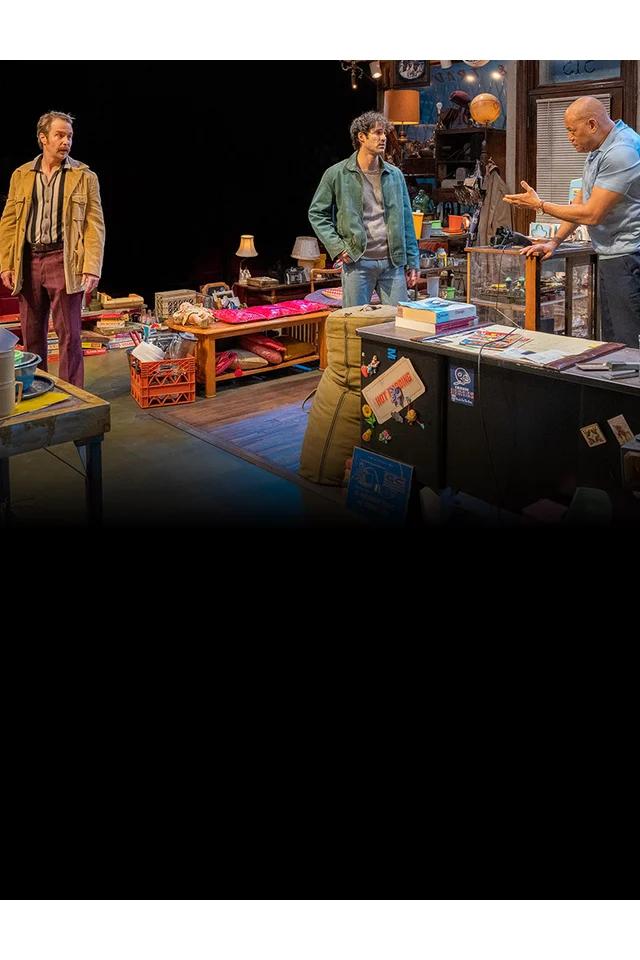
Richard Termine’s photograph of the 2022 Broadway production of American Buffalo in a cluttered junk shop.

American Buffalo

Play · 1975

Act I takes place at about 11 a.m. Don, who owns the junk shop where the entire play takes place, has sold a buffalo nickel to a customer for $90 but now suspects it is worth considerably more. He and his young gofer, Bob (sometimes called Bobby), plan to steal the coin back. Bob has been keeping watch on the customer's house and reports that he has left for the weekend with a suitcase. Teach, a poker buddy of Don's, arrives and learns of the scheme. He persuades Don that Bob is too inexperienced and untrustworthy for the burglary, and proposes himself as Bob's replacement. Teach suggests they steal the whole coin collection and more. Don insists on their poker buddy Fletcher going with Teach. Teach continues to argue that he can do the job without Fletcher. Act II takes place a little before midnight on the same day. Teach and Don make final preparations for the burglary while waiting for Fletcher, who is late. Teach tells Don that Fletcher is a liar and a cheater at cards, and prepares to go commit the burglary on his own. Don tries to persuade him not to take his gun with him when Bob appears at the store. He attempts to sell Don a buffalo nickel, similar to the one Don had sold the customer. When asked where he got the coin, Bob is evasive. Teach suspects that Bob and Fletcher have organized and completed their own burglary behind Don and Teach's backs. He asks Bob where Fletcher is. Bob tells him that Fletcher was mugged by "some Mexicans" and is in a hospital, but when Don calls the hospital, they have no record of his admission. Bob claims that he must have been mistaken about the name of the hospital, but the suspicious Teach strikes him on the head with a metal object. Another friend calls, corroborating Bob's story and naming the correct hospital. Don calls the hospital and confirms that Fletcher has been admitted with a broken jaw. Bob confesses that he made up the story about the customer leaving with a suitcase, and that he bought the second nickel from a coin dealer in order to make up with Don for his failure to keep tabs on the customer. Don admonishes Teach for wounding Bob and orders him to get his car so they can take him to the hospital.

Amy's View

Play · 1997

Act 1; We are introduced to Amy, Dominic, Evelyn, and Esme (all the characters except Frank and Toby). Esme and Dominic immediately dislike one another because of their differing views: Dominic supports new media and aspires to become a filmmaker, while Esme defends the importance of the theater. We learn that Amy is pregnant, and Esme reveals this to Dominic – despite Amy's wishes that she says nothing of it. Act 2; We are introduced to Frank, Esme's neighbour and financial consultant, and their relationship is hinted at. Amy and Dominic are still together, with children, but Esme continues to disapprove. There is also a continuation of Esme and Dominic's argument over popular culture and theater. The argument turns into one over Dominic's right to be with Amy and there is such frustration that the couple end up leaving Esme's home abruptly. Act 3; Amy comes back to visit her mother, and we learn that Dominic has left Amy for a young actress. Esme has also lost all her savings in an investment scandal, and continues to refuse Frank's love interest. Amy and Esme again quarrel over her choice to be with Dominic, discussing her view that love should be given unconditionally. She does not want to admit that her mother was partially right, but is still frustrated that Esme cannot see why she loved Dominic. Act 4; Amy and Dominic have separated and Amy has died. Dominic, now a film director, goes to Esme (who is once again a successful actress) seeking peace between them in order to honor what Amy was constantly trying to achieve. Amy's View is a four-act play set over the course of sixteen years. Act One begins in 1979, in the living-room of Amy's mother's home, which is decorated with paintings done by her late father, an obscure artist. Amy and her then-boyfriend, Dominic, are waiting for Amy's mother, Esme, to return from her theater performance in London. Esme's mother-in-law, Evelyn, is keeping them company while they wait. We quickly learn of a small publication Amy sold when she was a young girl called Amy's View, as well as Dominic's intense interest in cinema. Dominic has started a publication as well, called Noir et Blanc in which he reviews films, and which he hopes will lead him to a career in filmmaking. Amy realizes Noir et Blanc is quite like Amy's View, "except this time the view is Dominic's." When Esme does finally return, she is instantly concerned about Amy's wellbeing, a foreshadowing of the reason Amy has come to visit. Esme and Dominic are introduced for the first time, and each has a tentatively awkward and distant demeanor towards the other. Dominic explains more about his magazine: "we ring people up and we’re terribly nice to them. Then we write something horrid which appears the next day." He and Esme somehow share a good laugh over this, but it worries Amy nonetheless. He continues, adding that "these are well-known people. You think perhaps by now they’d be more secure. But not at all… It almost shocks me how much," which clearly irritates Esme, a prominent West End actress. Amy tries to ease the tension by inquiring about her mother's current play, but this quickly bores Dominic who is much more interested in discussing television or movies. He goes off in a huff to get some work done, leaving Amy and her mother to have a more private conversation. After a short while of discussing Amy's career and relationship with Dominic, Esme suddenly announces that she knows Amy is expecting a child. This is clearly the reason for Amy's visit, to get her mother's advice on the situation, since she feels as though she cannot reveal the situation to Dominic. Esme spends time attempting to figure out just why this is, and why Amy would want to be with this sort of man. In the end, Dominic comes back down to ask a quick question, but Esme, unexpectedly and under Amy's protest, informs Dominic of Amy's pregnancy. Act Two takes place six years later, in 1985, in the same living-room. Amy and Dominic, as well as their unseen children, and Esme and her new interest Frank, are returning from a ribbon cutting ceremony for a local fête. Everyone seems to be in high spirits, enjoying the summer weather, and it is briefly noted that Frank has begun looking after Esme's finances. The airy chitchat soon turns to conversation of Dominic's plan to interview Esme for his new television program – although she makes blatant attempts to escape his questions. He is putting together a piece about how he thinks the theater is dead and new generations can’t connect with the slow pace, the everyday bore of it all. Esme, although cheerful in manner and tone, resents Dominic, pressing that "it's always the death of the theater. The death of the novel. The death of poetry. The death of whatever they fancy this week […] It's off to the scaffold with everyone except the journalists!" It soon comes out that Dominic has hardly – if ever – even been to any plays, despite his ego as a critic. (Throughout this exchange, we see Evelyn once again, but she appears to have Alzheimer's, as she continues to interject, asking where Bernard has gone, and does not recognize Esme.) As the conversation escalates, it is revealed that what they really seem to be getting at is whether Dominic deserves to be with Amy or not. Dominic, feeling insulted and extremely frustrated, starts to get the children together to leave while Amy and her mother argue over Esme's refusal to give Dominic a chance. With the disagreement still unresolved, Amy and Dominic leave Esme alone to think over what's been said. Act Three begins once again in the living-room, eight years later in 1993. Amy arrives at the house looking for Esme to find Frank poring over various books and documents, Evelyn sleeping across the room in a wheelchair. Esme arrives not long after Amy, but is surprised to see her. It seems clear that they have not spoken for quite some time, and Esme is so glad to finally see her daughter again that she begins to weep as she hugs Amy. Once she has recovered, we learn that Esme has been acting as a nurse on a television show, and that Frank had been trying to marry Esme practically since the last time Amy had visited. Esme knows why Amy has come though, as her marital scandals have been all over the news since Dominic is now a "media monolith." It seems after all that Dominic had a weak point, and has just proved Esme right by leaving Amy for an attractive young Swedish actress. Dominic and Amy had married even, and yet he still could not commit completely. It was just the worry that Amy and her mother had discussed that night fourteen years ago. The focus then shifts and we learn that Amy's mother has run into a bit of a rough patch with her investments – about five hundred thousand dollars' worth. Amy is shocked and outraged of course, especially when she discovers that Esme's funds had been entrusted to Frank at Lloyd's of London. Amy wants Esme to petition, perhaps sue Frank, so that she may not have to pay all of the money back. Esme refuses, saying she knew what she was getting herself into and that she would have to face the consequences. This quarrel soon turns into another argument about Amy's relationship with Dominic. Amy wants her mother to know that there truly was a good, loving side to her husband, but that she hates to admit that she was wrong about some things and that Esme was right. There are intense emotions circulating throughout the two women as they grapple with their situations, and there is a heartfelt, although awkward, struggle as Esme tries to console Amy. In the fervor of the moment, before leaving, Amy says to her mother, "I went with Dominic because he was the future. I’m frightened of you because you’re the past." Act Four is set in 1995, and is set backstage, in a dressing-room of a small West End theater. A young actor, Toby, comes in, speaking with Esme about the play as she begins to ready for the next show. When he leaves to get Esme a cappuccino, Dominic wanders into the dressing-room. He has brought with him a box, tied with string, which he presents to Esme as a gift. He also reveals that he attended the matinee showing and enjoyed it very much. It is obvious that he has something else on his mind, however, and he soon inquires what has become of all the cheques he has sent her, wondering if she was insulted by it. She explains that every income she receives goes to paying off her debt, so it would be of no use to cash them. We slowly discover that Dominic has moved on to a new marriage and recently directed a hit film. They argue over Esme's relationship with Frank, her finances, the unnecessary violence of Dominic's new movie, and Dominic's new marriage. Then we learn that Amy has died due to a hemorrhage. Esme looks for some sort of emotion in Dominic, although he openly admits that, of course, he betrayed her. But he is clear in his reason for coming to see Esme. He knows that Amy "would have wanted that [they] should be friends." He doesn’t want Esme to waste the rest of her life hating him. He leaves, allowing her time to open her gift: bundles and bundles of five-pound notes.

An Act at Oxford

Play · 1705

An Act at Oxford is a 1704 comedy play by the English writer Thomas Baker. Although scheduled to appear at the Theatre Royal, Drury Lane that year it had censorship problems from the Lord Chamberlain, likely through the influence of the Oxford University authorities. Although performed earlier it did not have its London debut at Drury Lane until October 1705 under the alternative title of Hampstead Heath. The 1705 cast includes Robert Wilks as Bloom, John Mills as Captain Smart, Colley Cibber as Lampoon, William Bullock as Squire Calf, Benjamin Johnson as Deputy Driver, William Pinkethman as Chum, Anne Oldfield as Arabella, Susanna Mountfort as Berynthia and Jane Lucas as Mrs ap Shinken.

An Inspector Calls

Play · 1945

The play is set in 1912 at the Birlings' large home in the fictional industrial town of Brumley. Arthur Birling, a wealthy factory owner, magistrate and local politician, celebrates his daughter Sheila's engagement to Gerald Croft, son of a rival magnate. Also present are Birling's wife Sybil and their son Eric (whose drinking problem the family discreetly ignores). After dinner, Sheila and Sybil leave the dining room to go into the drawing room, while Birling lectures the young men on the importance of self-reliance and looking after one's own, and talks of the bright future that awaits them (which, he believes, will include a knighthood for himself in the next honours list). The evening is interrupted when the maid Edna announces the arrival of a man calling himself Inspector Goole, who explains that earlier that day he had seen the dead body of a young woman named Eva Smith, who had died by drinking disinfectant. He has been given the "duty" of investigating her death and the Birlings' involvement in it. He has seen her diary, which mentions members of the Birling family. Goole produces a photograph of Smith and shows it to Birling, who confirms that she worked in one of his factories. He reveals he dismissed her for leading a strike action demanding higher wages. Despite acknowledging that he left Smith without a job, Birling denies any responsibility for her death. Sheila, having been sent by her mother to bring Birling, Eric and Gerald to the drawing room, is shown a photograph of Smith. She explains that once, when she was out shopping with her mother, Sheila saw a dress she liked and tried it on, even though her mother and an assistant thought it was not right for her. Smith, now employed at this shop, also helped with the trying-on. Sheila realised that the dress did not suit her; Smith held the dress against herself, and Sheila could see that it looked much better on her. Seeing Smith smiling at the other assistant, Sheila took umbrage and angrily ordered the manager of the department store to fire her. Sheila's real motivation, which she ashamedly confesses, was the jealousy that she felt towards Smith, perceiving her as prettier than herself. Eric leaves the dining room. Sybil enters the dining room. The inspector mentions that Smith subsequently used the name Daisy Renton. Gerald is noticeably startled and admits to having met a woman named Daisy Renton in the Palace Bar, where Smith had resorted to prostitution to sustain herself. Seeing that Smith was hungry and struggling to cope financially, and was out of place there, Gerald gave her money and arranged for her to move temporarily into a vacant flat belonging to one of his friends. Gerald reveals that he began a relationship with Smith over the summer but parted with her after a few months. Sheila, disheartened, returns her engagement ring to Gerald, who leaves the house, saying he will return. The inspector turns his attention to Sybil, a patron of a charity that helps women in difficult situations, which Smith, by then pregnant and destitute, had turned to for help, using the name "Mrs. Birling". Sybil, seeing this as a deliberate mockery of herself, convinced the committee to deny her a grant. She argued that Smith had been irresponsible and suggested that she find the father and get him to face his responsibilities; Smith said that she had refused to accept any more money from the father once she knew it had been stolen. Despite vigorous cross-examination from the inspector, Sybil denies any wrongdoing. Goole plays his final card, forcing Sybil to lay the blame on the "drunken young man" who had got Smith pregnant. It slowly dawns on the rest of the family, except Sybil, that Eric is the young man in question, and "Mrs. Birling" was the first name that had come to Smith's mind because he had fathered her child. Eric enters, and after brief questioning from Goole, breaks down and admits responsibility for the pregnancy: he had raped Smith after a drinking spree at the Palace Bar. After finding out that Smith was pregnant, Eric stole from his father's business to support her and their child, but she refused the stolen money and cut contact with Eric. Birling and Sybil are outraged by Eric's behaviour, and the evening dissolves into angry recriminations. The inspector reminds the family that actions have consequences and that all people are intertwined in one society, stating: "if men will not learn that lesson, then they will be taught it in fire and blood and anguish." He leaves. Birling's greatest worry is the scandal that will arise from Eric's theft of his firm's money, which will come out at the inquest. The family begins to question if "Goole" was a real police inspector. Gerald returns and reveals that he had met a police sergeant he knew, who did not know of any police inspector named Goole. To confirm this, Birling makes a phone call to his friend, the chief constable, who confirms that there is no Inspector Goole on the force. Gerald points out that they could not be sure that Goole had shown the same photograph to the different members of the family; there could have been several young women, and they did not know that any of them had died. Gerald phones the infirmary, and they confirm that no one has died there that day, and they have not had a suicide in months. The family concludes that the inspector was a fraud and that they have been the victims of a hoax. Gerald and the elder Birlings celebrate in relief, but Eric and Sheila continue to rue their own and the others' actions. The phone rings: it is the police, who tell Birling that a young woman has just died on her way to the infirmary in a suspected suicide, and that a policeman is on his way to question the family.

Anastasia

Play · 1952 est

A former Cossack 'prince', now taxi-driver Bounine, discovers Anna an amnesiac in a Berlin asylum. Anna is mixed up in a plot to exploit Anastasia's inheritance of $10 million pounds, which is being held in a trust for any surviving heirs of the Romanov dynasty. As the scheme grows and the conspiracy prospers, Anna is trained for the last test of meeting the Imperial Grand Empress Maria, Anastasia's grandmother. Her acceptance of Anna is an essential obstacle in pulling off the conspiracy to obtain the money.

Anatomy of a Suicide

Play · 2017

The play follows three women, Carol, Anna and Bonnie, who, through the course of the play, are revealed to be mother, daughter, and granddaughter. The three women's stories play out simultaneously, while each exists in her own timeline. At the start of the play, Carol has just been released from the hospital after trying to die by suicide, Anna is a heroin addict, and Bonnie is a doctor. Carol and Anna are treated with electroconvulsive therapy. Carol dies by suicide offstage. Anna electrocutes herself in the bath, while her infant daughter, Bonnie, sleeps in the next room. At the end of the play, Bonnie sells the family home.

And Miss Reardon Drinks a Little

Play · 1967

Paul Zindel's dark comedy explores the relationship among three very different sisters after the death of their mother in the early 1960s. Having been abandoned by their father in early childhood, Catherine, Ceil, and Anna Reardon were raised in a small apartment by their mother. The three ladies are educated and become members of their local school community. Anna Reardon becomes a chemistry teacher, Catherine Reardon the assistant principal, and Ceil (Reardon) Adams is the superintendent of schools. The scene of the play is in the Reardon family apartment sisters Catherine and Anna are living following the death of their mother. Several months of caring for her sick mother only to see her pass has left Anna suffering a severe nervous breakdown. She has become a complete hypochondriac, obsessed with animals and rabies. She is also on an extended break from school for allegedly molesting a male student. Catherine's reaction to both her mother's death and her sister's ailment has been to drink "a little". She is consistently drunk throughout the show. Ceil did not have any sort of contact with the family while her mother was suffering, but rather ran off to marry her sister Catherine's boyfriend, Edward Adams (who never appears on stage). Ceil has come to the Reardon home to coax Catherine into having Anna committed. Neither Anna nor Catherine is interested in anything their sister has to say. Halfway through dinner, which consists of zucchini and kiwi, Fleur Stein invades the family conversation. Fleur works in guidance at Anna and Catherine's school, and wishes to butter up Mrs. Adams in attempt to gain a better salary. She is very colorful and somewhat obnoxious, which her husband, Bob, makes perfectly clear once he arrives. After a humorous, but often bitter evening, Ceil demands that Anna be locked up. Catherine refuses this demand, and Ceil essentially abandons the two women to take care of each other.

And This Was Odd

Play · 1951

And This Was Odd is a 1951 comedy play by the British writer Kenneth Horne. It was a reworking of an earlier play Wasn't It Odd that had first been staged at the Intimate Theatre in Palmers Green in 1940. It involves an elderly lady who uncovers her family's secrets while supposedly ill in bed. It ran for 54 performances at the Criterion Theatre in London's West End. The cast included Raymond Huntley, Peter Hammond, Avice Landone, Mary Jerrold and Mignon O'Doherty. It was directed by John Clements.

Angels in America

Play · 1992

Set in New York City, the play takes place between October 1985 and February 1986. The first part begins at a funeral, where an elderly rabbi eulogizes the deceased woman's entire generation of immigrants who risked their lives to build a community in the United States. Soon after, the deceased's grandson, Louis Ironson, learns that his lover Prior Walter, the last member of an old stock American family, has AIDS. As Prior's illness progresses, Louis becomes unable to cope, and he abandons Prior during a health episode that lands him in the hospital. Prior is given emotional support by their friend Belize, a hospital nurse and ex-drag queen, who separately also deals with Louis's self-castigating guilt and myriad excuses for leaving Prior. Joe Pitt, a Mormon Republican clerk in the same judge's office where Louis holds a word-processing job, is offered a position in Washington, D.C. by his mentor, the McCarthyist lawyer and power broker Roy Cohn. Joe hesitates to accept due to his agoraphobic, Valium-addicted wife Harper, who refuses to relocate. Feeling adrift and undesired by Joe, Harper retreats into drug-fueled escapist fantasies, including a dream where she crosses paths with Prior even though the two of them have never met in the real world. She confronts Joe about his deeply-closeted homosexuality, which he views as a sin. Torn by pressure from Roy and a burgeoning infatuation with Louis, Joe drunkenly comes out to his conservative mother Hannah, who reacts by changing the subject and hanging up the phone. Concerned for her son, she sells her house in Salt Lake City and travels to New York. After Joe confesses his homosexuality to a drug-addled Harper and leaves her, she flees their apartment and wanders the streets of Brooklyn, believing she is in Antarctica. Joe sets out to look for her, but follows Louis to Central Park, where they tentatively begin an affair. Meanwhile, Roy Cohn discovers that he has advanced AIDS and is dying. Defiantly refusing to publicly admit he is gay or has AIDS, Roy instead declares he has liver cancer. Facing disbarment for misappropriating money from a client, Roy is determined to beat the case so he can die a lawyer in good standing, and he attempts to position Joe in the Department of Justice to ensure the case is quashed. When Harper disappears and Joe refuses his offer, Roy flies into a rage and collapses in pain. As he awaits transport to the hospital, he is haunted by the ghost of Ethel Rosenberg, whom he prosecuted in her trial for espionage, and who was executed after Roy illegally lobbied the judge for the death penalty. Prior begins to experience intense dreams and visions as his health worsens. He hears the voice of an angel telling him to prepare for her arrival, a flaming book erupts from the floor during a medical check-up, and he receives visits from the ghosts of two ancestral Prior Walters, informing him that he is a divine prophet. Prior does not know if these visitations are hallucinations caused by an emotional breakdown or if they are real. At the end of Part One, a glorious winged Angel crashes through Prior's bedroom ceiling, addresses him as "Prophet", and proclaims that "the Great Work" has begun. The second part begins with a speech given by the world's oldest living Bolshevik, Aleksii Antedilluvianovich Prelapsarianov, addressing a crowd in Moscow in December 1985. He condemns the reforms proposed by Mikhail Gorbachev, decrying the notion of progress without political theory and declaring that the only way forward is to not move. At the funeral of a friend, a shaken Prior relates his encounter with the Angel to Belize. After revealing the presence of a mystical book underneath the tile in Prior's kitchen, the Angel reveals to him that Heaven is a beautiful city that resembles San Francisco, and God, described as a great flaming Aleph, created the universe through copulation with His angels, who are all-knowing but unable to create or change on their own. God, bored with the angels, made mankind with the power to change and create. The progress of mankind on Earth caused Heaven to suffer earthquake-like tremors and physically deteriorate. Finally, on the day of the San Francisco earthquake in 1906, God abandoned Heaven. The Angel brings Prior a message for mankind—"stop moving!"—in the belief that if man ceases to progress, Heaven will be restored. Since the night of his vision, his health has once again started to decline. Belize believes that Prior is projecting his own fears of abandonment and death into an elaborate hallucination, but Prior suspects that his illness is the prophecy taking physical form and that the only way the Angel can force him to deliver her message is for him to die. Roy lands at the hospital in the care of Belize, where his condition rapidly declines. He manages to use his political clout to acquire a private stash of the experimental drug AZT at the expense of withholding the drug from participants in a drug trial. Alone in the hospital and fighting disbarment, Roy finds himself increasingly isolated, with only Belize, who despises him, and the ghost of Ethel for company. Prior goes to a Mormon visitors center to research angels, where he meets Hannah, who is volunteering there and taking care of Harper, who has slowly returned to reality but is now deeply depressed. Harper and Prior share a spark of recognition from their earlier shared dream, and witness a vision of Joe and Louis together. Louis is aghast to learn that Joe is a practicing Mormon and, regretting his actions and resistant to the intensity of Joe's infatuation, begins to withdraw from Joe. He begs Prior's forgiveness, which Prior angrily refuses, and Prior, who knows about Louis's affair with Joe from his vision, becomes deeply hurt that Louis is attempting to move on. Joe visits Roy, who is near death, and receives a final paternal blessing from his mentor. However, when Joe confesses he has left Harper for a man, Roy rejects him in a violent reaction of fear and rage, ordering him to return to his wife and cover up his indiscretion. Joe returns to Harper, and they have an unsatisfying sexual encounter, which prompts Harper to realize their marriage is over. Prior, accompanied by Belize, jealously confronts a confused Joe at work, but the encounter descends into chaos when Belize recognizes Joe as Roy's protegé. Belize informs Louis about Joe's connection with Roy, whom Louis despises. Louis, as a result, researches Joe's legal history and confronts him over a series of hypocritical and homophobic decisions Joe himself wrote. The confrontation turns violent, and Joe punches Louis in the face, ending their affair. Ethel Rosenberg watches Roy suffer and decline before delivering the final blow as he lies dying: He has been disbarred after all. Delirious, Roy seems to mistake Ethel for his mother, begging her to comfort him, and Ethel sings a Yiddish lullaby as Roy appears to pass away. However, with a sudden burst of energy, he reveals that he has tricked her, viciously declaring that he has "finally [made] Ethel Rosenberg sing". He then suffers a stroke and dies. After Roy's death, Belize forces Louis to visit Roy's hospital room, where they steal his stash of AZT for Prior. Belize asks Louis to recite the Kaddish for Roy. Unseen by the living, Ethel guides Louis through the prayer, symbolically forgiving Roy before she departs for the hereafter. After his confrontation with Joe, Prior begins following him obsessively, neglecting his health. He collapses from pneumonia after following Joe to the Mormon center, and Hannah rushes him back to the hospital. Prior tells her about his vision and is surprised when Hannah accepts this, based on her belief in angelic revelations within Latter-day Saint theology. At the hospital, the Angel reappears, enraged that Prior has rejected her message. Prior, on Hannah's advice, wrestles the Angel, who relents and opens a ladder into Heaven. Prior climbs into Heaven and tells the council of Angels that he refuses to deliver their message, as without progress, humanity will perish, and he begs them for more Life, no matter how horrible the prospect might be. He returns to his hospital bed, where he awakens from his vision with his fever broken and his health beginning to recover. He makes amends with Louis but refuses to take him back. Meanwhile, Harper departs New York for San Francisco, leaving Joe alone. The play concludes in 1990, five years later. Prior and Louis are still separated, but Louis, along with Belize, remains close in order to support and care for Prior, and Hannah has found a new perspective on her rigid beliefs, forging a friendship with the three gay men. Prior, Louis, Belize, and Hannah gather before the angel statue in Bethesda Fountain, discussing the fall of the Soviet Union and what the future holds. Prior talks of the legend of the Pool of Bethesda, where the sick were healed. Prior delivers the play's final lines directly to the audience, blessing them and affirming his intentions to live on and telling them that "the Great Work" shall continue. The initial print editions of the play include two scenes in Perestroika that were frequently deleted from productions. With the publication of the "Revised and Complete Edition" in 2013, Kushner elected to follow "the verdict of twenty-two years of production history" and placed them in the play's appendix. The former Act Five, Scene 6, where Prior runs into Rabbi Isidor Chemelwetz and Sarah Ironson, Louis' grandmother, as they play cards in the streets of Heaven. A scene taking place between Act Five Scene 7 and 8, where a deceased Roy Cohn in the afterlife offers to represent God in a paternity suit filed by the angels.
Angels in Love

Play · 1953

Angels in Love is a 1953 comedy play by the British writer Hugh Mills. It premiered at the Royal Court Theatre in Liverpool. It later transferred to the Savoy Theatre in London's West End where it ran for 203 performances between 11 February and 17 August 1954. The West End cast featured Peter Hammond, Barbara Kelly, Peter Reynolds, Kynaston Reeves, Henry Kendall, Christopher Morahan, Myles Rudge and Maxine Audley. It portrays the life of the now grown-up Little Lord Fauntleroy.

Angélique

Play · 1998

The play begins as a young female slave arrives in Montreal from Madiere, Portugal. She is purchased by François Poulin de Franchville for his wife, Thérèse de Couagne, who attests she does not want a slave. Thérèse and François name her Marie-Josèphe Angélique after their dead child. François forces Angélique to have sex with him. At the encouragement of Ignace, Angélique is paired with César, another slave, for breeding. She gives birth to several children, though it is unclear if they are César's or François'. Meanwhile, Angélique begins a romantic relationship with Claude, a white indentured servant. François dies and Thérèse makes plans to sell Angèlique. Angélique, discovering she is about to be sold, plans to run away to America with Claude. While the two are leaving, a fire breaks out. It is never made clear who set it. On their journey to America, Claude abandons Angèlique, who is later apprehended on suspicion of starting the fire. She is tortured into confessing to starting the fire and is subsequently executed.

Animal Magnetism

Play · 1788

Animal Magnetism is a 1788 comedy play by the English writer Elizabeth Inchbald. A three-act farce, it premiered as an afterpiece at the Theatre Royal, Covent Garden in London on 22 May 1788. The original cast included John Quick as Doctor, William Blanchard as La Fleur, William Macready the Elder as Marquis De Lancey, Mary Wells as Constance and Isabella Mattocks as Lisette. The Irish premiere took place at the Crow Street Theatre in Dublin on 8 November 1788.

Anna Christie

Play · 1921

Anna Christie is the story of a former prostitute who falls in love, but runs into difficulty in turning her life around. The first act takes place in a bar owned by Johnny the Priest and tended by Larry. Coal-barge captain Old Chris receives a letter from his daughter, a young woman he has not seen since he lived in Sweden with his family and she was five years old. They meet at the bar and she agrees to go to the coal barge with him. The barge crew rescues Mat Burke and four other men who survived a shipwreck in an open boat. Anna and Mat don't get along at first, but quickly fall in love. A confrontation on the barge among Anna, Chris and Mat. Mat wants to marry Anna, Chris does not want her to marry a sailor, and Anna doesn't want either of them to think they can control her. She tells them the truth about her past: She was raped while living with her mother's relatives on a Minnesota farm, worked briefly as a nurse's aide, then became a prostitute. Mat reacts angrily, and he and Chris leave. Mat and Chris return. Anna forgives Chris for not being part of her childhood. After a dramatic confrontation, Anna promises to abandon prostitution and Mat forgives her. Chris agrees to their marriage. Chris and Mat have both signed to work aboard a ship that is leaving for South Africa the next day. They promise to return to Anna after the voyage.

Anna Lucasta

Play · 1944

A girl making her way through life as a prostitute seeks forgiveness from her family. The Lucastas, working-class people in a coal mining town, are selfish people whose daughter, Anna, has left home to lead what they consider a "life of shame" in the city. Rudolf, the son of a friend, comes to visit them on the suggestion of his father. He has several hundred dollars in his pocket and is eager to marry. The family decides that the youth is a hick, but there is a chance to marry off Anna "respectably". However, Rudolf turns out to be rather attractive and has graduated from an agriculture college. When Anna returns home, she is fascinated by him and the two fall in love, though she is still in love with her sailor boyfriend Danny. Anna gradually awakens to find out what it means to be treated by a kind young man. For Anna is not a degenerate, but a high spirited girl driven from home by her father's puritanical cruelty. Without telling Rudolf about her past, she agrees to marry him. But on her wedding day, Danny shows up. Anna, believing that a life with Rudolf is impossible, returns to her old haunts in the city. Rudolf realizes he loves Anna more deeply, and sets out to find her. He makes her realize his love for her and they go off together.

Anna in the Tropics

Play · 2002

The play is set in Ybor City, a section of Tampa and the center of the cigar industry. When Cuban immigrants brought the cigar-making industry to Florida in the 20th century, they carried with them another tradition. As the workers toiled away in the factory hand rolling each cigar, the lector, historically well-dressed and well-spoken, would read to them. It was the lector who informed, organized and entertained the workers until the 1930s, when the rollers and the readers were replaced by mechanization. In the play, the lector reads Anna Karenina, sparking the characters' lives and relationships to spin out of control.

Showing 481–600 of 8,284 shows

Load more shows