8284 shows

Clear filters

Alias Jimmy Valentine

Play · 1909

The following was compiled from a large extract of the play published in Current Literature during 1910, and from newspaper reviews of 1909–1910. Act I (The Warden's office at Sing Sing prison.) Rose Lane and two women from the Gate of Hope Society are visiting the Warden. Rose has brought along her mom's brother, Robert Fay. The four of them are discussing prison reform and criminal types with the Warden. Also present is Blickendolfenbach, with his new keyed lock that he hopes to sell to the state prison. Smith fetches Blinky Davis, who casually alters a $5.00 check into $50,000. Then Smith brings in Dick the Rat, who picks the new lock with just a hairpin. Smith, the prisoners and the inventor depart. The women ask the Warden about other convict types, and he promises to show them a romantic one. While he's gone, Rose tells the others about how a criminal tried to molest her on a train two years ago, but was thwarted by a young stranger. The Warden returns with Jimmy Valentine. Rose instantly recognizes him as the young stranger. Valentine enrages the Warden by refusing to pick the combination lock of the prison safe, claiming he has no knowledge of safecracking. Fay intervenes when the Warden berates Valentine, and urges the latter to apply for a pardon. (Curtain) Act II (Hotel parlor in Albany, New York, a few weeks later.) Valentine has been pardoned and released. He is due to meet Rose and her father at the hotel. While waiting, he is approached by old friends Bill Avery and Red Joclyn, fellow yeggs. They urge Valentine to resume his old profession, but he has fallen in love with Rose and repudiates crime. Suddenly Detective Doyle is spotted. Red and Bill hide, while Valentine verbally spars with Doyle, who wants him to sell out Bill Avery. Valentine refuses, and Doyle threatens to prosecute him over a safecracking in Springfield, Massachusetts. He leaves frustrated by Valentine's aplomb. Bill and Red reappear, and Valentine hands Bill a message from Rose, promising him a job out west. Bill thanks Valentine and departs promising to go straight. Rose and her father now appear. William Lane offers Valentine a position in his bank. Valentine allows himself to be persuaded, and reveals his real name, Lee Randall. When they leave, he tells Red to follow him to Illinois, where he'll get him an honest job. (Curtain) Act III (Randall's office at Fourth National Bank of Springfield, three years later.) Randall is now Assistant Cashier of Lane's bank, while Red Joclyn has been appointed a watchman. Randall's clerk Williams brings in a man called Cronin, who is actually Bill Avery. He is now prosperous through marriage, and brings a "doctored" photo for Randall to alibi himself for the Massachusetts safecracking. They both know Doyle is in town. After he leaves, Rose visits Randall with her younger siblings, Bobby and Kitty. Rose and Valentine are close to being engaged. Rose goes to her father's office, while the kids leave to inspect the newly installed bank vault. Doyle now enters, and begins to question Valentine, who stymies him by claiming to be Lee Randall. Doyle isn't quite fooled, but can't find a way to break Randall's alibi. Doyle starts to leave but lingers when he hears Red rush into Randall's office. Bobby has accidentally locked Kitty into the new vault, the combination for which hasn't been delivered by the manufacturer. (Curtain) Act IV (Vault room of bank, moments later.) Red Joclyn has cleared the bank to cut down on noise. They can hear Kitty's muffled cries for help. Randall turns off the lights to avoid distraction as he tries to feel the tumblers click. Each time he feels one, Red lights a match to check the dial number. Doyle has crept silently into the room to watch, and a moment later, so does Rose. Randall sandpapers his fingertips to sensitize them. Painstakingly he works the dial, number by number. Joclyn grows worried; he can no longer hear Kitty. Finally, the last number is felt, and the vault door is swung open. Kitty is unconscious but alive; Red picks her up and rushes her to a doctor. Randall spots Doyle and realizes the game is up. But Doyle yields his captive to Rose, who now knows the truth about Randall but still wants him. (Curtain)

Alice in Wonderland (Le Gallienne and Friebus)

Play · 1932

Act 1; As Alice, a seven-and-a-half years old girl, plays chess with her cat, Dinah, she describes her imagination about a Looking-Glass House. The rooms in the house are similar to the ones in her home but appear backwards. She decides that she is going to make-believe that the entrance to her home is through the looking glass that hangs in her drawing room. As she tells of this imagined entrance, the real looking glass transforms into a portal and Alice goes through it into a different world, "Wonderland". Upon Alice's arrival in Wonderland, she discovers a book and begins to read from it the nonsense poem "Jabberwocky". She next observes The White Rabbit rushing along and complaining about being late. She unsuccessfully attempts to follow him and comes to a tiny door leading to a garden which she is unable to fit through. Beside this door there is a table with a key and a bottle labeled "Drink Me" sitting on top of it. Alice drink's from the bottle and begins to shrink; eventually reaching the correct height to go through the door. However, she forgot to grab the key from the table and cannot open it. Alice starts crying profusely in frustration and her tears create a large pool of water in which she starts swimming. In this pool she comes across the Mouse whom she asks for help in finding a way out of the pool. Once on land, the mouse decides to assist in drying them off by reciting the "driest thing I know". Alice is introduced to the Lory, the Duck, and the Dodo by the Mouse, and the group proceeds to engage in nonsensical game called a caucus-race (a satire of political campaigns). After this ends, Alice wanders off by herself in Wonderland where she encounters a series of strange characters; among them the Caterpillar, the Frog-Footman, the Duchess, and a Cheshire Cat, the latter of whom appears and disappears at a whim. With each character Alice makes observations which compare the rules and customs of her world with this strange new world. Alice arrives at a tea party where she meets the Mad Hatter, the March Hare, and the Dormouse. From them she is informed about the foul-tempered and oppressive Queen of Hearts. After leaving this party, Alice meets the Queen of Hearts when she wanders into her garden. The queen bids Alice to join her in a game of croquet, but with live flamingos used as mallets. Alice plays poorly and the game ends rapidly. The Queen commands her courtier, the Gryphon, to introduce Alice to the Mock Turtle. The Mock Turtle begins a recitation of a grim life story but is interrupted by the White Rabbit who informs the court that a trial accusing the Knave of Hearts of theft is about to start. A trial full of illogical arguments and outrageous antics ensues which confounds Alice. Frustrated, she interrupts the proceedings and denounces the trial as nonsense. The Queen of Hearts orders Alice's beheading as punishment. Act 2; Alice runs and escapes the Queen of Hearts's guards into a land shaped like a gigantic chessboard. There she meets another queen, the Red Queen, who advises Alice on traversing through the squares. She informs Alice that she will become a queen when she arrives at the eighth square on the board. As Alice travels through the chessboard squares she encounters more strange characters; among them a railroad guard, the twins Tweedledum and Tweedledee, the White Queen, The Sheep, Humpty Dumpty, and the White King. Upon reaching the eighth square she is crowned a co-regent with the Red and White Queens, and a banquet is held in Alice's honor. Alice becomes overwhelmed by the attention of Wonderland's characters at the party and proclaims she can take no more. Wonderland suddenly vanishes and Alice wakes up in her own home next to Dinah her cat. She realizes her adventure was only a dream.

Alison's House

Play · 1930

Alison's House is a drama play in three acts by American playwright Susan Glaspell. It was first produced at Eva Le Gallienne's Civic Repertory Theatre on 14th Street, New York, on 1 December 1930, where it was given 25 performances in the regular repertory season. It was awarded the Pulitzer Prize for Drama in 1931. In May 1931 the production was transferred uptown to the Ritz Theatre, but it received indifferent reviews and closed after two weeks. It is 18 years since Alison Stanhope, the country's foremost poet, died. Now the house she lived in must be sold, but it holds secrets. Did Alison sacrifice the man she loved for the sake of her family's reputation? And whom do such sacrifices benefit? The play's struggles are set in 1899, on the cusp of the 20th century, in which very different values will come to prevail. Inspired by the life and work of the American poet Emily Dickinson, Glaspell set the play in her native Iowa.

All for the Better

Play · 1702

All for the Better is a 1702 comedy play by the English writer Francis Manning. The original Drury Lane cast included Thomas Simpson as Mendez, Robert Wilks as Woodvil, John Mills as Johnson, Charles Fairbank as Young Mendez, John Bickerstaff as Antonio, Benjamin Husband as Alphonso, Benjamin Johnson as Lopez, Mary Powell as Donna Theresa, Jane Rogers as Isabella, Mary Kent as Daria, Henrietta Moore as Elvira, Jane Lucas as Clora and Henry Norris as Nurse. Jeremiah Clarke composed the incidental music for the play.

All in the Wrong

Play · 1761

All in the Wrong is a 1761 comedy play by the Irish writer Arthur Murphy. It premiered at the Theatre Royal, Drury Lane in London, the under the management of David Garrick, on 15 June 1761. The original cast included Richard Yates as Sir John Restless, William O'Brien as Beverley, John Hayman Packer as Young Bellmont, Thomas Weston as Brush, Servant to Beverley, Astley Bransby as Blandford, Charles Blakes as Robert, Hannah Haughton as Lady Restless, Mary Ann Yates as Belinda, Mary Bradshaw as Tattle, Servant to Lady Restless and Jane Hippesley as Tippet, Servant to Belinda.

All on a Summer's Day

Play · 1787

All on a Summer's Day is a 1787 comedy play by the English writer Elizabeth Inchbald. It premiered at the Theatre Royal, Covent Garden in London on 15 December 1787. The original cast included William Thomas Lewis as Wildlove, John Quick as Sir Ralph Mooneye, Francis Aickin as Governor Morton, William Farren as Sir William Carrol, James Fearon as Chrysostom, William Macready as Lord Henley, Ann Brunton Merry as Louisa, Mrs Webb as Mrs Goodly and Henrietta Amelia Leeson as Lady Henrietta.

All the Way

Play · 2012

The play opens shortly after the assassination of John F. Kennedy on November 22, 1963, and continues through Johnson's landslide election on November 3, 1964. In his first year as president, Johnson engineers passage of the Civil Rights Act of 1964. Johnson has Senator Hubert Humphrey of Minnesota reach out to liberal congressmen and civil rights groups, while Johnson personally deals with Southern congressmen, who are deeply opposed to the legislation. The act has trouble getting passed through the United States Senate more than the U.S House of Representatives. Among the opposition to the Civil Rights Act of 1964 were senators Strom Thurmond and James Eastland. Their opposing views seemed to be complicated to manipulate causing the Civil Rights Act some trouble getting passed and off the Senate floor. At the end of Act One, eventually the law passes the Senate, by Johnson's use of cajolery, arm-twisting, and blackmail to get his way. Johnson himself is from the South, he is close to the recalcitrant southern congressmen, and he uses homespun and sometimes off-color stories to persuade them. A reviewer noted, "Johnson seems just to be shooting the breeze when really he's riding herd on friend and foe alike in anxious pursuit of his goals." Throughout, the play makes copious reference to congressional terminology unusual in Broadway plays, such as "cloture" and "filibuster," which are mechanisms used to extract bills from committees or even stall the bill from being voted on. Johnson is portrayed as emotionally needy and vulnerable, even as he rides roughshod over other people such as his wife, Lady Bird Johnson, and his longtime aide, Walter Jenkins, who is forced to resign after he is arrested on morals charge. He is disdainful of Humphrey and promises the vice-presidency to him in the 1964 elections if he goes all the way with Johnson. Johnson engages in spirited conversations with Senator Richard Russell Jr. of Georgia, who strongly opposes the legislation but finds that his ability to stop the bill has ebbed because of Johnson's tactics. On the other side, Dr. Martin Luther King Jr. must contend with more conservative leaders, such as Roy Wilkins, who oppose civil rights marches and militant leaders like Stokely Carmichael, who favor strong action. The more activist leaders prevail, and launch the "Freedom Summer;" young college students ride buses into the south to desegregate facilities. Three Freedom Riders (Michael Schwerner, Andrew Goodman and James Chaney) are killed allegedly by police brutality, forcing Johnson to send in the FBI and further inflaming emotions. J. Edgar Hoover is shown eavesdropping on Dr. King. In the second act, the action shifts to Atlantic City, New Jersey, where a battle is brewing at the 1964 Democratic National Convention. The segregated Mississippi delegation is challenged by the integrated Mississippi Freedom Democratic Party (MFDP). Outside of the Democratic Convention is the MFDP activist and leader demanding a seat in the convention that would integrate the votes. Fannie Lou Hamer one of the MFDP leaders tells her story on national television of her mistreatment by the Winona Chief Police county jail that would provoke the MFDP to get a seat at the convention. Johnson struggles on creating a strategy that would make both the MFDP and the primary party voters satisfied. Thirty-three days until the election Johnson and Barry Goldwater scores are head to head to win the presidential seat.

All the Way Home

Play · 1960

The play takes place in summer 1915 in Knoxville, Tennessee, where the extended families of the Folletts and the Lynches live. Jay Follet and his pregnant wife Mary have a six-year-old son named Rufus, who takes great joy in being with his father. Jay's brother, Ralph, is an undertaker. Ralph appears to have a drinking problem and mistreats his wife Sally. Mary's parents are Joel Lynch and Catherine Lynch, and her brother is Andrew. The play unfolds over a period of four days. During the first act, the Folletts leave Jay and Mary's home to visit their 104-year-old great-great-grandmother and Aunt Sadie Follet. Returning later that evening, Jay receives a frantic call from his brother Ralph that their father Jim-Wilson is in declining health. After Mary warns Jay about driving too fast, Jay leaves to find out what happened. In the second act, it is revealed that Jay is killed in an automobile accident. The remainder of the play deals with the family coming to terms with his death. It becomes uncertain if Jay had been driving drunk or if it had been a suicide. The third act takes place on the day of Jay's funeral. Mary tells Rufus, for the first time, that she is pregnant and that he may have a little brother or sister on the way.

Almost an Evening

Play · 2008

Almost an Evening is a series of three one-act plays written by Ethan Coen and directed by Neil Pepe. It premiered Off-Broadway in January 2008 at the Atlantic Theater Company Stage 2. After its initial run through February 10, 2008 it was transferred to the Bleecker Street Theater. Almost an Evening began previews March 20, 2008 and ran through June 1, 2008. The commercial run is the first partnership with Art Meets Commerce and the Atlantic Theater Company.

Almost, Maine

Play · 2004

Almost, Maine is a 2004 American play written by John Cariani, comprising nine short plays that explore love and loss in a remote, mythical almost-town called Almost, Maine. It premiered at the Portland Stage Company in Portland, Maine, in 2004, where it broke box office records and garnered critical acclaim. The play was published by Dramatists Play Service in 2007 and has since become one of the most popular plays in the United States with nearly 100 professional productions and over 5000 community, university, and high school productions to date. It has become one of the most frequently produced plays in North American high schools. It has also received over twenty international productions and has been translated into over a dozen languages.

Alzuma

Play · 1773

Alzuma is a 1773 historical tragedy by the Irish writer Arthur Murphy. It premiered in London at the Theatre Royal, Covent Garden on 23 February 1773. The original cast included William 'Gentleman' Smith as Alzuma, Thomas Hull as Pizarro, Robert Bensley as Don Carlos and Elizabeth Hartley as Orellana. The music was composed for the production by Thomas Arne. It is based on the Conquest of Peru by Francisco Pizarro in the sixteenth century. Murphy suggested that the British victory at Havana in 1762 influenced his sympathetic depiction of the Peruvians and hostility to Spain. Richard Brinsley Sheridan's later play Pizarro dealt with the same subject and themes.

Amadeus

Play · 1979

Since the play's original run, Shaffer extensively revised his play, including changes to plot details; the following is common to all revisions. The composer Salieri is an impoverished old man, having long outlived his fame. Speaking directly to the audience, he claims to have used poison to assassinate Mozart and promises to explain himself. The action then flashes back to the eighteenth century, at a time when Salieri is the wealthy and acclaimed court composer of the Austrian emperor. He adores Mozart's compositions and is thrilled at the chance to meet him, during a salon honouring his patron. But when he finally catches sight of Mozart, he is deeply disappointed to instead see the composer crawling around on his hands and knees, engaging in profane talk with his future bride Constanze Weber. Salieri cannot reconcile Mozart's boorish behaviour with the genius that God has inexplicably bestowed upon him, nor can he understand why God would not bestow similar gifts on him, a devout and chaste Catholic. Salieri renounces God and vows to do everything in his power to destroy Mozart. He befriends the composer and becomes his close confidant, while actively hampering and disrupting his professional career. Mozart's own fortunes are not helped due to his vulgar nature. On more than one occasion, only the personal intervention of Emperor Joseph II allows Mozart to continue (interventions which Salieri opposes and then is all too happy to take credit for when Mozart assumes it was he who intervened). Salieri humiliates Constanze by forcing her to strip naked in front of him when she comes to him for help. He smears Mozart's character with the Imperial Court, ruining many opportunities for the composer. A major theme in Amadeus is Mozart's repeated attempts to win the acceptance of Vienna's aristocracy with increasingly brilliant compositions, which are always frustrated either by Salieri's machinations or because the aristocrats cannot appreciate Mozart's innovations and willingness to challenge the accepted standards of classical music. Towards the end of the play, with his life completely ruined, Mozart is visited one last time by Salieri, who reveals he has been Mozart's enemy all along. This triggers a complete mental and physical breakdown in the composer. He later dies in Constanze's arms, singing a nursery tune. Salieri recounts how for the next thirty years, he was honored as the "greatest" composer in all of Europe, after which audiences began to turn away from his music and toward that of Mozart, as the world finally comes to recognize his true genius. With his tale finished, Salieri posts a written account of his false confession before attempting suicide with a shaving razor. He survives and his confession is met with disbelief and eventually rejected. Defeated, Salieri, doomed to live the rest of his life in obscurity and failure, absolves the audience of their mediocrity.

Amboyna

Play · 1673

Amboyna, or the Cruelties of the Dutch to the English Merchants is a tragedy by John Dryden written in 1673. Its subject is the Amboyna massacre and the death of Gabriel Towerson that took place on Ambon Island in 1623. Dryden reportedly wrote the play in the short space of a month; he wanted to produce a topical piece, since England was at that time at war with the Dutch Republic. It was dedicated to Lord Clifford, a member of the Cabal. The original production was acted by the King's Company at the theatre at Lincoln's Inn Fields. The original cast included Charles Hart as Captain Gabriel Towerson, Michael Mohun as Beaumont, Edward Lydall as Collins, Marmaduke Watson as Captain Middleton, Nicholas Burt as Perez, William Cartwright as Harman, William Wintershall as The Fiscal, William Beeston as Van Herring, Elizabeth James as Julia, Rebecca Marshall as Ysabinda and Katherine Corey as English Woman. Towerson's wife in the play, Ysabinda, is based on his real life wife, Mariam Khan (dates unknown), daughter of an influential merchant at the courts of the Mughul Emperors Akbar and Jahangir.

Ambrose Applejohn's Adventure

Play · 1921

Ambrose Applejohn is bored with his life in Cornwall, where he lives with his ward, Poppy Faire. He decides to sell his country estate so he can find excitement elsewhere. Several strangers appear at his door, all claiming reasons to be there that have nothing to do with the sale. One woman says she is a Russian dancer trying to defect, and a man claims to be looking for her. A couple says their car has broken down. Applejohn assumes they are all really prospective buyers investigating his home. That night Applejohn dreams he is a pirate, Captain Applejack. His visitors appear in the dream as his adversaries. The next day, he discovers that the visitors are thieves hunting for a treasure map hidden in the house. Applejohn and Faire overcome the criminals, and he decides that life in Cornwall is exciting enough after all.

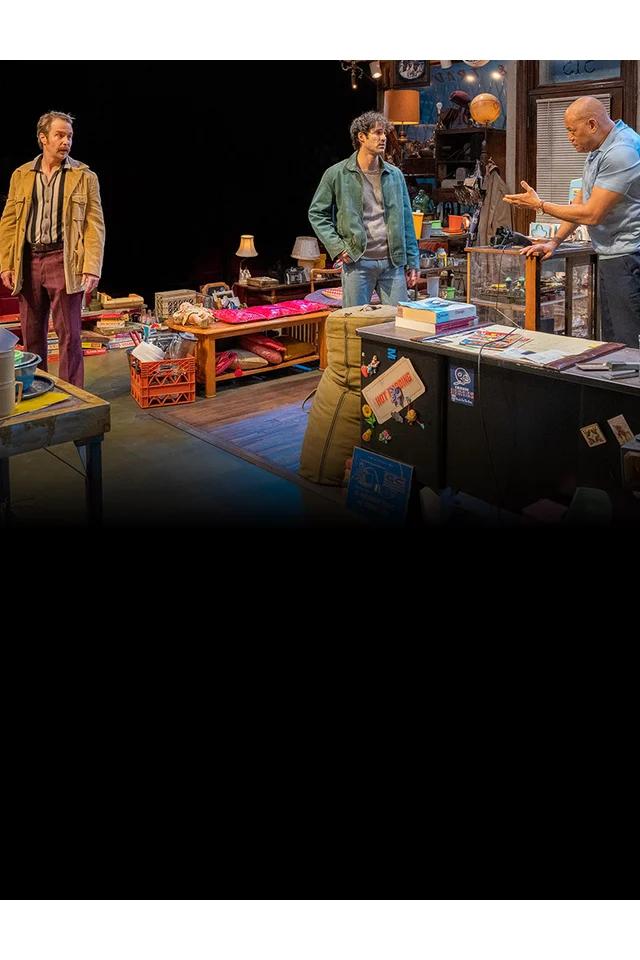
Richard Termine’s photograph of the 2022 Broadway production of American Buffalo in a cluttered junk shop.

American Buffalo

Play · 1975

Act I takes place at about 11 a.m. Don, who owns the junk shop where the entire play takes place, has sold a buffalo nickel to a customer for $90 but now suspects it is worth considerably more. He and his young gofer, Bob (sometimes called Bobby), plan to steal the coin back. Bob has been keeping watch on the customer's house and reports that he has left for the weekend with a suitcase. Teach, a poker buddy of Don's, arrives and learns of the scheme. He persuades Don that Bob is too inexperienced and untrustworthy for the burglary, and proposes himself as Bob's replacement. Teach suggests they steal the whole coin collection and more. Don insists on their poker buddy Fletcher going with Teach. Teach continues to argue that he can do the job without Fletcher. Act II takes place a little before midnight on the same day. Teach and Don make final preparations for the burglary while waiting for Fletcher, who is late. Teach tells Don that Fletcher is a liar and a cheater at cards, and prepares to go commit the burglary on his own. Don tries to persuade him not to take his gun with him when Bob appears at the store. He attempts to sell Don a buffalo nickel, similar to the one Don had sold the customer. When asked where he got the coin, Bob is evasive. Teach suspects that Bob and Fletcher have organized and completed their own burglary behind Don and Teach's backs. He asks Bob where Fletcher is. Bob tells him that Fletcher was mugged by "some Mexicans" and is in a hospital, but when Don calls the hospital, they have no record of his admission. Bob claims that he must have been mistaken about the name of the hospital, but the suspicious Teach strikes him on the head with a metal object. Another friend calls, corroborating Bob's story and naming the correct hospital. Don calls the hospital and confirms that Fletcher has been admitted with a broken jaw. Bob confesses that he made up the story about the customer leaving with a suitcase, and that he bought the second nickel from a coin dealer in order to make up with Don for his failure to keep tabs on the customer. Don admonishes Teach for wounding Bob and orders him to get his car so they can take him to the hospital.

Amy's View

Play · 1997

Act 1; We are introduced to Amy, Dominic, Evelyn, and Esme (all the characters except Frank and Toby). Esme and Dominic immediately dislike one another because of their differing views: Dominic supports new media and aspires to become a filmmaker, while Esme defends the importance of the theater. We learn that Amy is pregnant, and Esme reveals this to Dominic – despite Amy's wishes that she says nothing of it. Act 2; We are introduced to Frank, Esme's neighbour and financial consultant, and their relationship is hinted at. Amy and Dominic are still together, with children, but Esme continues to disapprove. There is also a continuation of Esme and Dominic's argument over popular culture and theater. The argument turns into one over Dominic's right to be with Amy and there is such frustration that the couple end up leaving Esme's home abruptly. Act 3; Amy comes back to visit her mother, and we learn that Dominic has left Amy for a young actress. Esme has also lost all her savings in an investment scandal, and continues to refuse Frank's love interest. Amy and Esme again quarrel over her choice to be with Dominic, discussing her view that love should be given unconditionally. She does not want to admit that her mother was partially right, but is still frustrated that Esme cannot see why she loved Dominic. Act 4; Amy and Dominic have separated and Amy has died. Dominic, now a film director, goes to Esme (who is once again a successful actress) seeking peace between them in order to honor what Amy was constantly trying to achieve. Amy's View is a four-act play set over the course of sixteen years. Act One begins in 1979, in the living-room of Amy's mother's home, which is decorated with paintings done by her late father, an obscure artist. Amy and her then-boyfriend, Dominic, are waiting for Amy's mother, Esme, to return from her theater performance in London. Esme's mother-in-law, Evelyn, is keeping them company while they wait. We quickly learn of a small publication Amy sold when she was a young girl called Amy's View, as well as Dominic's intense interest in cinema. Dominic has started a publication as well, called Noir et Blanc in which he reviews films, and which he hopes will lead him to a career in filmmaking. Amy realizes Noir et Blanc is quite like Amy's View, "except this time the view is Dominic's." When Esme does finally return, she is instantly concerned about Amy's wellbeing, a foreshadowing of the reason Amy has come to visit. Esme and Dominic are introduced for the first time, and each has a tentatively awkward and distant demeanor towards the other. Dominic explains more about his magazine: "we ring people up and we’re terribly nice to them. Then we write something horrid which appears the next day." He and Esme somehow share a good laugh over this, but it worries Amy nonetheless. He continues, adding that "these are well-known people. You think perhaps by now they’d be more secure. But not at all… It almost shocks me how much," which clearly irritates Esme, a prominent West End actress. Amy tries to ease the tension by inquiring about her mother's current play, but this quickly bores Dominic who is much more interested in discussing television or movies. He goes off in a huff to get some work done, leaving Amy and her mother to have a more private conversation. After a short while of discussing Amy's career and relationship with Dominic, Esme suddenly announces that she knows Amy is expecting a child. This is clearly the reason for Amy's visit, to get her mother's advice on the situation, since she feels as though she cannot reveal the situation to Dominic. Esme spends time attempting to figure out just why this is, and why Amy would want to be with this sort of man. In the end, Dominic comes back down to ask a quick question, but Esme, unexpectedly and under Amy's protest, informs Dominic of Amy's pregnancy. Act Two takes place six years later, in 1985, in the same living-room. Amy and Dominic, as well as their unseen children, and Esme and her new interest Frank, are returning from a ribbon cutting ceremony for a local fête. Everyone seems to be in high spirits, enjoying the summer weather, and it is briefly noted that Frank has begun looking after Esme's finances. The airy chitchat soon turns to conversation of Dominic's plan to interview Esme for his new television program – although she makes blatant attempts to escape his questions. He is putting together a piece about how he thinks the theater is dead and new generations can’t connect with the slow pace, the everyday bore of it all. Esme, although cheerful in manner and tone, resents Dominic, pressing that "it's always the death of the theater. The death of the novel. The death of poetry. The death of whatever they fancy this week […] It's off to the scaffold with everyone except the journalists!" It soon comes out that Dominic has hardly – if ever – even been to any plays, despite his ego as a critic. (Throughout this exchange, we see Evelyn once again, but she appears to have Alzheimer's, as she continues to interject, asking where Bernard has gone, and does not recognize Esme.) As the conversation escalates, it is revealed that what they really seem to be getting at is whether Dominic deserves to be with Amy or not. Dominic, feeling insulted and extremely frustrated, starts to get the children together to leave while Amy and her mother argue over Esme's refusal to give Dominic a chance. With the disagreement still unresolved, Amy and Dominic leave Esme alone to think over what's been said. Act Three begins once again in the living-room, eight years later in 1993. Amy arrives at the house looking for Esme to find Frank poring over various books and documents, Evelyn sleeping across the room in a wheelchair. Esme arrives not long after Amy, but is surprised to see her. It seems clear that they have not spoken for quite some time, and Esme is so glad to finally see her daughter again that she begins to weep as she hugs Amy. Once she has recovered, we learn that Esme has been acting as a nurse on a television show, and that Frank had been trying to marry Esme practically since the last time Amy had visited. Esme knows why Amy has come though, as her marital scandals have been all over the news since Dominic is now a "media monolith." It seems after all that Dominic had a weak point, and has just proved Esme right by leaving Amy for an attractive young Swedish actress. Dominic and Amy had married even, and yet he still could not commit completely. It was just the worry that Amy and her mother had discussed that night fourteen years ago. The focus then shifts and we learn that Amy's mother has run into a bit of a rough patch with her investments – about five hundred thousand dollars' worth. Amy is shocked and outraged of course, especially when she discovers that Esme's funds had been entrusted to Frank at Lloyd's of London. Amy wants Esme to petition, perhaps sue Frank, so that she may not have to pay all of the money back. Esme refuses, saying she knew what she was getting herself into and that she would have to face the consequences. This quarrel soon turns into another argument about Amy's relationship with Dominic. Amy wants her mother to know that there truly was a good, loving side to her husband, but that she hates to admit that she was wrong about some things and that Esme was right. There are intense emotions circulating throughout the two women as they grapple with their situations, and there is a heartfelt, although awkward, struggle as Esme tries to console Amy. In the fervor of the moment, before leaving, Amy says to her mother, "I went with Dominic because he was the future. I’m frightened of you because you’re the past." Act Four is set in 1995, and is set backstage, in a dressing-room of a small West End theater. A young actor, Toby, comes in, speaking with Esme about the play as she begins to ready for the next show. When he leaves to get Esme a cappuccino, Dominic wanders into the dressing-room. He has brought with him a box, tied with string, which he presents to Esme as a gift. He also reveals that he attended the matinee showing and enjoyed it very much. It is obvious that he has something else on his mind, however, and he soon inquires what has become of all the cheques he has sent her, wondering if she was insulted by it. She explains that every income she receives goes to paying off her debt, so it would be of no use to cash them. We slowly discover that Dominic has moved on to a new marriage and recently directed a hit film. They argue over Esme's relationship with Frank, her finances, the unnecessary violence of Dominic's new movie, and Dominic's new marriage. Then we learn that Amy has died due to a hemorrhage. Esme looks for some sort of emotion in Dominic, although he openly admits that, of course, he betrayed her. But he is clear in his reason for coming to see Esme. He knows that Amy "would have wanted that [they] should be friends." He doesn’t want Esme to waste the rest of her life hating him. He leaves, allowing her time to open her gift: bundles and bundles of five-pound notes.

An Act at Oxford

Play · 1705

An Act at Oxford is a 1704 comedy play by the English writer Thomas Baker. Although scheduled to appear at the Theatre Royal, Drury Lane that year it had censorship problems from the Lord Chamberlain, likely through the influence of the Oxford University authorities. Although performed earlier it did not have its London debut at Drury Lane until October 1705 under the alternative title of Hampstead Heath. The 1705 cast includes Robert Wilks as Bloom, John Mills as Captain Smart, Colley Cibber as Lampoon, William Bullock as Squire Calf, Benjamin Johnson as Deputy Driver, William Pinkethman as Chum, Anne Oldfield as Arabella, Susanna Mountfort as Berynthia and Jane Lucas as Mrs ap Shinken.

An Inspector Calls

Play · 1945

The play is set in 1912 at the Birlings' large home in the fictional industrial town of Brumley. Arthur Birling, a wealthy factory owner, magistrate and local politician, celebrates his daughter Sheila's engagement to Gerald Croft, son of a rival magnate. Also present are Birling's wife Sybil and their son Eric (whose drinking problem the family discreetly ignores). After dinner, Sheila and Sybil leave the dining room to go into the drawing room, while Birling lectures the young men on the importance of self-reliance and looking after one's own, and talks of the bright future that awaits them (which, he believes, will include a knighthood for himself in the next honours list). The evening is interrupted when the maid Edna announces the arrival of a man calling himself Inspector Goole, who explains that earlier that day he had seen the dead body of a young woman named Eva Smith, who had died by drinking disinfectant. He has been given the "duty" of investigating her death and the Birlings' involvement in it. He has seen her diary, which mentions members of the Birling family. Goole produces a photograph of Smith and shows it to Birling, who confirms that she worked in one of his factories. He reveals he dismissed her for leading a strike action demanding higher wages. Despite acknowledging that he left Smith without a job, Birling denies any responsibility for her death. Sheila, having been sent by her mother to bring Birling, Eric and Gerald to the drawing room, is shown a photograph of Smith. She explains that once, when she was out shopping with her mother, Sheila saw a dress she liked and tried it on, even though her mother and an assistant thought it was not right for her. Smith, now employed at this shop, also helped with the trying-on. Sheila realised that the dress did not suit her; Smith held the dress against herself, and Sheila could see that it looked much better on her. Seeing Smith smiling at the other assistant, Sheila took umbrage and angrily ordered the manager of the department store to fire her. Sheila's real motivation, which she ashamedly confesses, was the jealousy that she felt towards Smith, perceiving her as prettier than herself. Eric leaves the dining room. Sybil enters the dining room. The inspector mentions that Smith subsequently used the name Daisy Renton. Gerald is noticeably startled and admits to having met a woman named Daisy Renton in the Palace Bar, where Smith had resorted to prostitution to sustain herself. Seeing that Smith was hungry and struggling to cope financially, and was out of place there, Gerald gave her money and arranged for her to move temporarily into a vacant flat belonging to one of his friends. Gerald reveals that he began a relationship with Smith over the summer but parted with her after a few months. Sheila, disheartened, returns her engagement ring to Gerald, who leaves the house, saying he will return. The inspector turns his attention to Sybil, a patron of a charity that helps women in difficult situations, which Smith, by then pregnant and destitute, had turned to for help, using the name "Mrs. Birling". Sybil, seeing this as a deliberate mockery of herself, convinced the committee to deny her a grant. She argued that Smith had been irresponsible and suggested that she find the father and get him to face his responsibilities; Smith said that she had refused to accept any more money from the father once she knew it had been stolen. Despite vigorous cross-examination from the inspector, Sybil denies any wrongdoing. Goole plays his final card, forcing Sybil to lay the blame on the "drunken young man" who had got Smith pregnant. It slowly dawns on the rest of the family, except Sybil, that Eric is the young man in question, and "Mrs. Birling" was the first name that had come to Smith's mind because he had fathered her child. Eric enters, and after brief questioning from Goole, breaks down and admits responsibility for the pregnancy: he had raped Smith after a drinking spree at the Palace Bar. After finding out that Smith was pregnant, Eric stole from his father's business to support her and their child, but she refused the stolen money and cut contact with Eric. Birling and Sybil are outraged by Eric's behaviour, and the evening dissolves into angry recriminations. The inspector reminds the family that actions have consequences and that all people are intertwined in one society, stating: "if men will not learn that lesson, then they will be taught it in fire and blood and anguish." He leaves. Birling's greatest worry is the scandal that will arise from Eric's theft of his firm's money, which will come out at the inquest. The family begins to question if "Goole" was a real police inspector. Gerald returns and reveals that he had met a police sergeant he knew, who did not know of any police inspector named Goole. To confirm this, Birling makes a phone call to his friend, the chief constable, who confirms that there is no Inspector Goole on the force. Gerald points out that they could not be sure that Goole had shown the same photograph to the different members of the family; there could have been several young women, and they did not know that any of them had died. Gerald phones the infirmary, and they confirm that no one has died there that day, and they have not had a suicide in months. The family concludes that the inspector was a fraud and that they have been the victims of a hoax. Gerald and the elder Birlings celebrate in relief, but Eric and Sheila continue to rue their own and the others' actions. The phone rings: it is the police, who tell Birling that a young woman has just died on her way to the infirmary in a suspected suicide, and that a policeman is on his way to question the family.

Anastasia

Play · 1952 est

A former Cossack 'prince', now taxi-driver Bounine, discovers Anna an amnesiac in a Berlin asylum. Anna is mixed up in a plot to exploit Anastasia's inheritance of $10 million pounds, which is being held in a trust for any surviving heirs of the Romanov dynasty. As the scheme grows and the conspiracy prospers, Anna is trained for the last test of meeting the Imperial Grand Empress Maria, Anastasia's grandmother. Her acceptance of Anna is an essential obstacle in pulling off the conspiracy to obtain the money.

Anatomy of a Suicide

Play · 2017

The play follows three women, Carol, Anna and Bonnie, who, through the course of the play, are revealed to be mother, daughter, and granddaughter. The three women's stories play out simultaneously, while each exists in her own timeline. At the start of the play, Carol has just been released from the hospital after trying to die by suicide, Anna is a heroin addict, and Bonnie is a doctor. Carol and Anna are treated with electroconvulsive therapy. Carol dies by suicide offstage. Anna electrocutes herself in the bath, while her infant daughter, Bonnie, sleeps in the next room. At the end of the play, Bonnie sells the family home.

And Miss Reardon Drinks a Little

Play · 1967

Paul Zindel's dark comedy explores the relationship among three very different sisters after the death of their mother in the early 1960s. Having been abandoned by their father in early childhood, Catherine, Ceil, and Anna Reardon were raised in a small apartment by their mother. The three ladies are educated and become members of their local school community. Anna Reardon becomes a chemistry teacher, Catherine Reardon the assistant principal, and Ceil (Reardon) Adams is the superintendent of schools. The scene of the play is in the Reardon family apartment sisters Catherine and Anna are living following the death of their mother. Several months of caring for her sick mother only to see her pass has left Anna suffering a severe nervous breakdown. She has become a complete hypochondriac, obsessed with animals and rabies. She is also on an extended break from school for allegedly molesting a male student. Catherine's reaction to both her mother's death and her sister's ailment has been to drink "a little". She is consistently drunk throughout the show. Ceil did not have any sort of contact with the family while her mother was suffering, but rather ran off to marry her sister Catherine's boyfriend, Edward Adams (who never appears on stage). Ceil has come to the Reardon home to coax Catherine into having Anna committed. Neither Anna nor Catherine is interested in anything their sister has to say. Halfway through dinner, which consists of zucchini and kiwi, Fleur Stein invades the family conversation. Fleur works in guidance at Anna and Catherine's school, and wishes to butter up Mrs. Adams in attempt to gain a better salary. She is very colorful and somewhat obnoxious, which her husband, Bob, makes perfectly clear once he arrives. After a humorous, but often bitter evening, Ceil demands that Anna be locked up. Catherine refuses this demand, and Ceil essentially abandons the two women to take care of each other.

Showing 433–552 of 8,284 shows

Load more shows