Afterplay
In 1920s Moscow, Sonya from Chekhov’s Uncle Vanya meets Andrey from Three Sisters. Their conversation brings together characters shaped by disappointment and emotional loss in the aftermath of the earlier plays.
8284 shows
Clear filtersIn 1920s Moscow, Sonya from Chekhov’s Uncle Vanya meets Andrey from Three Sisters. Their conversation brings together characters shaped by disappointment and emotional loss in the aftermath of the earlier plays.
A documentary play built from the traumatic recollections of members of Newcastle Workers' Club, which was destroyed in the 1989 earthquake.
Afterwards is a 1933 mystery play by the British-American writer Walter Hackett revolving around a psychic medium. It enjoyed a West End run of 208 performances at the Whitehall Theatre between 7 November 1933 and 12 June 1934. The original London cast included Gordon Harker, Henry Daniell, Ronald Shiner, Jeanne Stuart and Marion Lorne.
After the Trojan War, King Agamemnon returns to Argos, where Clytemnestra has plotted to kill him in revenge for the sacrifice of their daughter Iphigenia and to take power with her lover Aegisthus. She persuades Agamemnon to enter the palace over costly robes, then kills him and Cassandra; Aegisthus joins her in claiming rule.
After Agamemnon returns from Troy, Clytemnestra plots with her lover Aegisthus to kill him, driven by revenge for Iphigenia's sacrifice and jealousy over the captive Cassandra. Cassandra foresees the murder, while Electra helps Orestes escape.
Agamemnon is a 1738 tragedy by the British writer James Thomson. It is based on the story of Agamemnon from Greek Mythology. The original Drury Lane cast included James Quin as Agamemnon, William Milward as Egistus, Theophilus Cibber as Melisander, William Havard as Talthybius, Mary Porter as Clytemnestra, Sussanah Arne as Cassandra, Anne Brett as Electra and Thomas Wright as Arcas. The prologue was written by Thomson's friend David Mallet, with Thomson returning the favour by adding a prologue to Mallet's Mustapha the following year.
After peace between Syracuse and Carthage requires prisoners to be released, Carthaginian soldier Ydasan seeks his captive daughter Ydace. The tyrant Agathocle's sons both desire her: Polycrate undermines the agreement, while Argide protects her, kills his brother in a fight, and persuades Agathocle to restore the republic.
Agis, A Tragedy is a blank verse tragedy by the Scottish dramatist John Home. It was his first play, but has been greatly overshadowed, by his second (and once famous) play Douglas. It is a classical drama, based on the life of Agis, king of Sparta and is founded on Plutarch's narrative. After writing the play in Scotland in 1747, Home took it to London, and submitted it to David Garrick for representation at Drury Lane, but it was rejected as unsuitable for the stage.
In an ahistorical Persia, Aglaura and Prince Thersames love one another, but the King also desires her. Court intrigues and mistaken identity lead to a tragic ending in the original version; Suckling also supplied an alternative tragicomic ending.
Agnes de Castro is a 1696 tragedy by the English writer Catharine Trotter. Based on the novel of the same title by Jean-Baptiste de Brilhac, it was first staged by John Rich's company at the Theatre Royal, Drury Lane. The original Drury Lane cast included Thomas Simpson as King, George Powell as Prince, John Verbruggen as Alvaro, Colley Cibber as Lorenzo, John Mills as Pedro, Jane Rogers as Agnes de Castro, Mary Kent as Bianca and Frances Maria Knight as Elvira. The prologue was written by William Wycherley. The published version was dedicated to the Duke of Dorset.
Agnes of God is a 1979 play by American playwright John Pielmeier which tells the story of a novice nun who gives birth but does not believe she has. After the child is found dead, a psychiatrist and the mother superior of the convent clash during the resulting investigation. The title is a pun on the Latin phrase Agnus Dei ("lamb of God").
After her divorce from a bankrupt husband, Agnete Lindemann survives by stealing from friends and arranging false collections. She falls in love with Rikard Berg, the lawyer who handled her divorce, and confesses her past dishonesty in hopes of beginning a truthful life with him. He cannot accept her confession, so she leaves to work as a housekeeper for a cousin in Nordfjord.
After a fire destroys a monastery library and its books, the resident monks and nuns confront the loss of their spiritual center. Purnima, a nun constrained by the monastery's gender roles, ultimately leaves to work among people affected by the civil war.
At Ephesus, Sparta's King Agésilas navigates Lysander's political plot and competing marriage alliances involving Lysander's daughters, the rulers Cotys and Spitridate, and Mandane. Agésilas pardons Lysander and consents to the marriages while securing his own political position.
Ah, Wilderness! is a comedy play by American playwright Eugene O'Neill that premiered on Broadway at the Guild Theatre on October 2, 1933. It differs from a typical O'Neill play in its happy ending for the central character, and depiction of a happy family in turn-of-the-century America. It is O'Neill's only well-known comedy. The play was successful in its first Broadway production and the touring production that followed. It has since become a staple of community repertory.
In an early twentieth-century Tsarist Russian village, children fight for their rights and education, challenging adults’ abuses and indifference and leading them toward a better path.
On November 4, 2008, Pastor Freeman performs a funeral service for "Righttocomplain", claiming that with the election of Barack Obama, the African-American community will no longer face hardships. However, the congregation's joyous celebration is undercut by the years that follow as they witness events such as the Flint water crisis and the deaths of unarmed Black Americans at the hands of police. A Black drag queen flight agent, Peaches, prepares a boarding gate at the airport while giving instructions over the phone to her friend Ladarius. As the play continues, it is revealed the flight is the last one in a program of government subsidized one-way tickets to Africa for all Black people who want it. The play frequently cuts back to Peaches at the gate, checking in various passengers and offering counsel to those who are hesitant. She also prepares Miss Bag, a suitcase she claims holds "our entire story as a people in this country" and encourages passengers to drop their stories in the bag so they may bring it to Africa. She also warns that all black people who elect not to board the flight will be subjected to "extreme racial transmogrification" by "The Powers That Be": they will be turned into white people. The rest of the play consists of vignettes showing the lives of black people in different settings, and how news of the flight affects them. In the first vignette, a black couple Damien and Trisha wait for her number to be called at an abortion clinic; Damien is actually a ghost after being killed in an act of police brutality, and Trisha sees the abortion as the only way to keep their child safe from both death and the spectacle of being a symbol of police brutality. The second vignette depicts the filming of The Real Baby Mamas of the South-Side, a reality show focused on stereotypical black women; brief moments where the camera stops rolling reveal the artificial nature of the show, as well as tensions among the cast due to the presence of "Rachonda" (Rachel), a self-proclaimed "transracial" black woman who is the only one who keeps up the stereotype when the camera are not rolling. In the third segment, a rich black family ignore the notice about the last flight, only to be confronted by the arrival of Black, the human personification of their family's "blackness", locked away in the basement by the family's deceased patriarch forty years prior when he became rich. In the last vignette, three inmates at a women's prison, along with one of the officers, prepare to be released so that they may board the planes while dealing with their complex feelings of what their new "freedom" entails. In the final scene, Peaches finishes getting all the passengers on the plane, but just as she is ready to board herself, she discovers she is unable to move Miss Bag. She tries to get it to move, protesting that leaving it behind means leaving behind all of African-American culture and history. Due to her efforts, the last plane leaves without her. Realizing that Miss Bag has disappeared, Peaches angrily protests to The Powers That Be to "give it back" as her drag is violently removed until she is left as a man. Before he is subjected to extreme racial transmogrification, he makes one last attempt to rally black solidarity to get back Miss Bag and thus reclaim African-American identity, but is met with silence—for there are no more Black people left.
Airline Highway takes place in the parking lot of The Hummingbird Motel, off the titular highway near New Orleans, where the residents have gathered to celebrate the life of Miss Ruby, an iconic burlesque queen who has been a mother figure to them all. Miss Ruby's life is nearing its end, and she requests that her funeral takes place while she is still alive. As the Mardi Gras-esque celebration continues into the night, the stories of the residents, their pain and disappointments unfold.
Two women are imprisoned in a mental asylum in the 1920s for having children outside marriage and are released in the 1970s.
A woman travels to Kyushu to reunite with the Dazaifu high priest she once loved. His jealous wife forges a rejection letter, prompting the woman to drown herself; the priest’s prayers bring the deity Tenman-Tenjin, who revives her.
The fragmentary tragedy probably dramatized the Trojan War story of Ethiopian prince Memnon, who killed Antilochus before being killed by Achilles. The surviving plot is almost entirely unknown.
After Achilles’ armor is awarded to Odysseus, Ajax attempts to kill him and the Greek commanders. Athena’s delusion makes Ajax slaughter livestock instead; when he regains his senses, shame leads him to suicide. The play then follows the dispute over his burial, which Odysseus resolves by persuading the commanders to honor Ajax in death.
Agatha Christie's play follows Pharaoh Akhnaton's religious reforms and political decline. As he elevates Ra and suppresses the old cult of Amon, unrest, famine and rebellion grow. Horemheb, Meriptah and Nezzemut plot his overthrow; Nefertiti is deceived into poisoning Akhnaton, and the epilogue announces the restoration of Amon's religion.
Betrothed as a child to the deity Iyieke, Olanma later marries a prince and takes on traditionally male duties. When her family neglects Iyieke’s worship, Olanma resists the deity’s demand that she return as his wife, and her daughter ultimately sacrifices herself to protect the family.
Set against economic hardship in 1970s Egypt, the play follows two poor lifelong friends. Masoud marries a wealthy woman drawn to his uncomplicated life, while he hopes to leave poverty behind in her family’s palace; their contrasting backgrounds and attitudes to marriage drive the comedy.
In a Jordanian family, the children and their mother challenge a controlling father for greater freedoms; his brother's return from Canada prompts a satirical explanation of local political life and privatization.
In an unnamed Arab dictatorship, cinema extra Zeinhom is repeatedly unemployed but resembles the ruler. After officials notice the resemblance while the dictator is dying, they recruit Zeinhom as a double; when the ruler dies, they install him as a compliant figurehead. Zeinhom is thrust from insecure work into the palace's rivalries and must navigate pressure from competing power centers while trying to govern.
A stage dramatization of the Aladdin story from One Thousand and One Nights.
A retired butcher, Alaba, offers a vantage point for satire on Nigerian politics; the play also explores human relationships with the environment and environmental justice.
Alasco is an 1824 tragedy by Martin Archer Shee, the Irish painter and future President of the Royal Academy. While best known for his artworks Archer Shee also wrote poetry, two novels and this play. It was intended to be staged at the Theatre Royal, Covent Garden in London, but objections by the censor George Colman to the play's subject matter led to the Lord Chamberlain, the Scottish peer the Duke of Montrose to refuse it a license. Montrose and Colman were wary of any plays they regarded as touching on any revolutionary themes. Archer Shee published the work with a lengthy preface defending the play, and it was performed at the unlicensed Surrey Theatre south of the River Thames in April 1824.
A one-person portrait of Albert Einstein that presents him as scientist and human being, including his hopes of becoming a violinist, intellectual curiosity, pacifism, flight from antisemitism and later dismay at nuclear weapons.
A biographical drama about Nazi architect Albert Speer's life, drawing on Gitta Sereny's account of his relationship with the truth.
At 70, Albertine lives in a retirement home and encounters her younger selves at ages 30, 40, 50, and 60 as she reflects on her life. Her sister Madeleine is the only other character.
Albina, Countess Raimond is a 1779 verse drama tragedy by the British playwright Hannah Cowley. It premiered at the Theatre Royal, Haymarket in London 31 July 1779. The original cast included Howard Usher as King Henry, West Digges as Westmoreland, William Wyatt Dimond as Edward, James Aickin as Egbert, Robert Palmer as Oswald, John Gardner as Steward and Katherine Sherry as Albina. She dedicated the play to the politician Lord Harrowby.
In this Tudor political interlude, allegorical figures Injury and Division accuse English authorities of administering law and justice unfairly. They plot to deepen discord by sending false or inflammatory messages to other characters.
A fraudulent astrologer and his thieves exploit Pandulfo’s desire to marry a young woman by promising to turn a farmer into her absent father. The real father returns, the impersonation and theft unravel, and the young people redirect the planned marriages toward themselves.
King Admetus is spared death only if another takes his place. His wife Alcestis agrees to die for him; after her death, their guest Heracles confronts Death and returns her to the palace, veiled, where Admetus recognizes her.
Alcibiades is a 1675 tragedy by the English writer Thomas Otway, based on the life of the Athenian statesman and general Alcibiades. Staged by the Duke's Company, it premiered at the Dorset Garden Theatre in London with a cast that featured Thomas Betterton as Alcibiades, Matthew Medbourne as Agis, Samuel Sandford as Tissaphernes, John Crosby as Patroclus, Henry Harris as Theramnes, Thomas Gillow as Polyndus, Mary Lee as Deidamia, Mary Betterton as Timandra and Elizabeth Barry as Draxilla. Alcibiades is a verse play is written in heroic couplets, that is rhymed verse in iambic pentameter, which was championed by John Dryden at the time. While Otway originally wrote in rhymed tragedies, he eventually settled on writing in blank (unrhymed) verse in iambic pentameter, the better to imitate Shakespeare. Alcibiades draws inspiration from Plutarch's Parallel Lives. The story centers around the historical character of Alcibiades during his exile to Sparta, and his seduction of the Spartan Queen.
In the surviving plot summary, Alcmaeon leaves his children Tisiphone and Amphilochus to be raised in Corinth. Queen Merope sells Tisiphone into slavery; Alcmaeon unknowingly buys her and returns to Corinth, where he reunites with Amphilochus and Tisiphone's identity is revealed. The ancient tragedy is lost, and its plot is reconstructed from a later summary and fragments.
This lost tragedy follows the mythic hero Alcmaeon in Psophis; the surviving account says its story is believed to have incorporated his death.
After ominous dreams, Queen Hecuba’s infant Paris is exposed on Mount Ida and raised by a herdsman. Years later, Paris wins games held in his honor despite being treated as a slave; when Prince Deiphobus plots against him, Cassandra and the herdsman reveal his identity and Hecuba is reunited with her son.
As Natalia Pushkina's relationship with Georges-Charles de Heeckeren d'Anthès develops, the play follows the circumstances around the poet's death and portrays a conspiracy by the authorities against him; Pushkin himself remains offstage.
A blank-verse dramatic poem about Alexander the Great and his war against the Persians.
Alexander the Great and the Indian princess Cleofile love one another, but intrigues involving her brother Taxilus and his ally Porus complicate their relationship. The five-act verse tragedy is based largely on a surviving work by Roman historian Quintus Curtius Rufus.
Alfie is a 1963 stage play written by Bill Naughton. Developed from a radio drama, the original London production starred John Neville, and the Broadway transfer starred Terence Stamp.
Alfonso, King of Castile is a historical tragedy by the English writer Matthew Lewis. It was published in November 1801, and was first staged at the Theatre Royal, Covent Garden the following year. It is set during the reign of Alfonso XI of Castile during the fourteenth century. The original Covent Garden cast included Charles Murray as Alfonso, George Frederick Cooke as Orsino, Henry Johnston as Caesario, Charles Klanert as Marco, John Whitfield as Melchior, William Claremont as Gomez, George Davenport as Ricardo, John Waddy as Father Brazil, Nannette Johnston as Amelrosa and Harriett Litchfield as Otillia.
Alfred is a 1778 tragedy by the British writer John Home. His final play it was not as well-received as his earlier efforts and he retired from playwriting. The original Covent Garden cast included William Thomas Lewis as Alfred, Thomas Hull as Edwin, John Whitfield as Earl of Surrey, Francis Aickin as Hinguar, Ann Street Barry as Ethelswida. The epilogue was written by David Garrick.
Alfred the Great is an 1831 historical play by the Irish writer James Sheridan Knowles. It portrays the life of the Anglo-Saxon King Alfred the Great. It premiered at the Theatre Royal, Drury Lane in London. The title role was played by William Macready, a frequent collaborator of Knowles. Other members of the cast included Charles Mayne Young as Edric, John Cooper as Guthrum, James Vining as Oddune, Henry John Wallack as Oswith, Mary Warner as Elswith and Thomas Cooke as Kenric. The published version was dedicated to the reigning monarch William IV.
The following was compiled from a large extract of the play published in Current Literature during 1910, and from newspaper reviews of 1909–1910. Act I (The Warden's office at Sing Sing prison.) Rose Lane and two women from the Gate of Hope Society are visiting the Warden. Rose has brought along her mom's brother, Robert Fay. The four of them are discussing prison reform and criminal types with the Warden. Also present is Blickendolfenbach, with his new keyed lock that he hopes to sell to the state prison. Smith fetches Blinky Davis, who casually alters a $5.00 check into $50,000. Then Smith brings in Dick the Rat, who picks the new lock with just a hairpin. Smith, the prisoners and the inventor depart. The women ask the Warden about other convict types, and he promises to show them a romantic one. While he's gone, Rose tells the others about how a criminal tried to molest her on a train two years ago, but was thwarted by a young stranger. The Warden returns with Jimmy Valentine. Rose instantly recognizes him as the young stranger. Valentine enrages the Warden by refusing to pick the combination lock of the prison safe, claiming he has no knowledge of safecracking. Fay intervenes when the Warden berates Valentine, and urges the latter to apply for a pardon. (Curtain) Act II (Hotel parlor in Albany, New York, a few weeks later.) Valentine has been pardoned and released. He is due to meet Rose and her father at the hotel. While waiting, he is approached by old friends Bill Avery and Red Joclyn, fellow yeggs. They urge Valentine to resume his old profession, but he has fallen in love with Rose and repudiates crime. Suddenly Detective Doyle is spotted. Red and Bill hide, while Valentine verbally spars with Doyle, who wants him to sell out Bill Avery. Valentine refuses, and Doyle threatens to prosecute him over a safecracking in Springfield, Massachusetts. He leaves frustrated by Valentine's aplomb. Bill and Red reappear, and Valentine hands Bill a message from Rose, promising him a job out west. Bill thanks Valentine and departs promising to go straight. Rose and her father now appear. William Lane offers Valentine a position in his bank. Valentine allows himself to be persuaded, and reveals his real name, Lee Randall. When they leave, he tells Red to follow him to Illinois, where he'll get him an honest job. (Curtain) Act III (Randall's office at Fourth National Bank of Springfield, three years later.) Randall is now Assistant Cashier of Lane's bank, while Red Joclyn has been appointed a watchman. Randall's clerk Williams brings in a man called Cronin, who is actually Bill Avery. He is now prosperous through marriage, and brings a "doctored" photo for Randall to alibi himself for the Massachusetts safecracking. They both know Doyle is in town. After he leaves, Rose visits Randall with her younger siblings, Bobby and Kitty. Rose and Valentine are close to being engaged. Rose goes to her father's office, while the kids leave to inspect the newly installed bank vault. Doyle now enters, and begins to question Valentine, who stymies him by claiming to be Lee Randall. Doyle isn't quite fooled, but can't find a way to break Randall's alibi. Doyle starts to leave but lingers when he hears Red rush into Randall's office. Bobby has accidentally locked Kitty into the new vault, the combination for which hasn't been delivered by the manufacturer. (Curtain) Act IV (Vault room of bank, moments later.) Red Joclyn has cleared the bank to cut down on noise. They can hear Kitty's muffled cries for help. Randall turns off the lights to avoid distraction as he tries to feel the tumblers click. Each time he feels one, Red lights a match to check the dial number. Doyle has crept silently into the room to watch, and a moment later, so does Rose. Randall sandpapers his fingertips to sensitize them. Painstakingly he works the dial, number by number. Joclyn grows worried; he can no longer hear Kitty. Finally, the last number is felt, and the vault door is swung open. Kitty is unconscious but alive; Red picks her up and rushes her to a doctor. Randall spots Doyle and realizes the game is up. But Doyle yields his captive to Rose, who now knows the truth about Randall but still wants him. (Curtain)
After Sir Roger Ackroyd is found stabbed in his study, Hercule Poirot investigates the household's suspects and uncovers the doctor's role in the murder and an earlier blackmail scheme.
After Colonel and Mrs. Grey return from India, their children struggle to connect with their mother. Amy’s theatrical fantasies lead her to mistake her mother’s affectionate friendship with Stephen Rollo for an affair, creating a chain of misunderstandings before the family reconciles.
Act 1; As Alice, a seven-and-a-half years old girl, plays chess with her cat, Dinah, she describes her imagination about a Looking-Glass House. The rooms in the house are similar to the ones in her home but appear backwards. She decides that she is going to make-believe that the entrance to her home is through the looking glass that hangs in her drawing room. As she tells of this imagined entrance, the real looking glass transforms into a portal and Alice goes through it into a different world, "Wonderland". Upon Alice's arrival in Wonderland, she discovers a book and begins to read from it the nonsense poem "Jabberwocky". She next observes The White Rabbit rushing along and complaining about being late. She unsuccessfully attempts to follow him and comes to a tiny door leading to a garden which she is unable to fit through. Beside this door there is a table with a key and a bottle labeled "Drink Me" sitting on top of it. Alice drink's from the bottle and begins to shrink; eventually reaching the correct height to go through the door. However, she forgot to grab the key from the table and cannot open it. Alice starts crying profusely in frustration and her tears create a large pool of water in which she starts swimming. In this pool she comes across the Mouse whom she asks for help in finding a way out of the pool. Once on land, the mouse decides to assist in drying them off by reciting the "driest thing I know". Alice is introduced to the Lory, the Duck, and the Dodo by the Mouse, and the group proceeds to engage in nonsensical game called a caucus-race (a satire of political campaigns). After this ends, Alice wanders off by herself in Wonderland where she encounters a series of strange characters; among them the Caterpillar, the Frog-Footman, the Duchess, and a Cheshire Cat, the latter of whom appears and disappears at a whim. With each character Alice makes observations which compare the rules and customs of her world with this strange new world. Alice arrives at a tea party where she meets the Mad Hatter, the March Hare, and the Dormouse. From them she is informed about the foul-tempered and oppressive Queen of Hearts. After leaving this party, Alice meets the Queen of Hearts when she wanders into her garden. The queen bids Alice to join her in a game of croquet, but with live flamingos used as mallets. Alice plays poorly and the game ends rapidly. The Queen commands her courtier, the Gryphon, to introduce Alice to the Mock Turtle. The Mock Turtle begins a recitation of a grim life story but is interrupted by the White Rabbit who informs the court that a trial accusing the Knave of Hearts of theft is about to start. A trial full of illogical arguments and outrageous antics ensues which confounds Alice. Frustrated, she interrupts the proceedings and denounces the trial as nonsense. The Queen of Hearts orders Alice's beheading as punishment. Act 2; Alice runs and escapes the Queen of Hearts's guards into a land shaped like a gigantic chessboard. There she meets another queen, the Red Queen, who advises Alice on traversing through the squares. She informs Alice that she will become a queen when she arrives at the eighth square on the board. As Alice travels through the chessboard squares she encounters more strange characters; among them a railroad guard, the twins Tweedledum and Tweedledee, the White Queen, The Sheep, Humpty Dumpty, and the White King. Upon reaching the eighth square she is crowned a co-regent with the Red and White Queens, and a banquet is held in Alice's honor. Alice becomes overwhelmed by the attention of Wonderland's characters at the party and proclaims she can take no more. Wonderland suddenly vanishes and Alice wakes up in her own home next to Dinah her cat. She realizes her adventure was only a dream.
Framed by Charles Dodgson telling the Liddell children stories during an 1862 river outing, the play presents Alice’s adventures in Wonderland and the Looking-Glass World as two separate dreams across two acts. The first ends with Alice waking in her drawing room; the second takes her through a chess-like world to become a queen before she wakes again.
Saida lies to her husband Omari so she can spend a weekend with her lover Abdallah. When Omari learns Saida's mother has died and discovers the affair, he tells Saida that the news is punishment enough and sends her to be present for the end of the funeral rites.
Alison's House is a drama play in three acts by American playwright Susan Glaspell. It was first produced at Eva Le Gallienne's Civic Repertory Theatre on 14th Street, New York, on 1 December 1930, where it was given 25 performances in the regular repertory season. It was awarded the Pulitzer Prize for Drama in 1931. In May 1931 the production was transferred uptown to the Ritz Theatre, but it received indifferent reviews and closed after two weeks. It is 18 years since Alison Stanhope, the country's foremost poet, died. Now the house she lived in must be sold, but it holds secrets. Did Alison sacrifice the man she loved for the sake of her family's reputation? And whom do such sacrifices benefit? The play's struggles are set in 1899, on the cusp of the 20th century, in which very different values will come to prevail. Inspired by the life and work of the American poet Emily Dickinson, Glaspell set the play in her native Iowa.
Two men sharing a large Helsinki apartment cannot afford the steep rent increase imposed by their landlady’s nephew. They advertise for a subtenant; the new lodger’s arrival complicates matters further when the nephew needs surgery and one of the tenants takes the case privately.
After her husband's death, a mother tries to keep officials from taking her three daughters. The play is based on a true story.
All Alive and Merry is a 1737 comedy play by the British writer Samuel Johnson. The original Lincoln's Inn Fields cast included William Giffard, Charlotte Charke and Anna Marcella Giffard. It was staged by Henry Giffard's company which had recently moved from the Goodman's Fields Theatre in Whitechapel.
A newlywed couple move into a Salem house haunted by Agatha Forbes, a witch who returns each November 22. When their party brings the ghost face to face with the guests, they try to break her spell.
In Florence, the manipulative Gostanzo’s schemes to control his children backfire and inadvertently let Valerio remain with his secret wife Gratiana while Fortunio woos Bellomora. A subplot follows the jealous Cornelio’s unfounded suspicions of his faithful wife.
Jim Harris, a Black man determined to become a lawyer, marries Ella, a white woman whose insecurity and racism undermine his ambitions. Across fifteen years, their relationship deteriorates under external prejudice and Ella’s control, while Jim repeatedly fails the bar exam and ultimately gives up trying.
Friends Ginger and Lily join the Women’s Royal Naval Service in wartime. Lily seeks a role ashore while Ginger longs to serve at sea, testing their friendship and the limits placed on women’s work.
The show consists of live readings of seven of Simon Rich's previously published short stories.
A composite portrait of a young movie actor returning to his hometown, tracing the forces that drive his pursuit of success and make achievement feel necessary for survival.
In 1947, Joe Keller's family faces the consequences of defective aircraft engine parts he knowingly shipped during the war, for which his partner Steve Deever was imprisoned. As Joe's son Chris seeks to marry Ann Deever, the truth about the crime and Ann's missing former fiancé Larry emerges, forcing Joe to confront his responsibility for the deaths of pilots and his own family.
At a beach house on Long Beach Island, Charlie attempts suicide and is rescued by Emma, who is showing the property to tenants. A firefighter and drug dealer and an escort then arrive, while Charlie reveals that he has killed six people and the group’s histories unfold.
The story revolves around a central group of four close friends (Lizzy, Tessa, Jacqueline, and Darcie) studying for final exams with only five days left of their senior year in college looming over them. During the night a series of secrets are revealed which change their lives forever.
All Out: Comedy About Ambition is a show from Simon Rich which consists of live readings of short stories about "ego, envy, greed, and basically just New Yorkers in general." The first production, directed by Alex Timbers, opened on December 12, 2025, at the Nederlander Theatre in New York City on Broadway and closed on March 8, 2026. All Out is Rich's follow up to the 2024 production All In: Comedy About Love.
A wife and mistress are waiting for the death of the man they both love. Their great love is a man who is wealthy and famous. The wife and mistress form an alliance in a ritual of the death watch.
All Rights Reserved is a 1935 comedy play by the British writer N.C. Hunter. It was first performed at the King's Theatre in Hammersmith. It then transferred to the Criterion Theatre, where it ran for 86 performances between 30 April and 13 July 1935. The cast included Nora Swinburne, Ronald Squire, Edmund Breon and Esma Cannon.
A troubled family faces disaster as a rising river threatens their home. Two brothers try to shore it up while their father dismisses their efforts; their sister’s vanity brings her close to death, and the youngest son comes of age amid the collapse.
On her way to meet her blind husband at the railway station on his birthday, the ailing Maddy Rooney encounters neighbors and strangers on a difficult country road. Returning home together, the couple learn that a child fell from the delayed train and was killed, leaving unresolved what Dan may have done.
All That Matters is a comedy play by the British writer Charles McEvoy. It ran for 45 performances between 8 February and 18 March 1911 at the Haymarket Theatre in London's West End. The original cast included Phyllis Neilson-Terry, Norman Trevor, C.V. France, J. Fisher White, Norman Page, Clare Greet, Helen Haye and Sydney Fairbrother.
Ty, in one week, impregnates his ex-girlfriend Jen, his married next door neighbor Maureen, and his university student Becca.
Playwright Leo Butler begins writing about LSD and meets former government drugs adviser David Nutt, who persuades him to join an LSD trial. The play becomes a comic, associative history of psychedelic experiences, framed by Butler's return home and bedtime story to his daughter.
In Alexandria, Mark Antony struggles between his love for Cleopatra and pressure to return to Rome with his wife Octavia. After a staged appearance of infidelity convinces him that Cleopatra betrayed him, Antony's forces turn against him. He attempts suicide after being told Cleopatra is dead; when she arrives, he dies, and she and her attendants kill themselves.
All for the Better is a 1702 comedy play by the English writer Francis Manning. The original Drury Lane cast included Thomas Simpson as Mendez, Robert Wilks as Woodvil, John Mills as Johnson, Charles Fairbank as Young Mendez, John Bickerstaff as Antonio, Benjamin Husband as Alphonso, Benjamin Johnson as Lopez, Mary Powell as Donna Theresa, Jane Rogers as Isabella, Mary Kent as Daria, Henrietta Moore as Elvira, Jane Lucas as Clora and Henry Norris as Nurse. Jeremiah Clarke composed the incidental music for the play.
Teenage newlyweds living with the groom’s parents struggle to consummate their marriage.
On the evening before their nonspeaking autistic son Laurence is due to move to a residential school, Tamora and Martin confront a social-services inquiry and their fears about his care. As a support worker helps them prepare Laurence for the move, the parents' relationship strains and the family faces the decision together.
A collection of short comic and dramatic one-act plays, mostly built around language, wordplay, existential questions and romantic complications. Its sketches range from a couple repeatedly resetting an awkward first meeting to three chimpanzees attempting to write Hamlet.
All in the Wrong is a 1761 comedy play by the Irish writer Arthur Murphy. It premiered at the Theatre Royal, Drury Lane in London, the under the management of David Garrick, on 15 June 1761. The original cast included Richard Yates as Sir John Restless, William O'Brien as Beverley, John Hayman Packer as Young Bellmont, Thomas Weston as Brush, Servant to Beverley, Astley Bransby as Blandford, Charles Blakes as Robert, Hannah Haughton as Lady Restless, Mary Ann Yates as Belinda, Mary Bradshaw as Tattle, Servant to Lady Restless and Jane Hippesley as Tippet, Servant to Belinda.
Jess, a therapist with cerebral palsy, cares for vulnerable disabled clients whose lives are affected by austerity.
All on a Summer's Day is a 1787 comedy play by the English writer Elizabeth Inchbald. It premiered at the Theatre Royal, Covent Garden in London on 15 December 1787. The original cast included William Thomas Lewis as Wildlove, John Quick as Sir Ralph Mooneye, Francis Aickin as Governor Morton, William Farren as Sir William Carrol, James Fearon as Chrysostom, William Macready as Lord Henley, Ann Brunton Merry as Louisa, Mrs Webb as Mrs Goodly and Henrietta Amelia Leeson as Lady Henrietta.
The play depicts the 1742 Dublin premiere of Handel’s Messiah and singer Susannah Cibber’s involvement, with Handel, librettist Charles Jennens, music historian Charles Burney and soprano Christina Maria Avoglio among its historical figures.
When an elderly woman leaves her estate to two politically opposed cousins, they must live peacefully in her cottage for a month to inherit. Their rivalry leads the solicitor to partition the cottage, turning ordinary domestic needs into comic border disputes; the cousins gradually cooperate, though the conflict flares again when they are about to part.
The play opens shortly after the assassination of John F. Kennedy on November 22, 1963, and continues through Johnson's landslide election on November 3, 1964. In his first year as president, Johnson engineers passage of the Civil Rights Act of 1964. Johnson has Senator Hubert Humphrey of Minnesota reach out to liberal congressmen and civil rights groups, while Johnson personally deals with Southern congressmen, who are deeply opposed to the legislation. The act has trouble getting passed through the United States Senate more than the U.S House of Representatives. Among the opposition to the Civil Rights Act of 1964 were senators Strom Thurmond and James Eastland. Their opposing views seemed to be complicated to manipulate causing the Civil Rights Act some trouble getting passed and off the Senate floor. At the end of Act One, eventually the law passes the Senate, by Johnson's use of cajolery, arm-twisting, and blackmail to get his way. Johnson himself is from the South, he is close to the recalcitrant southern congressmen, and he uses homespun and sometimes off-color stories to persuade them. A reviewer noted, "Johnson seems just to be shooting the breeze when really he's riding herd on friend and foe alike in anxious pursuit of his goals." Throughout, the play makes copious reference to congressional terminology unusual in Broadway plays, such as "cloture" and "filibuster," which are mechanisms used to extract bills from committees or even stall the bill from being voted on. Johnson is portrayed as emotionally needy and vulnerable, even as he rides roughshod over other people such as his wife, Lady Bird Johnson, and his longtime aide, Walter Jenkins, who is forced to resign after he is arrested on morals charge. He is disdainful of Humphrey and promises the vice-presidency to him in the 1964 elections if he goes all the way with Johnson. Johnson engages in spirited conversations with Senator Richard Russell Jr. of Georgia, who strongly opposes the legislation but finds that his ability to stop the bill has ebbed because of Johnson's tactics. On the other side, Dr. Martin Luther King Jr. must contend with more conservative leaders, such as Roy Wilkins, who oppose civil rights marches and militant leaders like Stokely Carmichael, who favor strong action. The more activist leaders prevail, and launch the "Freedom Summer;" young college students ride buses into the south to desegregate facilities. Three Freedom Riders (Michael Schwerner, Andrew Goodman and James Chaney) are killed allegedly by police brutality, forcing Johnson to send in the FBI and further inflaming emotions. J. Edgar Hoover is shown eavesdropping on Dr. King. In the second act, the action shifts to Atlantic City, New Jersey, where a battle is brewing at the 1964 Democratic National Convention. The segregated Mississippi delegation is challenged by the integrated Mississippi Freedom Democratic Party (MFDP). Outside of the Democratic Convention is the MFDP activist and leader demanding a seat in the convention that would integrate the votes. Fannie Lou Hamer one of the MFDP leaders tells her story on national television of her mistreatment by the Winona Chief Police county jail that would provoke the MFDP to get a seat at the convention. Johnson struggles on creating a strategy that would make both the MFDP and the primary party voters satisfied. Thirty-three days until the election Johnson and Barry Goldwater scores are head to head to win the presidential seat.
The play takes place in summer 1915 in Knoxville, Tennessee, where the extended families of the Folletts and the Lynches live. Jay Follet and his pregnant wife Mary have a six-year-old son named Rufus, who takes great joy in being with his father. Jay's brother, Ralph, is an undertaker. Ralph appears to have a drinking problem and mistreats his wife Sally. Mary's parents are Joel Lynch and Catherine Lynch, and her brother is Andrew. The play unfolds over a period of four days. During the first act, the Folletts leave Jay and Mary's home to visit their 104-year-old great-great-grandmother and Aunt Sadie Follet. Returning later that evening, Jay receives a frantic call from his brother Ralph that their father Jim-Wilson is in declining health. After Mary warns Jay about driving too fast, Jay leaves to find out what happened. In the second act, it is revealed that Jay is killed in an automobile accident. The remainder of the play deals with the family coming to terms with his death. It becomes uncertain if Jay had been driving drunk or if it had been a suicide. The third act takes place on the day of Jay's funeral. Mary tells Rufus, for the first time, that she is pregnant and that he may have a little brother or sister on the way.
In Rowley's Jacobean tragedy, King Roderick rapes his general Julianus's daughter Jacinta, prompting rebellion and an alliance with the Moorish king. A subplot follows Antonio's secret marriage and betrayal; the intertwined stories end in military defeat, mutilation, and multiple deaths.

After an onstage accident ends her acting career and leaves her in chronic pain, Miranda Fitch directs student Shakespeare productions at a struggling university. Three mysterious strangers offer her a cure, drawing her into a disorienting journey.
Helena, a physician's daughter, cures the King of France and chooses to marry Bertram, who rejects her and leaves for war. She follows him to Italy and fulfills his conditions through a bed trick and exchanged rings; after he returns home, she reveals herself and the King compels a reconciliation.
Brothers Tan Kioe Lie and Tan Kioe Gie leave home to seek work. Kioe Gie remains generous and principled, while Kioe Lie pursues wealth, abandons his fiancée, and makes increasingly corrupt choices. Years later, impoverished and fleeing arrest, Kioe Lie returns to find his brother and former fiancée prosperous and happy; he confesses to poisoning a business rival and kills himself.
A Yorkshire hospital faces closure in an NHS efficiency drive. As patients and staff struggle to keep the geriatric ward running, a documentary crew follows their campaign and the hospital choir, bringing the everyday lives of the elderly into view.
A site-specific promenade polydrama about Alma Mahler-Werfel unfolds in simultaneous scenes throughout an entire building. Audience members choose which events and characters to follow, creating individual paths through her relationships and life.
Almeyda, Queen of Granada is a 1796 tragedy play by the British writer Sophia Lee. The original Drury Lane cast included John Palmer as Abdallah, James Aickin as Ramirez, Richard Wroughton as Orasmyn, John Philip Kemble as Alonzo, Thomas Caulfield as Nourassin, Charles Kemble as Hamet, Sarah Siddons as Almeyda and Jane Powell as Victoria.
A young man secures a lucrative post in the colonial service, but the job requires him to be married and he has only one day to find a wife.
Almost an Evening is a series of three one-act plays written by Ethan Coen and directed by Neil Pepe. It premiered Off-Broadway in January 2008 at the Atlantic Theater Company Stage 2. After its initial run through February 10, 2008 it was transferred to the Bleecker Street Theater. Almost an Evening began previews March 20, 2008 and ran through June 1, 2008. The commercial run is the first partnership with Art Meets Commerce and the Atlantic Theater Company.
Almost, Maine is a 2004 American play written by John Cariani, comprising nine short plays that explore love and loss in a remote, mythical almost-town called Almost, Maine. It premiered at the Portland Stage Company in Portland, Maine, in 2004, where it broke box office records and garnered critical acclaim. The play was published by Dramatists Play Service in 2007 and has since become one of the most popular plays in the United States with nearly 100 professional productions and over 5000 community, university, and high school productions to date. It has become one of the most frequently produced plays in North American high schools. It has also received over twenty international productions and has been translated into over a dozen languages.
After a sultan executes his wife for adultery, he vows to marry and execute a new virgin each night. Almyna offers herself as his next wife, hoping to end the killings and change him; Abdalla and Zoradia die during a revolt at the palace.
Six actors play 62 roles in a comic retelling of Munster's famous 1978 rugby victory over the touring All Blacks, a match that was the New Zealand side's only loss on that tour.
Ruth Ambrose takes a job in a failing furniture store in the sleepy Maine town of Oldport. Her energy and business ideas revive the shop and stir the town out of its routines, bringing romantic complications along with its new prosperity.
Alonzo is a 1773 tragedy by the British writer John Home. The original Drury Lane cast included Samuel Reddish as Alonzo, Francis Aickin as King of Asturia, James Aickin as Costolo, Thomas Jefferson as Velasco, John Palmer as Sebastian, Laurence Clinch as Alberto, John Bannister as Messenger and Ann Street Barry as Orisminda.
Alphonso, King of Naples is a 1690 tragedy by the English writer George Powell. First staged by the United Company at the Theatre Royal, Drury Lane, the original cast included John Bowman as Alphonso, George Powell as Ferdinand, William Mountfort as Cesario, John Hodgson as Tachmas, Colley Cibber as Sigismond, John Freeman as Oswell, William Bowen as Fabio and Anne Bracegirdle as Urania.
An 87-year-old wealthy widow sacrifices her fortune for a relationship with a 22-year-old bon vivant. Her daughter and granddaughter oppose the relationship and are committed to a psychiatric hospital; years later they return to reclaim their rights, but the hospital treatment has left them with personality disorders, setting off reversals at the family mansion.
The play revisits the 2016 fight at Altsasu’s Koxka bar involving local residents and two Civil Guard officers. After arrests and a terrorism charge, it follows the dispute over the case and the disproportionate prison terms sought for young people, criticizing violence and the judicial response.
In Lima after the Spanish conquest, Inca princess Alzire agrees to marry Governor Gusman for her people’s sake while mourning Zamore, believed dead. When Zamore returns seeking revenge, Alzire is divided between love and obligation, and Gusman’s final act of forgiveness determines their fate.
Alzuma is a 1773 historical tragedy by the Irish writer Arthur Murphy. It premiered in London at the Theatre Royal, Covent Garden on 23 February 1773. The original cast included William 'Gentleman' Smith as Alzuma, Thomas Hull as Pizarro, Robert Bensley as Don Carlos and Elizabeth Hartley as Orellana. The music was composed for the production by Thomas Arne. It is based on the Conquest of Peru by Francisco Pizarro in the sixteenth century. Murphy suggested that the British victory at Havana in 1762 influenced his sympathetic depiction of the Peruvians and hostility to Spain. Richard Brinsley Sheridan's later play Pizarro dealt with the same subject and themes.
Am I Blue is a play by Beth Henley and was written in 1972 and first performed in 1974 at Southern Methodist University. It premiered Off-Broadway in 1982 at the Circle Repertory Company, in a night of plays called Confluence (also featuring Confluence by John Bishop and Thymus Vulgaris by Lanford Wilson).
An elderly widow and her daughter make their annual trip to Katwijk and invite a young playwright to join them; his arrival unsettles their established relationship.
Since the play's original run, Shaffer extensively revised his play, including changes to plot details; the following is common to all revisions. The composer Salieri is an impoverished old man, having long outlived his fame. Speaking directly to the audience, he claims to have used poison to assassinate Mozart and promises to explain himself. The action then flashes back to the eighteenth century, at a time when Salieri is the wealthy and acclaimed court composer of the Austrian emperor. He adores Mozart's compositions and is thrilled at the chance to meet him, during a salon honouring his patron. But when he finally catches sight of Mozart, he is deeply disappointed to instead see the composer crawling around on his hands and knees, engaging in profane talk with his future bride Constanze Weber. Salieri cannot reconcile Mozart's boorish behaviour with the genius that God has inexplicably bestowed upon him, nor can he understand why God would not bestow similar gifts on him, a devout and chaste Catholic. Salieri renounces God and vows to do everything in his power to destroy Mozart. He befriends the composer and becomes his close confidant, while actively hampering and disrupting his professional career. Mozart's own fortunes are not helped due to his vulgar nature. On more than one occasion, only the personal intervention of Emperor Joseph II allows Mozart to continue (interventions which Salieri opposes and then is all too happy to take credit for when Mozart assumes it was he who intervened). Salieri humiliates Constanze by forcing her to strip naked in front of him when she comes to him for help. He smears Mozart's character with the Imperial Court, ruining many opportunities for the composer. A major theme in Amadeus is Mozart's repeated attempts to win the acceptance of Vienna's aristocracy with increasingly brilliant compositions, which are always frustrated either by Salieri's machinations or because the aristocrats cannot appreciate Mozart's innovations and willingness to challenge the accepted standards of classical music. Towards the end of the play, with his life completely ruined, Mozart is visited one last time by Salieri, who reveals he has been Mozart's enemy all along. This triggers a complete mental and physical breakdown in the composer. He later dies in Constanze's arms, singing a nursery tune. Salieri recounts how for the next thirty years, he was honored as the "greatest" composer in all of Europe, after which audiences began to turn away from his music and toward that of Mozart, as the world finally comes to recognize his true genius. With his tale finished, Salieri posts a written account of his false confession before attempting suicide with a shaving razor. He survives and his confession is met with disbelief and eventually rejected. Defeated, Salieri, doomed to live the rest of his life in obscurity and failure, absolves the audience of their mediocrity.
Apu and Tanu's strained relationship is interrupted when an old photographer's studio sends them into different moments in the past. They encounter figures from film history and return to the present with a changed perspective on their quarrels.
Amasis, King of Egypt is a 1738 tragedy by the British writer Charles Marsh, about pharaoh Amasis I.
Senator Obediah Beck navigates political opposition in Washington, including conflict with the British ambassador’s wife and machinations by fellow politicians. Supported by his girlfriend and secretary, he ultimately outwits his adversaries.
Amboyna, or the Cruelties of the Dutch to the English Merchants is a tragedy by John Dryden written in 1673. Its subject is the Amboyna massacre and the death of Gabriel Towerson that took place on Ambon Island in 1623. Dryden reportedly wrote the play in the short space of a month; he wanted to produce a topical piece, since England was at that time at war with the Dutch Republic. It was dedicated to Lord Clifford, a member of the Cabal. The original production was acted by the King's Company at the theatre at Lincoln's Inn Fields. The original cast included Charles Hart as Captain Gabriel Towerson, Michael Mohun as Beaumont, Edward Lydall as Collins, Marmaduke Watson as Captain Middleton, Nicholas Burt as Perez, William Cartwright as Harman, William Wintershall as The Fiscal, William Beeston as Van Herring, Elizabeth James as Julia, Rebecca Marshall as Ysabinda and Katherine Corey as English Woman. Towerson's wife in the play, Ysabinda, is based on his real life wife, Mariam Khan (dates unknown), daughter of an influential merchant at the courts of the Mughul Emperors Akbar and Jahangir.
A lost Roman praetexta probably concerned Marcus Fulvius Nobilior’s conquest of Ambracia and may have defended him against political criticism. The article describes the performance context and possible theme, but the text itself does not survive.
Ambrose Applejohn is bored with his life in Cornwall, where he lives with his ward, Poppy Faire. He decides to sell his country estate so he can find excitement elsewhere. Several strangers appear at his door, all claiming reasons to be there that have nothing to do with the sale. One woman says she is a Russian dancer trying to defect, and a man claims to be looking for her. A couple says their car has broken down. Applejohn assumes they are all really prospective buyers investigating his home. That night Applejohn dreams he is a pirate, Captain Applejack. His visitors appear in the dream as his adversaries. The next day, he discovers that the visitors are thieves hunting for a treasure map hidden in the house. Applejohn and Faire overcome the criminals, and he decides that life in Cornwall is exciting enough after all.
America Hurrah is a satirical play by Jean-Claude van Itallie, which premiered at the Pocket Theatre in New York City on November 7, 1966. Directed by Jacques Levy and Joseph Chaikin, the play was an early expression of the burgeoning 1960s counterculture, expressing discontent with American consumerism and involvement in the Vietnam War. America Hurrah consists of three one-act plays: "Interview"; "TV"; and "Motel".
A documentary play about residents of Miracle Village, a Florida community of sex offenders, and their relationship with nearby Pahokee. The ensemble portrays real people and composite characters; a group-therapy frame and musical moments explore faith, forgiveness, justice, and community.
Tailor Vincas arranges a loan and a marriage between peasant Bekampis's family and Antanas, then seduces Bekampis's daughter Agota with stories of America. After Agota steals money so they can escape together, Vincas locks her in a bathhouse and flees alone.
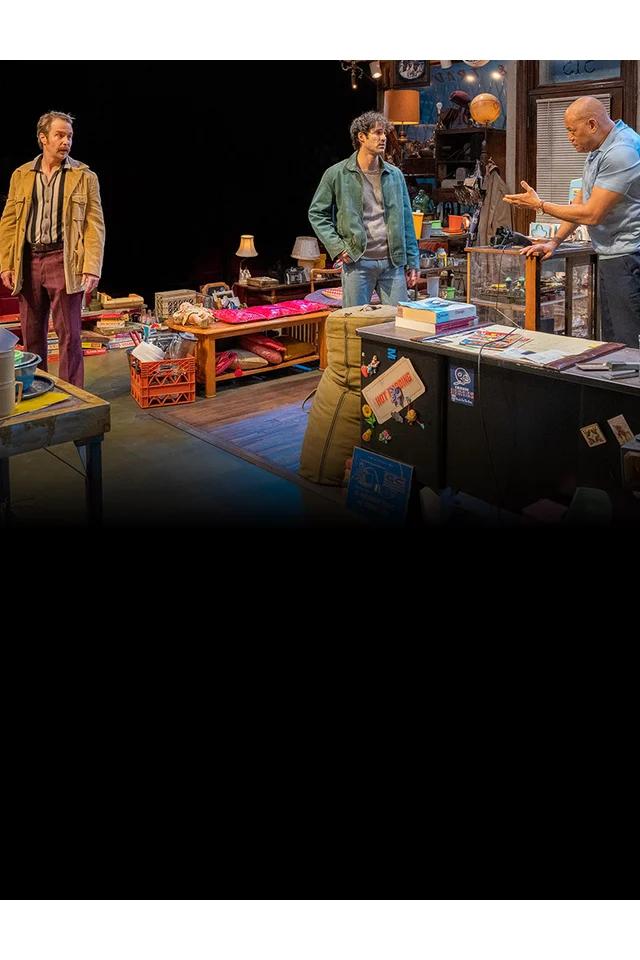
Act I takes place at about 11 a.m. Don, who owns the junk shop where the entire play takes place, has sold a buffalo nickel to a customer for $90 but now suspects it is worth considerably more. He and his young gofer, Bob (sometimes called Bobby), plan to steal the coin back. Bob has been keeping watch on the customer's house and reports that he has left for the weekend with a suitcase. Teach, a poker buddy of Don's, arrives and learns of the scheme. He persuades Don that Bob is too inexperienced and untrustworthy for the burglary, and proposes himself as Bob's replacement. Teach suggests they steal the whole coin collection and more. Don insists on their poker buddy Fletcher going with Teach. Teach continues to argue that he can do the job without Fletcher. Act II takes place a little before midnight on the same day. Teach and Don make final preparations for the burglary while waiting for Fletcher, who is late. Teach tells Don that Fletcher is a liar and a cheater at cards, and prepares to go commit the burglary on his own. Don tries to persuade him not to take his gun with him when Bob appears at the store. He attempts to sell Don a buffalo nickel, similar to the one Don had sold the customer. When asked where he got the coin, Bob is evasive. Teach suspects that Bob and Fletcher have organized and completed their own burglary behind Don and Teach's backs. He asks Bob where Fletcher is. Bob tells him that Fletcher was mugged by "some Mexicans" and is in a hospital, but when Don calls the hospital, they have no record of his admission. Bob claims that he must have been mistaken about the name of the hospital, but the suspicious Teach strikes him on the head with a metal object. Another friend calls, corroborating Bob's story and naming the correct hospital. Don calls the hospital and confirms that Fletcher has been admitted with a broken jaw. Bob confesses that he made up the story about the customer leaving with a suitcase, and that he bought the second nickel from a coin dealer in order to make up with Don for his failure to keep tabs on the customer. Don admonishes Teach for wounding Bob and orders him to get his car so they can take him to the hospital.
A woman goes to great lengths to defend stealing a piece of federally protected petrified wood.
Showing 385–504 of 8,284 shows
Load more shows