A Masque of Reason
Job and his wife continue questioning God about suffering and divine inscrutability. God appears beneath a palm tree, explains himself to Job, and apologizes to Job's wife for failing to act when she was accused of witchcraft.
8284 shows
Clear filtersJob and his wife continue questioning God about suffering and divine inscrutability. God appears beneath a palm tree, explains himself to Job, and apologizes to Job's wife for failing to act when she was accused of witchcraft.
Usurer Bloodhound plans marriages for himself and his children, including his daughter Moll to an elderly suitor, while she loves the young soldier Ancient Young. In a night of masks and mistaken identities, fortune-hunters, servants and thieves pursue their own schemes; revelations disrupt the double wedding, Moll and Ancient Young marry, and Bloodhound reconciles with his elder son.
Eccentric dowager Mrs. Basil lives in one room of her Oxford mansion until her grandson and his friends arrive with a new housekeeper who can levitate, prompting Mrs. Basil to question her disbelief in God.
This Kneehigh stage adaptation of Powell and Pressburger’s film changes June from American to British, replaces the film’s Anglo-American courtroom debate with arguments about war, and lets a coin toss determine Peter’s fate, producing different endings across performances.
A Memory of Two Mondays is a one-act play by Arthur Miller. He began writing the play in 1952, while working on The Crucible, and completed it in 1955. Based on Miller's own experiences, the play focuses on a group of desperate workers earning their livings in a Brooklyn automobile parts warehouse during the Great Depression in the 1930s, a time of 25 percent unemployment in the United States. Concentrating more on character than plot, it explores the dreams of a young man yearning for a college education in the midst of people stumbling through the workday in a haze of hopelessness and despondency. Three of the characters in the story have severe problems with alcoholism. Paired with the original one-act version of A View from the Bridge, the first Broadway production, directed by Martin Ritt, opened on September 29, 1955, at the Coronet Theatre, where it ran for 149 performances. The cast included Van Heflin, J. Carrol Naish, Jack Warden, Eileen Heckart, and Richard Davalos, who won the Theatre World Award for his performance. In 1959, Miller adapted the play for an ITV broadcast starring Alan Bates. Miller adapted the play for a 1971 television movie directed by Paul Bogart, A Memory of Two Mondays. After seven previews, a Broadway revival directed by Arvin Brown opened on January 26, 1976, at the Playhouse Theatre where, paired this time with 27 Wagons Full of Cotton by Tennessee Williams, it ran for 67 performances. The cast included Thomas Hulce, John Lithgow, Tony Musante, Joe Grifasi, and Meryl Streep.
The play presents an unusual evening in the life of Horace Parker, a selfish man. Horace refuses to escort Minnie, his ward and fiancee, to a ball because he would prefer to spend his evening at home reading about new discoveries about the planet Mars. Minnie goes to the ball with another escort, leaving Horace home alone. Horace falls asleep and dreams that he is visited by a man, a messenger from Mars. The Messenger sets out to cure Horace of his selfishness. After a series of visions, the Messenger reduces Horace to a beggar in rags. Having realized the error of his ways, Horace awakens a changed man.
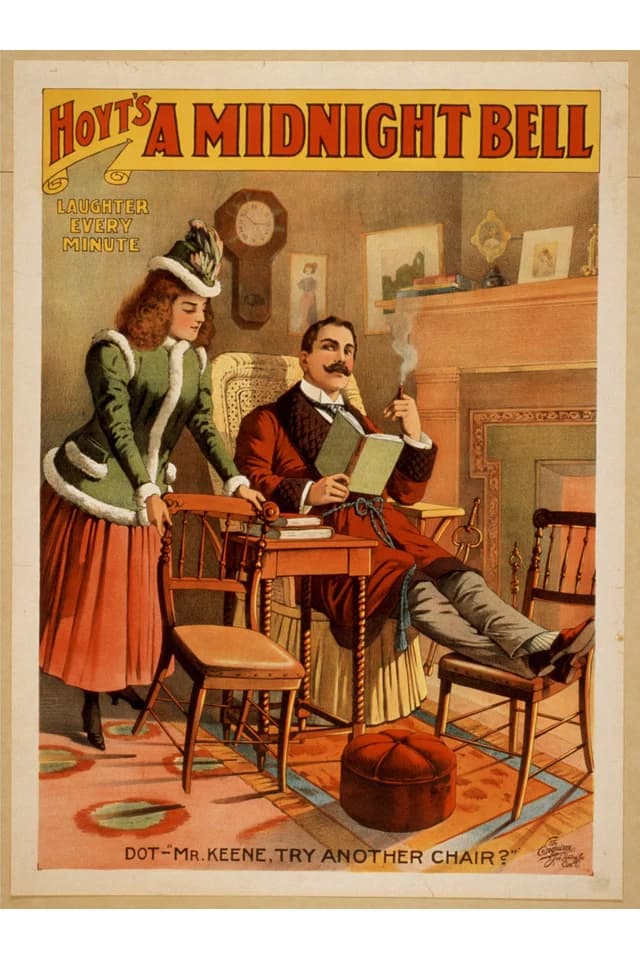
A Midnight Bell is a play written by Charles H. Hoyt. It was featured on Broadway in 1889 and starred Maude Adams. The play was adapted into an American silent film of the same name in 1921. The show ran from March 5 (delayed by one day for final rehearsal) through July 1, 1889.
An immersive, multisensory journey through a macabre dreamworld inspired by Edgar Allan Poe, where audiences explore theatrical rooms and encounter characters drawn from Poe’s stories and poems.
In Athens, four young lovers and a group of amateur actors enter a forest inhabited by fairies. Oberon and Puck use a love potion that misdirects the lovers' affections and causes Titania to fall for the transformed Bottom; the confusion is resolved before the lovers' wedding, where the actors perform Pyramus and Thisbe.
Teenage single mother Amy Aston struggles to bond with her unwanted baby daughter while working at a chicken factory and relying on her grandmother for care. A relationship with a violent, traumatized soldier threatens the baby's safety; the child survives, supplying the play's title miracle.
Thirteen-year-old Conor, whose mother is gravely ill, is isolated by his grandmother’s interference and the avoidance of his schoolmates. At seven minutes past midnight a monster appears, tells him stories, and insists that Conor must tell his own and face his deepest fears.
At a country estate, bored Natalya falls in love with her son's young tutor, Aleksei, while her ward Vera also loves him. Natalya tries to remove Vera as a rival by arranging her marriage to a wealthy neighbor, but the household's entangled affections and misunderstandings drive Aleksei and family friend Rakitin away, returning Natalya to boredom.
Set in a dilapidated Connecticut house in early September 1923, the play focuses on three characters: Josie, a domineering Irish woman with a quick tongue and a ruined reputation, her conniving father, tenant farmer and bullying widower Phil Hogan, and James Tyrone, Jr., Hogan's landlord and drinking companion, a cynical alcoholic haunted by the death of his mother. The play begins with Mike, the last of Hogan's three sons, leaving the farm. As a joke during one of their drunken bouts, Tyrone threatens to sell his land to his hated neighbor, T. Steadman Harder, and evict Hogan. Hogan creates a scheme in which Josie will get Tyrone drunk, seduce him, and blackmail him. Josie and Tyrone court in the moonlight. The scheme falls through when Josie finds out that Tyrone isn't going to sell the land to Harder after all. Tyrone tells Josie the story of how, after his mother died, he traveled back East on the train, and hired a blonde prostitute for $50 a night to overcome his grief. The four-act play ends with James Tyrone leaving for New York to handle his mother's estate, apparently to die soon of complications from alcoholism.
Seven independent vignettes follow characters undergoing transformations associated with possession, madness, and violence. Each scene is punctuated by part of the tragedy of Pentheus, while Dionysos watches unseen; the ensemble returns at the end to describe what followed.
Several centuries in the future, people live on pontoons above a flooded Earth under a tyrannical caste system that bans pleasure and culture. Divers salvage remnants of the twentieth century and debate how people once lived.
The show begins with an image of the Columbia Pictures Lady drenched in a bright light. This first scene takes place in the Now, Voyager set as well as the hospital lobby. It is summer in New York, 1955. The Columbia Pictures Lady sets the scene and talks about suicidal thoughts, loneliness, and marital troubles (all recurring throughout). The scene fades to Clara, an African-American woman in a maternity dress. She longs to be a successful writer as well as find someone she can "...co-exist in a true union" with. The Scene switches to Bette Davis and Paul Henreid on the deck of a liner from Now, Voyager. Bette takes on the thoughts of Clara and expresses her concerns about dying from blood loss in childbirth, as her mother had. She was supposed to be an angel to the family, but she did not bring her family peace. Clara's Mother comes into the picture and explains the difference of living between the blacks and whites in their town. Whites had sidewalks with paved roads, nice bathrooms and water fountains. Blacks had dirt roads, they weren't allowed to sit in restaurants and they had to sit on a separate train. Bette dreams of talking to Jesus; she writes about God often. Clara's father left the family to be with a girl who talks to willow trees. She talks about her forced relationship with her ex-husband, Eddie. The pregnant Clara enters and talks to Eddie about jealousy. She wants to do something with her life like he does. She reads her own story about dragging the dead body of her father through the grass, her is her "blood father". She talks about how her father had attempted suicide. She yearns to fly free like the Owl to be in the Kingdom of God. Dead. In scene two, the lights come up on Clara's entrance into her brother's hospital room and Viva Zapata!. Wally, Clara's brother is in a coma. Jean Peters takes on the story of Clara. Clara's mother enters upset about how her children are unhappy. Clara expresses that she is very happy because she is going to have one of her plays produced. Clara's mother doesn't understand how Clara could be happy without a family of her own. She asks Clara to get back together with Eddie now that she is pregnant. Jean Peters has extreme depression about her divorce from Eddie. She has to borrow money from Eddie because she doesn't make enough money independently, which drives her crazy. Wally is most likely not going to survive. Clara recites a poem about calling to God, but The Owl Answers. Clara's Mother and Father fight about their divorce. Jean Peters recites more from her play, wishing that she could fly away like the Owl to God. In the final scene, it is a flashback where Shelley Winters and Montgomery Clift are rowing in a small boat from the set of A Place in the Sun. Clara is in bed. She is bleeding and writing poems. Kennedy then notes that Clift continues to grow; she says that all three male movie stars are to be mute. Clara is sharing her aspirations of being an African American writer from a very young age. People told her it was unrealistic. Eddie calls her passion for writing an "obsession to write". Eddie says that she has become shy and secretive. Eddie feels like Clara is a spectator of her own life and that her diaries consume her. Eddie doesn't seem the same since he came back from the war in Korea. Jean Peters reads a segment of writing that talks about a bad fight between her mother and father. She again speaks of being an Owl in a fig tree and reaching the Kingdom of God. Jean Peters tells the story of Wally who dropped out of school to be in the army. He committed a crime and was let go from the army and is working in a hospital. He tried to go back to school but dropped out again. He married a girl right before he went to Germany. She graduated cum laude while he was a prisoner in stockade. It is back to current times and Clara cries about her brother being close to death. Her brother will live brain dead and paralyzed. The show closes with a "Brief dazzling image of the Columbia Pictures Lady."
Confined to a wheelchair, businessman Olegário becomes obsessed with controlling his young wife Lídia’s thoughts and fidelity, spying on her through the household staff. His jealous tests turn the home into a claustrophobic world of suspicion; Lídia ultimately flees with the chauffeur, and Olegário faces the collapse of his certainty.
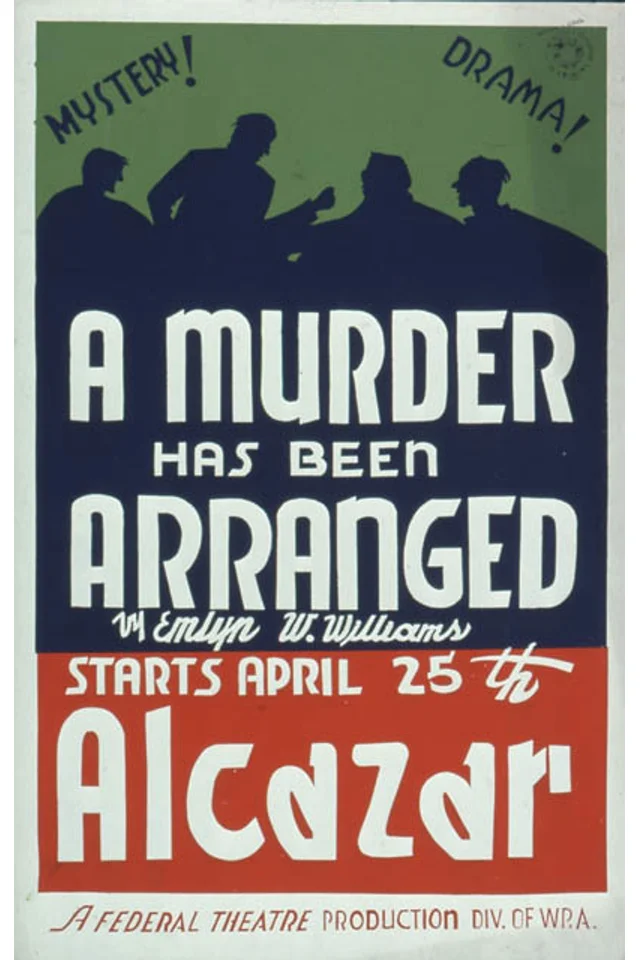
A Murder Has Been Arranged is a 1930 thriller play by the British writer Emlyn Williams. It ran for 77 performances at the St James's Theatre in London's West End between 26 November 1930 and 31 January 1931. The cast included Henry Kendall, Margaretta Scott and Amy Veness. It then went on an extended national tour with Donald Wolfit in the cast. In 1932 it was staged on Broadway and at the Pasadena Playhouse. The Broadway production featured Joseph Cotten in one of his earliest roles.
Cookbook author Bess Lapin and her retired husband Jeffrey gather with their three adopted children after two return from Europe and announce plans to marry; neighbors also intrude on the reunion.
After a funeral, professor Brian and his wife Eileen plan to abandon their daughter Emily, who has cerebral palsy, and run away with Brian's lover Nic, a mother caring for a son with the same condition; their overnight plan unravels as Nic's caregiver and the consequences of their choices force the women to confront what will happen to the children.
After Anne rejects her lover Slightall for the aristocratic Lord Skales, he falls into spendthrift behavior and debt. Her father stages an infernal masque and disguises himself as the Devil, offering financial rescue in exchange for Slightall’s soul; the supposed diabolical marriage instead reunites the lovers. In a comic subplot, a friar exposes an innkeeper’s wife and her constable lover through a staged conjuring trick.
Frank Welborn, ruined by Sir Giles Over-reach’s financial schemes, seeks to recover his standing while Over-reach plots to marry his daughter Margaret to Lord Lovell. Margaret and Tom Allworth outwit him, and Welborn regains his lands; Over-reach’s schemes collapse and he loses his sanity.
Stephen Foster, imprisoned for debt, is freed by his nephew Robert, then returns to gambling and marries a wealthy widow who hopes to find some trouble in her fortunate life. When a storm destroys the merchants’ ships, Stephen helps reform his brother and reconcile the family. In a subplot, Alderman Bruin’s daughter Jane prefers Robert to two foolish suitors, and the play ends with family reconciliation and a charitable foundation.
This biographical play follows Thomas Paine in two halves: his involvement in the American Revolution, then the French Revolution, ending with his funeral. Benjamin Franklin appears both as a historical figure and as narrator.
Pavel Mishemorov, a middle-class man who despises tabloid journalism, is dismayed when he learns his daughter Bozhana loves a journalist. She and her mother try to keep the relationship secret until it comes to light.
Cora Mellish loses a valuable necklace to gambling-club operator Edgar Pryor, who is holding it against her debts. Her ineffectual boyfriend Aubrey is aided by Clifford Tope and police constable Michael Marsden; the trio confront Pryor's gang, recover the necklace, and expose the mystery around its ownership.
Albert Stokes, a lonely office worker constrained by his overbearing mother, heads to a company party where he is falsely accused of groping a colleague. After returning home and threatening his mother, he wanders to a Soho bar and then a woman’s flat, where he acts violently and contemptuously. Back home, his mother tries to reassure herself that he is a good boy.
Kenneth Norman McCallister, a Protestant dole clerk in Belfast, has long discriminated against Catholics. After witnessing hatred directed at Irish supporters during a 1994 football qualifier, he questions his identity and travels to New York to support Ireland at the World Cup, embracing an Irish Protestant identity.
Salter confronts the consequences of having had a son cloned, as the young men he raised and their genetic counterparts struggle with identity, kinship, and the truth about their origins.
Two quarrelling partners in a digestive-pill company wager that the loser of a poker hand will serve the winner as butler for a year. A pair of sixes gives George B. Nettleton the advantage, leaving T. Boggs Johns to serve him.
A Parisian Romance (Un Roman Parisien) is a play written in French by Octave Feuillet and adapted in English by Augustus R. Cazauran. Producer A. M. Palmer staged it at the Union Square Theatre on Broadway, where it debuted on January 11, 1883, with Richard Mansfield starring as Baron Chevrial. Mansfield later purchased the rights to the play and made it part of the repertory of his touring company. The production used sets designed by Richard Marston. In 1932 Allied Pictures produced a film adaptation, also titled A Parisian Romance, directed by Chester M. Franklin. It starred Lew Cody and Marion Shilling.
The play begins with two English women, Mrs. Moore and Adela Quested. They travel to 1920s India, where Mrs. Moore's son, Ronny, is working. Ronny is supposed to be engaged to Adela. The women hope to experience India while they are there. Adela and Ronny are unsure if they are meant to be together. While on a hike led by Dr. Aziz, Adela is attacked in the Marabar Caves. She assumes it was Dr. Aziz, but later while testifying in court, which becomes a media sensation, she realizes Dr. Aziz is not the person who attacked her. Dr. Aziz brings up the racial tensions he feels between the English and the Indians.
Based on Alfred Redl's life, the play depicts a homosexual officer in Austro-Hungarian intelligence who is blackmailed by Russia into treasonous betrayals, against a backdrop of a declining empire.
In 1804 with Britain facing with an imminent French invasion, a Dorset country gentleman hatches a plan to thwart the enemy by impersonating Napoleon.
During a weekend at a country house before Amy and Isaac’s wedding, their longtime friend Emma and younger neighbor Josh join them; conversations expose tensions in the group’s relationships and expectations for adulthood.
New York power couple John and Natalie are hosting a dinner for Elliot, a friend from their college days, along with Mark, a strait-laced young man. After drinking too many expensive bottles of wine, the group's past and their long-buried secrets resurface. Over the course of this raucous evening, their basic belief systems are upended, as the four come to terms with what happens when they try to reconcile idealism with reality. This high-society evening turns into a night of sexually charged mind games that could change their lives forever.
Two middle-aged friends travel to India after each has lost a son. As they journey toward the Taj Mahal, the god Ganesha appears through people they meet and helps them confront grief, guilt, illness, and their friendship.
At the tomb of her husband, the grieving Dynamene plans to fast until she can join him in the underworld. A soldier on guard enters the tomb, and, with encouragement from her maid Doto, Dynamene chooses life with him; when the soldier faces disgrace for leaving his post, she persuades him to substitute her husband's body for one of the condemned men.
In occupied Paris in 1941, Pablo Picasso is taken from a café to a storage vault and questioned by Berlin cultural attaché Miss Fischer. She must authenticate three paintings seized from Jewish owners for a planned Nazi exhibition to burn so-called degenerate art; Picasso negotiates to save his work as they debate art, politics, sex and truth.
A motionless white-haired man, called Speaker, recounts fragments of a life through memories of birth, parents, photographs, funerals, and nightly rituals of lighting a lamp. The monologue moves toward the recognition that death is the sole matter connecting the recollections.
In an imagined Soviet village, deserter Pavel has hidden in a pigsty for years with his wife, Praskovya. He plans to confess and seek forgiveness, but fear, memories of domestic life and his wife’s resistance keep him trapped. Their struggle ends with Pavel freeing the pigs and leaving the sty to report his desertion.
A political satire stages a gathering of dictatorial African leaders at their New York embassy, where their attempts at cooperation expose vanity, insecurity and the absurdity of authoritarian power.
A Plot and No Plot is a 1697 comedy play by the English writer John Dennis. The original Drury Lane cast included Thomas Doggett as Bull senior, Colley Cibber as Bull junior, William Pinkethman as Baldernoe, Joseph Haines as Rumour, William Bullock as Frowzy, Jane Rogers as Sylvia and Mary Kent as Friskit.
In prewar Manila, sisters Candida and Paula try to keep their family home as their aging painter father refuses to sell or exhibit his self-portrait. Financial pressure brings a boarder into the house; Paula’s elopement and the painting’s growing notoriety force the family to confront competing ideas of Filipino identity and cultural change.
The play is set in the interrogation room of a downtown New York City police station in the early hours of July 5. Two hardened cops (Sergeant Kelly and Jack Delasante) have arrested two suspects for the murder of an old woman. During the interrogations, the police try to get confessions from the two suspects, Sean and Jimmy. As they do, they reveal far more about their own vulnerabilities than they intend. The tension of the play is increased by constant updates, by phone, of the state of mind of one of Kelly's daughters. Lonely and unstable, she becomes increasingly suicidal during the play. Jimmy (Alan Rosenberg) Sgt Kelly (George Dzundza) Jack Delasante (Jeffrey DeMunn) Sean (Laurence Luckinbill)
A Present from Margate is a 1933 British comedy play by Ian Hay and A.E.W. Mason. It premiered at the Palace Theatre in Manchester, before transferring to the Shaftesbury Theatre in London's West End. The cast included Reginald Gardiner, Joyce Bland, Michael Shepley and Frank Pettingell. It was produced by Athole Stewart.
A Prior Claim is an 1805 comedy play by the English writer and poet laureate Henry James Pye and Samuel James Arnold. It premiered at the Theatre Royal, Drury Lane on 29 October 1805. The original cast included William Dowton as Sir William Freeman, Vincent De Camp as Young Freeman, Robert William Elliston as Henry Mortimer, William Barrymore as Colonel Raymond, Robert Palmer as Lounger, John Henry Johnstone as Patrick O'Shatter, Maria Rebecca Davison as Maria, Harriet Siddons as Emily and Maria Theresa Kemble as Fanny. It was Pye's third play to be staged and marked a break from his two previous works, the historical tragediesThe Siege of Meaux (1794) and Adelaide (1800).
The household gods welcome James and Anne at the gate; the royal guests pass through the house and garden to songs by Aurora, Zephyrus and Flora and an appearance by May. After dinner, Mercury and Pan converse in the garden, where Pan serves wine from a fountain.
Ostrovsky's social drama probes bribery and corruption as a system embedded in everyday life, rather than as isolated wrongdoing. Officials and citizens justify their behavior within that system, putting honesty and moral responsibility under pressure.
A theatre-in-education work prompted by the murder of Leigh Leigh, focused on the victim’s peer group and conflicting responses to the crime; the murder itself is omitted.
This social drama, subtitled Pictures of Rural Life, centers on Nadya and depicts abuses of power and the immorality of Russian landowners. Its restrained portrayal of the heroine drew praise from literary critics, while censors barred the work from the Imperial Theatres for its depiction of the gentry.
Darya Ivanovna, the wife of a poor provincial official, wants to escape her provincial town for life in the capital. She schemes to draw Count Lubin, newly arrived from St Petersburg, into a love affair so he will help advance her husband's career and secure the family's move; the count accepts her promises.
Jonathan Wilson revisits the people and places of his queer youth in Toronto. Personal memories and shifting characters trace the Village’s past and its legacy for a new generation.
In the form of a screenplay written and performed by Walt Disney about himself, the play depicts his last days and his plan to build EPCOT as a city that will change the world.
In a contemporary queer retelling, Ebenezer “Ben” Scrooge is a successful but stingy interior designer who denies health benefits to his assistant Bob Cratchit and Bob's HIV-positive partner Tim. The ghost of Scrooge's former lover and business partner Jake Marley warns him; Christmas spirits reveal his past, his lover's AIDS-related death, and Tim's and Scrooge's possible futures, prompting him to change.
In this imagined inquiry into Anthony Blunt's divided life as an art expert and Soviet agent, Blunt supervises a restoration, discovers a concealed figure beneath paint, and faces questions of art, secrecy and loyalty.
A Question of Fact is a 1953 play by the British writer Wynyard Browne. A schoolteacher questions his beliefs and his career when he discovers that his father was hanged for murder. It was first staged at the New Theatre, Oxford before transferring to the Piccadilly Theatre in London's West End where it ran for 242 performances between 10 December 1953 and 10 July 1954. The original cast included Pamela Brown, Paul Scofield, Gladys Cooper, Henry Hewitt, Maureen Delany and Edith Sharpe.
A slightly perplexed tour guide introduces visitors to Mount Rushmore.
Three gay men living with HIV share a Manhattan apartment as illness, homophobia, faith and strained relationships shape their final months. After Tony dies, Billy returns to his family and Max accepts the support of his former partner Jason.
The Younger family in Chicago hopes to improve its circumstances with a life-insurance payment. Walter plans to invest in a liquor store, while his mother uses part of the money to buy a home in a white neighborhood; after the remaining funds are stolen, the family faces a buyout offer intended to keep them from moving in.
In a nonchronological, magical-realist dialogue, Black siblings Kay and Blake—figured as Sister Rat and Brother Rat—recount their circumstances in a house they call a cathedral and their longing for Rosemary, a white child. Their dreamlike, violent world uses racial and religious imagery to explore identity and power.
This early Brecht play critiques bourgeois society through a wedding and the people gathered around it.
Patrick Garland's stage adaptation presents Virginia Woolf's argument that women need financial independence and private space to write fiction. Woolf frames the discussion through a speaker's reflections on women's exclusion from education and literary history, including the imagined life of Shakespeare's sister Judith.
Jane Prowse’s stage adaptation presents selected real-life encounters from Jane Juska’s late-life adventures in sex and romance, following Juska’s newspaper advertisement seeking a man with whom to have sex and the replies it elicited.
A Safety Match is a 1921 play by the British writer Ian Hay, adapted from his own 1911 novel of the same title. It ran for 229 performances at the Strand Theatre in London's West End between 13 January and 3 August 1921. The cast included Herbert Marshall and Clifford Mollison.
John McGrath's contemporary morality adaptation of Lindsay's political satire confronts abuses in Scotland's clergy, lords, and burgh representatives through a demand for reform.
Young King Humanity is led away from moral rule by Sensuality and corrupt counsellors, while figures representing the clergy, lords, and burghs evade accountability. In the second part, the Poor Man and John Commonweal demand reform; Divine Correction frees the virtuous and advises the king to call Parliament.
A School for Greybeards is a comedy play by the British writer Hannah Cowley that premiered on November 25, 1786. The original cast included Thomas King as Don Alexis, John Philip Kemble as Don Henry, William Parsons as Don Gasper, John Bannister as Don Sebastian, John Palmer as Don Octavio, Mary Ann Wrighten as Rachel, Ann Maria Crouch as Donna Maria, Sarah Maria Wilson as Carlota, Margaret Cuyler as Donna Clara and Elizabeth Farren as Donna Seraphina.
Sir Arthur and Lady Stanmore have been married for five weeks and are very happy. However, her friend Miss Raven persuades her to behave in a capricious manner to her husband leading to a falling out. A similar story follows Sir Arthur's acquaintance, the wealthy Revel and his spendthrift son who he decides to teach a less by pretending he has lost his fortune.
A drama about the personal relationship between the poets Arthur Rimbaud and Paul Verlaine.
Martin Lynch-Gibbon's marriage and affair unravel when his wife Antonia reveals she is leaving him for her psychoanalyst, Palmer Anderson. As Martin's relationships with Georgie and Palmer's half-sister Honor entangle the families, hidden affairs and shifting attachments lead to an unexpected final pairing.
In 1946 New York, two sisters reunite after the older survived Nazi camps while the younger emigrated with their father before the war. The elder sister's memories of family and wartime separation confront the younger's Americanized life and the father's guilt as they try to rebuild their family bond.
In Roman Britain, princes Elred and Offa flee after their father’s defeat and disguise themselves as shoemakers. Offa, as Crispin, secretly marries Princess Leodice; Elred, as Crispianus, becomes a Roman military hero, while the Christian officer Albon and hermit Amphiabel are martyred. The subplot follows Winifred’s religious vocation and martyrdom, which inspires shoemakers’ honorific 'the gentle craft.'
Josefa, a maid found unconscious beside her Spanish lover's body and the gun that killed him, repeatedly changes her account while an inexperienced examining magistrate investigates. He discovers that she is trying to protect her other lover, her wealthy employer, and pursues the mystery despite pressure to obtain a quick confession.
A duet performance work based on the life of Jeannette Rankin, the first woman elected to the United States Congress.
Four English soldiers trapped overnight in a bombed cathedral quarrel, then sleep and experience dreams shaped by their attitudes to life and death. The dreams take on an Old Testament character.
Hereditary evil runs through three generations of a medical family, in the 'conflict of social morality and natural desires' - the dissolute and murderous Camerons (from 1867 to 1935) - before a son and daughter finally redeem the family name.
A married couple's dreams and desires center on Edward's fears of the unknown, aging, and the matchseller as a threat to his identity.
Jack McCracken takes charge of his family’s furniture business hoping to establish honest practices. He discovers that the relatives around him have much to gain from keeping its dishonest dealings intact.
Mrs Ferguson issues an invitation to a local Canadian Army base for one of the soldiers to spend Christmas with them. When he arrives he finds the house overwhelmed with the emotional issues of both of the Ferguson's daughters, plus a WAAF girl who has been billeted on them. The arrival of the easygoing Canadian leads to further turmoil in the Ferguson household.
In 1944 at the United States Army's Fort Neal in Louisiana, a light-skinned black man Sergeant Vernon Waters is murdered by an unseen shooter. Just before his death, Waters utters the enigmatic cry, "They still hate you!" Captain Richard Davenport is a black Army officer; a rarity. He arrives to investigate the killing. Initially, the primary suspects are local Ku Klux Klansmen. Later, bigoted white soldiers fall under suspicion. Ultimately, Davenport discovers the killer was one of the black soldiers under Waters' command. Waters' men hated him because Waters himself treated Southern black men with disdain and contempt. As Davenport interviews witnesses and suspects, flashbacks show what Sergeant Waters was like, and how he treated his men. The light-skinned Waters was highly intelligent and extremely ambitious. He loathed black men who conformed to old-fashioned racist stereotypes. Waters dreamed of sending his own children to an elite college where they would associate with white students, rather than with other blacks. In Waters' mind, Uncle Toms and "lazy, shiftless Negroes" reflected poorly on him, and made it harder for other African-Americans to succeed. For that reason, Waters persecuted black soldiers like Private C.J. Memphis, whose broad grin and jive talk infuriated Waters. Waters' cruelty and vindictiveness drove Memphis to suicide, which alienated the rest of Waters' men and turned them against him. Shortly before he was murdered, Waters came to realize how futile and foolish his lifelong attempts to behave like a white man had been. His dying words, "They still hate you," reflected his belated understanding that white hatred and disdain of black men like himself had nothing to do with stereotypical black behavior, and that whites would probably always hate him, no matter how hard he tried to emulate "white" ways.
An elderly writer's former mistress confronts him with letters revealing the truth about his past relationships, including his love for a deceased man. His wife helps negotiate the return of the letters as the former lovers revisit their history.
A Song of Sixpence is a 1930 British comedy play by the writers Ian Hay and Guy Bolton. Set in Scotland, it tells the story of three wives who rebel against their tight-fisted husbands. The play premiered at the Kings Theatre, Southsea, before transferring to the West End. It ran for 79 performances at Daly's Theatre between 17 March and 25 May 1930. The cast included Ian Hunter, Olive Blakeney, Jack Lambert and Campbell Gullan.
Chiappino offers to take the blame after his friend Luitolfo strikes the ruler of Faenza. When the townspeople acclaim him as their liberator instead of condemning him, he accepts the credit. The prospect of power tests his professed principles as the papal legate Ogniben draws out his self-deception.
On an outback property, the Dennison family faces illness, separation and thwarted plans. Margaret, who is dying of brain cancer, falls in love with the family’s boarder, poet Peter; Helen leaves for Sydney, while Kerry’s love for grazier’s son Geoff is constrained by her responsibilities at home.
At the remote island home of their adopted father, Myles Fletcher and Randal Devlin Scout are joined by their caretaker, Fletcher’s former lover and other houseguests. The reunion grows tense as a fashion designer exposes their secrets, until their father’s corpse appears from behind the curtains; the whodunnit uses a Faust-inspired killer, adoption secrets and a cast linked to the seven deadly sins.
Chicago police officers Joey and Denny are longtime partners and best friends. Joey is single and lonely, and Denny is married with children, but both men have flaws and serious problems. Denny cares deeply for his family, and that provides the justification for his criminal actions. Introverted Joey struggles with a drinking problem and secretly loves Denny's wife, Connie; angry tough-guy Denny can barely disguise his racism and cheats on Connie with a prostitute on his beat. The two men offer contrasting descriptions to Internal Affairs interrogators of their harrowing experiences. They relate how Walter Lorenz, a pimp that Denny has harassed over the years, shoots a bullet through Denny's front window, causing the flying glass to sever an artery in Denny's son's neck. Denny pursues Lorenz relentlessly, drawing Joey into a series of dangerous and incriminating activities. During a domestic disturbance call, the two return a frightened Vietnamese boy to a man who says he is the boy's uncle. The uncle turns out to be a cannibalistic serial killer, who eats the boy.
In a Bucharest neighborhood, Guard captain Dumitrache mistakes law clerk Rică Venturiano for a man pursuing his wife Veta, unaware that Venturiano has entered the wrong house while courting her sister Zița. As the household chases him through the night, the secret affair between Veta and Dumitrache’s assistant Chiriac is exposed to the audience, while Dumitrache remains largely oblivious.
Lermontov’s romantic drama follows poet Vladimir Arbenin, a protagonist partly modeled on the author. The play uses Arbenin’s story to examine the intellectual burdens and social concerns of a new generation in Russian society.
In this monodrama, the reclusive, misanthropic Monk O’Neill reflects on his past and tries to remake himself through solitude, memory and creative imagination.
Morgan Cervieng grows toward adulthood amid family life, grief, and the transformation of 1950s Luleå. As familiar neighborhoods disappear under industrial change, the family chronicle asks what people can preserve of a childhood, a city, or even a beloved dog.
On a quiet Sunday morning, Sue Jones prepares breakfast for her grandsons as they get ready for church. After a white woman is attacked, police arrest Sue's grandson Tom on her uncertain identification; before help arrives, a mob lynches him.
A Tailor-Made Man is a 1917 American play by Harry James Smith, which ran for 398 performances at the Cohan and Harris Theatre. It debuted on August 27, 1917, and played through August 1918. The play was adapted from the 1908 Hungarian play A Szerencse Fia ("Son of Luck") by Gábor Drégely. The Playbill and press referred to Dregely's play as The Well-Fitting Dress Coat, which derives from the play's German title (Der gutsitzende Frack), so presumably Smith worked from that translation. Grant Mitchell starred in the 1917 Broadway production, which was staged by Sam Forrest, and in an October 1929 revival. The play ran for just shy of an entire year at the Cohan and Harris Theatre in New York. The play was Smith's greatest success, but he did not live to see the full run, as he died in a train and automobile accident in March 1918 while working for the Red Cross. Actor Theodore Friebus, who played Dr. Sonntag, died in the wings during a performance on December 26, 1917, while awaiting his second act cue. The thirty-eight year-old actor succumbed to heart disease; an understudy finished that night's performance. The play later led to a 1922 silent film and 1931 film.
Rattigan and Gielgud's dramatization of Dickens is set during the French Revolution in London and Paris, using a flexible ensemble to portray its many roles. Gielgud planned to play Sydney Carton and several other characters.
On St Valentine’s Day, several suitors pursue Audrey Turfe, daughter of a constable. Squire Tub tries to break her engagement to John Clay by falsely accusing him of theft, while Justice Preamble uses a similar ruse against Tub. In the confusion, Pol-Marten marries Audrey, and a wedding masque retells the play’s story.
In the first scene, Helen and her teenage daughter Jo are moving into a shabby flat. Within a few minutes, the audience learns that they have little money, living off Helen's immoral earnings—money given to her by her lovers; she is not a true prostitute, being more of a "good time girl." Helen is a regular drinker, and she and Jo have a confrontational and ambiguously interdependent relationship. As they settle, Helen's surprise at some of Jo's drawings both suggests Jo's talent and originality and shows Helen's lack of interest and knowledge about her daughter. Jo rejects the idea of going to an art school, blaming Helen for having interrupted her training all too often by moving her constantly from one school to another. Jo now only wants to leave school and earn her own money so that she can get away from Helen. After this conversation, Peter (Helen's younger boyfriend) comes in. Jo assumes that Helen has moved here to escape from him, but the audience never is told the reason. Peter had not realised how old Helen was until he sees her daughter. Nonetheless he asks Helen to marry him, first half-jokingly, then more or less in earnest. In the next scene, Jo is walking home in the company of her black boyfriend. During a light-hearted, semi-serious dialogue, he asks her to marry him, and she agrees, but he is in the navy and will be away on his ship for six months before they can marry. He gives Jo a ring that she hangs around her neck under her clothes to hide it from Helen. Jo tells him that she is really leaving school and that she is going to start a part-time job in a pub. At the flat, Helen informs Jo that she is going to marry Peter. Peter enters, and a dialogue ensues among the three. Instead of only Jo and Helen attacking each other, a more complex pattern evolves: Jo attacks the others, the others attack Jo, and Helen attacks both Peter and Jo. Jo is truly upset at the thought of Helen marrying Peter, but pesters and provokes him in an effort to antagonise him. After Helen and Peter leave her on her own for Christmas, Jo weeps, and she is consoled by her boyfriend. She invites him to stay over Christmas, but she has a feeling that she never will see him again. The action moves to the occasion of Helen's wedding, the day after Christmas. Jo has a cold and will not be able to attend at the wedding. Because she is in her pyjamas, Helen catches a glimpse of the ring around her neck and learns the truth. She scolds Jo violently for thinking of marrying so young, one of her occasional bursts of real feeling and concern for her daughter. Asked by Jo about her real father, Helen explains that she had been married to a "Puritan" and that she had to look elsewhere for sexual pleasure. Thus she had her first sexual experience with Jo's father, a "not very bright man," a "bit retarded". She then hurries off to her wedding. Several months later, Jo is living alone in the same shabby flat. She works in a shoe shop by day and in a bar in the evenings to afford the rent. She is pregnant, and her boyfriend has not come back to her. She returns from a funfair to the flat in the company of Geoff, an art student, who has possibly been thrown out from his former lodgings because his landlady suspected he was gay. Jo offends him with insensitive questions about his sexuality, and he in turn maliciously criticises her drawings. She apologises and asks him to stay, sleeping on the couch. Geoff develops genuine concern for Jo's situation, and they develop a friendly, light-hearted relationship. The audience next sees Jo irritable and depressed by her pregnancy, with Geoff patiently consoling her. Then, seeking reassurance, he kisses her and asks her to marry him. Jo says that, although she likes him, she cannot marry him. She makes a sexual pass at him which he fails to recognise, confirming that "it is not marrying love between us". At this point, Helen enters. She has been contacted by Geoff, who wishes to keep this fact secret from Jo. Jo, however, guesses as much, and she is angry with both Helen and Geoff. Geoff tries to interfere in the quarrel between the two women, but each time, he is attacked by one or the other or both. As Helen is offering Jo money, Peter comes in, very drunk, and takes back the money and Helen's offer of a home to Jo. He leaves, insisting that Helen come with him; after a moment's hesitation, she runs after him. In the next scene, the baby is due at any moment. Jo and Geoff seem happy. He reassures her that Helen was probably mistaken about or exaggerating the mental deficiencies of Jo's father. Geoff has bought a doll for Jo to practise handling the baby, but Jo flings it to the ground because it is the wrong colour: Jo assumes that her baby will be as black as its father. Her momentary outburst against the baby, motherhood and womanhood is short-lived, and she and Geoff are about to have tea when Helen enters with all her luggage. Apparently, she has been thrown out by Peter and now plans to move in with her daughter. To get rid of Geoff, she behaves rudely to him while overwhelming Jo with advice and presents. Jo defends Geoff, but while she is asleep, Geoff decides to leave because Helen is determined and he does not want Jo to be pulled between them. Jo wakes, and Helen pretends that Geoff is out doing the shopping. When her mother learns that the baby will be black, she loses her nerve and rushes out for a drink, even though Jo's labour pains have begun. Alone, Jo comforts herself by humming a tune Geoff used to sing, still not realising that he has in fact gone.
Nat Weiss (played by Mason himself in the Broadway production) is a Jewish widower who learns that his son is in love with a black woman. Eventually Nat himself falls in love with the woman's mother. The play's title is not explained in the play itself.
Romeo and Juliet are imagined as an elderly couple facing illness, memory, and the prospect of separation. Rearranged passages from Shakespeare create a new account of enduring love and the demands of caring for another person.
A satirical comedy caricatures American politics through the story of Maverick Brander, a Texan thrust into politics, and his wife Bossy's ascent into society.
A cycle of three plays set in a mythical West Texas town, using distinctive language and characters to depict small-town Texas life.
A Thousand Clowns is a comedic stage play written by American playwright Herb Gardner. The play premiered on Broadway in 1962 and was a critical and commercial success. The play was nominated for the Tony Award for Best Play and since the original production has been revived twice on Broadway in 1996 and 2001.
As an apocalypse approaches in a fortnight, a mother gathers her five sons at their family farm near Middlesbrough. With the universe beginning to crumble, family secrets emerge and a lost love may be renewed as they prepare to face the unknown.
A comedy revue of James Thurber sketches, fables and satires, including “The Night the Bed Fell,” “The Secret Life of Walter Mitty” and “File and Forget,” which recounts his unwanted-book correspondence.
In 1804, women organize a play to entertain George III and the troops amid the threatened Napoleonic invasion. Against local class divisions and smuggling, a well-born young woman falls passionately in love with the youngest son of a notorious smuggling family.
Using Brechtian epic-theatre techniques, Jack Hibberd's popular play presents the life of opera singer Nellie Melba from her childhood in Melbourne to her death in Egypt. The role calls for an actor who can sing arias and parlour songs, alongside essential recorded music.
In 1828 Massachusetts, ageing tavern owner Major Cornelius Melody is a braggart and social climber, struggling against the American class system and the loss of his self-image.
A Touch of the Sun is a 1958 play by the British writer N.C. Hunter It premiered at the Grand Theatre in Blackpool before moving to the West End, initially at the Saville Theatre before transferring to the Princes Theatre. Its original run lasted for 202 performances between 31 January and 26 July 1958. The cast included Michael Redgrave, Diana Wynyard, Vanessa Redgrave and Ronald Squire Michael Redgrave won the Best Actor award at the Evening Standard Theatre Awards.
Ivan Tolkachov asks his friend Murashkin for a revolver and vents about the burdens in his life. When Murashkin also asks him to deliver a sewing machine and canary, Tolkachov snaps and chases him around the room, demanding blood.
Indebted gentleman Witgood disguises his former mistress as a wealthy widow to trick his usurer uncle into restoring his estates. The rival usurer Hoard steals the supposed widow, unaware she is penniless; she persuades Lucre to return Witgood’s property, while Witgood uses a feigned precontract to make Hoard pay his debts and marries Joyce. At the wedding, Hoard discovers the deception, but the parties reconcile.
Two poor middle-aged aristocrats, Lady Filmot and Lord Stewkly, try to arrange marriages between their younger children, Lucy Tryfort and Edward Bull, for the younger characters’ money.
Jenny Minnikin elopes to France with her father's assistant, Dick Drugget, to avoid an arranged marriage. She hides in a convent while her family pursues her, and Lady Kitty Crocodile proposes that Jenny marry both Dick and her other suitor, Kit Codling; a parallel courtship concerns Lady Kitty's maid and Colonel Crosby.
Penniless Tom Fashion schemes to marry the wealthy Miss Hoyden before his brother Lord Foppington can, enlisting friends and exploiting a mistaken identity to secure a bride and fortune. Parallel romantic deceptions complicate the plan.
A True Widow is a 1678 comedy play by the English writer Thomas Shadwell. It was first staged by the Duke's Company at the Dorset Garden Theatre in London. The names of the original cast are unknown. The prologue was written by Shadwell's colleague John Dryden. It was published the following year and dedicated to Charles Sedley.
In the fictional Texas town of Tuna, residents prepare for the annual Christmas yard-display contest, repeatedly disrupted by a vandal called the Christmas Phantom. Side stories follow Stanley's probation, Bertha's family and Joe Bob's troubled amateur production of A Christmas Carol.
A Tutor for the Beaus: Or Love in a Labyrinth is a 1737 comedy play by the British writer John Hewitt. It drew inspiration from an earlier one-act play Le Français à Londres by the French writer Louis de Boissy. The original cast included James Rosco as Lord Manly, Benjamin Johnson as Sir Charles Freelove, Thomas Wright as Belville, William Giffard as Heatly, Henry Woodward as Young Manly and Anna Marcella Giffard as Pinup.
A short play about the imprecision of DNA technology, presented within a program of plays exploring ancestry, identity, and confusion.
A Very Good Wife is a 1693 comedy play by the English writer George Powell. It was first performed by the United Company at the Theatre Royal, Drury Lane with a cast that included Powell as Courtwitt, John Hodgson as Wellborn, William Bowen as Squeezwit, George Bright as Venture, Joseph Haines as Sneaksby, Colley Cibber as Aminadab, Susanna Mountfort as Annabella, Frances Maria Knight as Widow Lacy, Elinor Leigh as Mrs Sneaksby.
In Palm Beach, a writer modeled on Bob Ellis is left alone while his wife and child are away. He entertains a public-service worker, a poet friend, and a journalist whose child he fathered; the episodic, music-filled play frames their private jokes and relationships against political crises and the end of the Whitlam decade.
In Copenhagen, Hans Christian Andersen’s celebrated children’s stories have a hidden source: a woman kept secret in the attic of his townhouse.
In Spanish-ruled Palermo, two pairs of young lovers face conflict after Almira rejects Prince Antonio, who then wounds her intended suitor Cardenes. Antonio returns disguised as a Turkish slave and becomes a go-between; after a pirate attack, his identity is revealed and the couples’ marriages are resolved, though Cardenes has changed through his recovery from injury and depression.
Showing 169–288 of 8,284 shows
Load more shows