1634 shows

Clear filters

1776

Musical · 1969

NOTE: The show can be performed in one or two acts. On May 8, 1776, the Second Continental Congress, convening in Philadelphia at present-day Independence Hall, proceeds with its business. John Adams, the controversial delegate from Braintree, Massachusetts, is frustrated because Congress will not even debate his proposals on independence. The other delegates, preoccupied with the rising heat, implore him to "Sit Down, John". Adams is frustrated that the Congress does nothing but "Piddle, Twiddle, and Resolve" as he imagines a conversation with his wife Abigail, who remains at the Adams homestead in Massachusetts and communicates by letter. Later, Adams meets delegate Benjamin Franklin, an elderly lecherous scamp, who suggests that Adams should let another, more popular delegate propose a resolution on independence and summons the charismatic Richard Henry Lee of Stratford, Virginia. Lee eagerly agrees to return to Virginia to procure an independence resolution from the Virginia House of Burgesses using his family's reputation and clout ("The Lees of Old Virginia"). Weeks later, new delegate Dr. Lyman Hall of Georgia arrives and is introduced to many important members of Congress, including Andrew McNair, the custodian; Stephen Hopkins of Rhode Island, an acerbic drunk; Edward Rutledge of South Carolina, the mysterious youngest delegate who leads the Congress's Southern caucus; and Caesar Rodney of Delaware, among others. As Congress is assembled, President John Hancock notes that the entire New Jersey delegation has been absent for quite some time. A gloomy dispatch from George Washington, commander of the Continental Army, arrives by courier and is read aloud by Secretary Charles Thomson. Shortly thereafter, Richard Henry Lee returns, bearing a resolution for independence. Elated, Adams seconds the motion to open debate on the resolution. John Dickinson of Pennsylvania, a conservative and royal apologist, immediately moves to table the debate. The vote is close, but debate is ultimately approved, prompting Dickinson to denounce the desire for independence as an overreaction to petty squabbles with Great Britain. The debate becomes more heated and personal, sparking a physical fight between Dickinson and Adams and causing Caesar Rodney to intervene; Rodney collapses from cancer. Pro-independence Scotsman Thomas McKean escorts Rodney back to Delaware, leaving conservative George Read in control of Delaware's delegation. Read quickly seconds Rutledge's motion to end the debate and vote on independence, knowing it is likely to fail. At this moment, the Reverend John Witherspoon arrives, announcing that New Jersey's legislature has deposed its royal governor, Franklin's estranged loyalist son, and has sent Witherspoon as the new delegate with explicit instruction to vote for independence. Adams, now seeing a path to victory, pushes to proceed with the vote, since ties are broken by Hancock, an Adams ally who is also from Massachusetts. Dickinson moves to require the vote for independence to be unanimous. The vote ends in a tie, but Hancock unexpectedly votes in favor of unanimity, explaining that if the colonies are divided, the crown will pit the colonies against each other. Knowing that Dickinson will quash the resolution if the vote proceeds immediately, Adams moves to postpone the vote to buy time to rally the needed support; he proposes that Congress draft a Declaration of Independence to build support abroad for the cause. Again, the vote ties; this time, Hancock votes to postpone. Before they adjourn, John Hancock appoints a committee of Adams, Franklin, Roger Sherman of Connecticut, Robert Livingston of New York, and Lee to draft the declaration. Lee informs the Congress that he has been appointed Governor of Virginia and departs, never to be seen again; Adams nominates another Virginian, the resident meteorologist Thomas Jefferson, who wants no part of the task as he is returning home to see his wife after six months. Jefferson is forced to accept the task after the other four explain why they cannot or should not ("But, Mr. Adams"). Adams sends for Jefferson's beloved wife Martha, reasoning that if Thomas cannot return to her, she can be summoned to him and potentially break his writer's block. When she arrives, she refuses to speak to Adams or Franklin and spends the night with her husband. Adams, alone, again exchanges letters with his wife Abigail ("Yours, Yours, Yours"). The next morning, Franklin and Adams again attempt to engage Martha in conversation; she speaks, but tersely, and talks of her courtship with Thomas ("He Plays the Violin"). Adams is delighted to find that Jefferson has written something, but instead of work on the declaration, it is a mere note asking for him and Martha to be left alone. In June, with the Congress in what looks like a state of total lethargy, another grim dispatch from General Washington arrives, denouncing the Continental Army recruits as useless, undisciplined and outmatched, having fallen prey to numerous prostitutes at the camp in New Brunswick, New Jersey. Adams, sensing that Washington is exaggerating the crisis in hopes of securing more money, convinces Samuel Chase of Maryland to go with him to New Brunswick to test Chase's fears that the Revolutionary War is doomed to end in defeat; Franklin, eager to see the prostitutes for himself, tags along. The other liberals also leave the chamber; with only the conservatives left, and a cold front having brought down the ambient temperature, John Dickinson leads his congressional allies in a defense of their wealth, status and politics ("Cool, Cool Considerate Men"), during which the courier arrives with another gloomy Washington dispatch. The conservatives depart, leaving McNair, the courier (a Continental Army corporal from Watertown, Massachusetts), and a teenage "leather apron" (workman) alone in the chamber. As McNair begins a mock session as president pro tempore, he escorts the courier to Adams's seat; there, the courier and McNair discourage the leather apron from joining the Army as the courier recalls his friends' deaths at Lexington ("Momma Look Sharp"). As Congress reconvenes in Philadelphia, Jefferson is outside the chamber while Thomson reads the completed draft of the declaration to the Congress. Adams and Franklin arrive, delighted: though the troops are indeed undisciplined, they showed exceptional shooting skill hunting waterfowl for dinner, and this convinced Chase to vote for independence. They congratulate Jefferson on his work, and Franklin compares the creation of this new country to the hatching of a bird, though they disagree on what kind ("The Egg"). On June 28, Hancock asks if there are any alterations to be offered to the Declaration of Independence. Many delegates voice suggestions, additions or deletions. Edward Rutledge of South Carolina objects in particular to a clause condemning the slave trade. He fiercely defends slavery as an institution, claiming that blacks are not people, that Jefferson is a hypocrite for also owning slaves while opposing their trade (to which Jefferson claims he has arranged for his existing slaves' manumission) and the northern colonies profit off it via the Triangle Trade ("Molasses to Rum"). Rutledge leads a walk-out with the delegates from both Carolinas and Georgia, and the rest of the Congress follows. Adams, who insists on including the slavery clause on principle that excluding it would make the Congress hypocrites, discusses the matter with Franklin, who tells Adams that he must accept some degree of compromise if he wants the independence resolution to pass. Adams calls on Abigail in his mind to help him, and she reminds him of his commitment to the cause ("Compliments"). Bolstered by her (and the arrival of a delivery of kegs of saltpeter he had previously requested from her), Adams recovers his energy and sends Franklin to try and win the support of Pennsylvania's James Wilson and Jefferson to talk to Rutledge. Re-reading a dispatch from Washington, Adams, now alone, wonders "Is Anybody There?" Hall returns; after considering the words of Edmund Burke, he decides to buck his constituency's loyalist preference and use his own judgment to vote Yea for independence on Georgia's behalf. It is now July 2. Hancock calls for the vote on the Lee Resolution. At this moment, Rodney returns to Congress to assure that Delaware will vote in favor of independence. Thomson calls on each delegation. Although Pennsylvania passes on their first call, the rest of the New England and Mid-Atlantic colonies vote in favor of independence except for New York, who reluctantly abstains. (New York's delegate, Lewis Morris, explained earlier that the New York Provincial Congress had been so dysfunctional that he had received no instructions on how to vote.) When South Carolina is called, Rutledge again insists that the slavery clause be removed in exchange for the southern colonies voting in favor; after a brief but passionate final argument about the matter, Jefferson himself reluctantly strikes out the passage. South Carolina, North Carolina and Georgia all vote "yea". On Pennsylvania's second call, Dickinson is about to announce that his colony votes "nay" when Franklin requests that the delegation be polled. Franklin votes "yea" and Dickinson votes "nay", leaving the decisive vote in the hands of Wilson, who had previously subordinated himself to Dickinson; now, fearing that if he sides with Dickinson he will be remembered forever as the man who prevented American independence, he changes his vote to "yea." With twelve colonies voting in favor of independence, none against, and one colony abstaining, the resolution is unanimously adopted. Hancock proposes that no man be allowed to sit in Congress without signing the Declaration.
42nd Street

Musical · 1980

Act I Auditions for 1933's newest show, Pretty Lady, are nearly over when Peggy Sawyer, fresh off the bus from Allentown, Pennsylvania, arrives in New York City with valise in hand. Billy Lawlor, already cast as one of the juvenile leads, notices her and hopes to charm her into accepting a date with him ("Young and Healthy"). He informs her she has missed the audition but he can help her bypass that process, but choreographer Andy Lee has no time for Billy's latest conquest and tells her, "Amscray, toots." Embarrassed and flustered, she rushes off, only to run into director Julian Marsh. One-time star Dorothy Brock, indignant at being asked to audition for a role, is reassured by co-writer and producer Bert Barry that he merely wants to make sure the songs are in her key ("Shadow Waltz"). Despite feeling she is a prima donna past her prime, Marsh agrees to cast her in order to get financial backing from her wealthy beau, Abner Dillon. Outside the theatre, co-writer and producer Maggie Jones and chorus girls Ann "Anytime Annie" Reilly, Phyllis Dale, and Lorraine Flemming take pity on Peggy and invite her to join them for lunch and some advice. They encourage her to show them a dance routine that is witnessed by Julian, who decides there might be room for one more chorus girl after all ("Go Into Your Dance"). Dorothy and Billy rehearse a kissing scene, but Abner refuses to put money into a show where he has to watch Dorothy kiss someone else. The kiss is removed from Pretty Lady ("You're Getting to be a Habit With Me"). Peggy faints and is taken to Dorothy's dressing room. Pat Denning (Dorothy's secret long-term boyfriend and former vaudeville partner) is there and tries to help her. Dorothy finds them there together and, assuming they are having an affair, blows up at them. Julian overhears the argument and, fearing that Abner will pull funding for the show, decides to end the affair between them. A phone call to an unsavory acquaintance brings Pat a visit from a couple of thugs who convince him to break it off with her. The show's cast then departs to Arch Street Theatre in Philadelphia, for the out-of-town tryout ("Getting Out of Town"). The scenery and costumes will not arrive on time, but the cast begins their dress rehearsal regardless ("Dames/Keep Young and Beautiful/Dames (Reprise)"). Peggy asks Julian if he will be attending a planned party, and he accepts because he is attracted to her. At the party, a drunk Dorothy, who misses Pat, tells Abner she was only with him because of his money and breaks up with him. Abner wants to close the show, but he is convinced to keep it running. Dorothy finds Pat, but he is once again driven off by Julian at the hands of the gangsters. Peggy tries to warn Pat, and Dorothy catches them together, becoming greatly upset ("I Only Have Eyes For You" and "Boulevard of Broken Dreams"). "Pretty Lady" finally opens ("We're in the Money"), but someone bumps into Peggy, which causes her to knock over Dorothy. When Dorothy cannot get up, an angered Julian immediately fires Peggy, and tells the audience that the show is canceled. Act II Dorothy's ankle is broken, and the show may close, but the chorus kids will not give up ("Sunny Side to Every Situation"). The chorus kids, certain Peggy could fill the lead role, find Julian and tell him that she's a fresh young face who can sing and dance circles around Dorothy. He decides it is worth a shot and rushes off to the train station to catch her before she departs. At Philadelphia's Broad Street Station, Julian apologizes to Peggy and asks her to stay and star in the show, but she responds that she has had enough of show business and wants to go home to Allentown. Dumbfounded, he tries to coax her with the words "Come on along and listen to the lullaby of Broadway..." After the cast joins him in the serenade, she decides to accept his offer ("Lullaby of Broadway"). Forced to learn the part in two days, Peggy is about to mentally collapse when Dorothy, who has been watching the rehearsals, unexpectedly visits her and realizes that beneath her nervous exterior, Peggy is good, "maybe even better than I would have been". She even offers a little friendly advice on how to perform the last song, "About a Quarter to Nine." It is time for the curtain to rise again ("Shuffle Off to Buffalo"). The opening night curtain is about to rise when Julian, now completely in love with Peggy, stops by for a last minute lip-lock and pep talk in which he utters the now iconic line, "You're going out there a youngster, but you've got to come back a star!" The show is a huge success sure to catapult her into stardom ("42nd Street"). In addition, although she is invited to and expected to attend the official opening night party, she decides to go to the chorus one instead. Julian is left alone onstage with only a single ghost light casting his huge shadow on the back wall. He quietly begins to sing, "Come and meet those dancing feet on the avenue I'm taking you to...42nd Street" ("42nd Street (Reprise)").

70, Girls, 70

Musical · 1971

70, Girls, 70 is a musical with a book by Fred Ebb and Norman L. Martin adapted by Joe Masteroff, lyrics by Ebb, and music by John Kander. The musical is based on the 1958 play Breath of Spring by Peter Coke, which was adapted for the movies in 1960 as Make Mine Mink. The plot concerns a group of larcenous old folks who steal furs from various New York City stores with the intent of using the proceeds from their resale to buy their Upper West Side retirement hotel, the New Sussex Arms, which is slated to be sold to developers.

9 to 5: The Musical

Musical · 2008

As the clocks ring and the workers wake up, Violet, Doralee, and Judy prepare for work ("9 to 5"). The workers begin another mundane and hellish day at work under Franklin Hart, Jr., President of Consolidated Industries. Judy and Violet meet for the first time and Judy reveals she does not have any work experience, but Violet states she will be proud to train her and gives her a few tips and pointers for surviving office life ("Around Here"). Franklin Hart, Jr., is a domineering and equally lecherous man, who lusts after his secretary, Doralee, and has no shame in making those feelings known, which discomfits Doralee ("Here for You"). Judy is having major issues on her first day (such as being unable to work a Xerox machine) and feels there is something more inhibiting her. All three women, in separate settings, share mutual feelings, but all feel they can overcome it and make it all work out in the end ("I Just Might"). A new day rises upon the begrudged workers of Consolidated and life resumes as normal. Around the lunch hour, Doralee and Judy speak for the first time as Doralee asks Judy to go to lunch with her, but Judy subtly refuses and Doralee doesn't know why. She then reflects on her whole life, about just being a pretty face and nothing much more ("Backwoods Barbie"). Violet is passed over for yet another promotion, which angers her since it is somebody that she personally trained. After a heated confrontation in Hart's office, Doralee finds out about Hart's rumor about their supposed 'affair', which infuriates her to the point of threatening him. All three of the women, who are now seemingly united in their contempt for Hart, go back to Violet's house and light up a joint. Suddenly, each woman lapses into a murderous fantasy involving Mr. Hart; Judy as an unforgiving femme fatale ("The Dance O' Death"), Doralee as a crack rodeo star ("Cowgirl's Revenge"), and Violet as a deranged Snow White ("Potion Notion"). All of these sadistic fantasies soon culminate into a celebration of Hart's death, which is quickly nixed after Hart is discovered alive ("Joy to the Girls"). The next day at the office, Violet unwittingly acts out her fantasy and believes she put rat poison into Hart's coffee. They all go to the hospital in a panic but learn he was never there. Roz overheard the ladies in the bathroom and tells Hart, who concocts a plan to scare them by pretending he was actually poisoned and to threaten them with the police. After Hart leaves, Roz sings a song confessing her obsessive love and fantasies for him ("Heart to Hart"). Hart confronts Doralee with the information and Doralee, acting on a fight or flight instinct, rips the phones out and ties up Hart with the wires, which he seems to get a quasi-sexual pleasure from. The women are seemingly puzzled as to what to do with Hart, but Judy and Violet create a plan in which they will imprison Hart in his own house. As they are carrying out their plan, they sing to Hart their issues with him and the problems in their own lives but will begin to make the changes in their lives and have the confidence to succeed ("Shine Like the Sun"). The women, empowered, have restrained Hart to a mechanical harness above his bed. After the Entr'acte, in Hart's office, the three women are pondering on how they can keep the office in the dark about Hart's disappearance when Doralee's skill at forging Hart's signature comes into play. Judy and Doralee both point out to Violet that she is, in a sense, the new Operating Officer of the company. Violet then lapses into a power fantasy and sings about her new hard-hitting role, like the rest of the male employees (who seem to rank above the women) ("One of the Boys"). Roz begins to get nosy and wonders where Hart actually is, which creates a new obstacle for the ladies to be rid of. Judy formulates the idea to send Roz to a one-month language seminar to learn French, which isn't necessary and is only a way to get rid of her. Roz receives the memo from Violet and is heartbroken because she believes that Hart doesn't like her and that the time she isn't at work is lonely and boring ("5 to 9"). As Hart is still strung up in his bedroom, he passes time by watching countless hours of soap operas. Doralee enters to give him a meal and Hart lashes out at her saying that he still has the control and will use it when he is free. Doralee brushes him off and leaves the room. Hart begins to recount how most of the men in history had "downfalls" by women and that he is no different, which angers him ("Always a Woman"). Back at the office, the new changes the women have made under Hart's name have seemed to ease the workers' lives and changed their outlook on work ("Change It"). Joe, who has shown admiration toward Violet through the show, asking her out many times, confronts her and asks why she rebuffs him. She claims she was a "one-man woman" and that her husband's death three years before has prevented her from dating again. Joe tells her that it is time to move on and possibly give someone new a chance ("Let Love Grow"). Violet accepts as they walk out of the scene holding hands. Later on that evening, Judy's ex-husband, Dick, shows up at Hart's house and asks her to take him back (since his secretary girlfriend dumped him). She rebuffs him and states she is a changed woman who will not crawl back to someone who broke her heart, showing strength as she orders him to leave ("Get Out and Stay Out"). The next day, Hart storms into the office with Judy hostage, which shocks the women, who have collected evidence about Hart's "creative accounting" and embezzling practices to use against him. The women, seemingly defeated, prepare to submit to Hart's wishes when they learn that the CEO of Consolidated, Mr. Tinsworthy, is paying a visit. The women and Hart meet Tinsworthy, who, after noting the changes in office life, gives the credit to Hart. Violet and the others step up and say they made the changes, but are shot down. However, in a comedic twist, Tinsworthy sends Hart to manage the South American branch in Bolivia. Violet is then promoted to Hart's position as President of the company and a celebration ensues, while Roz is devastated over the loss of her obsession. The characters deliver epilogues about what happened to everybody after the events of the story (Finale: "9 to 5" Reprise): Roz kept on working through the 90s. While she was unable to get through the departure of Hart, things changed when she met an old acquaintance on a social networking site and realized that she had found her soulmate. That turned out to be Hart's wife. Judy lived her life as a strong independent single woman and became a regular guest on The View after writing a bestselling memoir Life Without Dick. Doralee left Consolidated, went to Nashville, and became a successful country singer. Dwayne almost talked her into running for President of the United States, but bigger boobs have already been in the White House. Violet and Joe have been together for the past 30 years and are very happy together. She successfully ran Consolidated making it part of the top businesses in the country for employee satisfaction. Hart was abducted by a tribe of Amazons in the jungles of Bolivia and was never heard from again (in some versions, the tribe of Amazons are replaced with a tribe of angry warriors).

Musical · 2016

Premiered in full in 2016, the musical uses mainly pre-existing songs popular throughout the history of the United States to examine and reframe American history through the experiences of marginalized communities. Mac says that "A 24-Decade History of Popular Music is a reenactment of how the individual(s) may lose the long game but communities and movements, if continually brought together, have the potential to thrive while bending towards justice." Presented in eight acts and featuring 246 songs, the production is intended to last twenty-four hours when performed to completion.

A Beautiful Noise

Musical · 2022

A Beautiful Noise is a jukebox musical based on the life and music of Neil Diamond. It opened on Broadway at the Broadhurst Theatre on December 4, 2022. It grossed more than $1 million at the box office in the week leading up to its Broadway premiere. Titled for Diamond's 1976 album of the same name, A Beautiful Noise was written by Anthony McCarten and produced by Ken Davenport and Bob Gaudio. The musical is structured around a series of therapy sessions during which Diamond reacts to his lyrics as they are read by his psychiatrist from a second-hand copy of The Complete Lyrics of Neil Diamond. In a June 19, 2022 interview with The Boston Globe McCarten said: “She opens the book, and all 60 years of his songwriting and all that exploration pours out into a majestic musical collage, and once unloosed from the book, the songs take on lives of their own."

A Broadway Musical

Musical · 1978

A Broadway Musical is a musical with a book by William F. Brown, lyrics by Lee Adams, and music by Charles Strouse. The Broadway production closed after 14 previews and only one performance on December 21, 1978. The plot about a sleazy white theatre producer's attempt to adapt an African-American writer's serious play as a commercial stage musical was inspired by Adams and Strouse's real-life experiences with their 1964 Broadway production of Golden Boy. The star of the musical-within-the-musical (Sneakers, about a basketball star) closely resembles Golden Boy star Sammy Davis Jr. When the star opts to leave the show, the playwright – who from the start had resisted turning his work into a musical – steps in and takes on the lead role in order to save the production.

A Bronx Tale

Musical · 2016

A Bronx Tale is a musical based on the play by the same name with a book by Chazz Palminteri, music by Alan Menken, and lyrics by Glenn Slater. After a ten-year development process, the original one-man show was adapted into a new musical and premiered at the Paper Mill Playhouse, in Millburn, New Jersey on February 4, 2016. It opened on Broadway December 1 later that year. The original Broadway production was co-directed by Robert De Niro, who had directed the original film, and Jerry Zaks, who had directed the one-man show on Broadway in 2007. The show also features choreography by Sergio Trujillo. Tommy Mottola serves as the production's leading producer.

A Catered Affair

Musical · 2007

In the Bronx in 1953, young lovers Jane Hurley and Ralph Halloran decide to get married. Meanwhile, Jane's father, Tom, who owns a third-share in a taxi, agrees with one of his partners, Sam, that they will buy out the share of the third driver, Pasternak. Jane and Ralph, along with Tom and Sam, happily exclaim the virtues of partnership ("Partners"). Timing is inauspicious, since the bride's brother has just been killed in the Korean War. The couple does not want a large, expensive wedding, and Tom needs the money to buy out Pasternak. As Jane's mother Aggie announces that the upcoming wedding will be held quickly and quietly in City Hall, the neighborhood women react ("Women Chatter"). Dinner with Ralph's wealthier family leads Aggie to decide to give the couple a huge formal affair, committing her and Tom's life's savings and bereavement check to an elaborate wedding with an extensive guest list and a lavish catered reception ("Our Only Daughter"). Aggie feels guilty about having neglected Jane and sees an opportunity to plan the white wedding that she never had. The bride's gay Uncle Winston, initially hurt and furious at having been left off the original guest list, becomes a support for Aggie. Jane is initially beguiled by the attention, and happily picks out a wedding dress ("One White Dress"). But soon relationships are strained to the breaking point under the pressure of costly bridesmaids' dresses, cake layers, and each detail. Aggie confesses to Jane that she and Tom were married because she was pregnant ("Vision"), and because her father bought Tom his share in the taxi. Finally Jane and Ralph decide to call off the elaborate wedding and party and marry quietly as they had planned. The quiet and unemotional Tom finally expresses his love and caring for Aggie ("I Stayed"), and Tom and Aggie come closer together. As they get ready for the small wedding ceremony, Aggie secretly makes arrangements for Tom to buy his share of the taxi, which arrives in time for him to drive her to their daughter's wedding. Uncle Winston has the last word ("Coney Island"): "You paid your money, took the ride, but missed the view."

A Chorus Line

Musical · 1975

The show opens during an audition for an upcoming Broadway production. The formidable director Zach and his assistant choreographer Larry put the 24 dancers through their paces. Every dancer is desperate for work ("I Hope I Get It"). After a round of cuts, 17 dancers remain. Zach tells them he is looking for a strong eight-member dancing chorus of four boys and four girls. Wanting to learn more about them, he asks the dancers to introduce themselves. Reluctantly, the dancers reveal their pasts. The stories generally progress chronologically from early life experiences through adulthood to their chosen career. The first candidate, Mike Costa, explains that he is the youngest of 12 children. He recalls his first experience with dance, watching his sister Rosalie's dance class when he was a preschooler ("I Can Do That"). Mike replaced her one day when she refused to go to class—and he stayed. As Bobby Mills tries to hide his unhappy childhood by making jokes, the other dancers distrust this strange audition process and debate what they should reveal to Zach ("And..."), but since they all need the job, the session continues. Zach is angered that the streetwise Sheila Bryant is seemingly not taking the audition seriously. Opening up, she reveals that her mother married at a young age and her father neither cared about nor loved them. At age six she realized, as had fellow auditionees Bebe Benzenheimer and Maggie Winslow, that ballet helped her escape her unhappy family life ("At the Ballet"). Scatterbrained and tone-deaf Kristine Urich-DeLuca laments being unable to sing, while her husband Al finishes her phrases in tune ("Sing!"). Mark Anthony, the youngest dancer, relates his first exposure to the male and female anatomy and his first wet dream, and the Connie Wong laments the problems of being short, while the other dancers share their own memories of adolescence ("Hello Twelve, Hello Thirteen, Hello Love"). Diana Morales describes her horrible high school acting class ("Nothing"), Don Kerr remembers his first job at a nightclub and Judy Turner reflects on her problematic childhood while others talk about their parents' opinions ("Mother"). Greg Gardner discusses discovering his homosexuality and Richie Walters recounts nearly becoming a kindergarten teacher ("Gimme the Ball"). Finally, the newly-buxom Val Clark explains that talent alone isn't everything without good looks, and plastic surgery can really help improve one's image and career prospects ("Dance: Ten, Looks: Three"). The dancers go downstairs to learn a song for the audition's next section, but experienced dancer Cassie Ferguson, who has had notable successes as a soloist, stays onstage to talk to Zach. They have a history together: Zach had previously cast her in featured parts, and they had lived together for several years. Zach tells Cassie that she is too good for the chorus and shouldn't be at this audition. However, she explains her current inability to find solo work and is willing to "come home" to the chorus where she can at least express her passion for dance ("The Music and the Mirror"). Zach relents and sends her downstairs to learn the dance combination. Zach calls Paul San Marco, who has been reluctant to share his past, onstage for a private talk, and he emotionally details his childhood and teenage years, his early career in a drag act, facing his manhood and his homosexuality, and his parents ultimately discovering his lifestyle and disowning him for it, before breaking down, with Zach comforting him. Cassie and Zach's complex relationship resurfaces during a run-through of the number created to showcase an unnamed star ("One"). Zach confronts Cassie, feeling that she is "dancing down," and they rehash the issues in their relationship and her career. Zach points to the machine-like movement of the other dancers, who have all blended together and will probably never be recognized individually, and mockingly asks if she wants this. Cassie defiantly defends the dancers: "I'd be proud to be one of them. They're wonderful....They're all special. I'd be happy to be dancing in that line. Yes, I would...and I'll take chorus...if you'll take me." During a tap sequence, Paul falls and injures his knee that recently underwent surgery. After Paul is carried off to the hospital, all at the audition stand in disbelief, realizing that their careers can also end in an instant. Zach asks the remaining dancers what they will do when they can no longer dance. Led by Diana, they assert that whatever happens next in their lives and/or careers, they will be free of regret for pursuing their dreams ("What I Did for Love"). The final eight dancers are selected: Mike, Cassie, Bobby, Judy, Richie, Val, Mark, and Diana. "One" (Reprise/Finale) begins with an individual bow for each of the 19 characters, their hodgepodge rehearsal clothes replaced by identical spangled gold costumes. As each dancer joins the group, it is suddenly difficult to distinguish one from the other: ironically, each character who was an individual to the audience seems now to be an anonymous member of a never-ending ensemble.

A Christmas Story

Musical · 2009

Act 1 After passing a Salvation Army Santa Claus, radio disc jockey Jean Shepherd tells his audience that it reminds him of a highly important Christmas from his childhood in Indiana, told through the eyes of young Ralphie Parker. In December 1940, Ralphie plans to convince his parents to get him his dream present ("It All Comes Down To Christmas"). The family goes to Higbees department store where, in the window, Ralphie sees the present in person, a "Red Ryder Carbine Action BB Gun". The next day, while Ralphie's father struggles with his entry in a crossword puzzle contest ("Genius On Cleveland Street"), Ralphie accidentally blurts out what he wants, which his mother promptly shuts down with the classic excuse "You'll shoot your eye out". On the way to school, Ralphie, his brother Randy and his friends are accosted by bully Scut Farkus and his toady Grover Dill ("When You're A Wimp"). In class, Ralphie's teacher, Ms. Shields, assigns a theme on what the class wants for Christmas. This makes Ralphie think he can use his theme to get Ms. Shields to talk his parents into getting the gun for him ("Ralphie To The Rescue"), but he starts to lose heart as the weeks pass without the paper being graded. One night during dinner ("That's What A Mother Does"), Mr. Parker is informed by telegram that he's won an award in the contest. Soon after, the award arrives: a lamp shaped like a woman's leg. Despite Mrs. Parker's clear disgust, Mr. Parker puts it in the front window for all to see ("A Major Award"). While going to get a tree, the family car gets a flat. Ralphie helps his father change the tire by carrying a hubcap full of the tire's bolts. When it's accidentally knocked out of his hands, he seemingly says, "Oh fudge", though Shepherd clarifies he actually said "the F--- word". He gets in huge trouble for this, and though he claims he heard it from his friend Schwartz - he really heard it from his father - which in turn gets Schwartz in trouble with his mom, he becomes worried that this incident will doom his Christmas ("Act 1 Finale"). Act 2 Determined to save his Christmas, Ralphie tries to behave the rest of the month, but this is jeopardized on the last day before winter break when Schwartz "triple dog dares" their friend Flick to stick his tongue to a pole to see if it will stick ("Sticky Situation"). It does, and though no one is caught, the fire department is called to free him. Worse, when the themes are finally returned, Ralphie only gets a C+ instead of the expected A and a note repeating the dreaded phrase ("You'll Shoot Your Eye Out"). On the way home, Ralphie is again accosted by Scut and Grover. Finally snapping, he attacks them in a blind rage, spewing curses all the while. His mother eventually pulls him off and takes him home, and though he's frightened of what will happen, she reassures him and lets the matter drop ("Just Like That"). Still with no way to get the gun, Ralphie next tries the Santa working "At Higbees". This is also a failure, as he's once again told, "You'll shoot your eye out" ("Up On Santa's Lap"). On Christmas Eve, Mrs. Parker "accidentally" breaks the lamp, leading to a big argument with her husband, though they soon make up ("Before The Old Man Comes Home"). That night, all the kids struggle to sleep as they anticipate the coming morning ("Somewhere Hovering Over Indiana"). On Christmas morning, the family receives gifts of varying quality, including a humiliating pair of pink bunny pajamas for Ralphie. At the last moment, Mr. Parker reveals he got Ralphie the gun, but when he goes outside, the first shot ricochets and hits his glasses, breaking them. Luckily, he makes up a story about a fallen icicle and his mother doesn't learn the truth. When the neighbor's dogs eat the family's Christmas turkey, they go to a Chinese restaurant for dinner. Despite the setbacks, they and other families have a great Christmas, and that night, Ralphie falls asleep with his cherished gun in his arms ("A Christmas Story").

A Doll's Life

Musical · 1982

A Doll's Life was a 1982 musical with music by Larry Grossman, and a book and lyrics by Betty Comden and Adolph Green. A sequel to the 1879 Henrik Ibsen play A Doll's House, it told the story of what happened to the lead character, Nora Helmer, after she left her husband and her old life behind to face the world on her own; in doing so, it examined several aspects of feminism and the ways in which women are treated. A Doll's Life opened on Broadway at the Mark Hellinger Theatre on September 23, 1982, in a production directed by Hal Prince and starring Betsy Joslyn, George Hearn and Peter Gallagher. It closed three days later, after a run of 18 previews and 5 performances.

A Funny Thing Happened on the Way to the Forum

Musical · 1962

A Funny Thing Happened on the Way to the Forum is a musical with music and lyrics by Stephen Sondheim and book by Burt Shevelove and Larry Gelbart. Inspired by the farces of the ancient Roman playwright Plautus (254–184 BC), specifically Poenulus, Curculio, Pseudolus, Miles Gloriosus, and Mostellaria, the musical tells the bawdy story of a slave named Pseudolus and his attempts to win his freedom by helping his young master woo the girl next door.

A Gentleman's Guide to Love & Murder

Musical · 2012

A group dressed in mourning clothes enter and advise "those of you of weaker constitution" to leave the theater, as the show may prove disturbing ("Prologue: A Warning to the Audience"). In 1909, Lord Montague "Monty" D'Ysquith Navarro, Ninth Earl of Highhurst, is in jail. He says that he is writing his memoirs on the eve of his possible execution, and that his story could be called "A Gentleman's Guide to Love and Murder". He begins his story. In 1907, Monty is living in a shabby Clapham flat and his mother, a washerwoman, has just died. Miss Marietta Shingle, a mysterious old woman, arrives to tell Monty that his mother was, in fact, a member of the aristocratic D'Ysquith family. Isabel D'Ysquith had eloped with a Castilian musician (now also deceased), which caused her family to disown her. Wishing to spare her son any shame, Isabel never told him the truth of his ancestry. Now, Miss Shingle says, Monty is ninth in line to inherit the earldom of Highhurst. She insists that he take his rightful place in the family ("You're A D'Ysquith"). Monty writes a letter to Lord Asquith D'Ysquith Sr., the head of the D'Ysquith family banking house, explaining his connection to the family and inquiring if there might be a job available for him. Monty is in love with Miss Sibella Hallward, but she will not marry him due to his poverty ("I Don't Know What I'd Do"). Sibella has also drawn the attention of another gentleman of higher status, Lionel Holland. She dubiously accepts Monty's story about his lineage, but remarks that eight people would have to die in order for him to become earl. Monty receives a reply from Lord Asquith's son, Asquith D'Ysquith Jr., denying Isabel's existence and warning Monty against contacting the family again or using their name. Monty is dejected, but refuses to accept his apparent destiny as a poor commoner ("Foolish to Think"). He takes a tour of Highhurst Castle, the D'Ysquiths' ancestral home, on Visitors Day, where the spirits of his D'Ysquith ancestors admonish him that he does not belong there ("A Warning to Monty"). Lord Adalbert D'Ysquith, the current Earl of Highhurst, catches Monty looking around the ancestral library and drives him out, expressing his disdain for the commoners flooding his home ("I Don't Understand the Poor"). Monty decides to try his luck with the clergyman in the family, a dithering old man named the Reverend Lord Ezekial D'Ysquith. Ezekial gives Monty a tour of the ancestral family church. He remembers Isabel as a charming girl who broke her father's heart, but refuses to advocate on Monty's behalf, believing that it is best to avoid family intrigue. Monty and Ezekial ascend the bell tower, where Ezekial nearly loses his balance, thanks to a gusty wind and his own inebriation. Monty realizes how easy it would be to let Ezekial fall, exacting revenge for his mother and bringing him one step closer to the earldom ("Foolish to Think (Reprise)"). Rather than assisting Ezekial to safety, Monty lets him fall to his death. Monty returns to his dead-end job as a clerk, frustrated that he toils away while unworthy men grow rich, including Asquith D'Ysquith Jr. He observes Asquith Jr. and his mistress Miss Evangeline Barley, a recent Florodora girl, steal away to a winter resort. Monty follows them with the intention of poisoning Asquith Jr., but is unable to get close enough to deliver the poison. Asquith Jr. and Miss Barley go ice-skating on a frozen lake, and Monty is struck by inspiration. He cuts a hole in the ice, and the skaters fall through and drown ("Poison in My Pocket"). Monty returns to London and receives a letter from Lord Asquith D'Ysquith Sr., apologizing for the tone of his son's letter and inviting Monty to the bank to speak about a job. He is grief-stricken by his son's death in the skating "accident", and offers Monty a comfortable salary and a job as a stockbroker. Monty accepts. Sibella informs Monty that she is engaged to marry Lionel Holland. Upon learning of Monty's new position and income, she begins to reconsider, but forces herself to go through with marrying Lionel ("Poor Monty"). Monty now fixes on his distant cousin Henry D'Ysquith, a country squire. He encounters Henry in a town pub and rescues him from an assault by a foreclosed-on tenant. Henry is married but clearly prefers the company of men; Monty picks up on this and befriends him ("Better With a Man"). Henry is also an avid beekeeper, and tells Monty that a person can be killed by an excess of bee-stings. Monty obtains a bottle of lavender perfume, to which bees are extraordinarily attracted. At the D'Ysquith country estate in Salisbury, Monty douses Henry's beekeeping clothes with the lavender before introducing himself to Henry's sister, Miss Phoebe D'Ysquith. As she and Monty discover their similarities, Henry is stung to death ("Inside Out"). Monty consoles Phoebe, and concludes that since he cannot be with Sibella, she would be the perfect woman to be his countess when he becomes earl. As a woman of his own generation, she does not stand before him in the line of succession, and she is highly sympathetic to the plight of his mother. There are other women who do come before Monty in the lineage, including Lady Hyacinth D'Ysquith, an unmarried woman of a certain age, who devotes herself to philanthropic causes, primarily with the aim of bolstering her own social position. Posing as a member of the Foreign Office, Monty encourages Lady Hyacinth to travel first to war-torn Egypt, then to the Punjab (during a malaria pandemic) to establish a leper colony, in order to dispose of her. She returns unharmed both times, before Monty sends her to an African jungle where a cannibal tribe lives. Lady Hyacinth is reported missing and presumed dead ("Lady Hyacinth Abroad"). Monty proves a talented stockbroker, securing a significant salary increase and praise from Lord Asquith D'Ysquith Sr. ("The Last One You'd Expect - Part I"). His romance with Sibella continues despite her marriage and it is clear that she is impressed by Monty's determination to succeed ("The Last One You'd Expect - Part III"). Monty's next target is Major Lord Bartholomew D'Ysquith, a staunch eugenicist, vegetarian and bodybuilder. Monty encounters Lord Bartholomew at a weight-lifting hall and charms his way into acting as the major's spotter on the bench-press apparatus. Pretending to misunderstand his cries for help, Monty adds more weight than Bartholomew can hold, and then allows the barbell to fall and decapitate him. Monty continues to console Phoebe; actions that during her period of mourning for her brother have endeared him to her greatly (“The Last One You'd Expect - Part V"). Lady Salome D'Ysquith Pumphrey is an appallingly bad actress currently starring in a production of Henrik Ibsen's Hedda Gabler. Remembering that the play ends with Hedda's suicide by a pistol shot to the head, Monty sneaks backstage and loads the prop gun with real bullets. Lady Salome shoots herself and dies, to the shock of her fellow actors and the approval of the audience. The deaths of the Reverend Lord Ezekial, Asquith Jr., Henry, Lady Hyacinth, Major Lord Bartholomew, and Lady Salome now leave only two D'Ysquiths in the way: the present earl Lord Adalbert, and Lord Asquith Sr., Monty's employer and benefactor. Monty is suddenly conflicted, finding he has no desire to murder the kindly Lord Asquith, but is let off the hook when the old man suddenly succumbs to a heart attack ("The Last One You'd Expect - Part VIII"). As Lord Adalbert realizes that there is no one left between him and Monty, all of London is abuzz over the dashing young gentleman who's risen so far, so fast, and now stands next in line to inherit Highhurst ("The Last One You'd Expect - Part IX"). The curtain rises on Lord Asquith Sr.'s funeral. Monty delivers a stirring eulogy, but the assembled mourners are irritated at the endless string of D'Ysquith memorials they are compelled to attend ("Why Are All the D'Ysquiths Dying?"). Lord Adalbert worries that the curse that has fallen upon his family may strike him next ("Why Are All the D'Ysquiths Dying? (Reprise)"). Monty and Sibella continue their affair; he continues to love her despite his awareness of her flaws ("Sibella"). Sibella says that while she is unhappy with Lionel, she doesn't necessarily regret marrying for self-interest, and wouldn't begrudge Monty for doing the same. However, she would "forbid" him to marry for love. She also asks if Monty can secure Lionel an invitation to Highhurst, as he has political aspirations. Phoebe unexpectedly arrives, and Sibella hides in the next room. Phoebe declares her intention to marry Monty, even if the D'Ysquiths would look down on them. Monty accepts, but knows he is caught both figuratively and literally between the two women ("I've Decided to Marry You"). Monty is shocked to discover that Lady Hyacinth has survived her encounter with the cannibals and is returning to London. As she disembarks the ship, Monty uses an axe to cut the supports of the gangplank. It collapses, and she drowns in the harbor. Monty, Phoebe, Sibella, and Lionel are all invited to Highhurst for the weekend, so that Lord Adalbert can meet his heir. Monty and Phoebe arrive first, and meet the earl and his wife, Lady Eugenia D'Ysquith. The spirits of the D'Ysquith ancestors again warn Monty against presuming above his station ("Final Warning"). A long-brewing enmity between Lord Adalbert and Lady Eugenia is evident, and Adalbert makes several crass remarks about the scandal caused by Monty's mother. He and Monty head off to look at "some of the weapons that killed our ancestors" as Sibella arrives without Lionel, who's been called away for urgent business. Phoebe and Monty's engagement is news to Sibella. She begs him to break it off and declares that she loves him.

A Greek Slave

Musical · 1898

Heliodorus, a Persian soothsayer, looks into the future love lives of his wealthy matrons of Imperial Rome. His daughter Maia pretends to have the gifts of an oracle, and utters incomprehensible prophecies at a suitable price. Among their servants is one Archias, a talented sculptor, whose most recent achievement is a statue of Eros, God of Love, for which his fellow slave Diomed has acted as model. Maia has fallen in love with Diomed. The princess Antonia comes to the soothsayer in disguise and Maia, egged on by the Prefect Pomponius, who has been spurned by the princess, plans a humiliating trick. She announces to the princess that the God of Love has fallen in love with her. The statue is brought forth, and Heliodorus prepares to 'bring it to life'. Diomed is substituted and serenades the princess. But Heliodorus is planning a double-cross. He disapproves of his daughter's fancy for a slave, and when the seance is over and Maia has intended that Antonia should walk off with the statue, Heliodorus arranges that the real Diomed falls to the princess. But it does her little good. The slave, in his luxurious new surroundings, pines for Maia, and Antonia's love-making goes for nothing. Pomponius, who was anxious to see his marble lady wasting her affection on a marble statue, is furious at the social slight involved, and Heliodorus finds himself in hot water. Eventually, in the middle of the Roman Saturnalia, all is cleared up, and the correct pairs of lovers are united.

A Joyful Noise

Musical · 1966

A Joyful Noise is a musical with a script by Edward Padula and music and lyrics by Oscar Brand and Paul Nassau. The 1966 Broadway production was a flop but introduced choreographer Michael Bennett in his Broadway debut. Based on Mississippi author Borden Deal's 1959 novel The Insolent Breed, the story centers on Shade Motley, a fiddler who arrives in a small Southern town and shocks the stern community with his exuberant love of hillbilly music and life in general.

A Little Night Music

Musical · 1975

The setting is Sweden, around the turn of the 20th century. One by one, the Quintet – five singers who comment like a Greek chorus throughout the show – enter, tuning up. Gradually, their vocalizing becomes an overture blending fragments of "Remember," "Soon," and "The Glamorous Life." The other characters enter waltzing, each uncomfortable with their partner ("Night Waltz"). After they drift back off, the aging and sardonic Madame Leonora Armfeldt, a wealthy former courtesan, and her solemn granddaughter, Fredrika, enter. Madame Armfeldt tells Fredrika that the summer night "smiles" three times: first on the young, second on fools, and third on the old. Fredrika vows to watch the smiles occur. Middle-aged, successful lawyer Fredrik Egerman has recently married an 18-year-old trophy wife, Anne, a naive girl who loves Fredrik but is not attracted to him. The two have been married for eleven months, and Anne still protects her virginity. Upon coming home from work, Fredrik surprises Anne with tickets to a play, starring Desiree Armfeldt, a glamorous actress whom Anne greatly admires. Anne giddily fantasizes about what it would be like to be as beautiful and beloved as Desiree, and starts talking at Fredrik about her day. Fredrik, distracted by his lust, considers various ways he might seduce his wife but ultimately rules each one out and elects to take a nap instead ("Now"). Meanwhile, his son Henrik, a seminary student a year older than his stepmother, is frustrated and ignored ("Later"). Anne promises her husband that shortly she will consent to have sex even though she can't help recoiling at his touch ("Soon"), and all three of them lament at once. The number concludes with Fredrik sighing Desiree's name in his sleep, which Anne overhears. Anne's maidservant Petra, an experienced and forthright girl, slightly older than the teen herself, offers her worldly but crass advice. Desiree Armfeldt, although once prominent, is now a fading flower clinging onto what's left of her past fame. Desiree tours in small, obscure towns with her theatre troupe. Madame Armfeldt, Desiree's mother, has taken over the care of Desiree's daughter Fredrika. Fredrika misses her mother, but Desiree continually delays seeing her, preferring, somewhat ironically, her life on tour ("The Glamorous Life"). As Fredrik and Anne take their seats at Desiree's play, Anne's previous excitement quickly devolves into anxiety, suspicious that Fredrik and Desiree have a romantic history that he never disclosed to her. The play begins and Desiree immediately notices Fredrik in the audience, and the Quintet reveals their shared memories and passionate relationship ("Remember"). Desiree, ironically playing a sexually irresistible countess, exchanges amorous glances with Fredrik and delivers her lines in an overtly suggestive tone, confirming Anne's suspicions as true. Anne, upset and overwhelmed, demands that Fredrik take her home. Meanwhile, Petra tries to seduce a nervous and petulant Henrik. That night, as Fredrik remembers his past with Desiree, he sneaks out to see her. The two have a happy but strained reunion, reflecting on their new lives. Desiree sarcastically boasts of her own adultery, as she has been seeing the married dragoon, Count Carl-Magnus Malcolm. Following, Fredrik tries to explain how much he loves Anne, fending off Desiree's interjecting quips, but he ultimately reveals his sexual frustration ("You Must Meet My Wife"). Upon learning that Fredrik has gone for eleven months without sex, she agrees to accommodate him as a favor for an old friend. Madame Armfeldt offers advice to young Fredrika. The elderly woman reflects poignantly on her own checkered past and wonders what happened to prior refined styles of living ("Liaisons"). In Desiree's apartment, Count Carl-Magnus Malcolm proclaims his unannounced arrival in his usual booming tones. Fredrik and Desiree fool the Count with an innocent explanation for their disheveled appearance, but he is still suspicious. He boasts of his many duels and the various wounds he has suffered before demonstrating his skills in knife-throwing. Fredrik responds sarcastically, causing the dragoon to dislike him immediately. Carl-Magnus returns to his wife, Countess Charlotte. Charlotte knows of her husband's infidelity, but Carl-Magnus is too absorbed in his suspicions of Desiree to talk to her ("In Praise of Women"). When she persuades him to blurt out the whole story, a twist is revealed—Charlotte's little sister Marta is a schoolfriend of Anne's. Charlotte visits Anne and describes Fredrik's tryst with Desiree. Anne is shocked and saddened, but Charlotte explains that such is the lot of a wife, and love brings pain ("Every Day a Little Death"). Meanwhile, Desiree asks Madame Armfeldt to host a party for Fredrik, Anne, and Henrik. Madame Armfeldt reluctantly agrees and sends out a personal invitation; its receipt sends Anne into a frenzy, imagining Desiree further seducing Fredrik at the estate. Anne does not want to accept the invitation, but Charlotte convinces her to do so to heighten the contrast between the older Desiree and the young and beautiful teenager. Charlotte relates this to the Count, who (much to her chagrin) decides to visit the Armfeldts, uninvited, as well. Carl-Magnus plans to challenge Fredrik to a duel, while Charlotte hopes to seduce the lawyer to make her husband jealous and end his philandering. The act ends as all characters head to Madame Armfeldt's estate ("A Weekend in the Country"). Madame Armfeldt's country estate is bathed in the golden glow of perpetual summer sunset at this high latitude ("Night Waltz One and Two"). Everyone arrives, each with their own amorous purposes and desires—even Petra, who catches the eye of Armfeldt's fetching manservant, Frid. The women begin to quarrel with one another. Fredrik is astonished to learn the name of Desiree's daughter. Henrik meets Fredrika, and confesses to her he deeply loves Anne. Meanwhile, in the garden, Fredrik and Carl-Magnus reflect on the difficulty of being annoyed with Desiree, contrasting her immoral actions with her physical beauty ("It Would Have Been Wonderful"). Dinner is served, and the female Quintet singers comment on the characters’ suspense regarding the coming meal ("Perpetual Anticipation"). At dinner, Charlotte attempts to flirt with Fredrik and trades insults with Desiree. Soon, everyone is shouting and scolding everyone else, except for Henrik, who finally speaks up. He accuses the whole company of being amoral, and flees the scene. Stunned, everyone reflects on the situation and wanders away. Fredrika tells Anne of Henrik's secret love and the two dash off searching for him. Meanwhile, Desiree meets Fredrik and asks if he still wants to be "rescued" from his life. Fredrik answers honestly that he loves Desiree but cannot bring himself to hurt Anne. Regretful and hurt, Desiree can only reflect on the nature of her life and relationship with Fredrik ("Send In the Clowns"). Anne finds Henrik, who is attempting to commit suicide. The clumsy boy cannot complete the task, and Anne tells him she loves him, too. The pair begins to kiss, which leads to Anne's first sexual encounter. Meanwhile, not far away, Frid sleeps in Petra's lap. The maid imagines advantageous marriages but concludes that in the meantime, "a girl ought to celebrate what passes by" ("The Miller's Son"). Charlotte confesses her plan to Fredrik, and both watch Henrik and Anne, happy together, run away to start their new life. The two commiserate on a bench. Carl-Magnus, preparing to sleep with Desiree, sees this and jealously challenges Fredrik to Russian Roulette; Fredrik nervously misfires and merely grazes his own ear. Feeling victorious, Carl-Magnus reaffirms his love for Charlotte, finally granting her wish. After the Count and Countess leave, Fredrika and Madame Armfeldt discuss the recent chaotic turns of events. The elderly woman asks Fredrika a surprising question: "What is it all for?" Fredrika thinks about this and decides that love, for all of its frustrations, "must be worth it." Madame Armfeldt is surprised, ruefully noting that she rejected love for material wealth at Fredrika's age. She praises her granddaughter and remembers true love's fleeting nature. Fredrik finally confesses his love for Desiree, acknowledging that Fredrika is his daughter, and the two promise to start a new life together ("Send in the Clowns" (Reprise)). Madame Armfeldt sits alone with Fredrika, who tells her grandmother that she has watched carefully but still has not seen the night smile. Madame Armfeldt laughs and points out that the night has indeed smiled twice: first on Henrik and Anne, the young, and second on Desiree and Fredrik, the fools. As the two wait for the "third smile... on the old", it occurs: Madame Armfeldt closes her eyes and dies peacefully with Fredrika beside her ("Last Waltz").

A Million Dollars

Musical · 1900

A Million Dollars is a musical in three acts with music by A. Baldwin Sloane, lyrics by George V. Hobart, and a book co-authored by Hobart and Louis Harrison. The musical's plot is about a barber who comes into sudden wealth and rapidly spends his new fortune. The work premiered on Broadway at the New York Theatre on September 27, 1900. It ran there for 28 performances; closing on October 20, 1900. A Million Dollars was directed by Frank Smithson and produced by Meyer L. Sire and Henry B. Sire. The cast included Joe Ott as Prince Punxatawney, Ignacio Martinetti as Consomme de Noodle, Cora Tanner as Aurora Borealis, Josie Sadler as Tryphena Shoolz, Nat M. Wills as Cecil Roads, Joseph Sparks as Wishbone McManus, Ethel Everton as Grace Bullion, and Grafton Baker as Harold Spotwood.

A New Brain

Musical · 1998

Lisa, a homeless woman, asks the audience for change. Songwriter Gordon Schwinn works at his piano to meet a deadline for a children's television show, hosted by Mr. Bungee, whom he resents ("Prologue: Frogs Have So Much Spring (The Spring Song)"). Gordon takes a break from writing The Spring Song to meet his best friend Rhoda at a restaurant, who encourages him to keep working on the song. The waitress at the restaurant overhears them talking, and tells the pair about her love for the Mr. Bungee T.V. show and the specials at the restaurant. ("Specials"). During lunch, Gordon falls unconscious unexpectedly. Rhoda calls him an ambulance ("911 Emergency"), and Gordon is taken to the hospital. Gordon's greatest fear is dying with his greatest songs still inside him ("I Have so Many Songs"), to which he ponders about what makes a song ("Heart and Music"). Gordon's mother, Mimi, tries to reassure Gordon and herself that everything will be alright ("Mother's Gonna Make Things Fine"). Shortly after, a neurosurgeon, Dr. Jafar Berensteiner, explains that an MRI is necessary to find out what is afflicting Gordon ("Trouble in His Brain"). Gordon snaps at Mimi for underestimating his condition and not listening to the Doctor, to which a hallucination of Mr. Bungee appears to lecture Gordon about being rude ("Be Polite to Everybody"). Gordon awaits his boyfriend, Roger Delli-Bovi, who sings a song about his love for sailing ("Sailing"). The nurses, Nancy D., "the thin nurse", and Richard, "the nice nurse" appear to request a family history from Gordon, to which he states that he has only inherited the worst traits of his parents ("Gordo's Law of Genetics"). Thinking of his parents, Gordon sings about his father's horse betting addiction and his parents' eventual divorce ("And They're Off"). Rhoda announces that Roger is finally back from his sailing trip ("Roger Arrives"), and Roger and Gordon spend time together, though Gordon tells him to leave due to his own weak condition ("Just Go"). Richard enters to give Gordon a sponge bath in preparation for his MRI ("MRI Tomorrow"). During the sponge bath, Richard complains about being unsuccessful, causing Gordon to hallucinate a Mr. Bungee, who berates him. ("Poor, Unsuccessful, and Fat"). Gordon is visited by a minister, who tries to impose his Protestant beliefs on Gordon, who is Jewish. Gordon asks him to leave, and goes to sleep. Gordon is woken by Nancy, who tells him that it's time for his MRI ("MRI Day"). To cope with his claustrophobia, he imagines that he is on a sailing trip with Roger ("Sitting Becalmed in the Lee of Cuttyhunk"). Dr. Berensteiner tells Gordon that he has an arteriovenous malformation, and that Gordon needs a craniotomy ("Craniotomy"). Nancy D. informs him of the risks - if he doesn't go through with the operation, he could die, however, if Dr. Berensteiner is not exact with his surgery, he could also die. Gordon, given the choice by the Doctor, decides to go through with the operation, and Roger offers to sleep with Gordon that night. Rhoda arrives with news that Mr. Bungee needs a new song by the next morning, so Gordon declines Roger's offer and decides to write instead, as it may be the last song he ever writes ("An Invitation to Sleep In My Arms"). He then hallucinates about Lisa, who he encountered earlier on his way to lunch with Rhoda. Lisa implores the audience for both social change and change in the form of money ("Change"). Gordon sends his new song, to Mr. Bungee, who hates it, storming off to have his son write the song ("Yes"). Gordon, dejected, argues with his mother, as she still insists to him that everything will be perfectly fine ("In the Middle of the Room"). Mimi cleans Gordon's apartment, and in a rage, throws out all of his books ("Throw It Out"). Gordon waits anxiously as his surgery is delayed ("In the Middle of the Room (Reprise)") before the operation starts. Roger, distraught about the surgery, encounters Lisa, who consoles him ("A Really Lousy Day in the Universe"). In a coma, Gordon hallucinates a surreal mini-opera featuring people from his life ("Brain Dead", "Whenever I Dream", "Eating Myself Up Alive", "The Music Still Plays On"), concluding with a friendly Mr. Bungee telling Gordon to wake up ("Don't Give In"), leading him back to consciousness. Dr. Berensteiner celebrates the successful surgery ("Craniotomy (Reprise)"). Gordon and Roger fool around in the hospital shower, with the permission of Richard ("You Boys Are Gonna Get Me In Such Trouble!"). Content, Gordon expresses his new appreciation for life ("Sailing (Reprise)"). Months later, Gordon has recovered and is enjoying a new, more fulfilled life with Roger. They run into Lisa, who is selling Gordon's books that Mimi threw out. Gordon and Roger ask for them back, but she refuses ("On the Street (The Homeless Lady's Revenge)"). She flees with the books, leaving Gordon upset, but Roger calms him, telling him that they're "just books" ("Time"). Gordon has apparently overcome his fear of dying with his greatest songs inside him ("Time and Music"). With his life at last in balance, he is able to write again and finishes the spring song ("I Feel so Much Spring").

A Night Out

Musical · 1920

Act I The sculptor Joseph Pinglet is henpecked by his domineering wife, and is ready to rebel by a little unauthorised outing. He intends to dine with the attractive Marcelle Delavaux, the neglected fiancée of Maurice Paillard, in a private room at the Hotel Pimlico. Madame Pinglet has been summoned to visit her sick sister, but she locks Pinglet in his studio before she leaves. Pinglet uses the bell-pull as a rope and escapes by the balcony. Act II Pinglet and Marcelle have arrived at the hotel. Unknown to them, their fellow guests include Monsieur Matthieu and his four young daughters, who are given a room that is reputed to be haunted. By an oversight, the same room has also been allotted to Maurice Paillard, who is intent on an intimate evening with Victorine, the Pinglets' maid. Pinglet and Marcelle are disturbed by frantic banging on their door and the voice of Paillard, who has been terrified at finding in his room four figures in white – Matthieu's daughters – who he assumes are ghosts. The confusion is compounded by a police raid. The police take the names of all present. Victorine gives her name as Madame Pinglet. Back at his studio, Pinglet climbs in just before his wife returns. She is very dishevelled from a traffic accident. The summonses arrive from the police. Pinglet sees Mme. Pinglet's name on one of them and turns on his bewildered wife and upbraids her for her licentious behaviour. The police arrive with the others who have been at the hotel. In the ensuing row over Victorine's imposture, Pinglet's and Marcelle's part in the evening's events are overlooked and they escape any adverse consequences of their night out.

A Night with Janis Joplin

Musical · 2013

A Night with Janis Joplin is a musical that includes works of singer-songwriter Janis Joplin (1943–1970). Written and directed by Randy Johnson, the show has toured consistently since 2011, with a forthcoming stint at the Peacock Theatre in London beginning on August 20, 2024. The show mounted at Portland Center Stage from May 24 through June 26, 2011 with Cat Stephani in the lead role, before it traveled for stints at The Allen Theatre at the Cleveland Playhouse, the Mead Center for American Theater, Milkwaukee Repertory Theater, and the Arena Stage in Washington, DC in 2012 with Mary Bridget Davies. One review wrote of the opening night that “Davies not only filled in, she transcended, delivering a performance so raw, real and in-the-moment that it brought people to their feet again and again.” A Night with Janis Joplin officially opened at the Lyceum Theatre on Broadway on October 10, 2013 and closed in February, after 140 performances. The show was produced by Todd Gershwin and Daniel Chilewich, in association with The Estate of Janis Joplin and Jeffrey Jampol for JAM, Inc. The Broadway version garnered a Tony Award Nomination for the lead actress Mary Bridget Davies. Davies, who was born in Cleveland, Ohio, has previously played Joplin in the 2005 production of Love, Janis. She has also toured in Europe with Joplin’s original band, Big Brother and the Holding Company. Post-Broadway, the show traveled through North America beginning in 2015, touring for seven years and making over 130 stops at cities including Toronto, Ontario, Los Angeles, California, Detroit, Michigan, St. Louis, Missouri, Austin, Texas, Atlanta, Georgia and more. On August 23, 25 and 26 of 2022, the show traveled to Japan for three days of performances at the Tokyo International Forum Hall for an all-Japanese cast helmed by singer Aina the End playing the lead role of Janis Joplin. In 2023, it was announced that the hit show would move to the West End for a limited-run at the Peacock Theatre in London from August 20 – September 28, 2024 with Mary Bridget Davies returning to star in the lead role.

A Parisian Model

Musical · 1906

A Parisian Model is a 1906 Edwardian musical comedy with music by Max Hoffman, Sr. to a book and lyrics by Harry B. Smith. The story concerns a dressmaker's model who comes into a fortune. It opened on Broadway in 1906, ran with success and toured. It was produced by Frank McKee and Florenz Ziegfeld Jr., and starred Anna Held, Ziegfeld's common law wife. Soon after the success of this piece, Ziegfeld would launch his famous series of Ziegfeld Follies revues.

A Runaway Girl

Musical · 1898

A Runaway Girl is an Edwardian musical comedy in two acts written in 1898 by Seymour Hicks and Harry Nicholls. The composer was Ivan Caryll, with additional music by Lionel Monckton and lyrics by Aubrey Hopwood and Harry Greenbank. It was produced by George Edwardes at the Gaiety Theatre, London, opening on 21 May 1898 and ran for a very successful 593 performances. It starred Hicks's wife, Ellaline Terriss and the comic actor Edmund Payne. The work had stiff competition in London in 1898, as other successful musical comedy openings included A Greek Slave and The Belle of New York. A Runway Girl ran at Daly's Theatre in New York City in 1898 and again in 1900. Marie Celeste portrayed Winifred Grey in the 1900 Broadway cast. The story concerns an Englishwoman who joins a group of musicians in Italy who are really bandits. It is set in Corsica and Venice.

A Saint She Ain't

Musical · 1999

A Saint She Ain't is a musical with lyrics written by Dick Vosburgh and music by Denis King. The piece is inspired by Le Cocu Imaginaire, by Molière, but the story has been updated to an American port in the 1940s. The characters are based on famous performers of the era, such as Jimmy Durante, Mae West, W.C. Fields, and Rita Hayworth. A Saint She Ain't depicts a young couple who, receiving bad information, each believe that the other is unfaithful. The musical deals with the repercussions of love, jealousy, impulsiveness, and deception.

A Slice of Saturday Night

Musical · 1989

Seven teenagers dance and eye each other and flirt on a Saturday night at popular Club A Go Go in a town in the British provinces. Sue is going out with Gary, but he flirts with Penny and the other girls at every opportunity. Sharon and Rick like each other but are too shy to tell each other. Eddie is challenged by the boys to persuade "frigid" Bridget to "touch his whatsit" by closing time, over the course of the night he tries everything, with very little success. The owner of the club, ageing rocker Eric "Rubber-legs" De Vene, watches and lends an ear to the young people as they navigate the rituals of teenage fashion, music, sexual mores and relationships.

A Stoop on Orchard Street

Musical · 2003

On the Lower East Side of Manhattan on Orchard Street, in 1910, Eastern European immigrants, the Lomansky Family, begin a new life in America. An old vaudeville actor, Benny Lomansky, recalls his poverty-stricken childhood and the gossip around the tenement stoop, reliving the struggles and triumphs of his family and neighbors. He remembers that his father Hiram, who worked long hours for little pay, was envious of the lifestyle of his more affluent Americans. Hiram eventually abandons his family.

A Strange Loop

Musical · 2019

While working as a Broadway theatre usher at The Lion King, aspiring musical theater writer Usher contemplates the show he is writing, wanting it to represent what it is like to "travel the world in a fat, black, queer body" ("Intermission Song"). He plans to change himself, but his thoughts are too disruptive ("Today"). His mother, who constantly reminds him how hard she and his father worked to raise him, calls with a request that he write a Tyler Perry-style gospel play ("We Wanna Know"). Usher wishes he could act more like his "inner white girl" but is held back by expectations put on Black boys ("Inner White Girl"). His Thoughts criticize the show, claiming the main character should have more sex appeal and telling him to add certain elements. Usher's father leaves a voicemail saying he found Scott Rudin's number and urges him to leverage their common sexuality to make a connection ("Didn't Want Nothin'"). At a medical checkup, Usher's doctor inquires about his sex life and prescribes Truvada. Usher starts using dating apps but is rejected, causing him to rage against the gay community ("Exile In Gayville"). A stranger flirts with Usher before revealing he is a figment of Usher's imagination and dismissing the war between the "second-wave feminist" and "the dick-sucking Black gay man" within him ("Second Wave"). Usher's agent tells him Tyler Perry is seeking a ghostwriter for a gospel play, but Usher has a low opinion of Perry's work. Appearing as famous Black figures, his Thoughts accuse him of being a race traitor and persuade him to take the job ("Tyler Perry Writes Real Life"). Usher writes the play, acting out all the characters as caricatures ("Writing a Gospel Play"). At work, Usher tells a patron he cannot continue the show without confronting his parents with his artistic self. The patron advises him to live without fear ("A Sympathetic Ear"). Usher speaks with his parents over the phone, his father asking if he has contracted HIV and his mother asking about the status of the gospel play. After hooking up with "Inwood Daddy", a white man who fetishizes him and calls him racial slurs, Usher questions his "Boundaries". On his birthday, Usher's mother leaves a voicemail reminding him that homosexuality is a sin ("Periodically") while his father calls to inform him their church does not approve of his music ("Didn't Want Nothin' [Reprise]"). During Usher's arguing with his parents, his mother, horrified by her portrayal in the play, accuses him of hating and disappointing her. Usher recalls how his friend Darnell, thinking he deserved to die, refused HIV medication and concludes living with AIDS is worse than dying from it ("Precious Little Dream/AIDS Is God's Punishment"). His mother tells Usher he is loved but thinks he is struggling because of his homosexuality. The Thought who is portraying Usher's mother breaks the fourth wall, asking Usher if he wants the show to end with hateful caricatures of his parents. Usher claims that he is depicting life as it was when he was 17, to which the Thoughts remind him he is now 26. Usher then reflects on his childhood, realizing his perceptions must change before he can change ("Memory Song"). With his back to the audience, Usher wonders what will happen when the show ends. He turns around, concluding that he does not need to change because change is an illusion, and he, like everyone else, is in "A Strange Loop".

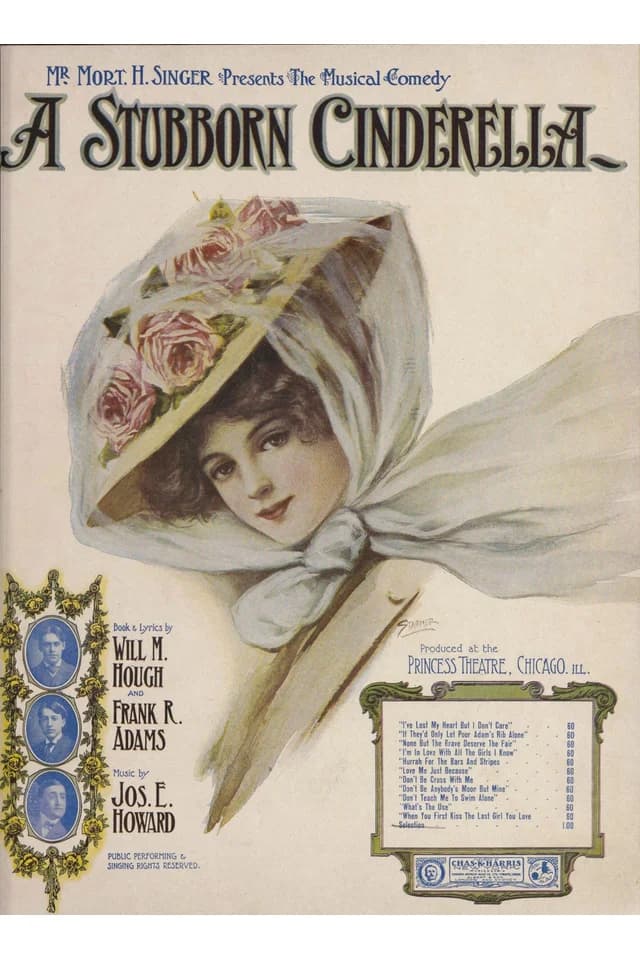
Poster for A Stubborn Cinderella

A Stubborn Cinderella

Musical · 1908

A Stubborn Cinderella is a musical in three acts with music by Joseph E. Howard, and book and lyrics co-written by William M. Hough and Frank R. Adams. A reinvention of the classic Cinderella folk tale, the plot is a spoof on American college life during the early 20th century. The musical is set at a fictional Columbus University in the United States, a Mountain Wilderness near the Mexican Border, and at a beach in Coronado, California. A Stubborn Cinderella premiered at the Alhambra Theater in Milwaukee, Wisconsin on May 24 1908. The production then moved to Chicago where it played for the grand opening of the newly built Princess Theatre at 319 S. Clark St. After an extensive run in Chicago, the production moved to New York City where it opened at the Broadway Theatre on January 25, 1909 and played for 88 performances. The Broadway production was produced by Mort H. Singer Jr. and staged by George Marion. Arthur Pell served as the musical director, and the scenic design were by Frank E. Gates and Edward A. Morange.

A Tale of Two Cities

Musical · 2008

The musical opens with Lucie Manette as a child, en route from France to England. She is delivered by Mr. Jarvis Lorry, an employee of Tellson's Bank to the home of Miss Pross, who had been nanny to Lucie's now-deceased mother. Later, Mr. Lorry returns to the Pross household to tell the now-adult Lucie that her father, Dr. Alex Manette, has been found alive in the Bastille after 17 years (Prologue: The Shadows of the Night). Dr. Manette, Lucie and Lorry set sail for England and meet Charles Darnay. Upon arriving, Darnay is arrested as a spy as he is discovered in possession of papers showing British troop placements. It is later found that the papers were dropped by John Barsad, henchman of Darnay's uncle, the Marquis St. Evermonde's (Dover). Lucie requests that Mr. Lorry arrange for a lawyer to defend Darnay in exchange for the kindness he has shown her and her father during their journey and Lorry agrees. We are then taken to the law office of Mr. Stryver and Sydney Carton - who arrives clearly intoxicated (The Way it Ought to Be - London). Carton decides with his friend, grave robber Jerry Cruncher, to attempt to blackmail Barsad by visiting several local taverns (No Honest Way). The next day, the trial commences (The Trial). Darnay is acquitted after the blackmail attempt succeeds and prompts the key witness to assert that Darnay and Sydney look similar after Sydney removes his barrister's wig and robe. The witness then admits it could have been either man-or anyone else-with those papers. Darnay takes Sydney and Stryver out to celebrate at a tavern that Sydney calls "home." (Round and Round) After Darnay is insulted by Sydney and leaves, Sydney reflects on why he acted this way (Reflection). Several months have passed and Darnay now desires Lucie's hand but asks her father's permission first (The Promise). On Christmas Eve, Lucie attempts to convince Sydney to have supper with her and her father, but he declines; out of kindness, she invites him to dinner the following evening, which he must accept. Awakened by her kindness, Sydney realizes what he has been missing in his life (I Can't Recall). The next day Darnay asks Lucie to marry him and she accepts (Now at Last). Sydney arrives and Lucie gives him his gift - a scarf. Unaware that he would be receiving one, Sydney tells Lucie to close her eyes and kisses her. Shocked, she informs him that Mr. Darnay has asked her hand in marriage. Upset - and embarrassed — Sydney leaves and reflects on the life he now cannot attain, and on the marriage and life of Darnay and Lucie together (If Dreams Came True). The action then switches over to France, where the king is expected to drive his carriage past Defarge's wine shop. Many children are very excited however near the road. One, the son of a man named Gaspard, is killed when the Marquis St. Evremonde's carriage passes. Madame Defarge, who was unaware of what the children were waiting for, expresses disgust for the death the Marquis has caused and urges Gaspard to murder him (Out of Sight Out of Mind). Gaspard later follows the Marquis to his chateau and does so. Darnay receives a letter from Gabelle, a former house servant in France, and agrees to defend him in the courts and leaves (Gabelle's Letter/I Always knew). Stryver and Sydney visit the Manette household one evening and Stryver tells of the killings and other developments there. During their visit, Sydney agrees to help put Little Lucie to bed (Now I Lay Me Down To Sleep). Meanwhile, a funeral is being held for Gaspard's son (Little One). At the funeral, officers come to arrest Gaspard for murder, but Ernest Defarge tells him to remain and the revolution begins (Until Tomorrow) Darnay is arrested when it is revealed that he is the Marquis' nephew. Lucie is devastated and turns to Sydney for guidance as Darnay left without explanation or revealing his true identity. Act 2 opens with the storming of the Bastille. The Defarges have found the notes left by Dr. Manette in his cell so many years before, but the people of Paris are still unsatisfied after the prison's fall (Everything Stays the Same). Darnay is sent to trial because he is a member of the aristocracy. At his trial, Madame Defarge reads Dr. Manette's charges against the Marquis St. Evremonde and his brother, who is Charles' father. At the end of his journal, Manette condemns them and all their descendants. Manette himself makes an impassioned plea to recant this and say that Darnay is nothing like his father and uncle. He adds that Darnay's execution would inflict a further burden on him and Lucie who suffered so greatly during his imprisonment. Manette's plea is denied and Darnay is sentenced to death. (The Tale). Lucie is depressed that Darnay has left without telling her why. Sydney at first is tempted to steal her from her husband, but realizes rather that the right thing would be to help Darnay (If Dreams Came True [Reprise]). Lucie wishes to die with her husband, but she realizes this may put her daughter in the same position she was in as a child. She vows to save both her husband and family yet still questions why Darnay left for France without telling her (Without a Word). Sydney makes arrangements with his old acquaintance Barsad to allow him entrance into the prison where Darnay is held (The Bluff). Realizing that he cannot simply escape with Darnay, Sydney concocts a plan to save him, and to allow Little Lucie to have her father and a brilliant life ahead (Let Her Be a Child). In Darnay's prison, after denying that he loves Lucie, Sydney switches clothes with Darnay and then drugs him, to the surprise of Barsad. Barsad delivers the unconscious Charles to Tellson's Bank, where his family is waiting. Lucie believes it is Sydney who has returned and reads a letter from him which is delivered by Barsad. In the letter, he explains he had to do this and that she has meant more to him than anything else in his entire life (The Letter). With both sadness for Sydney and joy for the opportunity for her life with Charles, Lucie and her family quickly leave France. Madame Defarge arrives armed and vows to not let any of the Evremonde family escape. She and Miss Pross struggle over the pistol and Madame is killed. Ernest learns of Madame's death and calls-off the massive hunt for the Evremondes to have the opportunity to mourn his wife (Defarge Goodbye - Lament). On the way to the gallows, a friendly and innocent seamstress realizes that Sydney is not Darnay, with whom she was imprisoned. However instead of betraying him, she calls him an angel and the two console each other. When she is called to the guillotine, Sydney bids her a final goodbye. He is next and as he climbs the stairs, he realizes the good that he has done for the woman who opened his eyes to so much love (Finale - I Can't Recall [Reprise]).

A Tree Grows in Brooklyn

Musical · 1951

The musical opens on a Saturday morning when the community is getting the week's pay (Payday). Hildy is waiting with her friend Katie for her boyfriend Johnny Nolan. While they wait they switch hats. Johnny arrives (Mine Till Monday) and thinks Katie is Hildy as Katie is wearing Hildy's hat and kisses her. Hildy angrily leaves. Meanwhile, Cissy, Katie's sister, hopes to marry Oscar, who would be her tenth husband, all of who she calls Harry after her first who left when he had to go back to his other wife. Oscar agrees to marry her if she can produce a baby. Katie and Johnny decide to marry (Make the Man Love Me) and Johnny resolves to quit drinking and spending money at saloons (I'm Like a New Broom). Johnny gets drunk anyway and doesn't have enough money to pay for their first piece of furniture, a bed. Katie pays for it, giving up having a grand wedding in church (Looks who Dancing). Meanwhile, Hildy has ended up marrying Aloysius (Mine Next Monday). Cissy pretends she is pregnant and has Johnny and Katie smuggle in an adopted baby while she sends Oscar away repeatedly to fetch food (Love is the Reason). Katie has had to get a job as a janitress to support herself, Johnny, and their daughter Francie. Johnny, who disappeared for two days, reappears during a rooftop party (If You Haven't Got A Sweetheart). Johnny tells Katie he got a job as a piano player and that sings will be better for them (I'll Buy You A Star). As the curtain rises on Act Two an old clothes man passes through an alley (That's How it Goes). Francie Nolan is teased by the other children until Katie comes to her defense. Cissy is excited to meet her first husband after his other wife has died, and narrates his qualities to Francie (He Had Refinement). Johnny is hoping to win a raffle at his job for a piano, which he hopes to give to Francie. He comforts Francie when she realizes that she no longer wants to make believe (Growing Pains). Cissy and her first Harry meet and are disgusted by each other and Cissy's beloved Oscar walks in on the scene, suspects the worst, and abandons Cissy (Is That My Prince?). At the raffle, Johnny wins, but is refused the prize as the rules forbid employees receiving the prize and he is thrown out. A surreal ballet chronicles his resulting downfall. Johnny leaves Katie and Francie to find work in the city (Don't Be Afraid of Anything). Cissy and Oscar reconcile and Cissy reveals that she pregnant with Oscar's child. Katie receives news that Johnny has been killed. She uses the money he left for her to buy flowers for Francie's graduation, making Francie the first person in the family to graduate (Finale).

A Wonderful World

Musical · 2021

A Wonderful World - The Louis Armstrong Musical is a jukebox stage musical with a book by Aurin Squire. The show features a score of music originally performed by Louis Armstrong and others, with orchestrations and arrangements by Branford Marsalis. The show was conceived originally by Christopher Renshaw and Andrew Delaplaine and is directed by Renshaw with choreography by Rickey Tripp. The musical tells an autobiographical account of the life of jazz musician Louis Armstrong (1901–1971), from the perspective of the four wives he had during his lifetime, Daisy Parker, Lillian Hardin, Alpha Smith, and Lucille Wilson. The title comes from the song "What a Wonderful World", originally released in 1967 and written by Bob Thiele and George David Weiss. The show opened on Broadway at Studio 54 on November 11, 2024, following previews beginning a month earlier. The show closed on February 23, 2025. The production ran for 151 performances, including 31 previews.

A Year With Frog and Toad

Musical · 2002

Act I Frog and Toad are hibernating ("A Year With Frog and Toad"). The birds are ready for spring, as the sleeping friends sing about their friendship and the year ahead ("Spring"). The protagonists awaken, and Toad begins to plant a garden, impatient that his plants grow slowly. He yells at the seeds but then worries that they are afraid to grow ("Seeds"). He sings, dances and plays the tuba to encourage them, which seems to work. The next day, Frog writes a letter to Toad, because Toad is sad that he never receives mail, and gives it to Snail to deliver ("The Letter"). They then go swimming in the pond, but Toad is embarrassed to be seen in his bathing suit, and he tries to slip unseen into the water ("Getta Load of Toad"). The animals, however, come to look at Toad in his suit, and eventually, freezing, he must come out, where everyone sees him in his bathing suit. Turtle proceeds to feed the fish in the pond ("Underwater Ballet"). Later on, Frog has left Toad a note that he has gone to the island on the lake to be alone, after embarrassing Toad in his bathing suit, and Toad worries that Frog is sad. He rides a log out to the island, bringing lunch for the two of them, but he falls off the log into the water. It turns out that Frog is in fact happy and simply wanted time alone to think ("Alone"). The two friends eat wet sandwiches without iced tea. Snail continues on his quest to deliver the letter to Toad. ("The Letter (Reprise)") Later on, at Toad's home, Toad is baking cookies. Frog and Toad, along with the Birds, go kooky eating cookies and wolf down the whole batch that were supposed to be for dessert ("Cookies"). Act II Frog and Toad try to fly a kite with some difficulty, eventually succeeding despite heckling from the birds ("The Kite"). By the end of summer, leaves cover the ground and the Birds fly south for the winter ("A Year With Frog and Toad (Reprise)"). Each of the two friends intends to surprise the other by raking his yard ("He'll Never Know"), but the squirrels soon make a mess of the neat piles of leaves, so neither of the friends discovers the good deed that the other has done. A few days pass as a storm comes, and Frog tells Toad a scary semi-autobiographical story about a young Frog, whose parents Mother Frog and Father Frog leave Young Frog to go find a way out of the woods. The story continues as the young Frog escapes from being eaten by a Large and Terrible Frog ("Shivers"). Now it is winter and the Moles come out to play ("Snow Ballet"). Snail continues to Toad's house to deliver the letter ("The Letter (Reprise)"). Frog and Toad decide to go sledding down a hill that frightens Toad ("Down The Hill"). Frog falls off the sled, which bears Toad on a dangerous and bumpy path. Toad, angry that Frog had supposedly made him sled down the steep hill on purpose, initially declares to dissolve their friendship. Snail finally arrives with the letter that Frog had sent to Toad months earlier. The letter tells how Frog is only happy when his friend Toad is happy. Toad forgives Frog, and Snail is proud to have delivered his first letter ("I'm Coming Out of My Shell"). Frog is late on Christmas Eve, and Toad is worried about all the bad things that might have happened to him ("Toad to the Rescue"). Finally, Frog arrives, delayed by wrapping Toad's present ("Merry Almost Christmas"). Frog and Toad are hibernating again in their respective beds. The Birds sing as spring approaches ("Finale").

Acorn Antiques: The Musical!

Musical · 2005

The plot revolves around the original (fictional) actors reprising their roles from stage. Contrary to their wishes, the experimental director adapts it into a gritty commentary on British suburban life, although the cast, led by Bo Beaumont (Julie Walters), want a fun piece with a good tap number. After a disastrous open dress rehearsal, the cast hijack the concept to return it to its original roots, and take it to the West End, funded by Bo Beaumont's lottery win. The second act is the musical within the musical, and is much more like the original series. Miss Babs (Celia Imrie) and Miss Berta (Sally Ann Triplett) run Acorn Antiques, aided by their employees and friends, Mrs Overall (Walters) and Mr Clifford (Duncan Preston). Soon, they discover a third sister, Miss Bonnie (Josie Lawrence), who is initially scheming and devious (for instance, she fires Mrs Overall, even after finding out she's her mother). The plot unfolds, the sisters are faced with financial woes, and family secrets. The show ends with the triumphant return of Mrs Overall, a windfall, and the union of Miss Berta and Mr Clifford.

Adele

Musical · 1913

Adele is a musical in three acts with book, music and lyrics by Adolf Philipp. The musical was coyly marketed and published as an English adaptation by Adolf Philipp and Edward A. Paulton with the claim that the original French book and lyrics were by Paul Hervé, and the music by Jean Briquet. However, both Paul Hervé and Jean Briquet were pseudonyms of Adolf Philipp and the work had never been written or performed in French prior to the original English language production. This was done to make the work seem like an authentic French stage work rather than the original creation of Adolf Philipp, an American. The musical is set in France in the cities of Paris and Trouville, Normandy. The plot concerns a French girl who falls in love with the son of her father's business rival.

Adonis

Musical · 1884

Act 1, scene 1: Talamea's Studio in Athens The sculptress Talamea has created a statue of a beautiful man called Adonis. The Duchess of Area and her four silly daughters, Nattie, Hattie, Mattie, and Pattie, visit Talamea's studio and admire her creation. The villain of the play, the Marquis de Baccarat, also arrives under the pretext of examining Talamea's creation, but with the intent of trying to seduce the duchess in order to obtain her money. The Duchess purchases the statue and leaves the studio with her daughters and the Marquis after being promised it will be delivered to her. Alone, Talamea cannot bear to lose her beloved creation, and invokes the goddess Artea to bring the statue Adonis to life. Adonis is then forced to choose a life full of love but poverty with Talamea, or a life with riches with the Duchess. He decides he wants wealth more than love, and chooses a life with the Duchess. Act 1, scene 2: Bunion Turke's cottage Meanwhile, a small-town miller, Bunion Turke, and his daughter, Rosetta are enjoying their lives in a small cottage. Rosetta is introduced through the song "I'm a Merry Little Mountain Maid", which was one of the hit songs of the musical. The Marquis de Baccarat arrives in the village and attempts to seduce Rosetta who resists. The miller interrupts and catches him physically accosting Rosetta. He chases the Marquis off. Act 1, scene 3: Duchess of Area's Garden The scene begins the "Guards' March and chorus", in which the Duchess's Guards are on parade as viewed from the elaborate gardens of her estate. This is followed by the "Duchess's Tigers"; a song which featured an octet of little boys. After this, Adonis sings the song "I'm Such a Susceptible Statuette" which, while possessing original words, was set to the music of the Lord Chancellor's song from Gilbert and Sullivan's Iolanthe. Jealous of Adonis, the Marquis de Baccarat gets into a duel with Adonis and loses. Adonis meets Rosetta, falls in love, proposes, and they run off together. This upsets Bunion Turke, the Duchess, and Talamea who all have song laments. Act 2, scene 1: A country village The act opens with a humorous lament of the show business chorister; with each member of the chorus ensemble getting an opportunity for a short solo in which they sing of the perils of wishing to be a star only to end up in the chorus. The song featured the tenor Horace Frail, a longtime ensemble player for Rice, singing a "high C" for an extended period; a feat which earned him plaudits in the press and made him an audience favorite. Adonis and Rosette arrive to get married. Several songs ensue, including one that featured a mechanical donkey. The wedding is interrupted by the Marquis who stops the wedding after producing papers which challenge the impending marriage. Act 2, scene 2: The Enchanted Wood The Marquis de Baccarat forces Rosetta to marry him in secret. He attempts to dominate her after their marriage, but is thwarted by Rosetta's grit and wits. Act 2, scene 3: Interior of a Country Store. This scene has no plot but featured Adonis showing off his sleight of hand abilities, a barbershop quartet, and other random entertainments. Act 2, scene 4: Forrest Unhappy with his separation from Rosetta, Adonis begs Talamea to assist him in becoming a statue again. She eventually relents. Act 2, scene 5: The Mystic Home of the Goddess of Art Talamea invokes the goddess Artea once again. Adonis transforms back into statue. A placard is hung around his neck saying "Hands off!"

After the Ball

Musical · 1954

In 1899 London, the upper crust gather at Lord and Lady Windermere's London house for a spectacular ball. Lady Windermere at first ignores the gossip that she has a rival for her husband's affections, an older woman called Mrs Erlynne, but she eventually confronts Lord Windermere with the accusation. He admits that he has been paying money to Mrs Erlynne but denies that he has had an affair with her and refuses to say more. In fact, Mrs Erlynne is Lady Windermere's mother, whom her daughter believes to be dead, and Lord Windermere is paying her money to keep her from revealing the relationship. Lady Windermere, still believing the worst of her husband, is tempted by the amorous advances of the debonair Lord Darlington and agrees to visit him at his flat. Mrs Erlynne, learning of this before Lord Windermere, rushes to Darlington's flat to prevent her daughter from committing a destructive folly similar to that which she herself committed twenty years earlier. Without letting Lady Windermere know that they are mother and daughter, Mrs Erlynne persuades her that a liaison with Lord Darlington would be disastrous, but before they can leave, Lord Windermere arrives. The ladies conceal themselves, but Lord Windermere discovers the fan that he has recently given his wife as a birthday present and demands to know if Lord Darlington has Lady Windermere in his rooms. To prevent the exposure of Lady Windermere, Mrs Erlynne enters, saying that it is she who is under Lord Darlington's roof and must have picked up Lady Windermere's fan by mistake. Lady Windermere's reputation is saved, but Mrs Erlynne's is compromised. Fortunately, her admirer, Lord Augustus Lorton, is convinced of her honour and proposes marriage. The Windermeres are reconciled, and all ends happily. Lady Windermere never learns that Mrs Erlynne is her mother.

Aida

Musical · 2000

Act 1 In the Egyptian wing of a modern museum, a man and a woman touring the exhibit catch each other's eyes. A statue of Amneris, a female Pharaoh, comes to life ("Every Story Is a Love Story") and transports them to Ancient Egypt, where Radames, captain of the Egyptian army, and his men are returning from an expedition through the land of Egypt's long-time enemy, Nubia ("Fortune Favors the Brave"). When his soldiers capture a group of Nubian women, he is captivated by one of the women, Aida, who tries to free herself by out-dueling one of his soldiers. Radames orders her to wash his back, but she refuses, saying that although the Egyptians took everything from the Nubians, they will never take their spirit ("The Past Is Another Land"). Radames saves Aida's companions from the copper mines (and certain death) by sending them to the palace groundskeeper instead. He also ensures Aida serves as a handmaiden to his betrothed, Princess Amneris. Radames' father, Chief Minister Zoser, greets his son with news that the Pharaoh is dying, and Radames must prepare to become the next ruler of Egypt ("Another Pyramid"). Unbeknownst to Radames, his father is poisoning the Pharaoh in order to accelerate Radames' ascension to the throne. Radames' Nubian servant, Mereb, is a young man who has learned the tricks of survival in Egypt. While delivering Aida to the princess, Mereb recognizes her as the daughter of the Nubian king under whom he had served during his days in Nubia. She commands him to keep her identity a secret, lest the Egyptians kill her ("How I Know You"). Presented to Amneris, Aida is liked immediately, and she perceives that the Princess' love of fashion only serves as a mask of her insecurities ("My Strongest Suit"). At a banquet, Amneris and Radames learn from the Pharaoh that they are to marry in seven days, leaving the captain distraught that his days as an explorer have ended ("Fortune Favors the Brave (Reprise)"). Together, he and Aida share their dreams and regrets ("Enchantment Passing Through"). Later that night, Amneris worries about her father's illness, and finds in Aida someone who understands and encourages her ("My Strongest Suit (Reprise)"). Bursting into his fiancée's chamber, Radames steals a moment with Aida to share his growing attraction to her. Aida is taken by Mereb to the Nubian camp, where she reluctantly submits to her people's pleas to lead them ("Dance of the Robe"). When she implores Radames to help the Nubians, he opens his heart by giving his possessions to them ("Not Me") and declaring his love for Aida ("Elaborate Lives"). Unable to fight her feelings any longer, she falls into his embrace. Their bliss is interrupted by news that Radames' armies have captured Amonasro, king of Nubia and also Aida's father. Unable to comfort her, Radames leaves Aida in distress. Rallying her people, Aida assures them that Nubia will never die ("The Gods Love Nubia"). Act 2 Amneris, Radames, and Aida are entangled in conflicted loyalties and emotions ("A Step Too Far"): Amneris is afraid that Radames's affection for her is waning, Radames worries his love for Aida could end his life as he knows it, and Aida fears she might be a traitor to her people as she loves Radames. Aida and Mereb bribe their way into Amonasro's prison cell, where she is reunited with her father. Mereb hatches a plan to escape with the king during the commotion of Amneris' wedding. To save her father and her nation, Aida must betray the man she loves ("Easy as Life"). Meanwhile, Zoser discovers Radames' affair and warns his son that it could cost him the throne, but Radames no longer shares his father's ambitions ("Like Father, Like Son"). After an emotional bout with his son, Zoser orders his men to find Aida and kill her. At the Nubian camp, Aida receives a written apology from Radames for the thoughtless way he acted upon hearing of Amonasro's capture ("Radames' Letter") and for his lack of showing affection. When Egyptian soldiers arrive seeking Aida, another Nubian, Nehebka, sacrifices herself so that the princess can live. Now even more determined to leave Radames forever, Aida goes to say good-bye to him over Mereb's objections ("How I Know You (Reprise)"). Radames informs Aida that he is calling off the wedding. Aida knows that this would ruin her father's escape and tells him he must go through with it ("Written in the Stars"). Radames agrees, on condition that she escapes to freedom on a boat he will provide. The heartbroken lovers part, but Amneris has overheard their entire conversation and tries to face the fact that her upcoming marriage is a sham ("I Know the Truth"). News of Amonasro's escape disrupts Amneris' wedding. Radames learns the truth of Aida's identity when he arrives at the docks just as she is about to board his boat with her father. Although he is angry that Aida hid this from him, she says she never lied about loving him. Zoser suddenly appears and attacks, and in the ensuing chaos, Mereb is mortally wounded by Zoser, but Radames makes possible Amonasro's escape by cutting the rope tied to the dock, while Aida stays with Radames and a dying Mereb. Zoser flees, and Mereb dies in the arms of his kind master and beloved princess. Radames and Aida are then arrested for treason. At the ensuing trial, Pharaoh announces Zoser's apprehension and sentences both Aida and Radames to be buried alive. Amneris foreshadows her role as a future Pharaoh by convincing her father to let the lovers die in the same tomb, an act of mercy for two people she has come to love. Facing death, Aida looks to Radames for strength ("Elaborate Lives (Reprise)"). As they are slowly deprived of light and air ("Enchantment Passing Through (Reprise)"), Radames swears he will search through a hundred lifetimes to find her again if he has to. Back in the contemporary museum, the spirit of Amneris reveals that as she became Pharaoh, "the lovers' deaths gave birth to a reign of peace" between Egypt and Nubia. She watches as the modern man and woman are strangely drawn to each other. They are the reincarnations of Aida and Radames, finding each other in a new beginning ("Every Story is a Love Story (Reprise)").

Aladdin

Musical · 2011

A man welcomes the audience to the Middle Eastern city of Agrabah. He notes that Agrabah is a diverse place, full of revered nobles, misfits, and even a few villains ("Arabian Nights"). Aladdin is a young man who spends his days stealing food from the street vendors of Agrabah along with his three best friends, Kassim, Omar and Babkak ("One Jump Ahead"). After being referred to as a "worthless street rat", Aladdin expresses his dreams of showing the world he's more than just a common urchin ("One Jump Ahead (Reprise)"). He notes his guilt in thievery, having vowed to never steal again after the death of his mother ("Proud of Your Boy"). Meanwhile, in the palace of Agrabah, Princess Jasmine is scolded by her father, the Sultan, for refusing yet another suitor. The Sultan demands that Jasmine must marry a noble prince before her birthday, which is only three days away. Jasmine laments the situation to her handmaidens ("These Palace Walls"). This news also disturbs the Sultan's Grand Vizier, Jafar, who wishes to usurp the throne himself. He and his assistant, Iago, search for a way to enter the "Cave of Wonders", a mysterious cavern in the desert said to hold untold power. The voice of the cave reveals that only one who is worthy, a "diamond in the rough", may enter. When Jafar asks about the identity of this "diamond in the rough", it is revealed to be Aladdin. Jafar and Iago set out to find him. While entertaining the locals ("Babkak, Omar, Aladdin, Kassim"), Aladdin meets Jasmine, who has disguised herself as a commoner to get a sense of life outside the palace. Aladdin has no idea who she is, but he is immediately smitten. After a brief scuffle with the guards, he takes Jasmine to his hideout, where they each reveal their unhappiness in their own lives ("A Million Miles Away"). They are discovered by the guards and Jasmine is escorted back to the palace. Aladdin is ordered to be killed, but he is saved by Jafar and Iago, who lead Aladdin to the Cave of Wonders ("Diamond in the Rough"). Grateful for saving his life, Aladdin honours Jafar's request to enter the cave. Once inside, Aladdin is instructed to bring the magic lamp to Jafar and touch nothing else. Astonished by all the treasure buried within the cave, Aladdin attempts to take the Egyptian chain along with the lamp. The cave angrily seals itself, trapping Aladdin inside. Engulfed in darkness, Aladdin rubs the lamp which, to his surprise, unleashes a magical Genie (revealed as the man from the beginning of the show) who offers to grant him three wishes. Aladdin initially shrugs this off in disbelief, prompting the Genie to display his powers with a musical number ("Friend Like Me"). The Genie then reveals that he has limitations to his powers. He can not grant wishes that include murder, romance, the revival of the dead, or wishing for additional wishes. Amused and overjoyed at his good fortune, Aladdin tricks Genie into magically freeing them from the cave without actually using a wish; thereafter, Genie states that Aladdin will not receive any more magic help unless he explicitly states "I wish". After Aladdin asks what Genie would wish for, Genie muses that he would wish for freedom since he is a prisoner of his lamp, so Aladdin promises to use his last wish to free Genie. Aladdin decides to use his first wish to become a prince in order to be legally able to court Jasmine (Act One Finale: "Friend Like Me"/"Proud of Your Boy" (Reprises)). A great parade storms through the streets of Agrabah, led by Genie, Babkak, Omar and Kassim. They announce the arrival of "Prince Ali of Ababwa" ("Prince Ali"). Once at the palace, Aladdin, disguised as Prince Ali, expresses to the Sultan his desire to marry Jasmine. Jasmine overhears the conversation and perceives Ali to be just another shallow prince. Jafar, who is suspicious of Ali, tells him the location of Jasmine's bedroom, not mentioning that it is against Agrabah law for the Princess to have a suitor in her quarters unsupervised. Aladdin courts Jasmine with a ride on his magic carpet provided to him by Genie ("A Whole New World"). Once they return, Jasmine recognizes Aladdin as the young man whom she met in the marketplace. Aladdin lies and says that he really is a prince, he just sometimes likes to dress as a commoner to escape the pressures of palace living, much like Jasmine did that day. Seeing he isn't shallow and self-absorbed like the others, Jasmine kisses Aladdin good night. After she leaves, Jafar has Aladdin arrested for entering the Princess' room unsupervised. Upon hearing the news, Babkak, Omar and Kassim storm the palace to rescue their friend ("High Adventure"). They are captured and thrown into the dungeon as well, but with a little help from Genie, Aladdin uses his second wish to free them ("Somebody's Got Your Back"). The Sultan greets Aladdin in the hall and gives him his blessing to marry Jasmine, meaning that Aladdin himself will inherit the throne as the new Sultan one day. Fearful of this great responsibility, he tells Genie he's going to save his third wish for a day he may need it rather than use it to free Genie like he promised. Distraught, Genie returns to his lamp and refuses to speak to Aladdin. Aladdin laments ("Proud of Your Boy" (Reprise II)). Meanwhile, Jafar and Iago manage to steal the lamp that Aladdin carelessly discarded. As the Sultan announces to the public that Jasmine is to wed Prince Ali ("Prince Ali" (Sultan Reprise)), Jafar appears and reveals Ali to be merely a common street rat named Aladdin whom the former then threatens to send to "the end of the road" if no one changes the latter's personality to meet his standards ("Prince Ali" (Jafar Reprise)). Genie then enters with Jasmine in chains, saying that Jafar is now his master and that his first wish was to make Jasmine his prisoner. Jafar uses his second wish to crown himself Sultan, which Genie reluctantly grants. Remembering what Genie told him earlier about the limitations to his powers, Aladdin tricks Jafar into wishing for himself to become a genie so that his power will be unmatched. Genie grants Jafar's wish, and Jafar is sucked into a lamp of his own, bound to it for eternity. Aladdin uses his third and final wish to set Genie free. He then admits to Jasmine that he loves her, but he cannot pretend to be someone he's not. Seeing the nobility in Aladdin, the Sultan decrees that henceforth the Princess can marry whomever she pleases. Babkak, Omar and Kassim are made royal advisors, while Iago is arrested. Aladdin and Jasmine are married, and Genie prepares for a long-awaited vacation. All ends well as Aladdin and Jasmine board the magic carpet and take flight (Finale Ultimo: "Arabian Nights"/"A Whole New World" (Reprises)).

Alice in Wonderland

Musical · 1886

Act I, "Alice's Adventures in Wonderland", is in two scenes: "A Forest in Autumn" and "A Glade in Wonderland". Act II, "Through the Looking Glass", consists of four scenes: "Through the Looking Glass"; "The Garden of Live Flowers"; "A Sea-Shore"; and "The Banqueting Hall – The Forest Again." A review in The Theatre summarised the story as follows: The story runs glibly, opening with a chorus of fairies surrounding Alice asleep in a chair beneath a tree, from there we progress splendidly, making a new acquaintance with all our old friends, the White Rabbit, the Caterpillar, the duchess with her Baby, the Cook with her reckless use of pepper, the Cheshire Cat with his remarkable smile, the Hatter, the Hare, and the Dormouse, who have their perpetual tea party, and treat Alice to conundrums and unconventional rudeness. Then comes a long and brilliant procession, which should fill Alice's heart with awe, if not with admiration, but our heroine is nothing daunted by this large crowd. "Why, they're only a pack of cards," she says, "I needn't be afraid of them?" and so she answers the sanguinary-minded queen of Hearts, in a reckless manner, and refuses to see heads knocked off in such profusion. She then dances with the Cards in a graceful gavotte, and afterwards protects her old friend, the Cheshire Cat, from an undeserved execution. The Gryphon and Mock Turtle then appear, and Alice receives some hints as to a sea education, and the first act of the dream play for children ends with the trial of the Knave of Hearts for eating the tarts, in which Alice's verdict of acquittal is unanimously passed. In the second act, Mr. Savile Clarke takes us to another book, Through the Looking-Glass, and Alice is introduced to the chessmen and Chorus, who dance stiffly for her delectation, then the Red Queen gives her some advice after she has spoken to the live flowers, and Tweedledum and Tweedledee appear. She soon makes friends with these massive twins, and pleads hard when they determine to have a mortal combat, but all to no purpose, and so after she has witnessed the greedy Carpenter and Walrus devour their daily portion of oysters, she assists in arming Tweedledum and Tweedledee for the fray. The arrival of a Crow sends the warriors to speedy flight, and Humpty Dumpty appears on his wall, and so the play goes on until we see Alice once more asleep in her chair, and hear her wake to say, "Oh! I've had such a curious dream!"

All Aboard

Musical · 1913

All Aboard is a musical in two acts and ten scenes with lyrics by E. Ray Goetz, music by composers E. Ray Goetz and Malvin M. Franklin, and a book by Mark Swan. The work also features additional songs written by composers Irving Berlin, Jack Glogau and Joaquin Valverde; and lyricists Irving Berlin and Earl Carroll. All Aboard premiered on Broadway at Lew Fields' 44th Street Roof Garden on June 5, 1913. It closed on September 6, 1913, after 108 performances. The production was produced by Lew Fields who also portrayed the roles of Jan Van Haan and Harold Hargreaves in the show. The musical was co-directed by William J. Wilson and William H. Post. The costumes were designed by Melville Ellis, the sets were designed by H. Robert Law, and the lighting was designed by David Atchison. Other members of the cast included Zoe Barnett as both Marime Sinkavitch and Florence DeForrest, Carter DeHaven as Dick Cyril Mahoney, Flora Parker DeHaven as Mary, Dolly Connolly as Tillie Whiteway, the drag performer George W. Monroe as both Nancy Lee and Boss Mahoney, Nellie DeGrasse as Nellie, Marcia Harris as Mrs. Van Haan, Nat Fields as Hook, Stephen Maley as Mr. Smooth, Venita Fitzhugh as Alice Brown, Arthur Hartley as Mr. Scoot, Natalie Holt as Carmen, Katherine Witchie as Margot, and Lawrence D'Orsay as the Captain of the ship.

All American

Musical · 1962

Act 1 A group of immigrants arrives via plane in New York ("Melt Us"). Among them is Professor Stanislaus Fodorski, who has accepted a position as professor of engineering at a small college. Taking a bus to the campus, he marvels at the panorama passing by ("What a Country!"). He is greeted by the school's dean, Elizabeth Hawkes-Bullock. Surprised that the dean is a woman, he is even more surprised to learn he will be boarding in a room in her house. An accomplished author, he confesses doubt about his teaching skills, and she admits the school may not be strong academically, but needs more teachers who think of their students as "Our Children". Two of those students are confined to their respective dorm rooms after Doctor Snoops, professor of comparative religion, catches Ed Bricker climbing the ivy to visit Susan Thompson's room ("Animal Attraction"). Fodorski's first engineering class does not go over well with any of the students except Ed, who has always been interested in bridges ("We Speak the Same Language"). The professor's fears about his teaching skills vanish when he watches his first football game, which he sees as an example of applied engineering ("I Can Teach Them!"). He starts incorporating football strategy into his lessons, and soon all his students are engaged and learning ("It's Fun to Think"). The admiration between the dean and the professor grows, and one evening, they reminisce about past romances ("Once Upon a Time"). Less happy is Susan, still confined to her dorm room and unable to join in the "Nightlife" fun on campus, but her mood changes when Ed appears on her balcony trellis. After a short visit, he climbs down the ivy, ecstatic about their growing affection for each other ("I've Just Seen Her"), and is almost caught again by Dr. Snoops, but Dean Hawkes-Booth's sudden arrival allows Ed to slip away unnoticed. Fodorski visits the gym to give a pep talk to Ed and the rest of the football team ("Physical Fitness"). The team's spirits are high on the day of the game against the school's rivals ("The Fight Song"), but their performance on the field is terrible. Coach "Hulk" Stockworth is knocked out by a charging player from the other side, and the only one who can take over is Fodorski. Following his advice to think of his legs as a giant lever, Ed kicks a 98-yard field goal, winning the game. Act 2 Professor Fodorski's sudden rise to fame has been noticed by Henderson, the owner of an advertising company called Exploiters Unlimited. Henderson plots to exploit the professor, make much money, then get him deported. Back on campus, the big hero at the Homecoming Ball is Ed "Bricker-the-Kicker", who accepts an award for his game-winning kick, claiming that "I Couldn't Have Done It Alone." Outside the ball, Fodorski proposes to the dean, who happily accepts ("If I Were You"). Suddenly, Henderson appears with a different kind of proposal, to form a Fodorski Foundation, and after a little persuasion, the professor agrees ("Have a Dream"). The football team has been winning game after game, and they are soon heading for the Cotton Bowl. As their successes continue, Fodorski's name is being used to endorse hundreds of products, and his face is on the cover of many magazines ("I'm Fascinating"). Ed Bricker's ego has also grown with each win, and he has given up interest in engineering in favor of professional football. Ed has also lost interest in Susan, who pleads for help from the dean. Feeling ignored by Fodorski, the dean shows up in Ed's dormitory with martinis and dressed seductively, planning to get him disqualified from the football team ("The Real Me"). Dr. Snoops arrives with the school president, who fires the dean. Hearing the news, Fodorski is shocked, and realizes he needs to make things right ("Which Way?"). He benches Ed so the school will lose the Cotton Bowl, thwarting Ed's hopes for a football career, and ruining Henderson as the Fodorski Foundation collapses. The two pairs of lovers reconcile, and with the dream of a football championship gone, the students go back to their studies, and Fodorski receives a letter granting his application for citizenship ("Finale").

All Shook Up

Musical · 2005

This synopsis is based on the current licensed version Somewhere in the Midwest in the summer of 1955, Chad, a guitar-playing roustabout, is released from a week in jail ("Jailhouse Rock"). In a nearby dreary little town, a young mechanic named Natalie Haller yearns for love and adventure, unaware that her best friend Dennis has a crush on her. Sitting in Sylvia's Honky-Tonk, the townspeople lament their feelings of loneliness ("Heartbreak Hotel"), before getting interrupted by the roar of a motorbike; Chad has arrived in town ("Roustabout"). In need of a mechanic, Chad is introduced to Natalie, who is instantly smitten ("One Night With You"). Upon learning that Mayor Matilda Hyde and the silent Sheriff Earl enforce the Mamie Eisenhower Decency Act, outlawing "loud music, public necking, and tight pants", Chad seeks to incite rebelliousness in the citizens ("C'mon Everybody"). Whilst Natalie repairs his motorbike, Chad inspires her to take to the open road ("Follow That Dream"). Chad recruits Dennis as his sidekick. The newly-formed duo meets the town's museum owner, Miss Sandra, whom Chad instantly falls in love with. He attempts to smooth-talk her, but she resists ("Teddy Bear/Hound Dog"), retreating to the Honky-Tonk where Natalie's widowed father, Jim Haller, also falls for her. Matilda's teenage son, Dean Hyde, declares his love for Sylvia's daughter, Lorraine. Chad encourages their blossoming relationship, much to Sylvia's dismay ("That's All Right"). Matilda demands that Dean be sent away on a bus to a military academy. However, Dean disobeys his mother to stay in town with Lorraine ("It's Now or Never"). Desperate for Chad's attention, Natalie disguises herself as a bearded man named 'Ed' to grow closer to him ("Love Me Tender"). Ed dramatically rides into town, with Chad instantly dropping Dennis as his sidekick in favor of him ("Blue Suede Shoes"). Jim receives romance advice from Chad, both unaware they seek the same woman ("Don't Be Cruel"). Under Chad's orders, Ed visits the museum to give Sandra a Shakespearean sonnet, which Dennis had previously suggested, though Sandra unexpectedly finds herself attracted to Ed. Flustered, Ed tries leaving, but Sandra is intent on seducing him ("Let Yourself Go"). Matilda, appalled that Dean has stayed in town to be with Lorraine, vows to arrest Chad due to his influence. Ed suggests that Chad should hide in the town's abandoned fairgrounds to evade capture. Jim, now with extra confidence, condemns Sylvia for having grown so bitter and gives her a very surprising kiss. Soon, everyone in town finds themselves escaping to the fairgrounds, desperate for someone to love ("Can't Help Falling in Love"). In the abandoned fairgrounds, the townspeople each search for their love ("All Shook Up"). Dennis reveals to Natalie that he's upset about the way Chad treats her, but she disregards his concerns ("It Hurts Me"). Disguised as Ed, Natalie attempts to bond with Chad by asking for advice on seducing a woman, but accidentally kisses him in the process ("A Little Less Conversation"). Chad and Jim discover they are both pursuing the same woman: Sandra, who is lustfully searching the fairgrounds for Ed ("The Power of My Love"). Chad quickly realizes that he, too, has feelings for his new sidekick ("I Don't Want To"). Meanwhile, Matilda and Earl are hunting for the elusive roustabout ("(You're the) Devil in Disguise"). Jim, heartbroken that Sandra doesn't care for him, comes across Sylvia, who confesses her feelings for him ("There's Always Me"). Dean and Lorraine plan to leave town, but they run into Chad, who convinces them to stay and fight for their love ("If I Can Dream"). Chad, Dean, and Lorraine confront Matilda. Earl finally breaks his silence, denying Matilda's orders to arrest Chad and instead confessing his love for her. With a newfound acceptance for love, Matilda allows Dean and Lorraine to remain together, as does Sylvia ("Can't Help Falling in Love (Reprise)"). Chad bravely confesses his feelings for Ed, who reveals his true identity as Natalie, causing Chad to leave town abruptly. Dennis takes the opportunity to confess his long-time crush to Natalie, who kindly rejects him. However, he and Sandra realize a common admiration for Shakespeare and subsequently fall for one another. Left alone with her father, Jim, Natalie reconciles with Chad's absence ("Fools Fall in Love"). The next day, a triple wedding takes place: Jim & Sylvia, Matilda & Earl, and Dennis & Sandra. Chad makes an unexpected return to the town, interrupting the wedding and declaring his love for Natalie. She decides to pursue her dreams with him and hit the open road together. The brides and grooms marry while the town celebrates ("Burning Love"). After the bows at curtain call, the cast sings one last song ("C'mon Everybody (Encore)").

All for the Ladies

Musical · 1912

All for the Ladies is a musical with music by Alfred G. Robyn and both lyrics and book by Henry Blossom. The musical premiered on Broadway at the Lyric Theatre on December 30, 1912. It closed on April 5, 1913, after 112 performances. The musical was created as a starring vehicle for comedian Sam Bernard who portrayed the central character of Leon von Laubenheim of Pantural, Clemente & Co. The production also starred Adele Ritchie as Nancy Panturel, Alice Gentle as Georgette Clemente, and Jerome Uhl as General Villefranche. The musical is set in France.

Allegiance

Musical · 2012

In 2001, aged World War II veteran Sam Kimura prepares for a Pearl Harbor anniversary ceremony. A woman arrives and tells him his estranged sister Keiko (Kei) has died; as Kei's executor, she gives Sam a packet and tells him the funeral will be held that afternoon. Angered by the opening of his old family wounds after nearly 60 years of estrangement, he berates his once-beloved sister for not leaving him in peace. Kei's ghost informs Sam that she couldn't rest in peace without making one last attempt to reconnect with him ("Prologue"). It is 1941, and Sammy is a newly elected class president who dreams of "Going Places", like college and high political office ("Wishes on the Wind"). His widowed father Tatsuo and grandfather Kaito (Ojii-chan) own a farm in Salinas, California. Sammy adores his older sister Kei, who has postponed her dreams to help raise him. Tatsuo is always pushing Sammy to be better and reach his potential. Sammy believes that Tatsuo blames Sammy for his wife's death in childbirth. After the Japanese sneak attack on Pearl Harbor in December, the US government fears that Japanese-Americans might be loyal to the Empire of Japan. Although Tatsuo advises his family to keep a low profile, Sammy volunteers for the military but is rejected as an enemy alien. Even as Japanese-Americans in the Western US are incarcerated in internment camps, Mike Masaoka, head of the Japanese American Citizens League (JACL), advises them to trust the US government. Sammy's family sells their beautiful farm for a discounted price and are sent to the bleak Heart Mountain Relocation Center in Wyoming ("Do Not Fight the Storm"). There Kei counsels patience; Tatsuo grimly accepts the events that led to internment ("Gaman"). Sammy believes military service is the way to prove internees' patriotism and win their freedom ("What Makes a Man"). When Ojii-chan becomes sick, Sammy asks the white Quaker volunteer nurse at the camp, Hannah, for cough syrup. She tells him it is only for the staff, but Sammy persuades her to give him the medication ("I Oughta Go"). Sammy helps the JACL organize the camp to petition for concessions ("Get in the Game"). Hannah and Sammy begin a relationship that causes additional tensions because interracial marriage is illegal ("Should I"). Tatsuo, outraged by the unjust loyalty questionnaire intended to identify "disloyal" Japanese, refuses to swear his allegiance to America; against his father's wishes, Sammy continues to try to enlist ("Allegiance"). Ojii-chan persuades Kei to go to the dance by insisting that mountains can be moved one stone at a time ("Ishi Kara Ishi"). Sammy and Hannah wish for a world where they could be together ("With You"). Kei has fallen in love with a draft resistance leader, Frankie Suzuki. Masaoka and the JACL advise internees to swear allegiance on the loyalty questionnaire to avoid being separated from their families ("Paradise"); Tatsuo is sent to a brutal prison for refusing. Kei reflects on her dead mother and Sammy's childhood ("Higher"). The siblings choose diverging paths: Sammy will risk his life in military service, while Kei joins the resistance advocating for internees' rights ("Our Time Now"). Masaoka obtains permission for Japanese-Americans to enlist, but only if they take the most dangerous assignments in Italy. Sammy enlists in the 442nd Regimental Combat Team, an all-Nisei unit. Frankie pledges to resist the draft unless his family is freed; Sammy condemns Frankie as a draft-dodger in an interview with Life magazine that trumpets Sammy's combat record ("Resist"). Tatsuo is given a copy of the magazine and released from prison because of Sammy's actions. Kei and Frankie help lead the camp's resistance ("This Is Not Over") before Frankie is jailed ("Resist" (reprise)). Hannah promises to help Kei win Frankie's freedom ("Stronger Than Before"). Sammy sees Hannah while on leave ("With You" (reprise)) before he leads a suicide mission, which kills most of his fellow soldiers ("442nd Battle"). In camp, during a scuffle between Frankie and a military policeman, Hannah is accidentally and fatally shot. Ojii-chan dies peacefully while tending his vegetable garden. Upon release, Frankie asks Kei to marry him ("Nothing in Our Way"). After the Enola Gay bombs Hiroshima ("Itetsuita"), America celebrates victory, and each internee is released and given $25 and a bus ticket ("Victory Swing"). After the war, Sammy learns that Frankie and Kei have a daughter, Hanako, named after Hannah. Aghast, he confronts Tatsuo, who tells him that Frankie was the son he always wanted. Already furious at Kei and Frankie for their role in the draft resistance, their involvement in Hannah's death is the final straw; he accepts a job in Washington offered by Masaoka. Kei argues with Sammy, calling him a coward for leaving ("How Can You Go?"). She tries to stop him, but only manages to tear the Purple Heart off of his uniform. Sammy bitterly insists that his sacrifice was worth losing his family ("What Makes a Man" (reprise)). Back in 2001, Sam opens the packet from Kei: inside is the Life issue, featuring Sammy's exploits, that Tatsuo had kept since the war. Sam attends Kei's funeral; her executor tells him her mother wanted to give Sam something else, and hands him his old Purple Heart medal. He realizes that the executor is his niece, Hanako. He breaks down, aware of his chance to forgive and to share in the love and compassion of his family ("Still a Chance").

Almost Famous

Musical · 2019

Almost Famous is a 2019 stage musical with music by Tom Kitt, lyrics by Cameron Crowe and Kitt, and a book by Crowe. It is based on the 2000 film of the same name written and directed by Crowe. Loosely based on Crowe's life, the musical follows a teenager who becomes a journalist for Rolling Stone magazine in the 1970s. The show debuted in San Diego at The Old Globe in 2019, with previews beginning on September 13 and a premiere on September 27. It ran through October 27. Creative work continued during the COVID-19 shutdown. Like the film, the musical begins in the San Diego, home of the Miller family, progresses to the San Francisco offices of Rolling Stone, and then travels through the United States on tour with the fictional band Stillwater. The Broadway production began previews on October 3, 2022, and opened November 3, 2022 at the Bernard B. Jacobs Theatre to mainly negative reviews. On December 19, it was announced that the show would close on January 8, 2023, after 30 previews and 77 performances. Critics thought the story didn't perform well on stage. The New York Times said the show was “too faithful to the movie to feel new, yet too staged to feel authentic.” Viewers also complained that the score lacked originality and memorability, but despite the poor reception, it received a nomination for Best Original Score at the 76th Tony Awards. In November 2023, Kitt and Crowe reworked Almost Famous during a residency at the Eugene O'Neill Theater Center in Waterford, Connecticut. Public readings of the workshop were given on November 11, 15, and 18. The workshop has not yet received public reviews.

Altar Boyz

Musical · 2004

Altar Boyz is a musical comedy with music and lyrics by Gary Adler and Michael Patrick Walker and a book by Kevin Del Aguila (based on an idea by Marc J. Kessler and Ken Davenport). Centering on a fictitious Christian boy band from Ohio, the show satirizes, among other things, the phenomenon of boy bands and the popularity of Christian-themed music in contemporary American culture. It began an Off Broadway run on March 1, 2005, and closed on January 10, 2010, after sixteen previews and 2,032 regular performances, making it the 9th longest-running Off-Broadway musical of all time.

Amazing Grace

Musical · 2012

Amazing Grace is a musical with music and lyrics by Christopher Smith and a book by Smith and Arthur Giron. The musical is Smith's first foray as a professional writer or composer. It is based loosely on the life of John Newton, an English slave trader who later became an Anglican priest and eventually an abolitionist. He wrote many hymns, including "Amazing Grace". The musical had a 2012 production by Goodspeed Musicals in Connecticut and a pre-Broadway run in Chicago in 2014.

Ambassador

Musical · 1971

Lewis Lambert Strether experiences a clash of cultures when he journeys to 1906 Paris to find his fiancée's wayward son and bring him back to America to take his rightful place as heir to the family fortune. The strait-laced Strether's mission falls by the wayside when he finds the openness of the European lifestyle far more attractive than his stifling existence and comes to the realization the only rescue the young man requires is from the values of his manipulative mother.

American Idiot

Musical · 2009

Set in the early 2000s, the musical opens with a group of suburban youths living unhappily in "Jingletown, USA". Fed up with the state of the union, the company explodes in frustration during "American Idiot". One of the youths, Johnny, begins to tell his story in "Jesus of Suburbia", revealing he comes from a broken home and feels dissatisfied with the world. He soon goes to commiserate with his friend Will, and a third friend, Tunny, joins the two at Will's house. As they party and get drunk they run out of beer, prompting them to pick up more at the local 7-Eleven. Tunny exposes the do-nothing go-nowhere quicksand of their lives in the "City of the Damned". Realizing they are not going anywhere, Johnny challenges his friends to start caring about their lives and everything around them ("I Don't Care"). Will's girlfriend, Heather, finds out that she is pregnant with Will's child, and expresses her conflicting feelings in "Dearly Beloved". Johnny borrows money and buys bus tickets to the city for the three young men, eager to escape suburbia. Before the boys are able to leave, Heather tells Will of her pregnancy. With no other choice, he tells his friends he must stay at home in "Tales of Another Broken Home". Johnny and Tunny depart for the city with a group of other jaded youths ("Holiday"). Johnny's dreams and expectations of the city have fallen short so far, and he walks around the city to establish more of a bond with it. While wandering the streets alone, he pines for a woman he sees in an apartment window ("Boulevard of Broken Dreams"). While Tunny finds it hard to adjust to urban life, he spends his time watching television and is seduced by advertisements featuring America's favorite son, an attractive and masculine all-American sex symbol. He becomes convinced that the favorite son is everything he wants to be as well. The favorite son is revealed to be an American soldier ("Favorite Son"). Believing that joining the military will give Tunny the purpose he believed Johnny and the city would give him, Tunny enlists ("Are We the Waiting"). Back in the city, a frustrated Johnny manifests a rebellious drug-dealing alter ego called St. Jimmy, who is the carefree punk Johnny has always wanted to be. Johnny takes party drugs for the first time during "St. Jimmy". His new-found courage thanks to St. Jimmy and the drugs allow Johnny to make a successful move on the girl in the window. Two weeks later, Johnny admits he has injected heroin for the first time and spends the night with the girl he saw in the window, whom he calls "Whatsername". Back in Jingletown, Will sits on the couch drinking beer as Heather's pregnancy progresses. Meanwhile, Tunny is deployed to a war zone, and is shot and wounded. Will and Tunny beg for relief in "Give Me Novacaine". Johnny is smitten with Whatsername and they go to a club together to celebrate, but St. Jimmy has other plans for them in "Last of the American Girls / She's a Rebel". St. Jimmy hands Johnny heroin and Johnny pressures Whatsername into injecting with him. St. Jimmy sets the mood, Whatsername expresses her trust in Johnny, and Heather pledges her love to her newborn baby in "Last Night on Earth". Will is increasingly neglectful as Heather devotes herself to caring for their baby. Heather has had enough of Will's pot-and-alcohol-fuelled apathy. Despite Will's protestations, she takes the baby and walks out ("Too Much, Too Soon"). At around the same time, lying in a bed in an army hospital surrounded by fellow injured soldiers, Tunny falls victim to the hopelessness he has seen during wartime ("Before the Lobotomy"). Tunny hallucinates while on medication and imagines he and his nurse engaging in a balletic aerial dance ("Extraordinary Girl"). He quickly falls in love with her. His hallucination disappears, and he's left with his fellow soldiers in agony ("Before the Lobotomy (Reprise)"). Back in the city, Johnny refuses some dope from Jimmy and instead chooses to reveal the depth of his love for Whatsername as she sleeps ("When It's Time"). His relationship with Whatsername threatens the very existence of St. Jimmy, and so Jimmy forces Johnny to become increasingly erratic, and amidst hallucinations and paranoid delusions, Johnny threatens Whatsername and then himself with a knife ("Know Your Enemy"). Whatsername attempts to convince Johnny to get help, while the Extraordinary Girl tends to Tunny's physical and emotional wounds as it is revealed that Tunny is now an amputee, and Heather and her baby are far away from Will who sits alone on his couch ("21 Guns"). Jimmy makes Johnny leave a note for Whatsername, saying he has chosen St. Jimmy and drugs over her. Angry and done, Whatsername tells Johnny that he is not the "Jesus of Suburbia" and reveals that St. Jimmy is nothing more than "a figment of [his] father's rage and [his] mother's love" ("Letterbomb"). She leaves him and his unwillingness to acknowledge his issues behind. Hurt by Whatsername's departure, Johnny longs for better days ahead, Tunny longs for home, and Will longs for all the things he's lost ("Wake Me Up When September Ends"). St. Jimmy appears and makes one last attempt to get Johnny's attention, but Johnny has made the conscious decision to end his self destruction, resulting in the metaphorical suicide of St. Jimmy ("The Death of St. Jimmy"). Johnny cleans up and gets a desk job but realizes there is no place for him there or in the city ("East 12th St."). Will, all alone with his television, bemoans his outcast state ("Nobody Likes You"). Will imagines Heather appearing with her new show-off rockstar boyfriend who is much cooler than Will ("Rock and Roll Girlfriend"). Sick of staying on his couch, Will heads to the 7-Eleven and, surprisingly, finds Johnny there. Johnny had sold his guitar for a bus ticket home. Tunny also appears at the 7-Eleven, having returned from deployment with the Extraordinary Girl. Johnny becomes furious with Tunny for leaving him in the city, but quickly forgives him, and the three friends embrace. Tunny introduces his friends to the Extraordinary Girl. Heather and her rockstar boyfriend arrive in style, and in an uneasy truce, she allows Will to hold their baby. Other friends show up to greet the three men they haven't seen in a year ("We're Coming Home Again"). One year later, Johnny laments that he lost the love of his life, but he accepts that he can live with the struggle between rage and love that has defined his life. With this acceptance comes the possibility of hope ("Whatsername"). After the cast takes their bows, the curtain rises to reveal the entire company with guitars, and they perform "Good Riddance (Time of Your Life)". Each performance of this song was recorded and given to the audience as a free digital download.

American Psycho

Musical · 2013

This synopsis reflects the 2016 Broadway production. Act I Patrick Bateman is a 26-year-old investment banker living in New York City at the end of the 1980s. Bateman documents his morning routine, which involves fastidious grooming, tanning, and carefully selecting a designer suit, before travelling to Wall Street ("Opening (Morning Routine)"/"Selling Out"). He arrives at Pierce & Pierce, the elite bank for which he works, and is greeted by his doting secretary, Jean ("Everybody Wants to Rule the World"). He anxiously enquires about the Fisher account, an exclusive account that is highly sought after by Patrick and his colleagues. Later, Patrick has lunch with his coworkers, Tim Price, Craig McDermott, Luis Carruthers and David Van Patten. They exchange fashion tips and critique restaurants before another colleague, Paul Owen, enters. Patrick learns that Owen has secured the Fisher account as well as reservations at Dorsia, New York's most exclusive new restaurant. Absurdly jealous, Patrick attempts to save face by showing everyone his new business card, which leads Paul to show his ("Cards"). Paul mistakes Patrick as Marcus Halberstam, another coworker of Bateman's. Patrick then invites him to his birthday dinner, thrown by Evelyn Williams, his girlfriend, and Courtney Lawrence, her best friend and Luis Carruthers' girlfriend. Patrick calls Evelyn, telling her about Paul coming to the party. Evelyn hates the idea of having an odd number at her table, so Patrick also invites Jean to appease her. Evelyn and Courtney discuss their designer clothes and expensive food before the party ("You Are What You Wear"). Patrick and Tim arrive at Evelyn's townhouse late, which irritates Evelyn. Over dinner, the party blandly pontificate about social and political issues, such as homelessness, gentrification and the Sri Lankan Civil War. Patrick makes a scene by butchering his birthday cake with a huge knife he is carrying ("Happy Birthday"). After dinner, Patrick and Tim go to a club, where they dance and snort cocaine ("True Faith"/"Killing Time"). Suddenly overcome with despair and an awareness of the hollowness of his existence, Patrick rushes out of the club ("In the Air Tonight"). Patrick meets a homeless man on the street, offering him money and taunting him, before stabbing him to death. At the gym, McDermott, Van Patten, and Luis work out and comment on the physiques of their female instructors ("Hardbody"). Meanwhile, it is revealed that Patrick is having an affair with Courtney. After having sex, Courtney ends the affair, telling a dismissive Patrick that they are betraying their respective partners. He meets his friends at the gym and attempts to strangle Luis in the steamroom. Luis interprets Patrick's actions as a sexual advance and begs him to continue; disgusted, Patrick flees. During the intermission of a showing of Les Misérables, Evelyn broaches the subject of marriage with Patrick, who is not convinced by the prospect, while Jean, also attending the show, observes from across the theater ("If We Get Married"). Patrick heads to the Meatpacking District and picks up a prostitute named Christine, to whom he introduces himself as Paul Owen. He hires another prostitute named Sabrina and pays the two to engage in violent, sadistic sex with one another and with him ("Not a Common Man"). On Christmas Eve, Patrick waxes lyrical about Les Misérables to Jean and the two discuss their plans for the holidays. Patrick escorts his mother to Evelyn's Christmas party, where he binges on drugs and alcohol ("Mistletoe Alert"). He runs into Paul Owen at the party and invites him back to his apartment. The two dance to "Hip to Be Square". Patrick spikes Owen's drink, puts on a raincoat and begins a long one-sided analysis of the artistic and commercial merits of the band Huey Lewis and the News before slaughtering Owen with an axe. Act II Patrick takes Owen's body to an apartment he owns anonymously and dissolves it in a bathtub with a bag of lye. Afterwards, he lets himself into Paul's apartment and stages his disappearance by resetting his voicemail and packing many of his possessions into a suitcase ("Clean"). Months pass, during which Patrick murders several people ("Killing Spree"). One afternoon, Patrick's mother arrives on Wall Street expecting to have lunch with her son; Patrick, who has totally forgotten about the appointment, panics and begs Jean to get rid of her. Jean convinces Patrick to attend the lunch and offers to join the pair. Much to Jean's delight, Mrs. Bateman tells her stories about Patrick as a child, and says they would make a good couple ("Nice Thought"). Back at Pierce & Pierce, Detective Donald Kimball calls on Patrick to question him about Owen's disappearance. Uneasy, Patrick tries his hardest to evade questioning and asks Kimball to keep him updated about the manhunt. Keen to disentangle himself from New York, Patrick calls Evelyn and suggests a holiday, and Evelyn proposes a trip to the Hamptons. The idyllic setting cannot heal Patrick's psyche, however; while Evelyn flourishes amid garden parties and Pilates classes, Patrick's grasp on reality loosens further ("At the End of an Island"/"Hardbody Hamptons"). He promises Evelyn that if they return to New York he will marry her. On his return, he appropriates Paul Owen's apartment as a place to host and kill more victims, beginning with Sabrina and Christine ("I Am Back"). Luis runs into Patrick at a Barneys store and begs Patrick to run away with him. Patrick responds aggressively, assaulting Luis. With his appetite for murder now totally unchecked, Patrick targets Jean, offering to take her to dinner at a restaurant of her choice. His sense of inferiority is piqued once again when she suggests Dorsia, where he is still unable to get reservations. Patrick gives Jean the rest of the day off and she wonders about her feelings for Patrick ("A Girl Before"). At Patrick's apartment that night, the pair discuss her hopes and aspirations. As he is preparing to murder her, Jean tells Patrick that she is in love with him; her confession causes him great distress and he implores her to leave. He leaves a long voicemail for Kimball confessing to the murder of Paul Owen and countless other people ("Clean (Reprise)"). The next morning, Jean apologizes to Patrick for what happened the night before. He forgives her and tells her that he will be recommending her for a promotion. Tim unexpectedly arrives at Patrick's office, announcing to Patrick that he's getting the Fisher account. Patrick is stunned, and Tim suggests celebrating with the rest of their crew. Patrick, Evelyn, McDermott, Van Patten, Tim, Luis, Courtney, and Patrick's brother, Sean, head to Tunnel ("Don't You Want Me"). Patrick is noticeably ill at ease and is desperate to go to dinner. Sean says he is able to get reservations at Dorsia, which impresses the guests. Patrick sees Kimball at the bar and approaches him, asking him about the voicemail confession. Kimball breaks into laughter, stating that he found Patrick's 'joke' "hilarious", despite Bateman's protestations that the confessions were genuine. Kimball tells Patrick that his narrative of what happened to Owen is impossible, as Owen is in fact in London; Kimball allegedly had dinner with him there twice. The next day, Patrick goes to Paul Owen's apartment, expecting it to be full of decomposing bodies and cordoned off by the police. Instead, he finds the apartment vacant and in pristine condition; the real estate agent, Mrs Wolfe, deflects all of Patrick's questions about Paul Owen and the bodies that were left in the apartment, before asking him to leave and never return. He marries Evelyn and resigns himself to a pointless existence in which the punishment and notoriety that he craves will forever be denied him ("This Is Not an Exit").

Amour

Musical · 1996

Amour is a musical fantasy with an English book and lyrics by Jeremy Sams, music by Michel Legrand, and original French lyrics by Didier Van Cauwelaert, who also wrote the original French libretto. The musical is adapted from the 1943 short story Le Passe-Muraille by Marcel Aymé and set in Paris shortly after World War II. It centers on a shy, unassuming clerk who develops the ability to walk through walls, and who challenges himself to stick to his moral center and change others' lives, and his own, as a result.

Amélie: The Musical

Musical · 2015

NOTE: The Broadway synopsis is based on its first preview. Changes to the plot were implemented in 2019 with the development of the UK production; the revisions are now what is licensed via Concord Theatricals and are therefore described here. The musical opens with an introduction of young Amélie and her family ("Times Are Hard For Dreamers (Prologue)"). Young Amélie is born to germaphobe father, Raphael, and to neurotic mother, Amandine, and she feels isolated and emotionally distant from her parents. She takes solace in her telescope, which she uses to view the universe from afar. Her only contact with her parents comes in the form of a monthly health check-up from her father. One day, Amélie gets so excited to see him that her heart races and Raphael misdiagnoses her with a heart condition ("World's Best Dad"). Her parents, paranoid, begin to homeschool Amélie and cut off all of her contact with the outside world. In a lesson with Amandine one day, Amélie imagines her goldfish, Fluffy, coming alive and speaking to her ("World's Best Friend"). When Amélie allows Fluffy to jump into her drinking glass, her parents panic and force Amélie to release Fluffy into the Seine, leaving her alone. Feeling bad, Amandine takes Amélie to Notre Dame to make up for what happened, and Amandine prays for guidance on how to deal with Amélie and hopes for a son ("World's Best Mom"). When they leave the cathedral, Amandine is crushed and killed by a suicidal tourist who leapt from the top of it. The death hits Raphael hard, and he builds a shrine in their home to Amandine, complete with a garden gnome. Years pass, and Amélie becomes bored with her quiet life and distant father, and she decides to leave home. Five years later, she is a waitress at a café in Montmartre ("Times Are Hard for Dreamers"). She has a quiet, happy life, and spends her time with her three co-workers: Suzanne, the café's owner and a past circus performer, Georgette, a hypochondriac, and Gina. Some of Amélie's regular customers include Gina's ex-boyfriend Joseph, Hipolito, a poet, and Philomene, an air hostess. ("The Commute") On the night of Princess Diana's death, Amélie discovers a box of childhood treasures belonging to the man who used to own her apartment ("The Bottle Drops"). She is determined to find the owner and anonymously deliver the box to him, and if the owner is touched by her gesture, she resolves that she will become an anonymous do-gooder. She first meets with a cranky grocer, Colignon, who constantly abuses his assistant, Lucien, a mentally-ill young man that has an obsession with fruit ("Three Figs"). Colignon tells Amélie to confer with his mother on the other side of town. At the train station, Amélie spots a man her age, Nino, who she is attracted to. However, the train arrives before she can introduce herself to him. At Colignon's mother's home, Amélie learns the surname of the box's owner: Bredoteau. When Amélie returns home Nino spots her on the street, noticing how pretty she is and finds himself intrigued with the box. Time passes, and Amélie's search for Bredoteau isn't working out. One day, she speaks to her neighbor, Julien Dufayel—an artist who suffers from a brittle bone disease, giving him the nickname 'The Glass Man'—and, possibly recognizing the box, tells her that Bredoteau is the incorrect name. The man was really called Bretodeau. Dufayel then shows Amélie his recreation of the painting The Luncheon of the Boating Party, remarking on Amélie's isolation ("The Girl with the Glass"). Amélie discovers Bretodeau in the phonebook and calls him from a payphone, telling him where he can pick up the box ("How To Tell Time"). When Bretodeau finds it, he reflects on his childhood and decides to call his ex-wife and arrange to meet their son. Taking it as a sign, Amélie continues her good-doing, taking a blind beggar on a tour of the streets of Paris, describing his surroundings in detail. ("Tour de France"). Later that night, Amélie has a strange dream where she imagines her lavish funeral in the style of Princess Diana's, where she is serenaded by Elton John and dubbed 'Godmother of the Unloved' – someone who gives herself to help others despite not being able to find her own love ("Goodbye Amélie"). Amélie suddenly realizes she hasn't helped her father and visits him the next day and tries to convince him to leave home ("Backyard"). He refuses, saying he can't leave the garden gnome, so Amélie secretly steals it as she leaves. On her way home, she spots Nino again at the train station, where he drops a photo album on the ground that Amélie takes. Amélie explores the album with Dufayel, and finds it is full of photo-booth photographs, one of which is a picture of a man who appears over and over again, expressionless. Nino appears and explains the meaning of the photos to the company ("When the Booth Goes Bright"). Amélie watches him from the distance, and Dufayel, seeing her attraction to him, encourages her to give the album back and meet Nino. Amélie seeks out his place of work, a sex shop, and goes dressed as a nun. While she waits for Nino, the other employees mock him, unknowingly painting him as a perfect match for Amélie. However, when he arrives, Amélie runs away ("Sister's Pickle"). He chases her but she escapes and reflects on her childhood, remembering how her mother told her never to get too close to anyone ("Halfway"). Amélie then calls Nino, but refuses to give him her identity, instead sending him a photo of her in another disguise and a riddle to solve. At the café, Amélie secretly instigates a romantic encounter between Joseph and Georgette. She also writes a letter in the voice of Gina's ex-husband, telling Gina that he greatly regrets eloping with his secretary; this final letter gives her the closure she needed to move on from mourning ("Window Seat"). Her father then turns up, telling Amélie about the missing gnome and how he has been getting anonymous postcards detailing the gnome's travels ("There's No Place Like Gnome"). The travels encouraged Raphael to step out of the house to look for him, and Amélie uses the opportunity to get him to relax and embrace the change, while introducing him to Suzanne, who he falls for. Meanwhile, Nino has been searching Paris for Amélie, and handing out posters with her photo on them to anyone he sees, wondering how he's fallen for someone who doesn't want to be found ("Thin Air"). While doing another of her good deeds—spray painting a quote from one of Hipolito's poems on walls around Paris—Amélie notices the flyers and runs home, sending Nino another photo and instructions to meet her at the Montmartre Carousel. Amélie constructs an elaborate trail to lead Nino to the album ("Blue Arrow Suite") and watches him follow it. When he finds the album, she calls out to him, asking about the man in the photo-booth. However, Nino is more interested in seeing her face, and she agrees to meet him at the café on Tuesday. Tuesday arrives and Nino is late for the meeting, prompting Amélie to imagine an elaborate story to his reasoning ("The Late Nino Quincampoix"). Meanwhile, Georgette is overwhelmed by Joseph's clingy nature. Nino shows up, but when he recognizes Amélie, she finds herself nervous and runs from him. Hurt and tired, Nino leaves, but the girls in the café go after him just as Amélie reconsiders and returns. Asking of Nino's whereabouts, Joseph lies and says he went off with Gina. Heartbroken, Amélie returns home. Outside the café, Gina, Georgette and Suzanne demand to know Nino's intentions with Amélie ("A Better Haircut"). Nino says he is honestly in love with her, and needs to know how she feels for him. Touched, Georgette gives him Amélie's address. At home, Dufayel tries to talk to Amélie, but she angrily tells him to stay out of her business, not stopping to hear that he has finally gotten out of his rut and painted a unique picture: a portrait of her. As she goes inside, Nino shows up outside her door and begs a conflicted Amélie to let him inside and stop running from him ("Stay"). She is convinced to let Nino inside when Dufayel, through the apartment's window, shows Amélie his painting and insists that she'll regret not trying a relationship with Nino. She opens the door and tells Nino she wants to be with him. He tells her he loves her, even if she cannot love him back ("Halfway (Reprise)"). They kiss and Amélie takes him to the photo booth, where she shows him the answer to the mystery of the man in the album: he's the repairman who takes a photo after fixing the booth, to check if it works properly. They go into the photo booth, taking pictures together, and reflecting on their newfound happiness and wondering what will happen next ("Where Do We Go From Here?"). The story of Amélie is narrated by all of the people in her life. They tell us how every moment of our lives and everyone we meet are connected in ways we may not know or understand ("The Flight Of The Blue Fly"). Born to two neurotic and self-centered parents— Raphael and Amandine—young Amélie doesn't learn how to love. One day during her monthly medical exam, her heart beats wildly and Raphael misdiagnoses her with a heart defect, leading the parents to homeschool her away from the outside world ("World's Best Papa"). They give her a goldfish, Fluffy, to keep as a friend. One day during a geometry lesson, Amélie gets distracted by Fluffy, causing Amandine to scold her ("World's Best Friend"). Amandine's irritating neuroticism causes Fluffy to become suicidal, leading him to jump out of his bowl; when chaos ensues as Raphael and Amandine attempt to get the fish back in its bowl, they decide that it has to go, and Amélie is forced to release him into a nearby canal. Later on, Amandine and Amélie go to Notre Dame Cathedral, where they pray for a baby brother ("World's Best Mama").

An American in Paris

Musical · 2014

This synopsis reflects the American version of the musical play, which was revised after its premiere 2014 run in Paris. Setting: Paris, 1945, at the end of the Second World War. Act I Adam Hochberg walks on stage and downs a cup of liquor. He sits at a piano and recounts the story of the day his friend, Jerry Mulligan, came to Paris. Just after the liberation of France, US Army Lieutenant Jerry Mulligan is struck by a mysterious girl after seeing her on the maze-like streets of Paris ("Concerto in F"). Ready to rebuild his life after the war, he deliberately misses his train home and decides to stay in Paris to nurture his passion for painting. He makes his way to a cafe/lodging house, where he meets Adam Hochberg, a fellow veteran and pianist, whose war injuries have left him with a permanent limp. Recognizing a kindred spirit, Adam helps Jerry find a place to live and helps him get started in Paris. Henri Baurel, the son of wealthy French industrialists, enters to rehearse the nightclub act he is putting together with Adam. Henri reveals his plans to run his family's American branch while becoming a nightclub star in secret, fearing his parents' disapproval of his dreams of being an entertainer. Both Henri and Jerry berate Adam for making his new song too dark when what Paris needs is light. Adam retorts that as artists, they have a duty to show the horrible things they've seen, and teases Henri about his fear of proposing to his girlfriend, whose name he will not tell Adam. The three bond in friendship as they imagine a brighter future ("I Got Rhythm"). Adam takes Jerry to the Paris ballet, where he is accompanying auditions, to sketch the dancers. Jerry bumps into headstrong American philanthropist, Milo Davenport, who, struck by his talent and good looks, invites him to a party to introduce him to gallery owners. Henri's mother, Madame Baurel, arrives with Ballet Director Maestro Z, and introduces Milo to him as a potential donor. Dancers arrive for the audition, and the audition has begun when to Jerry's shock, the mysterious girl arrives, apologizing for being late. She is told to leave, but Adam convinces her to dance in the back. As the audition continues, the girl dances beautifully, impressing the Ballet Director, Milo and both Jerry and Adam ("Second Prelude"). The girl introduces herself as Lise Dassin, and Maestro Z recognizes her as the daughter of the famed ballerina Arielle Dassin. In gratitude for his help, she gives Adam a flower and a kiss on the cheek before hurriedly leaving for her job. Milo, charmed by Lise and her mysterious demeanor, tells the maestro she will fund his season only if he commissions a piece just for Lise with a score written by Adam. She then takes it a step further, demanding it be designed by the 'noted painter' Jerry Mulligan. Helpless at her charismatic hands, the maestro agrees, except for allowing Jerry to design the ballet—he has his own stable of designers. Immediately infatuated with Lise, Adam sits down, thrilled with the prospect of writing a ballet that joins French and American culture. Jerry interrupts Lise at her job at a perfume counter to tell her that she got the job. Lise is reserved, and but Jerry will not be dissuaded as he tries to get her to agree to meet with him at the Seine that evening, causing a ruckus in the store until he is thrown out ("I've Got Beginners' Luck"). Madame Baurel enters and congratulates Lise she is to be the prima ballerina of the Théâtre du Châtelet Ballet. It is revealed Lise lives with the Baurel family, which they have not disclosed to the Ballet in order to avoid charges of nepotism. At the Baurel home, Henri attempts to write a letter proposing to his girlfriend, who is revealed to be Lise. Meanwhile, Lise sits down at a cafe and writes a letter to her mother; although presumed dead, she still hopes they are alive and writes a letter every day. She begs for advice: whether to marry Henri as expected, or try for true love ("The Man I Love"). Adam watches the scene from afar, falling deeper in love with Lise. Jerry is sketching a bench at the banks of the Seine when Lise arrives for their meeting, telling him she cannot accept his friendship. He shows her an incomplete sketch of her he began after their first encounter on the street, and proposes she meet him every day so he can draw her until he gets it right. Offended, she refuses, but Jerry calms the atmosphere by saying Lise doesn't have to say anything if she doesn't want to. It becomes clear both are haunted by events during the War, and she solemnly agrees with him to put the war behind them. To lighten the mood, he declares her name too sorrowful and decides to call her Liza, telling her that in the hour they are together, they are just two crazy, happy fools down by the river ("Liza"). She agrees, only if he swears to never tell anyone. Overjoyed, he tries to kiss her, but she pushes him in the river. They both agree to meet the next day, same time, same place. Henri is still attempting to draft his proposal letter, and his mother warns him if he doesn't do it soon, somebody else will. She implies his reluctance to propose is perhaps due to a romantic interest in men, which Henri denies, and warns him the family, vulnerable to accusations of collaboration with the Nazis, must be concerned with appearances. Lise enters with Mr. Baurel who says Henri has something to say to her. Dodging the subject, he asked her about her new position and tells her of him coming American tour. Lise tells him should he ever want a companion in America, she will accompany him gladly, and he takes this as an agreement to the proposal he has not yet made, mistaking her obvious glow of happiness for excitement about the ballet rather than for love of Jerry. Back at the cafe, all three men rejoice over their love for Lise, eventually joining in a trio without realizing they are all singing about the same woman ("S'Wonderful"). Henri shows the other two his proposal letter, only to find he has Lise's notebook by mistake. He reads the letter to her mother about her doubts over doing what is expected of her, marrying Henri and following her heart. Stricken, he nonetheless finds a glimmer of hope in the letter. Adam offers to console him with a drink while Jerry heads over to Milo's party. Jerry arrives at Milo's apartment to discover there was no party, and Milo has invited him on a date on false pretenses ("Shall We Dance?"). Initially annoyed, Jerry relents after Milo gives him constructive criticism on his art and takes him to meet various gallery representatives, and they begin a casual relationship. Over the next week, Adam and Lise work on the new ballet, and struggle with the material. Milo continuously brings Jerry's designs in and they are routinely rejected. Milo and Jerry embark on a trek of the Parisian art world, exploding with new life and post-war energy as Milo falls in love with him. Jerry's designs are finally accepted, but the ballet continues to run into many problems, and Lise and Jerry find solace in their short daily meetings. Milo and Jerry go to a costume party, and Jerry is shocked to discover Lise there with Henri. Jerry realizes Lise is engaged to his friend and, in a fit of rage, he removes both his and Milo's masks, and with Lise watching, kisses her ("Second Rhapsody/Cuban Overture"). Act II Adam is commissioned by the Baurels to play at one of their parties, not knowing his connection to Henri. Jerry is brought as Milo's plus one, and, in an attempt to cover up his secret nightclub act, Henri denies knowing them, arousing his parents' suspicions. After learning the party is a benefit for the ballet and dancers will be there, Jerry tries and fails to leave for the fear of confronting Lise. After seeing Lise is not among the dancers, he laughs in relief, causing a stir among the guests which eventually turns into a wild dance number ("Fidgety Feet"). After the performance, he discovers Lise is indeed there as a guest of honor. The Baurels, surprised to find both enjoy jazz, ask Milo for a recommendation for a nightclub, and when Milo asks Jerry, he recommends the nightclub where Henri and Adam are booked to perform. The Baurels announce Lise and Henri's engagement, crushing both Adam and Jerry, who lashes out at Milo and storms into the garden. Henri asks Milo to dance to comfort her, and they recognize each other as kindred spirits. Lise follows him out into the garden. Jerry confronts her. Lise cannot lie and says she loves him, but cannot be with him because she is beholden to Henri for a reason she refuses to disclose. Jerry questions Henri's love for her and begs her to meet him again. Lise tells him she does not have the luxury of love and runs away because "life is not like your American movies." Jerry is left in despair. It is revealed Milo, Adam and Henri have been watching the altercation the whole time. Back at their respective homes, they all act as if nothing has happened. In parallel conversations, Milo and Henri ask Jerry and Lise if they have anything to tell them. Dodging the question, they ask if they're worried of what the public thinks of them. They respond they don't care as long as they're in love ("Who Cares?/For You, For Me, For Evermore"). Henri pledges his love for Lise, but Jerry decides to be honest with Milo and break things off. Although she has fallen in love with him, she thanks him for being honest and they end their relationship amicably. Adam and Milo reflect on the love around them and wonder why there is no love for them ("But Not For Me"). In a nightclub in Montparnasse on one of their last shows, Adam and Henri get ready for a show. Adam begs Henri to let Lise stay in Paris and accuses him of being a coward both during the war and afterwards. Henri, furious, admits the truth: Lise is beholden to Henri because he and his family saved her life during the occupation.

Anastasia

Musical · 2016

In 1906, Saint Petersburg, Russia, Dowager Empress Maria Feodorovna comforts her youngest granddaughter, five-year-old Grand Duchess Anastasia, who is saddened that her grandmother is moving to Paris, France. Before departing, the Dowager Empress gives Anastasia a music box as a parting gift ("Prologue: Once Upon a December"). Eleven years later, Anastasia is attending a ball with her family when the Bolsheviks invade the palace. As they attempt to escape, Anastasia tries to retrieve her music box, only to be captured along with the rest of her family ("The Last Dance of the Romanovs"). The Dowager Empress later receives word in Paris that the entire family has been executed. In 1927, Gleb Vaganov, a general for the Bolsheviks, who now control Russia, announces to the gloomy Russians that the now-poor Saint Petersburg has been renamed Leningrad, and he promises a bright and peaceful future. The Russians protest this change, but are then uplifted by a rumor that Anastasia may have survived and escaped the royal family's execution. Two wanted con men, the handsome young Dmitry and an ex-member of the Imperial Court, Vlad Popov, hear the rumors and brainstorm "the biggest con in history": they will groom a naïve girl to become Anastasia in order to extract money from the Dowager Empress ("A Rumor in St. Petersburg"). Dmitry and Vlad hold unsuccessful auditions for the scheme at the theater in the abandoned Yusupov Palace. Just as they are about to give up hope of finding a suitable impostor, a street sweeper named Anya walks in to ask Dmitry about paperwork to get tickets for Paris. Dmitry and Vlad become fascinated as Anya explains that she doesn't remember who she is due to her amnesia and has very few memories of her past ("In My Dreams"). Realizing that she bears a strong resemblance to Anastasia, they select Anya as their impostor. At the capital, government workers sort through rumors and reports for any that require further action. Three bitter actresses report Anya, Dmitry, and Vlad's plot to Gleb; he dismisses them and decides to have Anya put under surveillance ("The Rumors Never End"). Back at the palace, Vlad and Dmitry groom a feisty Anya to become Anastasia through history, dining, and dancing lessons ("Learn to Do It"). Gleb orders Anya's arrest, and she is brought to his office in the Nevsky Prospect. The general interrogates the girl and warns her about the consequences of pretending to be Anastasia. He tries to convince her that Anastasia is really dead by revealing that his father was one of the soldiers who shot the Romanovs and, as a boy, Gleb heard the gunshots and the family's screams. However, Gleb notices that Anya has the "Romanov eyes" and realizes that Anya could indeed be Anastasia. As he harbors feelings for her, he lets her off with a warning ("The Neva Flows"). Anya reunites with Dmitry and they are teased and attacked by his old con partners, whom they must fight off ("The Neva Flows Reprise"). Impressed by Anya's fighting skills, Dmitry opens up to her for the first time and tells her about his childhood in the streets of St. Petersburg and how he had to take care of himself as an orphan ("My Petersburg"). Dmitry begins to trust her enough to show her a music box that he's failed to open, unaware that it is the memento which had been given to Anastasia by the Dowager Empress. Anya easily winds and opens the box and begins to vaguely remember her past, including an imperial ball many years earlier ("Once Upon a December"). After this episode, Anya is more resolute than ever in her desire to get to Paris, but Dmitry lacks the money for tickets. Anya then gives him her only possession: a diamond that was found sewn into her dress in the hospital years earlier ("A Secret She Kept"). At the train station, Count Ipolitov recognizes Anya as Anastasia and kisses her hand. As they board the train to Paris, the count leads his fellow exiles in a prayer of farewell to Russia ("Stay, I Pray You"). During the train ride, Anya, Dmitry, and Vlad reflect on what they hope to accomplish in Paris: Anya hoping to discover that she is actually Anastasia, Dmitry's desire for the money, and Vlad hoping to win back Countess Lily Malevsky-Malevitch ("Sophie" in the 1997 animated film), the Dowager Empress's lady-in-waiting with whom he had an affair ("We'll Go From There"). Count Ipolitov is fatally shot by the police for illegally boarding the train. The police officers then go after Anya, Dmitry, and Vlad since they are wanted criminals in Russia, but they all jump off the train, narrowly avoiding capture. As they travel across Russia by foot, Gleb receives orders to follow Anya and kill her if she is the real Anastasia ("Traveling Sequence"). Gleb agrees to the task, but he realizes that he is in love with Anya and questions his heart ("Still"). Anya, Vlad, and Dmitry finally arrive in France, and as they travel to Paris, Anya summons the courage to continue on with the hope that she will finally discover who she is ("Journey to the Past"). Anya, Vlad and Dmitry arrive in Paris and are swept up by the sights and sounds of the city ("Paris Holds the Key (to Your Heart)"). When Vlad and Dmitry go off on their own, Anya visits the Pont Alexandre III bridge, named after Anastasia's grandfather, and she feels a strong connection to it ("Crossing a Bridge"). Now a bitter, elderly woman, Dowager Empress Maria Feodorovna reads the letters from various women claiming to be Anastasia and, heartbroken, declares that she will see no more of them ("Close the Door"). As Gleb arrives in Paris, Lily parties at the Neva Club, where she and her guests reminisce about the old Russia ("Land of Yesterday"). Lily is reunited with Vlad, with whom she is angry for stealing her jewelry when they were lovers. The two rekindle their scandalous romance and Vlad convinces her to let Anya meet the Dowager Empress at the ballet the next week ("The Countess and the Common Man"). However, Vlad accidentally drops the ballet tickets and Gleb, overhearing their plans, reaffirms his loyalty to the Bolsheviks ("Land of Yesterday Reprise"). At the hotel, Anya has a nightmare about the execution of the Romanovs ("A Nightmare"). Dmitry comforts her and recounts a story of how he bowed to Anastasia at a parade as a young boy. Anya vividly remembers this, and the two realize that Anya is indeed the Grand Duchess Anastasia ("In a Crowd of Thousands"). At the ballet, Vlad suspects that Anya and Dmitry are falling in love and is heartbroken on their behalf that the two can never be together ("Meant to Be"). During the performance of Swan Lake, Anya sees the Dowager Empress and remembers her. The Dowager Empress also sees Anya and recognizes her, but clings to denial. Dmitry and Gleb (who is conflicted about whether or not to shoot Anya) reflect on their romantic feelings ("Quartet at the Ballet"). After the ballet, Lily also recognizes Anya as Anastasia and immediately takes her to the Dowager Empress. Dmitry is anxious about the meeting and realizes that he has fallen in love with Anya, but knows he must let her go to her family ("Everything to Win"). Anya leaves the meeting enraged, having learned from the Dowager Empress that Vlad and Dmitry intended to use her in their scheme for money. As she storms off, Dmitry waits for the Dowager Empress. Marie coldly dismisses him, but Dmitry disrespectfully stops her. He begs her to see Anya, but she refuses again. Back at the hotel, Anya begins to pack, but she is interrupted by the Dowager Empress who, impressed by Dmitry's courage, has come to give her an opportunity. Anya is shocked by the Dowager Empress's cruelty, asserting that she isn't the nana that Anya remembered. The Dowager Empress angrily questions Anya about her past and the Romanov family, but Anya compels her to reflect on the person she has become. Anya suddenly remembers the night that the Dowager Empress left her for Paris. When Anya produces the music box and sings the lullaby, the Dowager Empress finally realizes that Anya really is Anastasia and the two embrace, now reunited after twenty years ("Once Upon a December Reprise"). A press conference is held the next morning, where Vlad and Lily try to fend off the hungry reporters ("The Press Conference"). Before appearing in public, the Dowager Empress tells Anya that Dmitry did not take the reward after all and reveals her respect for him. Anya expresses misgivings about her future life as a princess and the Dowager Empress insists that no matter what she chooses, they'll always be together. Anya runs off to think; she realizes that she is in love with Dmitry, and decides that she must go after him ("Everything to Win Reprise"). As she turns to leave, Anya sees that Gleb has slipped in and locked them in the room. She realizes why he is there and Gleb says that he must kill her to complete his father's mission. Anya now clearly remembers the day her family was killed and, without fear, taunts him to kill her so that she can be with her family. Overcome with emotion and not willing to bear the shame of his father, Gleb is unable to kill Anya ("Still/The Neva Flows Reprise"). Anya comforts Gleb and they call a truce. The Dowager Empress realizes that Anya has chosen to renounce her royal status; she and Gleb announce to their people that the rumors of the Grand Duchess will now cease; as far as the world is concerned, Anastasia is dead. Anya discovers Dmitry at Pont Alexandre III, where they embrace. The couple leaves Paris as the spirits of the Romanovs celebrate the life that Anya and Dmitry will have together ("Finale").

Animal Crackers

Musical · 1928

Animal Crackers is a musical play with music and lyrics by Bert Kalmar and Harry Ruby and a book by George S. Kaufman and Morrie Ryskind. The musical starred the Marx Brothers and is set at the Long Island Home of Mrs. Rittenhouse; a character portrayed by Margaret Dumont in the 1928 production on Broadway. The lyrics and music of several songs in Animal Crackers entered the public domain in the United States in 2024. The full script, copyrighted in 1929, entered the public domain in the United States in 2025.

Ankles Aweigh

Musical · 1955

Ankles Aweigh is a musical with a book by Guy Bolton and Eddie Davis, lyrics by Dan Shapiro, and music by Sammy Fain. The plot involves Hollywood starlet Wynne, who secretly marries a Navy pilot while filming a movie in Sicily. She disguises herself as a sailor and stows away on his ship to grab a covert honeymoon. They get mixed up with an espionage ring. The original Broadway production opened April 18, 1955, and ran for 176 performances, but lost money.

Anna Karenina

Musical · 1992

In 1870s Russia, Anna Karenina is a virtuous woman married to a government official 15 years older than she. Anna falls in love with the handsome and charming Count Alexei Vronsky, but she is torn by her loyalty to her husband and small son. Meanwhile, Vronsky had first courted Ekaterina "Kitty" Alexandrovna Shcherbatsky, who chose him over gentleman farmer Konstantin Dmitrievich Levin. When Vronsky falls in love with Anna instead, Kitty becomes ill, and Levin, heartsick, withdraws to his country estate. Kitty and Levin finally declare their love for each other. Anna's choice of love over duty leads to tragedy: Her affair with Vronsky is revealed, and she is shunned; eventually, she throws herself in front of an oncoming train.

Annie

Musical · 1978

In 1933 New York City, eleven-year-old Annie sleeps in an orphanage, with many other girls her age. When six-year-old Molly wakes up from a bad dream, Annie comforts her by singing about her own parents; even though they abandoned her at the orphanage as a baby, she holds on to the hope that they will come back for her ("Maybe"). Annie decides to escape to find her parents, but is caught by Miss Hannigan, the cruel keeper of the orphanage. To punish Annie's behavior, she forces all the girls to clean, and they lament the terrible conditions of the orphanage ("It's the Hard Knock Life"). Later on, Bundles the laundry man comes in to pick up the blankets, allowing Annie to escape in his truck. Miss Hannigan realizes she is gone and chases after the truck. The other orphans cheer her on but await punishment when Hannigan returns ("It's the Hard Knock Life (Reprise)"). Annie escapes, running into a friendly stray dog. She tells him of better days to come ("Tomorrow"). She fools a police officer into believing he is her dog, named Sandy. Later, Annie and Sandy stumble upon a Hooverville, a shanty town full of formerly well-off people suddenly rendered homeless by the Great Depression. They sarcastically toast the former president ("We'd Like to Thank You, Herbert Hoover"). The shanty town is broken up by the cops, who take Annie back to the orphanage, where Miss Hannigan punishes her with extra chores. At the orphanage, Miss Hannigan vents her frustration at being surrounded by children ("Little Girls"). Grace Farrell, the assistant to the billionaire Oliver Warbucks, comes to the orphanage, asking for an orphan to spend Christmas at his mansion. Seeing how poorly Miss Hannigan treats Annie, Grace insists on taking her ("Little Girls (Reprise)"). At Warbucks's mansion, Grace introduces Annie to the staff and explains that she will have every luxury available ("I Think I'm Gonna Like It Here"). Oliver Warbucks returns and is not happy to have Annie in his mansion, having assumed all orphans were boys. Warbucks instructs Grace to take her to a movie while he works, but when he realizes that Annie has never seen New York, he decides to take her there himself, walking the 45 blocks to the Roxy and seeing New York City in all of its glory ("N.Y.C."). Grace pays Miss Hannigan a visit to tell her that Warbucks wants to officially adopt Annie. Hannigan becomes furiously envious that the orphan she hated so much will suddenly have everything. Her ne'er-do-well brother Rooster and his girlfriend, Lily, drop by, in hopes of a handout. When Miss Hannigan mentions that Annie is going to be adopted by Warbucks, Rooster realizes they can use this situation to their advantage to bring Annie back to Miss Hannigan ("Easy Street"). Having noticed a broken locket around Annie's neck, Warbucks buys her a new, more expensive one from Tiffany's. When he offers Annie the locket and attempts to take off the old one, Annie bursts into tears, as the locket was the only thing left to her by her parents, and she still holds out hope that they will return for her. Warbucks pledges to find her parents, no matter what it takes, calling J. Edgar Hoover to get the Federal Bureau of Investigation on the job ("You Won't Be an Orphan for Long"/"Maybe (Reprise)"). Annie appears on Bert Healy's radio show ("Maybe (Reprise)"), where Warbucks announces that he is offering $50,000 to the couple who can prove they are her parents. Healy sings a song with the Boylan Sisters ("You're Never Fully Dressed Without a Smile"). At the orphanage, the girls are listening to the show. They joyously sing along ("You're Never Fully Dressed Without a Smile (Reprise)"). A couple claiming to be Annie's parents, Ralph and Shirley Mudge, arrive at the orphanage. In fact, they are Rooster and Lily in disguise. They believe they can pass themselves off as Annie's parents, with Hannigan's help, for which she demands half of the money ("Easy Street (Reprise)"). Warbucks brings Annie to Washington, D.C., where she meets President Franklin D. Roosevelt. Roosevelt and his Cabinet are inspired by her optimism and decide to make it a cornerstone of their administration ("Tomorrow (Reprise)"). Once back home, Warbucks tells Annie how much he loves her ("Something Was Missing"). Because all the people claiming to be her parents were frauds, he offers to adopt her, and Annie gleefully accepts. The delighted staff get Annie dressed for the formal adoption proceedings and tell of how her arrival has changed their lives ("Annie"). As Judge Louis Brandeis shows up to begin the adoption proceedings, Warbucks and Annie dance together ("I Don't Need Anything But You"). They are interrupted by Rooster and Lily in disguise. The two present forged documents, as well as the other half of Annie's locket, seemingly confirming their story. Warbucks requests that she be allowed to stay one more night, and they can take her away on Christmas morning. The next morning, Annie wonders if her life with her parents will really be as good as her life with Warbucks could have been ("Maybe (Reprise)"). Warbucks receives a surprise visit from Roosevelt and his Secret Service. The FBI has learned that Annie's parents are actually David and Margaret Bennett, who died long ago in a fire when Annie was a baby. Mr. and Mrs. "Mudge" show up to take Annie along with the money but are quickly revealed to be none other than Rooster and Lily; the Secret Service arrests them, along with Miss Hannigan, for their crimes. Annie is officially adopted by Warbucks, who notes that this Christmas is the beginning of a new life for them, for the orphans (all of whom are adopted by wealthy friends of Warbucks) and for the rest of the country, thanks to Roosevelt's New Deal ("A New Deal for Christmas").

Annie Get Your Gun

Musical · 1946

When the traveling Buffalo Bill's Wild West show visits Cincinnati, Ohio ("Colonel Buffalo Bill"), Frank Butler, the show's handsome, womanizing star ("I'm a Bad, Bad, Man"), challenges anyone in town to a shooting match. Foster Wilson, a local hotel owner, doesn't appreciate the Wild West show taking over his hotel, so Frank gives him a side bet of one hundred dollars on the match. Annie Oakley enters and shoots a bird off Dolly Tate's hat, and then explains her simple backwoods ways to Wilson with the help of her siblings ("Doin' What Comes Natur'lly"). When Wilson learns she's a brilliant shot, he enters her in the shooting match against Frank Butler. While waiting for the match to start, Annie meets Frank Butler and is instantly smitten with him, not knowing he will be her opponent. When she asks Frank if he likes her, Frank explains that the girl he wants will "wear satin... and smell of cologne" ("The Girl That I Marry"). The rough and naive Annie comically laments that "You Can't Get a Man with a Gun". At the shooting match, Annie finds out that Frank is the "big swollen-headed stiff" from the Wild West show. She wins the contest, and Buffalo Bill and Charlie Davenport, the show's manager, invite Annie to join the Wild West Show. Annie agrees because she loves Frank even though she has no idea what "show business" is. Frank, Charlie, and Buffalo Bill explain that "There's No Business Like Show Business". Over the course of working together, Frank becomes enamored of the plain-spoken, honest, tomboyish Annie and, as they travel to Minneapolis, Minnesota, on a train, he explains to her what "love" is ("They Say It's Wonderful"). Buffalo Bill and Charlie discover that their rival, Pawnee Bill's Far East Show, will be playing in Saint Paul, Minnesota, while the Wild West show plays in nearby Minneapolis. They ask Annie to do a special shooting stunt on a motorcycle to draw Pawnee Bill's business away. Annie agrees because the trick will surprise Frank. She sings her siblings to sleep with the "Moonshine Lullaby". As Annie and Frank prepare for the show, Frank plans to propose to Annie after the show and then ruefully admits that "My Defenses Are Down". When Annie performs her trick and becomes a star, Chief Sitting Bull adopts her into the Sioux tribe ("I'm An Indian Too"). Hurt and angry, Frank walks out on Annie and the show, joining the competing Pawnee Bill's show. Returning to New York from a tour of Europe with the Buffalo Bill show, Annie learns that the show has gone broke. Sitting Bull, Charlie, and Buffalo Bill plot to merge Buffalo Bill's show with Pawnee Bill's as they believe that show is doing well financially. Annie, now well-dressed and more refined and worldly, still longs for Frank ("I Got Lost in His Arms"). At a grand reception for Buffalo Bill's troupe at the Hotel Brevoort, Pawnee Bill, Dolly, and Frank also plot a merger of the two companies, assuming Buffalo Bill's show made a fortune touring Europe. When they all meet, they soon discover both shows are broke. Annie, however, has received sharpshooting medals from all the rulers of Europe worth one hundred thousand dollars, and she decides to sell the medals to finance the merger, rejoicing in the simple things ("I Got the Sun in the Mornin'"). When Frank appears, he and Annie confess their love and decide to marry, although with comically different ideas: Frank wants "some little chapel", while Annie wants "A wedding in a big church with bridesmaids and flower girls/ A lot of ushers in tail coats/ Reporters and photographers" ("An Old-Fashioned Wedding"o). When Annie shows Frank her medals, Frank again has his pride hurt. They call off the merger and the wedding, but challenge each other to one last shooting match to decide who is the best shot. On the ferry to the Governors Island match site, Dolly attempts to ruin Annie's chances by tampering with her guns. She is caught and stopped by Sitting Bull and Charlie. However, they then decide to follow through with Dolly's plan so that Annie will lose the match, knowing that would soothe Frank's ego allowing the two to reconcile and the merger to take place. As the match is ready to begin, Annie and Frank's egos come out again with each claiming they are better than the other ("Anything You Can Do"). Sitting Bull convinces Annie to deliberately lose the match to Frank, reminding her that she "can't get a man with a gun." That done, Frank and Annie finally reconcile, deciding to marry and merge the shows. Notes: This description is based on the 1966 revised book. In the 1999 book, Frank also deliberately misses his shots in the final match, which ends in a tie. o written for 1966 revision and included in 1999 Broadway Revival; not in the original production § omitted from the 1999 Broadway Revival

Anyone Can Whistle

Musical · 1964

The story is set in an imaginary American town that has gone bankrupt. (Its former major industry was an unidentified product that never wore out. Everyone has one now, and no one needs a replacement.) The only place in town doing good business is the local mental asylum, known as "The Cookie Jar", whose inmates look much healthier than the disgruntled townspeople ("I'm Like the Bluebird"). All the money is in the hands of Cora Hoover Hooper, the stylish, ruthless mayoress and her cronies Comptroller Schub, Treasurer Cooley, and Police Chief Magruder. Cora appears carried in a litter by her backup singers, and admits that she can accept anything except unpopularity ("Me and My Town"). The scheming Comptroller Schub tells her that he has a plan to save her administration and the town, promising, "It's unethical." He tells her to meet him at the rock on the edge of town. At the rock, a local mother, Mrs. Schroeder, tries to tell her child, Baby Joan, to come down from the rock, when Baby Joan licks it and a spring of water begins flowing from it. The town instantly proclaims a miracle, and Cora and her council eagerly anticipate tourist dollars as they boast of the water's curative powers ("Miracle Song"). It is soon revealed to Cora that the miracle is a fake, controlled by a pump inside the rock. The only person in town who doubts the miracle is Fay Apple, a skeptical but idealistic young nurse from the Cookie Jar. She appears at the rock with all forty-nine of the inmates -- or "Cookies" -- in tow, intending to let them take some of the water. Schub realizes that if they drink the water and remain insane, people will discover the fraud. As he tries to stop Fay, the inmates mingle with the townspeople, until no one can guess who is who. Fay disappears and, hiding from the police, admits that she hopes for a hero to deliver the town from Cora and her lackeys ("There Won't Be Trumpets"). Cora arrives on the scene with the Cookie Jar's manager, Dr. Detmold, who says that Fay has taken the records to identify the inmates. He tells Cora that he is expecting a new assistant who might help them. At that moment a mysterious stranger, J. Bowden Hapgood, arrives asking for directions to the Cookie Jar. He is instantly taken for the new assistant. Asked to identify the missing Cookies, Hapgood begins questioning random people and sorting them into two groups, group A, and group one, without divulging which group is the sane one. The town council becomes suspicious, but Hapgood simply questions them until they begin to doubt their own sanity. Cora is too caught up with his logic to care ("Simple"). As the extended musical sequence ends, the lights black out except for a spotlight on Hapgood, who announces to the audience, "You are all mad!" Seconds later, the stage lights are restored, and the cast is revealed in theater seats, holding programs, applauding the audience, as the act ends. The two groups are now in a bitter rivalry over which is the sane group ("A-1 March"). Another stranger, a French woman in a feathered coat appears. It is really Fay Apple in disguise. She introduces herself as the Lady from Lourdes, a professional Miracle Inspector, who has come to investigate the miracle. As Schub runs off to warn Cora, Fay seeks out Hapgood in his hotel, and the two seduce each other in the style of a French romantic film ("Come Play Wiz Me"). Fay tries to get Hapgood's help in exposing the miracle. Hapgood, however, sees through her disguise and wants to question her first. Fay refuses to take her wig off and confesses to him that this disguise, leftover from a college play, is the only way she can break out of her shell. She begins to hope, however, that Hapgood may be the one who can help her learn to be free ("Anyone Can Whistle"). Meanwhile, the two groups continue to march, and Cora, trying to give a speech, realizes that Hapgood has stolen her limelight ("A Parade in Town"). She and Schub plan an emergency meeting at her house. Back at the hotel, Hapgood comes up with an idea, telling Fay to destroy the Cookies' records, so both they and Fay can be free. When Fay is reluctant, Hapgood produces a record of his own he is her fiftieth Cookie. He is a practicing idealist who, after years of attempted heroism, is tired of crusading and has come to the Cookie Jar to retire. Inspired by his record, Fay begins to tear the records up. As she does, the Cookies appear and begin to dance ("Everybody Says Don't"). Cora is at her house with her council. Schub has put the miracle on hiatus but announces that they can easily pin the blame on Hapgood. The group celebrates their alliance ("I've Got You to Lean On"). A mob forms outside the hotel, and Hapgood and Fay, still disguised, take refuge under the rock. Discovering the fraud, Cora and the council confront them. At that moment, Cora receives a telegram from the governor warning that if the quota of 49 cookies is not filled, she will be impeached. Schub tells her that since Hapgood never said who is sane or not, they can arrest anyone at random until the quota is filled. Hapgood refuses to help Fay stop the Mayoress since he has given up crusading. Although she knows she still isn't out of her shell, Fay angrily swears to go it alone ("See What it Gets You"). As Cora and the police force begin rounding up Cookies, Fay tries to get the key to the wagon from the guards in an extended ballet sequence ("The Cookie Chase"). As it ends, Fay is captured, and Dr. Detmold recognizes her. Fay tells the townspeople about the fake miracle, but the town refuses to believe her. Detmold tells Cora that even without the records, Fay can identify the inmates from memory. Cora warns that she will arrest forty-nine people, normal or not, and Fay, helplessly, identifies all the Cookies, except Hapgood. She tells him the world needs people like him, and Hapgood can't turn himself in. He asks Fay to come with him, but she still can't bring herself to break free. They regretfully part ways ("With So Little to Be Sure Of"). Word comes of a new miracle from the town beyond the valley, of a statue with a warm heart, and the townspeople, including Magruder and Cooley, rush off to see if it is real. Soon the town is all but deserted, and Cora is alone again. Again, Schub has the answer they can turn the entire town into one big Cookie Jar. Cora realizes she and Schub are meant for each other, and they dance off together. As Fay resumes work, Detmold's real new assistant Jane Borden Osgood arrives, and Fay is horrified to realize that she is even more rigid and disbelieving than Fay herself, and the new nurse marches the Cookies off to the next town to disprove the new miracle. Horrified at seeing what she might become, Fay returns to the rock calling for Hapgood. When he doesn't answer, she tries to whistle and succeeds in blowing a shrill, ugly whistle. Hapgood appears again, saying, "That's good enough for me." As they embrace, the water begins flowing from the rock a true miracle this time ("Finale").

Anything Goes

Musical · 1934

Five versions of the libretto of Anything Goes exist: the original 1934 libretto, the 1962 off-Broadway revival libretto, the 1987 revival libretto, the 2011 revival libretto, and the 2022 revised libretto. The story has been revised, though all involve similar romantic complications aboard the SS American and feature the same major characters. The score has been altered, with some songs cut and others reassigned to different scenes and characters, and augmented with various Porter songs from other shows. Billy Crocker, a young Wall Street broker, has fallen in love with a beautiful girl he met at a party and spent the evening with in a taxi. His boss, Elisha J. Whitney, is preparing to make a business deal and is going to travel to London aboard the SS American. Evangelist-turned-nightclub singer Reno Sweeney will be traveling aboard the same ship. Billy sees Reno as a friend, but she obviously has feelings for him ("I Get a Kick Out of You"). Billy goes to the dock to say farewell to his boss and Reno ("Bon Voyage"), and glimpses the mysterious girl again. He learns that she is the heiress Hope Harcourt and, escorted by her mother Mrs. Harcourt, is on her way to England with her fiancé Lord Evelyn Oakleigh, a handsome but stuffy and hapless British nobleman. Billy stows away on the ship with a plan of winning Hope's heart. "Moonface" Martin, a second-rate gangster labeled "Public Enemy 13", and his girlfriend, Bonnie, have disguised themselves as a minister and a missionary and, innocently aided by Billy, board the ship under their assumed identities, stranding the ship's real chaplain back at the port. Moonface and Bonnie mistakenly leave behind their leader, "Snake Eyes" Johnson, Public Enemy 1. To thank him, Bonnie and Moonface let Billy have Snake Eyes Johnson's passport and ticket without telling him to whom they belong. Billy cons Evelyn into leaving him alone with Hope, by convincing him he is very ill. When he goes to get some air, Billy and Hope meet again, and it turns out she has been unable to stop thinking about him as well ("All Through the Night"). Though Hope prefers Billy, she insists she must marry Evelyn. Unbeknownst to Billy, her family's company is in financial trouble and a marriage to Evelyn would promote a merger and save it. The ship's crew gets a cable from New York saying that Public Enemy 1 is on board. Moonface admits his true identity to Billy and he and Bonnie conspire to disguise Billy as a crew member since he is now presumed to be Snake Eyes Johnson. A quartet of lovelorn sailors comfort themselves with the thought of romance when they reach shore ("There'll Always Be a Lady Fair"). On deck, Bonnie lures the sailors to her ("Where Are the Men?"), then steals the clothes of one of the men for Billy. Hope discusses her impending marriage with Evelyn and discovers that he is not particularly pleased with the engagement either. Billy asks Reno to help separate Evelyn and Hope, and she agrees. Billy and Reno reaffirm their friendship ("It's Friendship"). Reno tries to charm Evelyn; she succeeds and he invites her for a drink in his cabin. She and Moon plot that Moon should burst into the cabin and discover Reno half-naked in Evelyn's arms, providing sufficient reason for breaking off the engagement. However, when Moon breaks into the room, machine gun in tow, he instead sees Reno fully dressed and Evelyn nearly undressed. Moon tries to invent some indecent explanation for the situation, but Evelyn insists that he would be quite pleased by any rumor depicting him as a passionate lover, especially if Hope heard it. Moon admits that the plot has failed. The crew discover that Billy is not a sailor, and Moon and Reno create a new disguise for him from a stolen pair of trousers, a jacket taken from a drunken passenger, and hair cut from Mrs. Harcourt's Pomeranian and made into a beard. Reno tells Billy that Evelyn has kissed her, and she is sure she will be Lady Oakleigh soon, since love moves so quickly these days ("Anything Goes"). Mrs. Harcourt, recognizing her dog's hair, angrily pulls off Billy's beard and the crew and passengers realize he must be the wanted man. As Snake Eyes Johnson, Billy is an instant celebrity. Billy is honored by both crew and passengers as "Public Enemy Number One". He tells the Captain that Moon (who is still disguised as a minister) is helping him reform from his wicked ways. Moon is asked to lead a revival in the ship's lounge. The passengers confess their sins to the "Reverend", and Lord Evelyn admits to a one-night stand with a young Chinese woman, Plum Blossom. Hope is not impressed with Billy's charade, and to please her, he confesses to everyone that he is not really Snake Eyes Johnson. Moon attempts to compensate by revealing that he is not a minister; he is Public Enemy Number Thirteen. The captain sends them both to the brig. Reno restores the mood of the Revival ("Blow, Gabriel Blow"). Moon tries to cheer Billy up ("Be Like the Bluebird"). Billy doubts he will ever see Hope again; he and Moon cannot leave their cell until they return to America. Their card-playing Chinese cellmates Ching and Ling, imprisoned for conning all the third class passengers out of their money, will be put ashore in England. Moon and Billy challenge them to a game of strip poker, win their clothes, and disguise themselves again. Billy, Moon, and Reno show up at the Oakleigh estate in Chinese garb. Billy and Moon tell Oakleigh's uncle that they are the parents of "Plum Blossom" and threaten to publicize Evelyn's indiscretion if he does not marry her. Oakleigh offers to buy them off and Moon gleefully accepts the cash, much to Billy and Reno's chagrin. Billy and Reno find Hope and Evelyn, who are both unhappy with the prospect of their matrimony. Hope declares that she desperately wants to marry Billy ("The Gypsy in Me"). Billy spots Whitney and finally learns that Evelyn and Hope's planned marriage is really an awkward business merger. Billy realises that Oakleigh is manipulating them all; Hope's company is really worth millions and Billy informs Whitney of that fact. Whitney offers to buy the firm from Hope at an exorbitant price, and she accepts. The marriage is called off since a merger is now impossible. Billy and Hope get married, as do Reno and Evelyn. A cable from the U.S. government fixes Billy's passport problems and declares Moon "harmless". Moon indignantly pockets Oakleigh's check and refuses to return it. Young Wall Street broker Billy Crocker helps his boss Elisha J. Whitney prepare for his trip to London. Eli tells Billy the next morning he is to make a huge sale of a sinking asset. Billy then runs into his friend; evangelist turned night club singer Reno Sweeney who is leaving on the same ship to London. Reno tries to convince Billy to join her, but he refuses and she laments her unrequited love for him ("I Get A Kick Out Of You"). Billy then reveals to Reno he has fallen in love with someone else and she berates him, believing he led her on before sadly reaffirming her feelings for him after he leaves ("I Get A Kick Out Of You - Reprise"). The next morning the crew of the SS American prepare to set sail ("There's No Cure Like Travel") as Reno and the other passengers board. Among them is debutante Hope Harcourt, the subject of Billy's infatuation. She is joined by her wealthy English fiancé Lord Evelyn Oakleigh and her mother Evangeline, who has set her daughter up to be married in order to solve their family's recent financial struggles. Billy comes aboard to give Eli his passport and spots Hope. Upon hearing that she is to be wed, he stays on the ship in order to pursue her. Also sneaking on to the American is Public Enemy No. 13 Moonface Martin, who is disguised as a priest. He is joined by Erma, the promiscuous girlfriend of Public Enemy #1 Snake Eyes Johnson, who is nowhere to be found. Billy inadvertently helps Moonface evade the FBI. Moonface returns the favor by giving Billy Snake Eyes' ticket as the ship leaves the dock ("Bon Voyage"). Later that night, Billy bumps into an apologetic Reno who encourages him to go after his real love. When Billy starts to express insecurities about being with Hope, Reno builds up his confidence while playfully putting herself down, and he returns the favor ("You're The Top"). Billy then scares off a seasick Evelyn so he can court Hope away from him ("So Easy To Love"). Though she returns Billy's feeling, Hope insists on maintaining her duty and marrying Evelyn. Once alone though, she repeats his romantic words ("So Easy To Love - Reprise"). Eli drunkenly sings about his excitement for the trip, reminisces on his days in Yale, and unsuccessfully invites Hope's mother, Evangeline, to spend the night with him ("The Crew Song"). In the next room over, Moonface and Erma are visited by Billy, who hides when the ship's captain comes in and reveals that Billy is believed to be Snake Eyes Johnson. The next morning a quartet of sailors sing about the joy of seeing women as they come ashore ("There'll Always Be a Lady Fair") while Erma steals another seaman's clothes to disguise Billy from the crew and his boss. Reno then encounters her old friend Moonface, shortly after which Evelyn approaches her and reveals himself to be a huge fan. Evelyn invites Reno for tea in his room, which Moonface convinces her to accept so she can seduce Evelyn, which they'll use to blackmail him and break up his engagement. Reno agrees to his plan and they sing about what great friends they are, only to descend into bickering ("Friendship"). The attempted extortion proves to be a failure, with Reno and Evelyn instead finding themselves utterly charmed by each other. Billy and Moonface then try to frame Evelyn as a madman to Evangeline only for Hope to step in and expose Billy's identity. The crew pursues him while Reno reprimands Hope for ignoring her own happiness and chasing away the man she loves.

Applause

Musical · 1970

Middle-aged actress Margo Channing presents the Tony Award to rising star Eve Harrington, who graciously thanks "my producer, my director, my writer and above all, Margo Channing". In flashback, Margo recalls the opening night for one of her plays a year-and a-half before, when Eve entered her life. Margo's admirers crowd her dressing room and fill the air with "Backstage Babble". Among the admirers is Eve, a young woman who says that she, alone and friendless in New York, has found solace in watching her hero, Margo, perform. As soon as Margo can be alone with Bill Sampson, her director and fiancé, she tries to convince him to stay with her and not go to Rome to direct a movie. Bill firmly but lovingly tells her goodbye ("Think How It's Gonna Be"). Margo dreads facing the opening night party alone, and, wanting to have a good time, she persuades Duane, her gay hairdresser, to take her and Eve to a gay nightclub in Greenwich Village ("But Alive"). The lively evening ends back at Margo's apartment. Eve declares that it has been the best time she's ever had ("The Best Night of My Life"). Margo, seeing her 19-year-old self in one of her old movies on TV, senses the impact her increasing age will have on her career and sarcastically asks, "Who's That Girl?". Four months later, Eve has become Margo's indispensable assistant, impressing Margo's close friends, including her producer, Howard Benedict. Howard takes Eve to a "gypsy" hangout. "Gypsy," Howard explains, "is the name dancers affectionately give themselves as they go camping from show to show." The "gypsies", led by one of their own, Bonnie, celebrate "the sound that says love" – "Applause". That night, at three a.m. after a phone call from Bill in Rome, Margo longingly wishes he would "Hurry Back". Bill arranges to hurry back two weeks later, but at Margo's welcome home party for him, a misunderstanding leads to a disastrous evening ("Fasten Your Seat Belts"). Eve, as Margo's ever-present assistant, knows Margo's part in the play completely, and Eve contrives to get herself hired as Margo's understudy. Margo, feeling betrayed and threatened, faces Eve with an ironic "Welcome to the Theatre". Bill accuses her of being paranoid about Eve, and after a bitter fight, he says goodbye to Margo, ending his relationship with her. Margo is left alone on an empty stage. Margo is visiting her friends, playwright Buzz Richards and his wife Karen, in their Connecticut home. Karen, thinking Margo behaved unfairly to Eve, arranges for Margo to miss a performance by draining the car's gas tank so they cannot return to New York in time for the evening's performance. Stuck in the country for the night, they express their warm feelings as "Good Friends". Back in New York, Eve gives a triumphant performance in Margo's role. Howard again takes Eve to the "gypsy" hangout where she snubs Bonnie and her friends, who do a scathing parody of a girl who becomes an overnight star ("She's No Longer a Gypsy"). Margo is devastated when she reads a nasty interview that Eve has given in which she refers to "aging stars." Bill now realizes what Eve's true intentions are and rushes back full of love for Margo, telling her she's "One of a Kind". Margo, though, is too focused on her career to want to return to Bill. Eve, who has made an unsuccessful pass at Bill, ensnares the playwright, Buzz, and she rejoices that she now has a man who can help her career ("One Hallowe'en"). Her plans with Buzz are crushed by Howard who claims her for himself, telling her "We both know what you want and you know I'm the one who can get it for you" – Eve needs Howard's influence as a producer as well as his silence concerning her devious rise to stardom. Margo seems to have lost everything because of Eve, but suddenly she realizes she could be the winner because she now has a chance at "Something Greater" – a life with Bill. In the finale, she and Bill join with everybody answering the question "why do we live this crazy life?" – "Applause".

Are You with It?

Musical · 1945

Are You with It? is an American musical with music by Harry Revel and lyrics by Arnold B. Horwitt. The musical book by Sam Perrin and George Balzer is based on the novel Slightly Perfect by George Malcolm-Smith. The production opened on Broadway at the New Century Theatre where it ran from November 10, 1945, through April 27, 1946. The show then moved to the Shubert Theatre where it played from April 30 through June 29, 1946, closing after a total of 264 performances.

Arizona Lady

Musical · 1954

Hungarian immigrant Lona Farrell runs the Sunshine Ranch and hires Roy Dexter as foreman, though Sheriff Sullivan suspects Roy is an outlaw. Roy is actually the Colorado Kid, pursuing Burt Morton, who killed his father. After a sabotaged horse race and Roy’s arrest, he escapes to a border bar and reveals his identity. The Sheriff discovers that ranch foreman Jim Slaughter is the real Morton and recovers Lona’s horse, Arizona Lady. At the Kentucky Derby, the horse wins a wager, and the Sheriff recognizes that Lona loves Roy, so he changes the bridegroom.

Around the Clock

Musical · 1906

Around the Clock had a loose plot that centers around the young Philadelphia lawyer Tom Wilson. Tom's uncle, Hank Wilson, is currently residing in a remote part of Asia and is engaged to Nellie who lives in the same city as Tom. Hank tasks Tom with assisting him in courting Nellie while he is abroad, and the two attend a music hall performance where they end up falling in love. Nellie marries Tom instead of Hank, and conflict ensues upon Hank's return; with all issues resolving happily by the end of act 2. The drunk Billie Smith provides humorous commentary and physical comedy throughout and is the true star of the show. The final act is essentially a show within a show, with the characters viewing a vaudeville production.

Around the World

Musical · 1946

Around the World is a musical based on the 1873 Jules Verne novel Around the World in Eighty Days, with a book by Orson Welles and music and lyrics by Cole Porter. It involves an around-the-world adventure by Phileas Fogg. The expensive musical extravaganza opened on Broadway in May 1946 but closed after 75 performances. As he did with his unsuccessful 1938 stage production of Too Much Johnson, Welles shot film sequences that were integrated into Around the World. This footage is lost.

Aspects of Love

Musical · 1988

At a train station in Pau, France in 1964, 34-year-old Alex Dillingham reflects on his love life over the past 17 years ("Love Changes Everything"). A woman (Giulietta Trapani) replies to him that "it's all in the past." Flashing to 1947, Rose Vibert, a 25-year-old actress, complains that their production of The Master Builder is a flop. The producer, Marcel, tries to placate Rose by introducing her to a fan, 17-year-old Alex ("A Small Theatre in Montpellier"). Alex and Rose have a brief tryst at his uncle George's villa in Pau ("Seeing is Believing", "The House in Pau"). George Dillingham, in Paris with his mistress, Giulietta Trapani, an Italian sculptor, returns to his villa to see for himself what Alex and Rose are doing ("An Art Exhibition in Paris", "A Memory of a Happy Moment"). Rose is attracted to George, who is overcome when he sees Rose dressed in a gown belonging to his beloved late wife, Delia, also an actress, and remarks how much Rose resembles Delia ("In Many Rooms in the House at Pau"). He advises Alex that all good things have to end, and that his interlude with Rose will be a memory. Alex insists that his relationship with Rose is real love ("On the Terrace"). George leaves, and Rose leaves to rejoin Marcel. Alex realizes that Rose had never taken him seriously ("At the House at Pau"). Two years later, Alex, now a soldier, visits his uncle in Paris, and is shocked to find that Rose is now George's mistress. He accuses her of chasing his uncle's money, but Rose protests that she really loves George. She admits that she did love Alex once, and the two, drawn to each other again, fall into bed ("George's Flat in Paris"). The next morning, an agitated Rose tells Alex to leave before George returns. Alex, enraged, pulls out his gun. Rose throws a candlestick at Alex, and the gun goes off, shooting Rose in the arm, and she faints ("First Orchestral Interlude"). After George arrives, he and Alex each try to convince the other that the other is the right man for Rose. George wins the debate, insisting that Alex should begin a new life with Rose, and Alex finally agrees ("She'd Be Far Better Off With You"). George then heads to Venice to see his former mistress, Giulietta. However, Rose orders Alex to leave, having chosen to stay with George. Alex leaves, and Rose and Marcel follow George to Venice. Rose intends to confront Giulietta and reclaim George. In Venice, Giulietta and Rose bond while discussing George's foibles. They both express surprise that the other woman is not at all what they'd imagined. George returns and says that he has lost most of his money ("Stop. Wait. Please"). Rose then asks George to marry her and he agrees. At the wedding, Giulietta shocks everyone by claiming her best man's rights and kissing Rose on the mouth. George, however, is delighted ("A Registry Office"). At "A Military Camp in Malaya", Alex receives a letter from Rose telling him that she married George, and they are expecting a child. Twelve years later at a theatre in Paris, Rose has risen to stardom and has a young lover, Hugo. Marcel and the rest of the cast celebrate the latest hit (A Month in the Country) ("Leading Lady"), but Rose insists that she must return to the villa at Pau and to her husband George and their 12-year-old daughter, Jenny. Marcel reintroduces her to the 32-year-old Alex ("At the Stage Door"). Rose is delighted and insists that he come with her to Pau. At the villa, Jenny is excited by the prospect of her mother's return. George is happy to see Alex, returning with Rose, and Jenny, who has heard much about him, meets him for the first time. Rose and George insist that Alex should stay with them ("Other Pleasures"). Meanwhile, in Venice, George's former mistress, Giulietta, ponders the meaning of stable, long-lasting love versus romantic infatuation ("There Is More to Love"). Two years later, Alex suggests that Jenny needs a Paris education, which upsets Rose, who suspects that her daughter has developed an unhealthy crush on Alex ("The Garden at Pau (Version 2)"). That evening Jenny appears wearing Delia's gown, much as Rose did ("On the Terrace (Version 2)"); George happily dances with his daughter. Jenny tries to draw Alex into the dance, but Alex politely refuses ("The First Man You Remember"). Later, Jenny and Alex are left alone, and Jenny finally convinces Alex to give her the last dance. Rose catches Jenny clasping Alex in a very adult fashion, and Alex leaves. Jenny tells her mother that Alex is the first to make her feel like a woman. Rose confronts Alex, who admits to having feelings for Jenny, but insists that he would never harm her ("The Vineyard at Pau"). Later, Jenny tells Alex that she loves him. She begs him to be honest, then kisses him ("Up in the Pyrenees"). George plans his wake, insisting that there should be dancing and fun. Rose tells him that he's bound to outlive them all ("George's Study at Pau"). At a circus in Paris, George, Rose, Alex, and Jenny are celebrating Jenny's fifteenth birthday ("Journey of a Lifetime"). George becomes agitated as he watches Jenny talking with Alex ("Falling"). Later, Alex puts Jenny to bed. Jenny tries to convince him that she's really in love with him, but Alex insists that they're just cousins. Jenny falls asleep, and Alex reflects that he knows he must not love her, but cannot help loving her. George overhears Alex and is enraged, suspecting the worst. He collapses, and Alex comes out of Jenny's room to find him dead ("Jenny's Bedroom"). At George's wake, Giulietta gives a eulogy celebrating George's unconventionality and his belief in living life to the fullest ("Hand Me the Wine and Dice"). Giulietta and Alex join in the dancing and are attracted to each other, eventually trysting in a hayloft. Jenny spies on them, while Marcel tries to comfort the grieving Rose. Alex, alone with Giulietta, wonders how to end his relationship kindly with Jenny. He returns to the villa for one last confrontation. Alex tries to explain to Jenny that their relationship was unnatural. She reminds him that he was only seventeen when he met Rose, and that she is no younger than Shakespeare's Juliet ("On the Terrace (Version 3)"). Rose bids Alex farewell, but then breaks down and begs Alex not to leave her. Alex, unsure of how to reply, leaves ("Anything But Lonely"). At the train station at Pau, as Alex and Giulietta wait for the train, Giulietta wonders what will happen when Jenny reaches legal majority in three years. Alex, unable to reply, reflects once more on how love changes everything ("It Won't be Long till Jenny's a Woman").

Assassins

Musical · 1990

This synopsis reflects the current licensed version of the show. The published script of the 1992 Off-Broadway production is slightly different. The show opens in a fairground shooting gallery where human figures trundle past on a conveyor belt. One by one, a collection of misfits enters, where the Proprietor of the game entices them to play, promising that their problems will be solved by killing a president ("Everybody’s Got the Right"). Leon Czolgosz, John Hinckley, Charles Guiteau, Giuseppe Zangara, Samuel Byck, Lynette "Squeaky" Fromme, and Sara Jane Moore are given their guns one by one. John Wilkes Booth enters last and the Proprietor introduces him to the others as their pioneer before he begins distributing ammunition. The assassins take aim as "Hail to the Chief" heralds Abraham Lincoln's offstage arrival. Booth excuses himself, a shot rings out and Booth shouts, "Sic semper tyrannis!" The Balladeer, a personification of the American Dream, appears and begins to tell Booth's story ("The Ballad of Booth") as the scene changes to Richard H. Garrett's barn in 1865. Booth, mudstained and with a broken leg, is attempting to write his reasons for killing Lincoln in his diary but cannot hold the pen. He forces his associate David Herold to write for him at gunpoint. As Booth dictates, blaming Lincoln for the Civil War and for destroying the South, the Balladeer interjects that Booth's motives really had more to do with his personal problems, much to Booth's annoyance. When a Union soldier calls for Booth's surrender, Herold abandons him and surrenders. In desperation, Booth throws the Balladeer his diary so that he can tell his story to the world. The Balladeer reads out Booth's justifications, and Booth laments that his act will not be enough to heal the country. As the Union soldiers set fire to the barn, Booth commits suicide, and the Balladeer concludes that Booth was a madman whose treacherous legacy only served as inspiration for other madmen. The Balladeer rips Booth's diary and burns the pages. The Assassins gather in a bar. Guiteau toasts to the U.S. presidency, speaking of his ambition to become Ambassador to France. Hinckley accidentally breaks a bottle, and Czolgosz flies into a rage, describing the bottle factory he works in and how many men die or are injured just to make a bottle. Guiteau jokingly tells Czolgosz to find another job, and the two begin to argue about the American Dream, with Guiteau defending America and Czolgosz dismissing it as a lie. Czolgosz grabs a bottle, barely stopping himself from throwing it. Booth urges Czolgosz to take control of his fate by breaking a bottle himself, but Czolgosz cannot. Zangara complains about his stomach pains, and Booth suggests fixing them by shooting Franklin D. Roosevelt. A radio broadcast, narrated by the Proprietor, describes Zangara's failed attempt to assassinate Roosevelt at Bayfront Park in Miami. He misses Roosevelt and accidentally kills Chicago Mayor Anton Cermak instead. Five bystanders are interviewed in turn, telling the audience their versions of the event; each is convinced that they personally saved the president ("How I Saved Roosevelt"). From an electric chair, Zangara sings his refusal to be afraid and that he did not care whom he killed as long as it was one of the men who control the money. Peeved that as an "American nothing" he has no photographers at his execution, Zangara is electrocuted as the bystanders preen for the cameras. American anarchist Emma Goldman gives a lecture from offstage as Czolgosz listens, enraptured. He introduces himself to her and declares his love, but she tells him to redirect his passion to social justice. She gives him a leaflet that she tells him contains an idea that is "not mine alone, but mine". As she prepares to leave, Czolgosz offers to carry her bag, to which Goldman protests. Czolgosz, in his first display of assertiveness, still insists. Fromme and Moore meet on a park bench and share a joint. Fromme speaks of the apocalyptic preachings of Charles Manson, remembering how they met and declaring herself his lover and slave. Juggling her purse, a can of Tab and a bucket of Kentucky Fried Chicken, Moore claims she is an informant for the FBI (or used to be), has been a CPA and had five husbands and three children. They connect over their shared hatred of their fathers, and using Colonel Sanders as a graven image, they give the bucket of chicken the evil eye and then shoot it while laughing. Moore realizes that she knew Manson in high school, and the women scream in delight over their memories of him. Czolgosz reflects on how many men die just to make a gun. Booth, Guiteau and Moore enter one by one and join him in a barbershop quartet in which they honor a single gun's power to change the world ("The Gun Song"). Czolgosz decides to shoot the president. Czolgosz arrives at the 1901 Pan-American Exposition where William McKinley is shaking visitors' hands. The Balladeer sings ("The Ballad of Czolgosz") as Czolgosz joins the line, and upon reaching McKinley, he shoots him. Samuel Byck sits on a park bench. He talks into a tape recorder, preparing a message to Leonard Bernstein telling Bernstein he can save the world by writing more love songs, and explaining that he is going to change things by crashing a 747 into the White House and killing Richard Nixon. Then he accuses Bernstein of ignoring him, just like the other celebrities he has recorded tapes for, such as Hank Aaron and Jonas Salk. After flying into a rage, Byck stands up and angrily sings the chorus to "America" before storming offstage. John Hinckley sits in his rumpus room playing a guitar. Lynette Fromme enters and asks him to play her a song, but he refuses. Fromme notices a picture of Jodie Foster, who Hinckley claims is his girlfriend. When Fromme realizes the picture is a publicity photo, she pulls out a picture of Charles Manson and mocks Hinckley for being in love with a woman he has never met, which makes him throw her out in a fit of rage. Alone, he swears that he will win Foster's love "with one brave, historic act" and sings a love song to her while Fromme individually does the same to Manson ("Unworthy of Your Love"). An image of Ronald Reagan appears on a wall in the back of the stage, and an enraged Hinckley shoots it over and over again, but the picture keeps reappearing. The Proprietor mocks Hinckley by quoting Reagan as Hinckley fires, missing each time. Back at the Proprietor's shooting range, Charles Guiteau flirts with Sara Jane Moore while giving her marksmanship tips before trying to kiss her. When she rebuffs him, he becomes enraged and attacks her. Her gun goes off in his ear, and he backs off, angrily proclaiming that he will be the next ambassador to France. The scene changes to a train station, where Guiteau goes to meet James Garfield and James Blaine. He asks to be made Ambassador, but Garfield mockingly refuses, prompting Guiteau to shoot him. Guiteau is arrested and sent to the gallows, where he recites a poem he wrote titled "I Am Going to the Lordy". The Balladeer sings about Guiteau's trial and sentencing while Guiteau merrily cakewalks up to the noose, getting more optimistic with each verse. Guiteau sings along with the Balladeer about Guiteau's optimism before he is hanged ("The Ballad of Guiteau"). Squeaky Fromme and Sara Jane Moore prepare to assassinate Gerald Ford. Moore has brought along her nine-year-old son and her dog (which she accidentally shoots), which causes an argument between the two women, who briefly turn on each other. Moore accidentally spills her gun's bullets just as President Ford enters the stage. Not recognizing him at first, the two women allow him to help them, but upon discovering who he is, Fromme tries to shoot him, but her gun jams. Having no other resource, Moore tries to throw her bullets at Ford. Samuel Byck is driving to the airport to hijack a plane, which he plans to crash into the White House. Growing unhinged, he records a message addressed to Nixon, complaining about contemporary American life, how the public is constantly lied to, and announces that killing him is the only solution. The assassins congregate in limbo to enumerate their reasons for taking action and lament not receiving any "prize" for their efforts. The Balladeer admonishes their violent methods and argues for the possibility of the American Dream. The Proprietor leads the assassins in a song for all Americans dispossessed by the Dream ("Another National Anthem"). Against his protests, the assassins force the Balladeer offstage. On the sixth floor of the Texas School Book Depository, the ghosts of the assassins, led by Booth, appear before a suicidal Lee Harvey Oswald. They implore him not to become his own victim and to instead assassinate John F. Kennedy, thereby sharing his pain and disillusionment with the world. They tell Oswald that this act will empower the assassins of the future and revitalize the actions taken by assassins of the past. Finally moved by the idea that he has the power to unite the assassins, Oswald shoots ("November 22, 1963"). After the assassinations, various citizens recall what they were doing when they heard that the president had been killed, reflecting on their grief. ("Something Just Broke"). The assassins regroup once more at the shooting range, now with Oswald. They proudly reassert that "everybody's got the right to be happy" before loading and aiming their guns ("Everybody's Got the Right (Reprise)").

Aunt Hannah

Musical · 1900

Aunt Hannah, a wealthy but religious and conservative woman, departs on a trip and leaves her mansion in the care of her nephew, Jack. To the chagrin of Hannah's servants, Jack decides to throw a wild party in his aunt's house while she is away. Everything is going off with a rip-roaring fun time, until Aunt Hannah unexpectedly returns home from her trip early. Jack must use his wits to deceive his aunt to avoid trouble. Co-opting an old beau of Hannah's into his plan, he manages to smooth things over and all ends well.

Avenue Q

Musical · 2003

The show is set on a Sesame Street-like "outer-outer borough" of New York City. Princeton, a recent college graduate, is anxious to discover his purpose in life; but first, he must find an apartment and a job, with no work experience and an English degree ("What Do You Do with a B.A. in English?"). Beginning his search on Avenue A, he finally finds an affordable apartment on Avenue Q. His new neighbors are Kate Monster, a kindergarten assistant teacher who longs for a boyfriend; Rod, an obsessively neat Republican investment banker; Nicky, Rod's slacker roommate; Brian, an aspiring comedian recently laid off from his catering job; Christmas Eve, Brian's Japanese fiancée and a therapist with no clients; Trekkie Monster, a surly recluse who surfs the Internet all day in search of pornography; and Gary Coleman, the former child actor who now serves as the apartment superintendent. Debates ensue over whose life is worst, and they conclude that it is Coleman's ("It Sucks to Be Me"). Nicky, who is straight, suspects that Rod is gay and assures Rod it is okay with him if he is, but Rod insists otherwise ("If You Were Gay"). While moving into his apartment, Princeton learns that he has been laid off from the job he had lined up. He finds a penny minted in his birth year, declaring it a sign that he will soon find his purpose in life ("Purpose"). Kate Monster dreams of starting a "Monstersori" school for young "people of fur". Princeton innocently asks Kate if she and Trekkie are related, since they are both monsters, but Kate angrily pronounces his assumption racist. Princeton, taken aback, counters that Kate's Monstersori School would discriminate against non-monsters. Gary, Brian, and Christmas Eve join them in agreeing that racism, while problematic, is an adult reality ("Everyone's a Little Bit Racist"). Princeton receives money from his parents. The Bad Idea Bears, two charming troublemakers, convince him to spend it on beer. Kindergarten teacher Mrs. Thistletwat assigns Kate to teach the next morning's kindergarten class, her first solo teaching opportunity. She decides that her lesson will be about the Internet and all its educational attributes, but Trekkie Monster and the neighbors explain another reality of adulthood: many adults, even "normal people", use it to find pornography ("The Internet is for Porn"). Princeton gives Kate a mixtape. His puzzling song selections make her question his intended message, but eventually, she decides that he must like her after he invites her on a date to the Around the Clock Café ("Mixtape"). Brian opens the show with his lame stand-up act ("I'm Not Wearing Underwear Today"), before introducing skanky chanteuse Lucy the Slut, who wows the guys, especially Princeton, with a seductive cabaret number ("Special"). The Bad Idea Bears suggest that Kate and Princeton order some "harmless" Long Island Iced Teas, and once Kate is totally inebriated, Princeton takes her home to bed, where they have enthusiastic, high-decibel sex. Gary fields angry calls from other tenants but refuses to intercede ("You Can Be as Loud as the Hell You Want When You're Makin' Love"). Meanwhile, Rod hears Nicky say, "I love you, Rod," in his sleep, and is jubilant, but he eventually realizes he was dreaming. Kate and Princeton profess their mutual love, and he gives her his lucky penny ("Fantasies Come True"). The next morning, a hung-over Kate oversleeps and misses her teaching assignment. Mrs. Thistletwat berates her, and Kate angrily quits her job before she can be fired. Christmas Eve decides unilaterally that it is time she and Brian were married. At the wedding, Nicky blurts out his suspicion that Rod is gay. Rod, furious, insists he has a girlfriend none of them have ever met ("My Girlfriend Who Lives in Canada") and tells Nicky he is no longer welcome in their apartment. When Kate catches Christmas Eve's wedding bouquet, Princeton panics, confesses his fear of commitment, and asks Kate if they can just be friends. Kate retorts that she already has many friends, and ends their relationship ("There's a Fine, Fine Line"). A despondent Princeton has been holed up in his apartment after breaking up with Kate ("It Sucks to Be Me" (reprise)), but the neighbors coax him outside, where he once again runs into Lucy, who seduces the rebounding Princeton ("There is Life Outside Your Apartment"). Kate is angry, but Christmas Eve explains that it means she is in love with him ("The More You Ruv Someone"). Kate writes a note to Princeton suggesting that they rendezvous at the Empire State Building and leaves it with Lucy, who promptly destroys it. Nicky, having been kicked off of all his friends' couches, laments his fate to Gary who confesses that he is deriving pleasure from Nicky's misfortune; they agree that this, while morally wrong, is yet another reality ("Schadenfreude"). On the Empire State Building's viewing platform, Kate, thinking that Princeton has stood her up, throws his lucky penny away. A hundred stories below, Lucy, who had just dumped Princeton for lacking a job, plans or money, is knocked unconscious by the penny. At the hospital, Kate figures out that Lucy sabotaged the meeting, while Kate and Princeton unsuccessfully try to work out their problems over Lucy's comatose body. Rod is too proud to accept Nicky's repeated apologies, despite clearly missing him, and tearfully consults Christmas Eve. Princeton, Kate, and Nicky dream of returning to happier times ("I Wish I Could Go Back to College"). Princeton gives a still-homeless panhandling Nicky a quarter, and marvels at how fantastic he feels. Since thinking only about himself has gotten him nowhere, he decides to raise money to build Kate's Monstersori School. He solicits everyone, even breaking the fourth wall to shake down the audience, but the results are disappointing ("The Money Song"). Then Trekkie Monster, recalling his own traumatic school experiences, donates ten million dollars and explains to the astonished cast that "in volatile market, only stable investment is porn!" ("School for Monsters/The Money Song" (reprise)). Kate joyfully opens her new school. Brian lands a consulting job, and Christmas Eve finally has a paying client (Rod), so the newlyweds move to a better neighborhood. Rod finally comes out, unsurprisingly, and takes Nicky back in. Nicky finds Rod a boyfriend – Ricky, a muscle-bound hunk who otherwise looks and sounds exactly like Nicky. The Bad Idea Bears discover Scientology. Lucy, having recovered from her head injury, becomes a born-again Christian and takes a vow of chastity. Kate and Princeton agree to give their relationship another go ("There's a Fine, Fine Line" (reprise)). A new college graduate inquires about the vacancy in the building ("What Do You Do with a B.A. in English" (reprise)), and Princeton has an epiphany: he concludes that his purpose may be to put everything he has learned into a Broadway musical. Everybody, especially the newcomer, immediately ridicules him. The cast reminds Princeton that, in the real world, many people never find their purpose, but life goes on, and everything, both good and bad, is "only for now" ("For Now").

Babes in Arms

Musical · 1937

Babes in Arms is a 1937 coming-of-age musical comedy with music by Richard Rodgers, lyrics by Lorenz Hart, and book by Rodgers and Hart. It concerns a group of small-town Long Island teenagers who put on a show to avoid being sent to a work farm by the town sheriff. Several songs in Babes in Arms became pop standards, including the title song, "Where or When", "The Lady Is a Tramp", and "My Funny Valentine". The film version, released in 1939, starred Judy Garland and Mickey Rooney and was directed by Busby Berkeley.

Baby It's You!

Musical · 2009

Florence Greenberg is an average New Jersey housewife. A talent show is held at her daughter's school, and a group of African-American girls are preparing to perform. Florence's daughter is surprised at their talent, quickly notifying her mother, and Florence decides to make the group recording artists. To accommodate them, she founds Scepter Records. After the success of the Shirelles, the new name of the group, Florence and Scepter Records go on to "discover recording artists like the Kingsmen, the Isley Brothers and Dionne Warwick."

Back to the Future: The Musical

Musical · 2020

In Hill Valley, California, October 25, 1985 ("Overture"), Marty McFly arrives at the home of his scientist friend, Dr. Emmett "Doc" Brown, to find a pre-recorded message, playing on a large amplifier, asking Marty to meet him in the parking lot of Twin Pines Mall after midnight. After destroying the amplifier while playing his electric guitar, Marty walks through town and dreams about being a successful rock artist. A man named Goldie Wilson is running for mayor ("It's Only a Matter of Time"). When Marty's band audition is rejected ("Got No Future"), Marty's girlfriend, Jennifer Parker, comforts him ("Wherever We're Going") but they are interrupted by fundraisers for the restoration of the town's clock tower, which was damaged by lightning in 1955. Marty, with a flyer on the clocktower in hand, heads home to find his father George being harassed by his boss, Biff Tannen. George discourages Marty from chasing big dreams, his brother Dave explains his job at a burger restaurant and his mother, Lorraine McFly, discourages his sister, Linda, from dating and talks about how she first met George and kissed him at a school dance as Marty laments his family's state ("Hello, Is Anybody Home?"). At the Twin Pines Mall parking lot, Marty meets Doc who unveils a time machine made from a DeLorean and explains how he built it ("It Works"). However, due to inadequate protection while loading plutonium into the car's reactor, Doc is afflicted by acute radiation poisoning and is dying. Marty jumps in the car to seek medical help but accidentally accelerates to, sending him back in time to the day Doc conceptualised time travel in 1955. Ditching the car in a barn, Marty wanders to the town square where the citizens of Hill Valley celebrate the town ("Cake"). Marty witnesses his teenage father being threatened by Biff and his gang ("Got No Future" (reprise)) and tells him to stand up for himself. When he accidentally reveals then-diner employee Goldie will become Mayor of Hill Valley, Goldie is inspired and encourages George to also increase his self-esteem ("Gotta Start Somewhere"). Marty later finds George spying on teenage Lorraine from a tree ("My Myopia") but is knocked unconscious when George falls. Hours later, Marty wakes up in Lorraine's bedroom, where he is being cared for. Lorraine falls for Marty who tries to fend off her advances ("Pretty Baby"). Marty finds his way to Doc's house and convinces a younger Doc that he came from 1985 by revealing his knowledge about Doc's Flux Capacitor. Finding the car, Doc worries that Marty will be stuck in 1955 forever. As Marty despairs ("Future Boy"), Doc states that a bolt of lightning could power the time machine, and from the information on Marty's flyer, they plan how to use the lightning bolt. Marty tells Doc he encountered both of his parents; realizing Marty's future existence is in jeopardy, Doc instructs him to avoid meeting anyone from history and make sure George and Lorraine fall in love. The next day, they infiltrate Hill Valley High School ("Hill Valley High School Fight Song"), where Marty encourages George to ask Lorraine out to the school's upcoming dance. George tries to follow Marty's advice but runs afoul of Biff, forcing Marty to intervene. As Marty and George are chased around the campus, Lorraine tells her friends about the boy she tended to, while Biff and his gang hear rumors about Marty and plot to get rid of him. Marty fends off Biff, inadvertently awing Lorraine further ("Something About That Boy"). Doc Brown dreams of the social, technological, economic, and political advances of the future ("21st Century"), waking up as Lorraine invites Marty to the school dance to which Marty reluctantly accepts ("Something About That Boy" (reprise)). Marty visits George to boost his self confidence and dance abilities in preparation for the dance ("Put Your Mind to It"), running through the plan for George to win over Lorraine as well. As he plans to use a wire running from the clocktower to send the lightning to the DeLorean, Doc recalls how some scientists throughout history became famous, while others failed to fulfil their goals ("For the Dreamers"). Meanwhile, Biff and his gang learn of Marty's attendance at the upcoming dance and plot to beat him up ("Teach Him a Lesson"). On the night of the dance, Doc thanks Marty for giving him hope for his future; Marty secretly writes a letter to warn him of his death in 1985, despite being warned of the harm from disclosing future events. Marty reflects on his only chance to return to the future, while thinking of Jennifer back in 1985 for inspiration ("Only a Matter of Time" (reprise)). During the school dance ("Deep Divin'"), Lorraine advances on Marty ("Pretty Baby" (reprise)) before Biff locks him in a nearby dumpster and assaults Lorraine. Biff overpowers an arriving George, but George defeats him in one punch. As George escorts a grateful Lorraine to the dance, singer Marvin Berry and his band, on a smoke break, free Marty from the dumpster. Marvin's fingers are accidentally clamped by the closing lid. Knowing music will be needed for George and Lorraine to kiss, Marty volunteers to play guitar instead. The band plays "Earth Angel" as George and Lorraine kiss, saving Marty's existence. On Marvin's request for another song, Marty performs "Johnny B. Goode", but his guitar solo stuns the crowd. After bidding farewell to George and Lorraine, Marty leaves the dance to meet Doc who explains that high winds disconnected the upper cables and that he would have to reconnect them despite his fear of heights. Marty gives his letter to Doc who destroys it, worried about the consequences. Doc faces his fear and the storm to connect the wires ("For the Dreamers" (reprise)), while Marty drives the DeLorean, inserts the electric hook and accelerates to 88 miles per hour as the lightning strikes and sends him back to October 26, 1985. However, upon arrival, the car shuts down, preventing Marty from bringing Doc to the hospital. As Marty grieves over failing to save Doc, Doc appears, revealing that he pieced the letter back together and wore a better protective suit. He thanks Marty and bids him goodbye before departing to the future in the DeLorean. Marty sleeps in the courthouse square. The following morning, Marty discovers his father is now a renowned science fiction author with an annual celebration named after him, his family is more professionally and socially successful, and a timid Biff is in George's employ. At the celebration, the McFlys present the town with a check to restore the clock tower. As Marty and his band perform "The Power of Love" and the whole town joins in, Doc suddenly returns in the upgraded DeLorean, insisting Marty come with him to see the future. Marty hops in, and Doc sets the car's destination date to the exact time and date of the musical's current performance. The DeLorean takes off and flies overhead, and into the future ("Finale").

Showing 25–144 of 1,634 shows

Load more shows