1634 shows

Clear filters

Pacific Overtures

Musical · 1975

Act I Conceived as a Japanese playwright's version of an American musical about American influences on Japan, Pacific Overtures opens in July 1853. As traditional Japanese music plays, the Reciter is revealed on stage. Since foreigners were expelled from the island empire two hundred and fifty years previously, explains the Reciter, elsewhere wars are fought and machines are rumbling, but in Nippon they paint screens, plant rice, exchange bows, and enjoy peace and serenity, and there has been nothing to threaten the changeless cycle of their days ("The Advantages of Floating in the Middle of the Sea"). However, unknown to the Nipponese, President Millard Fillmore, determined to open up trade with Japan, has sent Commodore Matthew C. Perry and a fleet of four warships across the Pacific. To the consternation of Lord Abe and the Shogun's other Councillors, the stirrings of trouble begin with the appearance of Manjiro, a fisherman who had been lost at sea and rescued by Americans. He has returned to Japan and now attempts to warn the authorities of the approaching warships, but is instead arrested for consorting with foreigners. A minor samurai, Kayama Yezaemon, is appointed Prefect of Police at Uraga to drive the Americans away - news which leaves his wife Tamate grief-stricken, since Kayama will certainly fail and both will then have to commit seppuku. As he leaves, she expresses her feelings in dance as two Observers describe the scene and sing her thoughts and words ("There Is No Other Way"). As a Fisherman, a Thief, and other locals relate the sight of the "Four Black Dragons" roaring through the sea, an extravagant Oriental caricature of the USS Powhatan pulls into harbor. Kayama is sent out in a boat to meet with the Americans but he is laughed at and rejected as not being important enough. He enlists the aid of Manjiro, the only man in Japan who has dealt with Americans; disguised as a great lord and speaking arrogantly, Manjiro is able to get an answer from them: Commodore Perry must meet the Shogun within six days or else he will shell the city. Facing this ultimatum, the Shogun refuses to commit himself to an answer and takes to his bed. Exasperated by his indecision and continued procrastination, his Mother, with elaborate courtesy, slowly poisons him. ("Chrysanthemum Tea"). Kayama devises a plan by which the Americans can be received without technically setting foot on Japanese soil, thanks to a covering of tatami mats and a raised Treaty House in a small cove in Kanagawa, for which he is made Governor of Uraga. He and Manjiro set off for Uraga, forging a bond of friendship through the exchange of "Poems". Kayama has saved Japan, but it is too late to save Tamate: when Kayama arrives at his home, he finds that she is dead, having committed seppuku after having received no news of Kayama for many days. Already events are moving beyond the control of the old order: the two men pass a Madam instructing her inexperienced Oiran girls in the art of seduction as they prepare for the arrival of the foreign devils ("Welcome to Kanagawa"). Commodore Perry and his men disembark and, on their "March to the Treaty House", demonstrate their goodwill by offering such gifts as two bags of Irish potatoes and a copy of Owen's "Geology of Minnesota", gifts that make the Nipponese reciprocal gifts seem insignificant. The negotiations themselves are observed through the memories of three who were there: a warrior hidden beneath the floor of the Treaty House who could hear the debates, a young boy who could see the action from his perch in the tree outside, and the boy as an old man recalling that without "Someone In a Tree", a silent watcher, history is incomplete. Initially, it seems as if Kayama and the Nipponese have won; the Americans depart in peace. But the barbarian figure of Commodore Perry leaps out to perform a traditional Kabuki "Lion Dance", which ends as a strutting, triumphalist, all-American cakewalk. Act II The child emperor (portrayed by a puppet manipulated by his advisors) reacts with pleasure to the departure of the Americans, promoting Lord Abe to Shogun, confirming Kayama as Governor of Uraga and raising Manjiro to the rank of Samurai. The crisis appears to have passed, but to the displeasure of Lord Abe the Americans return to request formal trading arrangements. To the tune of a Sousa march, an American ambassador bids "Please Hello" to Japan and is followed by a Gilbertian British ambassador, a clog-dancing Dutchman, a gloomy Russian (quipping, "Don't touch the coat"), and a dandified Frenchman all vying for access to Japan's markets. With the appearance of this new group of westerners, the faction of the Lords of the South grow restless. They send a politically charged gift to the Emperor, a storyteller who tells a vivid, allegorical tale of a brave young emperor who frees himself from his cowardly Shogun. Fifteen years pass as Kayama and Manjiro dress themselves for tea. As Manjiro continues to dress in traditional robes for the tea ceremony, Kayama gradually adopts the manners, culture and dress of the newcomers, proudly displaying a new pocket watch, cutaway coat and "A Bowler Hat". Although Kayama, as stated in his reports to the Shogun, manages to reach an "understanding" with the Western merchants and diplomats, tensions abound between the Japanese and the "barbarians". Three British sailors on shore leave mistake the daughter of a samurai for a geisha and climb over the garden wall to speak to her. Though their approach is initially gentle ("Pretty Lady"), they grow more persistent to the point where they offer her money; the girl cries for help and her father kills one of the confused sailors while the others flee. Kayama and Abe travel to the Emperor's court discussing the situation and its political repercussions. While on the road, their party is attacked by cloaked assassins sent by the Lords of the South and Abe is assassinated. Most of the assassins are cut down by Abe's bodyguard, but he himself is killed by the sole remaining assassin. Kayama is horrified to discover that the remaining assassin is his former friend Manjiro; they fight and Kayama is killed. In the ensuing turmoil, the puppet Emperor seizes real power and vows that Japan will modernize itself. As the country moves from one innovation to the "Next!", the Imperial robes are removed layer by layer to show the Reciter in 19th century Western military dress. Contemporary Japan - the country of Toyota, Seiko, air and water pollution and market domination - assembles itself around him and its accomplishments are extolled. "Nippon. The Floating Kingdom. There was a time when foreigners were not welcome here. But that was long ago..." says the Reciter, now in modern dress: "Welcome to Japan."

Paint Your Wagon

Musical · 1951

Act I In the California Wilderness in May 1853, a crusty old miner, Ben Rumson, is conducting a makeshift funeral for a friend. Meanwhile, his 16-year-old daughter Jennifer discovers gold dust. Ben claims the land, and prospectors start flocking to the brand new town of Rumson ("I'm On My Way"). Two months later Rumson has a population of 400, all of whom are men except for Jennifer. Prospector Jake Whippany is waiting to save enough money to send for Cherry and her Fandango girls ("Rumson"), while Jennifer senses the tension building in town ("What's Going On Here?"). Julio Valveras, a handsome young miner forced to live and work outside of town because he is Mexican, comes to town with dirty laundry and runs into Jennifer, who volunteers to do his laundry. They also talk to each other ("I Talk to the Trees"). Steve Bulmarck and the other men ponder the lonely nomadic life they lead in the song "They Call the Wind Maria". Two months later the men want Ben to send Jennifer away, and he wishes her mother was still alive to help him ("I Still See Elisa"). Jennifer is in love with Julio ("How Can I Wait?"), and when Ben sees Jennifer dancing with Julio's clothes, he decides to send her East on the next stage. Jacob Woodling, a Mormon man with two wives, Sarah and Elizabeth, arrives in Rumson where the men demand Jacob sell one of his wives. To his surprise, Ben finds himself wooing Elizabeth ("In Between") and wins her for $800 ("Whoop-Ti-Yay"). Jennifer is disgusted by her father's actions and runs away, telling Julio that she will be reunited with him in a year's time ("Cariño Mío”). Cherry and her Fandango girls arrive ("There's a Coach Comin' In"). Julio learns his claim is running dry which means he has to move on to make a living and that he will not be there to greet Jennifer when she returns. Act II A year later in October, the miners celebrate the high times in Rumson now that the Fandango girls are around ("Hand Me Down That Can o' Beans"). Edgar Crocker, a miner who has saved his money, falls for Elizabeth and she responds, although Ben does not notice since he thinks Raymond Janney is in love with her (he is). Another miner, Mike Mooney, tells Julio about a lake that has gold dust on the bottom and he considers looking for it ("Another Autumn"). Jennifer returns in December, having learned civilized ways back East ("All for Him"). Ben tells his daughter that he will soon be moving on since he was not meant to stay in one place for long ("Wand'rin' Star"). The next day as Cherry and the girls are packing to leave they tell her about Julio leaving to find the lake with a bottom of gold. Raymond Janney offers to buy Elizabeth from Ben for $3,000, but she runs off with Edgar Crocker. Word comes of another strike 40 miles south of Rumson and the rest of the town packs up to leave except for Jennifer, who is waiting for Julio to return, and Ben, who suddenly realizes that Rumson is indeed his town. Late in April, Julio appears, a broken man. Ben welcomes him and Julio is amazed to see Jennifer is there. As they move toward each other, the wagons filled with people move on.

Pal Joey

Musical · 1940

Based on original 1940 book Act I In Chicago in the late 1930s, singer/dancer Joey Evans, a charming "heel" with big plans, schemes to get his own nightclub. He auditions for an emcee job at a second-rate nightclub ("You Mustn't Kick It Around"). Joey gets the job and begins rehearsals with the chorus girls and club singer Gladys Bumps. Joey meets young and naïve Linda English outside a pet shop, and he impresses her with grandiose lies about his career. Linda innocently falls for Joey's line ("I Could Write a Book"). As the chorus girls are doing a song-and-dance number at the club that night ("Chicago"), Linda arrives with a date. Wealthy married socialite Vera Simpson arrives at the club and shows a definite interest in Joey. Joey plays hard-to-get and insults Vera, who walks out. Mike, the club owner, fires Joey, but Joey, believing Vera will be back, strikes a deal: if Vera doesn't come back within the next few days, Joey will leave without pay. The chorus girls continue with the show ("That Terrific Rainbow"); Linda, having witnessed Joey's caddish behavior, has left the club. Vera doesn't return, so Joey is fired. When Linda refuses to answer his calls, Joey calls Vera ("What is a Man"). After Joey's last night as emcee, Vera picks him up from the club and they start an affair ("Happy Hunting Horn"). Vera is glowing in the romance and sets Joey up with an apartment and expensive clothes ("Bewitched, Bothered and Bewildered"). While shopping for clothes for Joey, he and Vera run into Linda, leaving Vera jealous and Linda distraught. Vera gives Joey his own nightclub, "Chez Joey", and Joey looks forward to rising to the top ("Pal Joey"/"Joey Looks to the Future" ballet). Act II The chorus girls and singers from the old club have relocated to "Chez Joey", where they rehearse for the opening performance ("The Flower Garden of My Heart"). Melba, an ambitious reporter, interviews Joey, recalling her interviews with various celebrities—including Gypsy Rose Lee ("Zip"), especially notable since the original actor playing Gladys, June Havoc, was Lee's real-life sister. Ludlow Lowell, Gladys' old flame, introduces himself as an agent with papers that Joey unthinkingly signs as the rehearsal continues ("Plant You Now, Dig You Later"). In Joey's apartment the next morning, Joey and Vera reflect on the pleasures of their affair ("In Our Little Den"). Linda overhears Gladys and Lowell plotting to use the papers Joey signed to blackmail Vera. Linda calls Vera, who initially distrusts Linda; Vera confronts Joey, asking what his relationship is with Linda, and Joey responds defensively ("Do It the Hard Way"). Linda comes to the apartment to convince Vera, and Vera, seeing Linda's sincerity, now believes her. Vera and Linda agree that Joey is not worth the trouble ("Take Him"). Vera calls her friend the police commissioner, who arrests Gladys and Lowell. Vera throws Joey out and closes "Chez Joey" ("Bewitched, Bothered, and Bewildered" reprise). Joey, now penniless, runs into Linda again outside the pet shop, and she invites him to dinner with her family. He joins for a meal and then they part as friends, with him claiming to have been cast in a nonexistent show in New York.

Palmer Cox's Brownies

Musical · 1894

Prince Florimel is the adopted son of King Stanislaus who rules the Brownie band. Florimel is betrothed to Titania, Queen of the Fairies. Their wedding is attended by the fae and the Brownies who genuinely wish the couple happiness. The wedding is also attended by the evil head demon Dragonfel and his lesser demon companions who are in disguise and secretly plot against the Florimel and his bride. Titania and her ladies in waiting are kidnapped by the demons, and are taken to Dragonfel's castle on a far off enchanted island. The Brownies build a boat and pursue, but are caught in a terrible storm. They are saved by the goddess Euphrosyne who summons Neptune to calm the seas. The Brownies finish their journey to the island on an airship, but upon arriving at the castle in the night time they are confronted by a fire breathing dragon. The Brownies defeat the dragon and enter the castle, managing to hide from the armed guards. King Stanislaus and his men disguise themselves to gain admittance into Dragonfel's court. They attack Dragongel, but just as he is about to be defeated, he summons Vulcan who brings forth an earthquake that brings the castle down upon everyone and causes a volcano to rise up out of the earth. Erupting lava that threatens to destroy the Brownies, while Dragonfel escapes to his mines with Titania still his captive. Florimel prays to Euphrosyne and she saves the Brownies once again. The Brownies give thanksgiving for the rescue. The coming of the sun weakens the Brownies, as their magic is only powerful at night. In their weakened state, they are captured by the demons and enslaved to work in Dragonfel's mines. The Russian Brownie has a hidden stick dynamite, and he uses it to explode rock down upon Dragonfel. Meanwhile Euphrosyne aids in rescuing Titania and her fae maidens, and brings a humbled Dragonfel to a place of repentance. Florimel and Titania are reunited and all return happily to Brownie-land.

Panama Hattie

Musical · 1940

Act I Hattie Maloney owns a night club in the Panama Canal Zone where she also performs. Three sailors from the S.S. Idaho, Skat Briggs, Windy Deegan and Woozy Hoga, ask her to sing at a party they are organizing ("Join It Right Away"). Nick Bullet, Hattie's fiancé, is a wealthy Navy officer. They are about to meet his eight-year-old daughter Geraldine (Jerry), off the boat from Philadelphia. He tells Hattie, "My Mother Would Love You". Hattie, eager to make a good impression on her prospective stepdaughter, spends three weeks' wages on her elaborately frilly outfit. But when she arrives, Jerry makes fun of Hattie's clothing and way of speaking. Feeling that her marriage is off, Hattie gets drunk on rum ("I’ve still Got my Health"). Kitty-Belle, the daughter of Admiral Whitney Randolph, wants to marry Nick, and she schemes to end his romance with Hattie. Florrie, a singer in the night club, develops a crush on Nick's very proper butler Vivian Budd ("Fresh as a Daisy"). Nick's efforts to persuade Jerry and Hattie to get along with each other finally succeed, with Jerry making the still hungover Hattie cut the bows off her dress and shoes ("Let’s Be Buddies"). Jerry gives Hattie advice on how to behave like a lady at a party where she is to be presented to Nick's boss, the Admiral ("I’m Throwing a Ball Tonight"). Admiral Randolph is to be presented with a cup, and his daughter Leila suggests that Hattie might present it filled with goldenrod. This gives Whitney hay fever; Hattie is blamed, and Nick is ordered not to marry Hattie. Act II The sailors from the S. S. Idaho uncover a spy plot involving saboteurs. Hattie swears off rum ("Make It Another Old Fashioned Please"). Hattie has it out with Leila, whose boyfriend keeps being called in whenever Hattie is on the verge of hitting her. Meanwhile, Florrie continues to try to attract the romantic attention of Budd ("All I’ve Got to Get Now is My Man"). Hattie, two of the sailors and Budd meet regarding these various threads ("You Said It"). Mildred Hunter, Leila's best friend, turns out to be a terrorist. She gives Jerry a secret package to put in Nick's desk. Hattie overhears the plot to blow up the Panama Canal control room, finds the bomb and throws it out, saving the day. The grateful Admiral Whitney retracts his order and the sailors praise Hattie ("God Bless the Woman").

Panjandrum

Musical · 1893

Panjandrum is a musical with music by Woolson Morse and words by J. Cheever Goodwin, written for and produced by the DeWolf Hopper Opera Company. It opened on May 1, 1893, at the Broadway Theatre (on 41st Street, now demolished) in New York and closed at the end of September 1893. Described as an "olla podrida" in two acts, Panjandrum is set in the Philippines. It starred Hopper as Pedro and Della Fox as Paquita; Fox was replaced by Hopper's new wife, Edna Wallace, but Fox eventually rejoined the cast. The plot centers around a toreador trying to regain his sweetheart. The two of them and her friend are all captured by a savage tribe, and Pedro is disguised as the king of the tribe.

Parade

Musical · 1998

In Marietta, Georgia, during the American Civil War, the sounds of drums herald the appearance of a young Confederate soldier who bids farewell to his sweetheart as he goes to fight for his homeland. The years pass, and it is 1913. The soldier has become an old one-legged veteran preparing to march in the annual Confederate Memorial Day parade ("The Old Red Hills of Home"). As the parade begins ("The Dream of Atlanta"), Leo Frank, a Jewish man from Brooklyn, New York, is deeply uncomfortable living here due to his religion, college education and the cultural differences between the North and South ("How Can I Call This Home?"). His discomfort spills into his relationship with his wife Lucille, a more assimilated Jewish Georgian, who has planned an outdoor meal spoiled by Leo's decision to go in to work on a holiday. Meanwhile, two local teens, Frankie Epps and Mary Phagan, ride a trolley car and flirt. Frankie wants Mary to go to the movies with him, but Mary playfully resists, insisting her mother will not let her ("The Picture Show"). Mary, who has recently been laid off, leaves to collect her final paycheck from the pencil factory managed by Leo. Lucille bemoans the state of her marriage, feeling unappreciated by a man so wrapped up in himself and unfulfilled in life; she wonders whether Leo was the right match for her ("Leo at Work" / "What Am I Waiting For?"). Mary arrives in Leo's office to collect her paycheck. That night, police Detective Starnes and Officer Ivey rouse Leo from his sleep, and without telling him why, demand he accompany them to the factory, where Mary has been found raped and murdered in the basement. The police immediately suspect Newt Lee, the African-American night watchman who discovered the body ("Interrogation"). Lee, under interrogation, maintains his innocence, but he inadvertently directs Starnes' suspicion upon Leo, who did not answer his telephone when Lee called him to report the incident. Leo is arrested, but not charged. Mrs. Phagan, Mary's mother, becomes aware of Mary's death. Reporter Britt Craig sees in Mary's murder the possibility of a career-making story ("Big News"). Craig attends Mary's funeral, where the townspeople of Marietta are angry, mournful, and baffled by the shattering tragedy ("There is a Fountain" / "It Don't Make Sense"). Frankie and Tom Watson, editor of The Jeffersonian, an extremist right-wing newspaper, swear revenge on Mary's killer ("Tom Watson's Lullaby"). Governor John Slaton pressures the local prosecutor Hugh Dorsey to get to the bottom of the crime. Dorsey, an ambitious politician with a "lousy conviction record", together with Starnes and Ivey, interrogate Newt Lee, learning nothing. Dorsey releases Newt, reasoning that "hanging another Nigra ain't enough this time. We gotta do better." He blames Leo and sends Starnes and a reluctant Ivey to find eyewitnesses ("Something Ain't Right"). Craig eagerly begins an effective campaign vilifying Leo ("Real Big News"). Leo meets with his lawyer Luther Z. Rosser, who vows to win the case. Meanwhile, Dorsey makes a deal with factory janitor and ex-convict Jim Conley to testify against Leo in exchange for immunity for a previous escape from prison. Lucille, hounded by reporters, collapses from the strain and rebukes Craig when he attempts to obtain an interview ("You Don't Know This Man"). She tells Leo that she cannot bear to see his trial, but he begs her to stay in the courtroom, as her absence would make him look guilty. Leo's trial begins, presided over by Judge Roan. A hysterical crowd gathers outside the courtroom, as Watson spews invective ("Hammer of Justice") and Dorsey begins his prosecution ("Twenty Miles from Marietta"). He produces a series of witnesses, most of whom give trumped evidence fed to them by Dorsey. Frankie testifies, falsely, that Mary said Leo "looks at her funny", a sentiment echoed verbatim by three of Mary's teenage co-workers, Iola, Essie and Monteen ("The Factory Girls"). In a fantasy sequence, Leo becomes the lecherous seducer they describe ("Come Up to My Office"). Mary's mother testifies ("My Child Will Forgive Me"), and the Franks' housekeeper Minnie McKnight claims Leo came home in an agitated state the night of the murder and that his marriage to Lucille was abusive. The prosecution's star witness, Jim Conley, claims that he witnessed the murder and helped Leo conceal the crime ("That's What He Said"). Leo is desperate. As Dorsey whips the courtroom into a frenzy, Leo delivers a heartfelt statement, pleading to be believed ("It's Hard to Speak My Heart"), but it is not enough. He is found guilty and sentenced to hang. The crowd breaks out into a jubilant cakewalk as Lucille and Leo watch, terrified ("Summation and Cakewalk"). It's now 1915, as Leo appeals the case. The northern press strongly disapproves of the way the trial was conducted, as African-American domestics wonder if the reaction would have been as strong if the victim had been Black ("A Rumblin' and a Rollin'"). Lucille tries to help Leo with his appeal but reveals crucial information to Craig, leading to an argument between herself and Leo ("Do it Alone"). She finds Governor Slaton at a party ("Pretty Music") to advocate for Leo, accusing Slaton of being a fool or a coward if he accepts the verdict. Meanwhile, Watson tells Dorsey that he will support his bid for governor if he makes one. Dorsey and Judge Roan go on a fishing trip, where they discuss the political climate and the upcoming election ("The Glory"). The governor re-opens the case, and Leo and Lucille rejoice ("This Is Not Over Yet"). Slaton visits the factory girls, who admit to their exaggeration (“Factory Girls" (reprise)), and Minnie, who says Dorsey intimidated her and made her sign a statement (“Minnie McKnight's Reprise”). Slaton also visits Jim Conley, who is in jail as an accessory to the murder. Conley sticks to his story despite its noticeable inconsistencies with the evidence, and along with his Chain Gang, refuses to give Slaton any information ("Blues: Feel the Rain Fall"). A year later, after deliberation, Slaton commutes Leo's sentence to life in prison in Milledgeville, Georgia, a move that ends his political career. The citizens of Marietta, led by Dorsey and Watson, are enraged and riot ("Where Will You Stand When the Flood Comes?"). Leo is at a prison work-farm. Lucille visits, and he realizes his deep love for his wife and how much he has underestimated her ("All the Wasted Time"). Later, a party of masked men (including Starnes, Ivey, Frankie, and the Old Confederate Soldier) arrive and kidnap Leo. They take him to Marietta and demand he confess to the murder on pain of death. Leo refuses, and although Ivey is convinced of his innocence, the group prepares to kill him. As his last request, Leo has a sack tied around his waist, since he is wearing only his nightshirt, and asks Ivey to give his wedding ring to Lucille. The group hangs him from an oak tree ("Sh'ma"). Eight months later, on Confederate Memorial Day 1916, a remorseful Britt Craig gives Leo's ring, which has been delivered to him anonymously, to Lucille. He is surprised that she has no plans to leave Georgia, now governed by Dorsey, but she refuses to let Leo's ordeal be for nothing. Alone, she gives in to her grief, but takes comfort in believing that Leo is with God and free from his ordeal. Outside, the annual Memorial Day Parade begins ("Finale").

Paradise Lost: Shadows and Wings

Musical · 2003

Before a battle with the forces of darkness, angels leave their children behind a wall, promising to return with wings. Seventeen years later, the children remain abandoned. Logos and Ignis train the tribe for a war Logos believes lies beyond the wall, while Exstasis remembers the night the parents left and questions whether the tribe should remain imprisoned. She sets out in search of the hidden wings. As the tribe debates whether to break through the barrier, they ultimately pass through it together in a musical victory.

Paradise Square

Musical · 2019

Paradise Square is a stage musical, with music by Jason Howland, lyrics by Masi Asare and Nathan Tysen, and a book by Christina Anderson, Larry Kirwan and Craig Lucas. Set in New York City during the Civil War and the New York City draft riots, the musical follows conflict between Irish Americans and Black Americans. The production is directed by Moisés Kaufman and choreographed by Bill T. Jones, with intimacy direction by Gaby Labotka. The musical opened on Broadway at the Ethel Barrymore Theatre on April 3, 2022. The show received mixed reviews from critics, and earned 10 nominations at the 75th Tony Awards, including Best Musical, with Joaquina Kalukango winning Best Actress.

Paris

Musical · 1928

Mrs. Cora Sabot is a domineering and haughty society matriarch who lives in Massachusetts. Her son Andrew plans on marrying the famous French stage actress Vivienne Rolland. Mrs. Sabot goes to Paris and decides that the actress is not of the caliber she wishes for her son, and therefore intends to stop the marriage. There she feigns drunkenness and fakes falling under the romantic influence of Guy Pennel, Vivienne's stage partner. However, she actually does become drunk and is comically transformed into a passionate woman. Mrs. Sabot's scheme works, and Vivienne realizes that she and Guy are meant to be romantic partners in life as well as on the stage. Andrew meanwhile understands that Brenda Kaley, as slow and obtuse as she is, will make the perfect wife.

Passing Strange

Musical · 2006

Passing Strange is a comedy-drama rock musical about a young African American's journey of self-discovery as an artist, while combining strong existentialist and meta-fictional elements (especially self-referential humor). The musical's lyrics and book are by Stew with music and orchestrations by Heidi Rodewald and Stew. It was created in collaboration with director Annie Dorsen. The musical was developed at the Sundance Institute Theatre Lab in 2004 and 2005, one of the few works to be invited back for a second round of development. It had productions in Berkeley, California and Off-Broadway before opening on Broadway in 2008, garnering strong reviews and several awards. Spike Lee filmed the musical on Broadway in July 2008, premiering the film in 2009.

Passion

Musical · 1994

The musical is usually presented in one act. An intermission was added only for the London production. In Milan in 1863, two lovers are at the height of ecstasy ("Happiness"). The handsome captain, Giorgio, breaks their reverie by telling Clara that he is being transferred to a provincial military outpost. In the next scene, Giorgio is in the mess hall at the army camp with Colonel Ricci, the unit's commanding officer, and Dr. Tambourri, its physician. He thinks longingly of Clara ("First Letter") and she thinks longingly of him ("Second Letter"). Giorgio's thoughts are interrupted by a bloodcurdling scream. The Colonel tells him not to worry; it's just Fosca, his sick cousin. Giorgio offers to lend her some of his books. As he begins to adjust to the tedium of life at the outpost, the sensitive Giorgio feels increasingly out of place amongst the other men ("Third Letter"). He starts becoming friendly with the Doctor, who says Fosca has a nervous disorder. She frequently collapses into seizures, exposing her suffering and need for connection. Fosca arrives after dinner to thank Giorgio for the books. When he suggests she keep a novel longer to meditate over it, she explains that she does not read to think or search for truth, but to live vicariously through the characters. She then darkly muses on her life ("I Read"). Giorgio awkwardly changes the subject, but when he observes a hearse pulling up, Fosca has a hysterical convulsion. Giorgio is stunned and appalled ("Transition"). The next afternoon, the Colonel, the Doctor, Giorgio, and Fosca go for a walk together. As they stroll through a castle's neglected garden, Giorgio politely engages Fosca in conversation while mentally narrating a letter to Clara. When Fosca confesses that she feels no hope in her life, he tells her that "the only happiness that we can be certain of is love." Fosca is hurt and embarrassed, but recognizes that Giorgio, like herself, is different from others, and asks for his friendship ("Garden Sequence"). Giorgio and Clara exchange letters about Fosca. Clara urges him to avoid her whenever possible. When Giorgio is preparing to take a five-day leave, Fosca shows up unexpectedly, begging him to return soon. Fosca is next seen reading, stone-faced, from a letter Giorgio has sent rejecting her feelings as he and Clara make love ("Trio"). Upon Giorgio's return, Fosca reproaches him. She demands to know about his affair and learns that Clara is married. In a sharp exchange, they agree to sever all ties. Weeks go by with no contact between them, but just as he is beginning to think he is finally free of Fosca, Giorgio is informed by the Doctor that she is dying. His rejection of her love has exacerbated her illness. Giorgio, whose job as a soldier is to save lives, must visit her sickbed. He reluctantly agrees. Giorgio enters Fosca's chamber, and she implores him to lie beside her while she sleeps. At daybreak, Fosca asks him to write her a letter acknowledging the impact that she has made on his soul ("I Wish I Could Forget You"). She then tries to kiss him. She is seized by another convulsive attack, and he hastens from the room. The soldiers gossip about Giorgio and Fosca while playing pool ("Soldiers' Gossip"). The Colonel thanks Giorgio for the kindness he has shown Fosca and explains her history. As a child, Fosca's parents doted on her, and she once had illusions about her looks. When she was 17, the Colonel introduced her to an Austrian count, Ludovic. Fosca was taken with him, though she had her reservations. Once they were married, Ludovic took all her family's money. Fosca eventually discovered that he had another wife and a child. When confronted, he admitted his deception and vanished. It was then that Fosca first became ill. After her parents died, she went to live with the Colonel, who felt responsible for her circumstances ("Flashback"). Meanwhile, Clara has written Giorgio a letter ("Sunrise Letter") in which she describes her fear of losing love when she is old and no longer beautiful. Giorgio makes his way to a desolate mountain and is in the midst of reading when Fosca appears. After Giorgio lashes out at her in anger ("Is This What You Call Love?"), she crumples and faints. He picks her up and carries her back in the rain. The rain, the ordeal of getting Fosca back to camp, and perhaps exposure to her contagious emotions conspire to give Giorgio a fever. He falls into slumber and dreams that Fosca is dragging him down into the grave ("Nightmare"). The Doctor sends him to Milan on sick leave ("Forty Days"). As he boards the train, he is followed once again by Fosca. She apologizes for everything and promises to keep her distance for good. Giorgio pleads with her to give him up. She explains that her love is not a choice: it is who she is, and she would gladly die for him ("Loving You"). Giorgio is finally moved by the force of her emotion. He takes her back to the outpost ("Transition"). The Doctor warns Giorgio that he must stop seeing Fosca because she threatens his mental and physical health. Giorgio requests to forgo his leave; he feels it his duty to stay and help her as much as he can. In Milan, Clara questions him jealously about Fosca. Giorgio asks Clara to leave her husband and start a new life with him, but she says she cannot because of her son. At Christmas, Giorgio is told that he has been transferred to military headquarters. Later, he reads Clara's newest letter, in which she asks him to wait until her son is grown before planning a more serious commitment ("Farewell Letter"). Giorgio finds he no longer desires the carefully arranged, convenient affair they shared ("Just Another Love Story"). Having discovered the letter Fosca dictated, the Colonel accuses Giorgio of leading her on and demands a duel. Giorgio insists the letter is sincere. The Doctor attempts to mediate between them, but Giorgio insists on seeing her again. He realizes that he loves Fosca, for no one has ever truly loved him but her. That evening, he returns to Fosca's room, knowing that the physical act might very well kill her ("No One Has Ever Loved Me"). They embrace, their passion consummated at last. The duel takes place the following morning behind the castle. Giorgio shoots the Colonel and lets out a shrill howl eerily reminiscent of Fosca's earlier outbursts. Months later, Giorgio is in a hospital, dazed, recovering from a nervous breakdown. He is told that Fosca died shortly after their night together; the Colonel recovered from the wound. Dreamlike, the other characters in the story reappear as Giorgio begins reading Fosca's last letter. Gradually her voice joins his, and together they look back on their revelations ("Finale"). The company walks off, Fosca last, leaving Giorgio alone at his table.

Peggy Sue Got Married

Musical · 2001

Peggy Sue Got Married is a 2001 musical adapted from the 1986 film directed by Francis Ford Coppola. The musical shares the same storyline as the movie, following a 42-year-old woman as she travels back in time to relive certain high school experiences. The book was written by Arlene Sarner and Jerry Leichtling, with music composed by Bob Gaudio, and lyrics by Jerry Leichtling. The musical opened in the West End theatres of London in August 2001, with Ruthie Henshall starring as Peggy Sue; other actors included Tim Howar, Gavin Lee, and Andrew Kennedy. Ruthie Henshall received an Olivier Award nomination for Best Actress in a Musical in the role of Peggy Sue. The production runs for two hours and thirty minutes, with one intermission.

People Are Wrong!

Musical · 2002

People Are Wrong! is a 2004 Off-Broadway musical written by Robin Goldwasser and Julia Greenberg, and stars John Flansburgh, Robin Goldwasser's husband, of the band They Might Be Giants. It played Off-Broadway at the Vineyard Theatre from October 22, 2004 until December 11, 2004. The production starred John Flansburgh, Erin Hill, David Driver, Robin Goldwasser, Chris Anderson and Maggie Moore. The show tells the story of a young New York couple who move to the country upstate and are tormented by Xanthus, a cult leader posing as a gardener/landscape artist. The story is told entirely in music, making this musical a rock opera.

Perfect Harmony

Musical · 2006

The first day of the school year begins, with the singing of the "Alma Mater" by the school's two a cappella groups: the world-famous, all male, Acafellas and their perennially overshadowed classmates, the all female, Ladies in Red. Applauding them as he addresses the assembly, Dr. Mergh, the high school psychologist, cautions that while he feels the community should recognize the tremendous accomplishments of these champion boy singers—and that "the girls try hard too, of course"—he is concerned about the pressure of tight harmony singing and worries that a cappella is a cult that this year will finally be "claiming its victims". The Acafellas (Philip, Lassiter, Jasper, and JB) sing "Get Ready" to demonstrate to all the auditioning freshmen exactly how it is done. In the audience, Simon Depardieu is fighting nervousness since he is a bit of a late bloomer, even for a freshman. His nerves only get worse when he hears that Lassiter, the Acafellas' pitch, is looking for a talented musician who knows how to blend, JB is hoping for a cool dude, and Philip wants a guy who will not screw up their championship vibe. Simon knows he does not exactly check those boxes. He gives a powerful but highly unorthodox audition with "Three Times A Lady". Meanwhile, the Ladies in Red (Melody, Meghan, Mickey, Valerie, and their student manager Kerri) are already in a crisis. Valerie apologizes for abandoning the group at nationals the previous year by locking herself in the janitor's closet so she would not have to be looked at, and promises she will be there this year. Meghan challenges Melody's decision to keep singing the same old songs, especially "My Life Flows On In Endless Song, How Can I Keep From Singing?." Melody co-opts the insubordination, for now, by making Meghan their new soloist, and changing the name of the group to Lady Treble. On Tap Day, the Acafellas arrive to induct Simon into the group, although he is confused by their song, "Mony Mony". But as the Acafellas' singing progresses, he understands and then joyfully joins in. The group is complete. However, the plans for both groups are thrown awry when they learn that this year's nationals will be held at their high school and will be televised live on MTV 3. Meghan and Mickey decide that the MTV 3 exposure necessitates new choreography and demonstrate "What I Like About You", but Melody worries that it is perhaps a little "loose" and she performs a more ladylike version. Lassiter worries that the announcement "...is a setback... All anyone can think about is what color cummerbunds they should wear when they hoist the trophy on MTV 3..." He resolves to teach the guys to stop focusing on winning and start focusing on musical truth. He teaches the group a new song, "Back on the Chain Gang", and wants them to "...forget about the words... just sing from your inside; what you'd say if you were on a chain gang..." But the Acafellas are resistant to his methods. A standoff ensues that is only resolved when Philip admits that the guys are nervous that they'll embarrass themselves. Lassiter promises that the Acafellas will win nationals and Philip promises that the group will follow Lassiter. On a quiet corner on campus, Meghan tries to help Valerie learn to be looked at. Valerie suggests that Meghan date Jasper but Meghan objects vehemently saying "...No, he's Melody's boyfriend. We can't even talk about talking about that..." She then suggests that Valerie and Simon could get together and practice their perfect pitch. At the Christmas Concert the Acafellas suffer a humiliatingly disastrous performance, and so the boys vote to abandon Lassiter's new method. In a huff, Lassiter relinquishes the pitchpipe, stunning the group and walking away from his best friend, Philip. The girls sound great behind their new soloist, Meghan. They are all delighted that Melody's new plan is working, but mentions that Meghan has some room for improvement—specifically, her dancing is a distraction. Determined to do better, Meghan tries to practice singing without dancing with "My Life Flows On In Endless Song", but it is no use; she sounds better when she moves. Frustrated, she cheers herself up by singing her favorite song, "Do You Love Me (Now That I Can Dance)". Walking past the room, Jasper overhears and joins her. Initially startled, Meghan sings back and they duet—until Melody overhears and catches them. She grabs Jaspers hand, insults Meghan, and leaves her alone to ponder what she has done. A month later, the Acafellas are trying to adjust to life without Lassiter. JB has convinced them to let him sing a solo, "Easy", only JB has turned it into a star turn slow jam. Watching JB sing, Kiki Tune, an unscrupulous talent agent, convinces JB to quit school and become a professional a cappella superstar. And so the Acafellas are forced to soldier on with only three singers. They try to sing "I Think We're Alone Now", but it is no use—Philip cannot hit the high notes and lashes out when Simon suggests they invite Lassiter to return. Lassiter tries his hand at composing but cannot find inspiration. Philip continues to practice his new part by himself. Simon, having just lost his idol JB, sings the duet they learned in happier times, "I Think I Love You." As he sings, his voice drifts through the vents to Lassiter in the library and Philip in the music room. Hypnotically they join in and all three trio on the song. Still unable to sing high enough and with only a week left before regional finals, Philip visits the legendary voice whisperer, Toby McClintoch. She explains that his problem is not singing high enough, it is singing "inside enough". Philip is baffled until she counsels that nothing can cure his voice in a week, as "...only two things work instantly in this world: love and drugs". At regionals Philip announces to the audience that the three remaining Acafellas are about to perform an arrangement normally sung by five voices. They sing "I Think We're Alone Now" and nail all five parts! Backstage, Meghan tries to apologize to Melody and explain that nothing happened with Jasper. Melody cuts her off and says that she would never let personal feelings interfere with Lady Treble. But when the girls go out on stage to perform and Meghan steps forward for her solo, Melody steals the spotlight and starts singing the solo instead. The two battle for control in "Goodbye to You." Regional is over and the Acafellas have won first place, again. But when the Acafellas' collective urine sample tests positives for banned substances, the boys are forced to give back the winning trophy. Philip blames Simon and is about to kick him out of the group when JB returns. JB dismisses the drug test results saying, "...false positives happen all the time..." and announces that he left the professional a cappella world because he knew his friends were hurting and needed him to help get the group back together. He, Jasper, and Simon force Lassiter and Philip to finally confront each other and tell each other how they truly feel. Later that afternoon, Valerie confides to Simon how nervous she is about being looked at by the audiences at nationals and on MTV 3. Simon suggests she find something that covers her, like a wet suit. The Acafellas strut on stage singing The Jackson Five's "I Want You Back". They sound fantastic, but Philip stops the song and confesses publicly that he is actually the reason that the boys failed their drug test at regionals; he used his stepmother's home botox kit to help him hit the high notes. He apologizes to Lassiter, Simon, and all the guys and walks off stage saying they can still win without him. Just as he is about to exit the auditorium, Simon calls out to him and begins singing "I Want You Back". Going into the audience, Simon brings Philip back to the group and the boys insist he sing with them. Acknowledging finally that "...it's not about winning", Philip jumps back on stage and joins them. Now complete, the Acafellas sound amazing. Meanwhile, backstage, Valerie has disappeared again despite her promises. In a panic, Melody insists that their student manager Kerri sing Valerie's part, commanding her to "...not let this be a disaster." As the applause for the boys dies down, Lady Treble enters the stage and they sing their old standby, "My Life Flows On In Endless Song." Valerie finally enters, but something goes terribly awry, and she knocks down all the girls except Kerri. She is terrified, but refuses to let it be a disaster, and slowly starts singing. Gathering strength with every note, she unleashes a powerful and passionate voice that blows the roof off! Moved by the force of Kerri's performance, the girls of Lady Treble get up and join her, and they have never sounded better. As the two groups recover from performances at nationals that were nothing like they expected, Valerie and Simon compose a new arrangement to commemorate the year, a song about joy—the joy of being in the sound. The two groups join to sing Pat Benatar's "We Belong" and everyone takes a solo line. 'For worse or for better, they belong, they belong together.'

Peter Pan

Musical · 1954

The Darling nursery As Mr. and Mrs. Darling prepare for an evening out, two of their children, Wendy and John, play at being their parents. When Mrs. Darling notices Michael is left out, she gets him into the game and joins in with all of them watched by the dog Nana, their nursemaid. When Mr. Darling comes in to have his tie tied, he questions having a dog as a nursemaid, but Mrs. Darling defends her. The previous week, while the children slept, Nana saw a boy in the room who flew out of the window before she could catch him, leaving behind his shadow, which Mrs. Darling has put away in a drawer. In spite of this, Mr. Darling still insists on Nana spending the night downstairs tied up. Mrs. Darling and the children sing a lullaby ("Tender Shepherd"). The children fall asleep. A fairy, Tinker Bell, and Peter Pan fly in through the window to look for his shadow. Wendy is awakened by the boy's cries when he is unable to re-attach his shadow and helps him by sewing it back on. Peter is thrilled when his shadow is re-attached ("I've Gotta Crow") and tells her that he lives in Neverland ("Never Never Land") with the Lost Boys. Peter gives her a "kiss" (a button) that Wendy puts around her neck after giving him a "kiss" (a thimble). Wendy wakes her brothers up, and Peter invites them all to Neverland, and promises to teach them to fly. Peter happily launches himself into the air ("I'm Flying"). Peter sprinkles the children with fairy dust and tells them to "think lovely thoughts" ("I'm Flying – Reprise"). The children follow Peter, but Michael goes back when the maid, Liza, comes into the room, giving her some of his fairy dust and inviting her to come to Neverland with them. In later Broadway revivals, the Liza scene is replaced with Peter and the Darling children flying over London on their way to Neverland. Neverland In Neverland, Peter's "Lost Boys" are standing outside their underground lair, wondering when he will return, when they hear Captain Hook and his pirates ("Pirate March"). The boys hide. Hook tells Smee, his right-hand man, that he wants to kill Peter, because he cut off his hand and threw it to a crocodile, which has since then developed a taste for Hook and follows him around. He had to replace his hand with a hook. Luckily for Hook, the crocodile has swallowed a clock that ticks and alerts Hook to its presence. Hook accidentally stumbles upon the entrance to the hideout, and summons Smee and his men to provide background music while he plans the Boys' demise ("Hook's Tango"), a rich cake with poisonous icing. Hook suddenly hears a loud tick-tock; the crocodile appears but Hook escapes. The pirates flee, and the Boys reappear, thinking they are safe. Suddenly, a group of "Indians" appears, led by Tiger Lily ("Indians"). They leave the Boys alone, and go on hunting the pirates. The Lost Boys suddenly spot Wendy in the sky and thinking she is a bird, one of them shoots an arrow. Peter, Michael and John land and think the arrow lodged in her heart, but instead find it stuck in the button Peter gave her and she is not dead. The Lost Boys build a house around her, hoping that she will become their mother ("Wendy"), to which, when she wakes up, she agrees. Hook plants the cake, but Wendy doesn't let the children eat it as she knows it wouldn't be good for them; instead, she tells the Boys stories, including Cinderella. Hook is infuriated that the Boys have found a mother. He plots to kidnap Wendy and the Boys, while Smee and the pirates play another song "Hook's Tarantella". After the pirates leave for their ship, Liza arrives and dances with the animals of Neverland while Peter keeps watch outside the house. A few days pass with everyone having adventures. One day in the forest, after Peter leads the Boys in their anthem ("I Won't Grow Up"), they almost run into the pirates, who have captured Tiger Lily and tie her to a tree. Peter hides and mimics Hook's voice, ordering the men to release her. When Hook arrives, he is enraged and demands that the "spirit of the forest" speak to him. Peter tricks them all into thinking he is Hook, and that the real Hook is a codfish. Hook asks the "spirit" to reveal its true identity. Peter obliges, pretending to be a "beautiful lady" ("Oh, My Mysterious Lady") and Hook and his pirates try to ambush Peter, but they are chased away by Tiger Lily and her tribe of Native Americans. Back at the hideout, Tiger Lily and her tribe are almost shot by the Boys, until Peter reveals the truce between them. They smoke a peace pipe and vow eternal friendship ("Ugg-a-Wugg"). Tiger Lily and her Indians leave to stand guard around the house above. Wendy asks Peter to sing the Boys a lullaby ("Distant Melody") based on the classic fairy tale Cinderella. Michael and John want to return home, and Wendy admits to being homesick, too. The Boys wish they had parents, and Wendy offers hers to all of them. Everyone is excited about being adopted, except Peter, who says he will not go because he knows he will grow up if he does. Wendy tells him she will come back once a year to do his spring cleaning. The pirates attack and subdue the Indians. They give Peter a fake all-clear signal, so Peter sadly sends Wendy, her brothers, and the Lost Boys on their way. Before she leaves, Wendy sets out Peter's "medicine" (a drop of water) for him to take before bed. After she tearfully leaves, Peter, who pretended not to care, throws himself on a bed and cries himself to sleep. As they leave the underground house, Wendy and the boys are captured by the pirates. Hook then sneaks into the lair and poisons Peter's "medicine". Tinker Bell awakens Peter, tells him of the ambush, and warns him about the poison, but he waves her off as he prepares for a rescue. Desperate, she drinks the poison herself. Dying, she tells Peter that if every boy and girl who believes in fairies would clap their hands, she would live. Peter asks the audience to believe and clap their hands. They do, and Tinker Bell is saved. Peter grabs his dagger and heads off to rescue Wendy and the Boys. The Jolly Roger Hook revels in his success ("Hook's Waltz"). As the plank is prepared, Hook hears the tick-tock of the crocodile and panics. It is actually Peter with a clock, and while Hook cowers Peter and the Boys help the Indians, the animals and Liza onto the ship and hide. Peter hides in a closet and kills two pirates Hook sends in. A third pirate, Starkey, refuses to obey Hook's order to go in and jumps overboard. The pirates then carry the Boys in, and the Boys pretend to be afraid as they are carried in. Peter disguises himself as a pirate, and the pirates think the "doodle-doo" (named so because Peter still crows after killing the pirates) killed all the Boys. Hook believes the ship is now cursed, and everyone thinks Wendy is the source. The pirates push Wendy to the plank. Peter ditches his disguise and the Indians and animals attack, as well as the Boys who are alive and armed. The pirates are all defeated, and Peter challenges Hook to a duel and defeats him. Hook threatens to blow up the ship with a bomb, but runs into the real crocodile (whom Peter also brought on the ship). Peter catches the dropped bomb and tosses it in the sea after Hook slides down the plank (which is shaped like a slide) with the crocodile chasing behind him. As Peter puts his fingers in his ears, the bomb explodes and Hook is eaten by the crocodile. Everyone sings Peter's praises ("Finale: I've Gotta Crow" [reprise]). Before the Darling children and the Lost Boys go to London, Liza asks Peter to teach her to crow ("Finale: I've Gotta Crow" [2nd reprise]). Back home, the Darlings sit by the nursery window night after night, hoping for the return of their children. The children silently reappear and sing to their mother ("Tender Shepherd" [reprise]). The Darlings happily agree to adopt the Lost Boys ("Finale: We Will Grow Up"). Wendy promises to wait for Peter, hoping that one day he will return for her. Years pass, and Peter returns to the nursery, surprising a much older Wendy, who no longer expected him. He has come to take her to Neverland for Spring cleaning, but she declines as she is now grown up; married with a daughter of her own, Jane. Peter starts to cry, and Wendy leaves the room at the sound of her husband's offstage voice. Jane awakes and, like her mother before her, asks, "Boy, why are you crying?" Peter introduces himself, but Jane knows all about him from her mother's stories. She has been waiting for him to come take her to Neverland and to learn to fly. Peter, now happy again, throws fairy dust on her, but as they are about to leave, Wendy tries to stop them, saying, "Oh, if only I could go with you!" In the most poignant moment of the show, Peter answers with a sad but understanding smile, "You can't. You see, Wendy... you're too grown up" and so Wendy reluctantly lets Jane go, "just for Spring cleaning." Her daughter and the "boy who wouldn't grow up" fly off into the night as Wendy watches from the window. ("Finale: Never Never Land [Reprise]")

Phantom of the Opera

Musical · 1976

The story begins ("Introduction") with Richard, new manager of the Paris Opera House (previously president of Northern Railways and a member of the Stock Exchange Choir), greeted by the artists and staff ("Welcome Sir, I'm So Delighted"). The previous managers of the Paris Opera did not last very long, due to problems with the legend of the Opera Ghost, who demands 20,000 francs a month and his own private box. These requests are defied by the adamant and foolish Richard, little knowing the mayhem that will take place if he refuses to accept the Ghost's demands. Madame Giry, the box keeper, warns Richard that he may have upset the "Ghost". She is horrified when Richard demands use of Box Five (the Ghost's box). She knows the "Ghost" will not stand idly by while Richard refuses to accept his demands. She warns Richard to expect a run of horrific events. The evening performance begins ("Accursed All Base Pursuit of Earthly Pleasure"). The ghost provides his first warning in the form of the murder of Mephistopheles. After the performance, Richard's handsome (if somewhat dim) son Raoul, who is madly in love with the chorus girl Christine Daae, goes to her dressing room, only to hear her speak with another man. Jealous, Raoul enters the room to find it empty. This "ghost" seems very real, as is his love for Christine and woe betide anyone who gets in his way ("How Dare She"). A Groom comes to talk to Richard in his office about the disappearance of a horse named Caesar ("Late Last Night I'm In The Cellars"). Richard decides that the man is an idiot and promptly fires him. Raoul, feeling betrayed, meets with Christine at a local graveyard ("All Of My Dreams Faded Suddenly"). He is then introduced to the angelic voice of the Angel Of Music ("While Floating High Above"). Christine leaves and the Phantom attempts to throttle Raoul, but is disturbed by a Grave Digger, and runs off. Back at the Opera House, the unfortunate Richard has had to stand by while his son pursues the chorus girl Christine Daae and now must convince his diva Carlotta, who feels she is too ill to perform, to sing at the performance later that evening, with the help of his staff ("She Says She's Got The Nodules"). An agreement is made that Christine Daae will sing the role, while Carlotta mimes the act. This was not what the Phantom had in mind. He'll not cease causing "accidents" and will do all in his power to disrupt the proceedings, including rubbing out the lead singer. At the evening performance, Carlotta mimes the act incorrectly and very clearly out of sync with Christine ("What Do I See"). Christine faints before the end of the performance and Carlotta starts to croak like a frog, causing her to stop the performance. Laughing madly, the Phantom declares to the whole stage that Carlotta is bringing down the chandelier. But then, he finds the chandelier is the wrong one and switches it to a candelabra, dropping it on Carlotta. After the performance, Christine and Raoul meet on the rooftop of the Opera House to discuss running away from the Opera House and the Phantom together. But the Phantom isn't very far away at all. He appears from behind the statue of Apollo and towers above them ("To Pain My Heart Selfishly Dooms Me"). Christine and Raoul leave the roof, leaving the Phantom alone. An old man enters, throwing bird-seed down for the pigeons on the Opera House's roof. The Phantom's hurt turns to anger, and he throws the unfortunate man off the building. He screams that Christine will be his and the first act ends. A performance of Faust begins with Christine singing the lead role of Marguerite ("Ah! Do I Hear My Lover's Voice?"). However, during the song there's an unscheduled blackout and when the lights come back up, Christine has disappeared. The show quickly adjourns and the rest of the cast search high and low for her all over the Opera House, taking their lanterns into the audience ("No Sign! I See No Sign!"). But to no avail. The scene switches to the Phantom's underground domain, where he has kidnapped Christine in his boat and ties her to a post at his mist-shrouded dock before rowing slowly back into the darkness, leaving Christine behind ("Somewhere Above The Sun Shines Bright"). Meanwhile, the search party above ground migrates to the boiler room and the Persian reveals his true identity and fills us in on the Phantom's history ("Born with a Monstrous Countenance"). Raoul searches for a way down to the cellars below the Opera House ("In the Shadows, Dim and Dreay"). He succeeds and slips through a manhole with the rest of the group, into a boiler room. However things quickly heat up, literally, as the Phantom traps them inside. It looks like the end for the motley group, and they break into a chorus of ("What an Awful Way to Perish"). The final scene takes place in the Phantom's Chapel, with his organ and its unkempt riot of sheet music as a center-piece. He seems determined to wed Christine and expresses his love for her ("Ne'er Forsake Me, Here Remain"). As the song ends, Christine tears off his mask and the Phantom screams in anger and shame, hiding his face from Christine. His sobs fade, and he turns back, with a determined and violent look in his eyes, and produces a priest and chorus girl to bear witness to the forced marriage between him and Christine. But just in time, Raoul, the Persian and the rest of the group burst in, having escaped the Boiler Room and come through The Phantom's traps. The Phantom, suddenly finding himself in a tight spot, produces a knife and pulls Christine in front of him. In act of love to Christine, the Phantom stabs himself with his own dagger and dies in Christine's arms ("Ne'er Forsake me, Here Remain"). Christine remarks that the Phantom was always the angel of music ("He Will Not Go Without A Friend").

Pickwick

Musical · 1963

Set in England in 1828, the story centres on wealthy Samuel Pickwick and his valet Sam Weller, who are in a debtors' prison where they recall the misadventures that led to their imprisonment. On the previous Christmas Eve, Pickwick introduced his friend Wardle, Wardle's daughters, Emily and Isabella, and their Aunt Rachael to Nathaniel Winkle, Augustus Snodgrass, and Tracy Tupman, three members of the Pickwick Club. They were soon joined by Alfred Jingle, who tricked Tupman into paying for his ticket to a ball that evening. Upon learning Rachael is an heiress, Jingle set out to win her hand and eventually succeeded. Pickwick engages Sam Weller as his valet and, through a series of misunderstandings, he inadvertently leads his landlady, Mrs. Bardell, to believe he has proposed marriage to her. Pickwick is charged with breach of promise and hauled into court, where he is found guilty as charged and sentenced to prison when he stubbornly refuses to pay her compensation.

Piff! Paff!! Pouf!!!

Musical · 1904

Piff! Paff!! Pouf!!! is a musical in two acts with music by Jean Schwartz, lyrics by William Jerome, and a book by Stanislaus Stange. It is considered the best musical created by the writing team of Schwartz and Jerome. A hit with audiences, it was the longest running musical of the 1903-1904 Broadway season. Set on the Atlantic City Boardwalk and at a mansion along the banks of the Hudson River in the Hudson River Valley in the state of New York, the musical follows a recently widowed man whose deceased wife, an heiress, left him her fortune in her will on the condition that he marry off all four of their daughters in the order of their birth prior to receiving any of her money.

Pipe Dream

Musical · 1955

The action of the play is in the mid-1950s, and takes place on Cannery Row in Monterey, California. In the Steinbeck book which forms the basis for the musical, the Bear Flag is a bordello and Suzy a prostitute. This is alluded to in the musical, but never expressed outright. In the early morning hours, marine biologist Doc is already at work in his one-man Western Biological Laboratory, getting an order of starfish ready to be shipped to a university. His unintelligent friend Hazel (a man) comes in to chat with him ("All Kinds of People"). Millicent, a wealthy young lady, enters from the next room, where she has been spending (part of) the night with Doc. Mac, another friend of Doc, brings in Suzy, who has injured her hand breaking a window to steal some donuts. Doc, whose lack of a medical degree does not stop the denizens of Cannery Row from seeking him out for treatment, bandages her hand, as the irritated Millicent leaves. Suzy, new in town, is curious about Doc's work ("The Tide Pool") and tells about her journey from San Francisco ("Everybody's Got a Home but Me"). Fauna, who runs the nearby Bear Flag Café—an establishment open even at this hour—had heard that a new girl in town had injured herself, and has come to talk to Suzy. Fauna is initially reluctant to invite Suzy into the Bear Flag, but when Jim, the local plainclothes cop gives Suzy a hard time, Fauna takes Suzy in. Suzy is fully aware of what kind of a place it is. The Palace Flophouse, where Mac, Hazel, and other locals reside, is a storage shed behind the Chinese store now owned by Joe the Mexican, and the Flophouse residents muse on their awkward path through life ("A Lopsided Bus"). Fauna comes by briefly to tell Hazel that she has run his "horror scope" and that he will one day be President. The Flophouse boys have a problem: Joe the Mexican acts unaware that he owns the shed; he has not appeared to either demand rent or to kick them out. They would like to know whether Joe is aware of his ownership, without tipping him off. The boys come up with the idea of raffling off their shed, with the raffle rigged so that Doc, who would not kick them out, will be the winner. The prize money will allow Doc to buy the microscope he needs for his scientific work. They sound out Joe about the scheme; he offers to sell tickets in his store and displays no awareness that he owns the shed. Suzy and Doc are attracted to each other; she has in fact been quietly tidying his rooms while he is down at the tide pool catching specimens ("The Man I Used to Be"). Fauna tries to persuade Doc, who is very successful with the ladies, to woo Suzy. When Doc is dismissive, Fauna explains that she wants to get Suzy out of the Bear Flag when it is taken over for the night by a private party. Doc agrees to take Suzy out and treat her like a lady. Fauna goes back to the Bear Flag ("Sweet Thursday"), and works to give Suzy confidence ("Suzy is a Good Thing"). Doc and Suzy's date is the source of great interest to the people of Cannery Row. Both are nervous; Doc wears an unaccustomed necktie, while Suzy tries to act like a lady, but her polish wears thin at times. ("All At Once You Love Her"). At the end of the meal, they decide to continue the evening on a secluded sand dune. The next morning, the girls of the Bear Flag are exhausted; the members of the private party wore them out. They wonder how Suzy's date with Doc went. Although it is only July, Fauna is busy ordering the Bear Flag's Christmas cards ("The Happiest House on the Block"). Suzy comes in and tells Fauna of the date; that Doc made no pass at her, and that Doc confided how lonely he is. She is convinced Doc "don't need nobody like me"; he needs a wife. Fauna is encouraging, but Suzy believes that Doc, knowing what he does of her history and work, will not want her. The Flophouse is to host a fancy dress party the following night, at which the raffle is to take place—Fauna proposes that at the party, Suzy sing "Will You Marry Me?" to Doc. Suzy is still nervous; Fauna reminds her that the previous night, Doc did not treat her like a tramp, and she did not act like one. As word spreads of the celebration, the community becomes enthusiastic about the get-together ("The Party That We're Gonna Have Tomorrow Night") At the Flophouse, a wild celebration takes place. Fauna, at first in the costume of a witch, seems to transform her costume into that of a Fairy Godmother. After some sleight of hand with the tickets, Doc wins the raffle, to the surprise of some. When Suzy comes out in a white bride's dress and sings her lines, Doc is unimpressed, and Suzy is humiliated. As both stalk off in opposite directions, the party disintegrates into a brawl. Suzy gets a job at a burger joint, and moves into an abandoned boiler, with entry through the attached pipe. Doc is unhappy, and Hazel decides something has to be done ("Thinkin' "). He is unable to come up with an answer, and eventually forgets the question. Some weeks pass, and Joe the Mexican woos Suzy. He has no success, and his attempts irritate Doc. The next day, Doc himself approaches the pipe with flowers in hand ("How Long?"), still uncertain as to why he is seeking a girl like Suzy. Suzy lets him in the boiler, which she has fitted up in a homelike manner. She is doing well at the burger joint, but is grateful to Fauna for giving her confidence. She is confident enough, indeed, to reject Doc, who is unhappy, but philosophical ("The Next Time It Happens"). Hazel sees Doc even more dispirited than before, and asks Suzy for an explanation. Suzy says that she is not willing to go over and be with Doc, but "if he was sick or if he bust his leg or an arm or something", she would go to him and bring him soup. The wheels in Hazel's head begin unaccustomed turnings, and sometime later when Mac passes Hazel on the street, Mac is surprised to see his friend carrying a baseball bat. When the scene returns to Doc's lab, he is receiving treatment from a real doctor and trying to puzzle out how he broke his arm. Suzy comes in, and makes soup for him as Hazel and Mac take turns watching at the keyhole. Doc admits that he needs and loves Suzy, and they embrace. As Fauna and the girls arrive, so do the other Flophouse boys, and Mac gives Doc what was bought with the raffle money—the largest (tele)scope in the catalog. ("Finale")

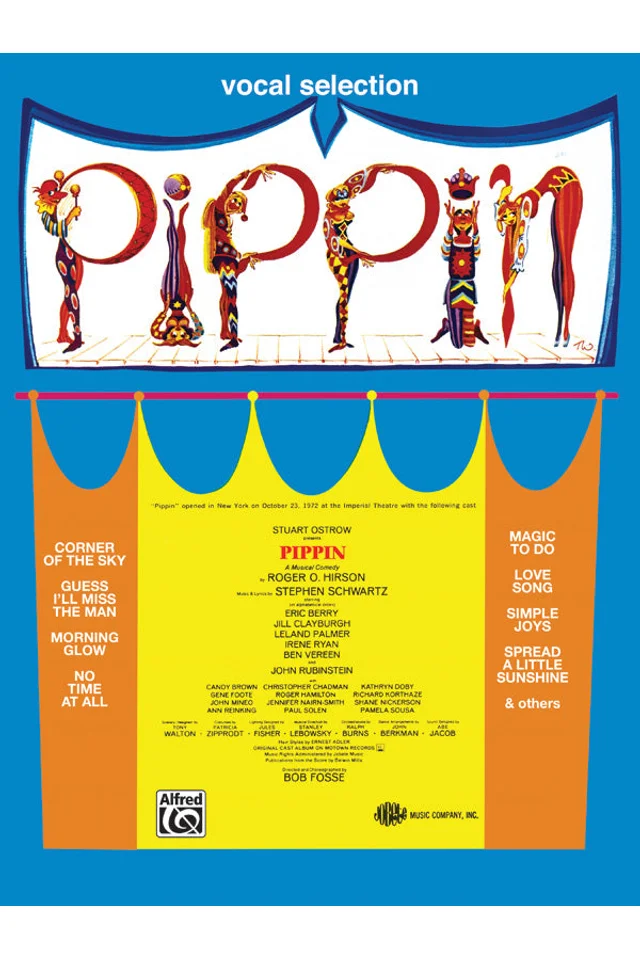
Blue and orange Pippin vocal selections cover with illustrated figures forming the title and a theatrical curtain motif.

Pippin

Musical · 1972

A traveling performance troupe of Players led by a Leading Player invites the audience to witness their show, promising a spectacular experience ("Magic to Do"). They begin telling the story of Pippin (his actor is described as a new Player making his stage debut), the first son of Frankish King Charlemagne. After a brief overview of his life from birth to young adulthood, Pippin, a recent university graduate, sings of his search for his purpose in life ("Corner of the Sky"). Pippin returns home to his father's castle and estate, where Charlemagne and Pippin's reunion is constantly interrupted by nobles, soldiers, and courtiers vying for Charlemagne's attention ("Welcome Home"). Pippin also meets with his ambitious stepmother Fastrada, and her strong but dim-witted son Lewis. Charlemagne and Lewis are going to battle against the Visigoths soon, and Pippin begs his father to take him along as a soldier to prove himself. Charlemagne reluctantly agrees and explains the battle plan to his men ("War is a Science"), interrupted repeatedly by an over-enthusiastic Pippin. The Players express the battle through song and dance, with the Leading Player and two lead dancers in the middle (performing Bob Fosse's famous "Manson Trio") and the actual violence in the background ("Glory"). Charlemagne declares victory and leads his army off to the next battle. A disillusioned Pippin has a cynical discussion with an enemy soldier's severed head, recognizing the futility of war. He flees to the countryside as the Leading Player sings of the pleasures of a free and easy life ("Simple Joys"), then meets with Berthe, his paternal grandmother, exiled by Fastrada. She tells Pippin to stop worrying about his future and enjoy the pleasures and comforts of the present ("No Time at All"). Pippin takes this advice to heart and searches for more lighthearted pastimes. He enjoys many sexual encounters but soon becomes overwhelmed by their meaninglessness and forces all the women away ("With You"). The Leading Player suggests to Pippin that fulfillment can be found in fighting against Charlemagne's tyrannical ways, and Pippin plots a revolution against his father. Fastrada learns of Pippin's plan and devises one of her own: if Pippin either successfully kills Charlemagne, or fails and is arrested for treason, Lewis will be next in line for the throne either way. She manipulates Charlemagne into going to his annual prayer early, and she tells Pippin that he will be at the chapel unarmed ("Spread a Little Sunshine"). At the royal chapel at Arles, Pippin confronts his father, who justifies his cruelty and tyranny as necessary to achieve peace and prosperity for the realm. He then resigns to his fate, and after Pippin assassinates him, the people rejoice and bow to their new king ("Morning Glow"). The Leading Player informs the audience that the actors will break for now, but assures them they will enjoy the finale. As king, Pippin brings peace to the land by giving to the poor, eradicating taxes, ending the military, and peacefully settling foreign disputes. However, this soon falls apart, as Pippin is forced to go back on many of his promises, reverting to Charlemagne's ways. At Pippin's request, the Leading Player revives Charlemagne, who takes the throne back, and Pippin is left discouraged, as his life is still unfulfilled. The Leading Player counsels him to keep going down his life's path ("On the Right Track"), but after experimenting with art and religion, Pippin falls into monumental despair and collapses on the floor. Widowed farm-owner Catherine finds him on the street, and is genuinely attracted to him ("And There He Was"), to the Leading Player's concern. Introducing herself ("Kind of Woman"), she has Pippin help as a farmhand on her estate. Pippin thinks himself above such things ("Extraordinary"), but after comforting her son, Theo, on the sickness and eventual death of his pet duck ("Prayer for a Duck"), he falls in love with Catherine ("Love Song"). As time goes by, Pippin grows too comfortable in monotony and leaves the estate to continue searching for his true purpose. Catherine is heartbroken and reflects on him, spontaneously beginning a song that was not initially in the script, to the Leading Player's anger and surprise ("I Guess I'll Miss the Man"). The Leading Player and the troupe find Pippin alone and tell him that the only fulfilling thing is their planned finale, in which Pippin will commit suicide by lighting himself on fire for one burst of glory. At the last moment, he realizes that there must be something more to life and chooses not to follow through. Catherine and Theo enter, defying the script, and stand beside Pippin. He realizes that his purpose was never to achieve greatness or glory, but rather to live an ordinary life ("Finale"/"Magic Shows and Miracles"). The furious Leading Player calls off the show and tells the rest of the Players and the orchestra to pack up, abandoning Pippin, Catherine, and Theo on a truly empty stage. Pippin is left devoid of anything extraordinary but finally feels fulfilled. The "Theo ending" was originally conceived in 1998 by Mitch Sebastian, and is included in all newer productions of Pippin, including the 2013 Broadway revival. After the Players shun Pippin for not performing the grand finale, and he avers his contentment with a simple life with Catherine, Theo remains alone on stage and sings a verse of "Corner of the Sky", after which the Leading Player and the Players return, backed by the "Magic to Do" melody, implying that the existential crisis at the heart of the play is part of a cycle and will now continue, but with Theo as the Players' replacement for Pippin. Current productions vary between the two possible endings, though Schwartz himself has expressed his preference for the newer ending. This is also the ending used in most licensed versions of the musical. Notes

Play On!

Musical · 1996

Vy comes to swinging 1940s Harlem to write songs for the Duke, Harlem's greatest band leader. To overcome the sexist barriers of the time against women songwriters, she disguises herself as a man, Vy-man. She finds the Duke in tears over his loss of Lady Liv, Harlem's "queen of the blues". The Duke likes Vy-man's music, so he instructs the songwriter to go to the Cotton Club and present one of her songs as if it were a new song written by the Duke for Lady Liv. Once Lady Liv finds Vy-man to be quite charming, a series of mistaken pairings ensue. Meanwhile, Jester and several other Cotton Club performers are rebelling against the overly serious and tyrannical club manager, Rev. Since Rev has a crush on Lady Liv, the performers persuade him that he should woo her by learning to swing and scat, giving up his old fashioned ballads. More confusion results before the truth is revealed, and the couples are appropriately united.

Pokémon Live!

Musical · 2000

The following synopsis is based on videos of the show as provided by the production manager, Chris Mitchell, and the script he provided to pocketmonsters.net. The story begins with a shadowed Giovanni releasing a commercial challenging all Pokémon Trainers to win the one-of-a-kind Diamond Badge by defeating him and his Pokémon in a battle. Ash declines to join his mother Delia, and Professor Oak to a lecture on sleep disorders among Snorlax, because he has decided to accept the mysterious Gym Leader's challenge. As he prepares for the journey, Misty chastises him for not taking her to the movies for her birthday as promised three weeks ago. Ash promises to make it up to her somehow, but adds that Pokémon are his friends too ("You and Me and Pokémon"). Together with Brock, Ash and Misty head off for the Gym using a map downloaded from the Diamond Badge website. Meanwhile, Jessie, James, and Meowth get a call from Giovanni ordering them to go to his headquarters. When they arrive, he gloats about his ultimate creation, MechaMew2. The mechanical monster—based on the powerful Mewtwo he had late in the anime's first season and Pokémon: The First Movie—will soon be unstoppable ("It Will All Be Mine"). He orders Team Rocket to capture Ash's Pikachu, because it has Thundershock and Thunder Attack, two techniques that MechaMew2 doesn't have. They promise to do as he says after he promises them a good pay. Soon, several trainers face off against MechaMew2, which copies the attack of its challengers and uses it against them to defeat them. Among the moves it learns is Self Destruct, which it is not ordered to return as doing so would destroy it. Giovanni praises his mechanical Pokémon and gloats that as soon as it learns every Pokémon's attack, nothing will stand in his way ("It Will All Be Mine (Reprise)"). In the forest, Brock chases cute girls and Misty laments that Ash is ignoring her in favor of his Pokémon. Ash tells his friends that he wants them to travel together forever ("My Best Friends"). Jessie, James and Meowth dig a pitfall trap for Ash and his friends to fall into, but the heroes walk right over it without incident because the Rockets forgot to remove the supports. To their misfortune, Jessie and James only realize the cause when they pull out the supports and fall into their own trap, leaving a frustrated Meowth to run off for a rope to pull them out. In the meantime, Delia and Professor Oak approach the old, run-down building where the Snorlax lecture is supposed to be held. After Delia confesses that she feels that she is losing touch with her son, the Professor reassures her by saying that things never stay the same for long ("Everything Changes"). Suddenly, several Rocket Grunts rush out of the shadows and surround them, and Giovanni says that the lecture was a trap to lure Professor Oak to them. When the Boss also recognizes Delia, she insists that anything between them was in the past, to which he says that some things don't have to change. Giovanni orders the Rocket Grunts to take Delia and Oak to an (offstage) helicopter and to his headquarters, where they'll witness something that will change the world forever ("Everything Changes (Reprise 1)"). Back in the forest, the heroes are lost and alone after Brock earlier threw the map in the river while asking a female trainer for directions. They try getting help from a deaf trainer with Brock interpreting his signs, who agrees to share his map on the condition that he and the "guy with the goofy smile" have a battle first. Offended, Ash agrees to this, but the deaf trainer sends out Jigglypuff, who instantly starts singing, which makes everyone fall asleep, after which Jigglypuff draws on their faces. Some time later, Misty wakes up and wipes Jigglypuff's drawings off Ash's face, singing about her unrequited love for him as she does so ("Misty's Song"). Ash and Brock wake up as well, with the former wondering aloud who was singing just now. Misty claims the song was Jigglypuff's, and the heroes notice that the deaf trainer kept his end of the deal and left his map for them. The group continues on to the next part of the path, this time with Misty carrying the map. Meanwhile, Meowth gets Jessie and James, who have also danced to Jigglypuff's song, out of the pit while complaining about their incompetence. Realizing that Meowth is right, Jessie and James lament their status as failures. Meowth cheers them up by telling them that being failures is something at which they're successful ("The Best at Being the Worst"). With that, the Rockets set out to find Pikachu again. Using their Magikarp submarine, they manage to catch up with the trainers at Cerulean Blue Lagoon, where Ash declares that he's going to use Pikachu against the gym leader ("Pikachu (I Choose You)"). While the kids get caught up in the song, Team Rocket captures Pikachu when he dances near them. By the time Ash realizes Pikachu is missing, Team Rocket is long gone. After an intermission segment in which Ash's Pokédex Dexter explains his important contribution to Ash's continuing success and gathers data from the audience ("What Kind of Pokémon Are You?"), the heroes return to the forest. Ash is positive that his favorite Pokémon has once again been kidnapped by Team Rocket. Misty, still upset about being ignored on her birthday, suggests that maybe Pikachu has just left Ash of his own will because of the trainer's new habit of ignoring his friends. She runs after Brock, leaving Ash to ponder her words and worry that Pikachu did leave on his own. Ash bids an emotional farewell to Pikachu ("The Time Has Come"). At the Gym, Delia and Professor Oak are in the battle arena and locked inside giant cages. Oak asks Delia why the Boss recognized her. She explains that Giovanni is an old boyfriend from when she was a teenager and used to hang out with a bad crowd, which she put behind her when she met Ash's father. She never told this to Ash, fearing that he would not understand. Delia came to hate Giovanni, which he arrives just in time to hear. Realizing Delia has changed, Giovanni tells them that they're here to witness the final battle, as the only attacks left to be learned are Pikachu's electric moves ("You and Me and Pokémon (Reprise)"). Immediately after, the Rockets arrive with the captured Pikachu ("Double Trouble"). Giovanni orders them to battle MechaMew2 using Pikachu. They attempt to command Pikachu, but Pikachu shocks the Rockets instead, knocking them into the cages and allowing Oak and Delia to escape. Giovanni is unconcerned with his prisoners' escape. He realizes that Pikachu's trainer is necessary to make it battle, so he orders Jessie, James, and Meowth to bring Ash to him. They agree and set off to capture Ash ("Double Trouble (Reprise)"). Meanwhile, as she and Brock search fruitlessly for Pikachu, Misty admits that she just wanted Ash to realize that he's alienating his friends—specifically, her. Brock realizes Misty really likes Ash, and Misty denies it by saying Brock wouldn't know anything about liking someone—after all, he's always chasing Nurse Joy and Officer Jenny ("Two Perfect Girls"). Not far away, Delia and Professor Oak continue their discussion about her past and conflict over whether or not to tell it to Ash. Meanwhile, Misty continues to lament over her feelings for Ash. Elsewhere, Ash tells himself that he may have to go on without Pikachu, even if it hurts ("I've Got a Secret"). Soon, all five of them converge in the forest. Delia tells Ash that Giovanni has Pikachu in his hideout and that Team Rocket kidnapped him. Ash is furious, determined to get his Pokémon back and win the Diamond Badge. Before he can leave, Delia tells Ash of her past with Giovanni. Ash is shocked by the news and is in a hurry to leave. Suddenly, Jessie and James appear on scooters, ordering Ash to come with them. The team is utterly shocked when Ash agrees to join them without a fight. The others try to follow, but Meowth says that Ash was the only Pokémon trainer Giovanni wanted. As Ash and Team Rocket leave, Delia laments that she gave Ash even more of a reason to confront Giovanni. ("Everything Changes (Reprise 2)"). At his headquarters, Giovanni tells MechaMew2 that soon, their conquest of the world will begin. Ash runs in and demands that his Pikachu be returned. When Giovanni hears his surname and realizes he's Delia's son, Ash is angered and tells him to leave his mother out of this. Jessie and James enter announcing their capture of Ash, missing that he had already entered the arena, and celebrate having done two things correctly in one day. The Boss grows annoyed with them and orders them to leave, and they crash their scooters upon exiting. Joyfully reunited with Pikachu, Ash prepares to battle Giovanni and is shocked when he reveals himself to be the Gym Leader from the commercial. Giovanni mockingly gives Ash the Diamond Badge, saying he'll retrieve it after Ash loses. Ash orders Pikachu to Thundershock, then Thunder MechaMew2, but the attacks do not affect it. MechaMew2 then returns the attacks, rendering Pikachu unable to battle. With that, Giovanni proclaims his victory because his Pokémon has now learned every single attack. Undaunted, Ash engages the Boss in a fistfight ("You Just Can't Win"). Tiring of the scuffle, Giovanni orders MechaMew2 to attack Ash with Hyper Beam, but Mewtwo appears to save Ash with a forcefield. He then attacks MechaMew2 with a collection of Ash's happy memories, like his love for Pokémon and Misty. MechaMew2 speaks for the first time and rebels against Giovanni, revealing that it learned about love and goodness from Ash. Recognizing that Giovanni is evil, MechaMew2 feels it must stop his plans no matter the cost. MechaMew2 puts Giovanni in a headlock and prepares to Selfdestruct, telling Mewtwo to take an unconscious Ash somewhere safe.

Portofino

Musical · 1958

Portofino is a musical with a book by Richard Ney (who also served as producer), lyrics by Ney and Sheldon Harnick, and music by Louis Bellson and Will Irwin. In his book on Broadway, The Season, William Goldman described its growing pains similarly to Buttrio Square and Breakfast at Tiffany's. Set in a piazza in the Italian resort town of Portofino, the plot involves auto-racing duke Nicky; his Texan rival Kitty; his granddaughter Angela, a practicing witch; the local padre; and his look-alike Guido, an emissary from the devil. When critics crucified the show during its Philadelphia tryout, Ney, the producer, left it to the cast to decide if they should continue to New York City, they voted to continue.

Present Arms

Musical · 1928

Present Arms is a Broadway musical comedy that opened April 26, 1928, with music by Richard Rodgers, lyrics by Lorenz Hart, and the book by Herbert Fields. It was produced by Lew Fields, with musical numbers staged by Busby Berkeley. It ran for 155 performances at the Lew Fields' Mansfield Theatre, which is known as the Lena Horne Theatre today. Present Arms was filmed in 1930 with Irene Dunne, with its title changed to Leathernecking. The film is presumed lost.

Pretty Filthy

Musical · 2015

Described as a "porn docu-musical," the show follows several vignettes of adult film stars, focusing extensively on Becky, a young woman just beginning in the industry. She moves to Los Angeles, where she gets a manager and changes her name to Taylor St. Ives. Throughout her experience, she brings along her boyfriend Bobby, who himself becomes an adult film star, and meets veteran star Georgina Congress, exploring the challenges of the industry in forming relationships, gender parity and the evolution since its inception.

Pretty Woman

Musical · 2018

Pretty Woman is a musical with music and lyrics by Bryan Adams and Jim Vallance, and a book by Garry Marshall and J. F. Lawton. The musical is based on the 1990 film of the same name written by Lawton and directed by Marshall. It centers on the relationship that develops between Vivian Ward, a free-spirited Hollywood prostitute, and Edward Lewis, a wealthy businessman who hires her for a week to be his escort for several business and social functions. The original production of Pretty Woman premiered at the Oriental Theatre, Chicago in March 2018, with direction and choreography by Jerry Mitchell, and starring Samantha Barks and Steve Kazee, as Vivian and Edward. It made its Broadway debut at the David T. Nederlander Theatre on August 16, 2018, and closed one year later on August 18, 2019.

Prince Ananias

Musical · 1894

Arriving at the court of King Boniface, a touring troupe of players finds that the king has lost his ability to laugh. They are tasked with finding his sense of humor; the penalty for failure is death. They produce a work, Prince Ananias, that is not well-received, except that the title character is so inept that the king bursts out laughing. Thus, the players have a happy ending, as do the several pairs of lovers who overcome various romantic and backstage complications.

Prince of Central Park

Musical · 1988

Prince of Central Park is a 1989 Broadway musical with music by Don Sebesky, lyrics by Gloria Nissenson and a book by Evan H. Rhodes. It is based on Rhodes' 1974 novel The Prince of Central Park and its 1977 television movie adaptation which starred Ruth Gordon and Brooke Shields. The musical was a notorious flop, losing nearly $2 million and closing after only four performances. Today, it is best remembered for a humorously negative review by Frank Rich in The New York Times.

Princess Caprice

Musical · 1912

Princess Caprice is a musical theatre work described as a "comedy with music", in three acts, with music by Leo Fall. The book was adapted by Alexander M. Thompson from Fall's operetta Der liebe Augustin by Rudolf Bernauer and Ernst Welisch. The lyrics were by A. Scott-Craven, Harry Beswick and Percy Greenbank. Much of the music was from Der liebe Augustin, but Fall composed four new numbers, with lyrics by Scott-Craven, for the new piece. The story involves mistaken identities and farcical financial dealings at a European palace, following which the proper romantic partners are paired happily. The original production opened at the Shaftesbury Theatre, London, on 11 May 1912, running for 265 performances until January 1913. It was produced by Robert Courtneidge. The piece then toured.

Princess Charming (operetta)

Musical · 1925

Princess Charming is an operetta with music composed by Albert Szirmai. The English libretto by Arthur Wimperis and Lauri Wylie is based on the Hungarian libretto by Franz Martos. The operetta is set in the Palace of the Elyrian Embassy in the fictional European country of Novia and the Sigman Castle adjoining the Royal Palace. The story concerns a young princess who accepts a proposal of marriage from the elderly king of a neighboring country as protection against an uprising by her own subjects. Captain Torrelli, a military officer sent by the king, fears imminent danger to the princess and marries her himself. The officer then escorts her to his king for an annulment, but the couple fall in love and elope. The operetta was first presented in Hungarian in 1925 in Budapest as Alexandra. Its English-language premier was in London in 1926, and it was revived on Broadway and elsewhere. A 1934 film adaptation was made, starring Evelyn Laye.

Princess Toto

Musical · 1876

Absent-minded Princess Toto is due to marry Prince Caramel, but her earlier betrothed Doro returns after being shipwrecked. Confusion follows when Caramel disguises himself as the brigand Barberini, and Toto runs off with him shortly after marrying Doro. She later joins her father’s court disguised as American Indians, while Doro and Caramel each pursue her. After more mistaken identities, Toto recognizes Doro as her husband and agrees to marry him again; Caramel proposes to Toto’s nurse, Jelly.

Priscilla, Queen of the Desert

Musical · 2006

The drag queen Mitzi Mitosis – stage name of Anthony "Tick" Belrose – is performing at a club ("Downtown" [Australia and London]/"I've Never Been to Me"; "It's Raining Men" [Broadway]) when his estranged wife Marion, calls in for a favour. While Tick is offstage, fellow drag queen Miss Understanding performs her own number ("What's Love Got to Do With It?"). From the phone in Tick's dressing room, Marion reveals that she needs an act for a few weeks at her business in distant Alice Springs, Australia. Tick is at first reluctant, but Marion informs him that part of the reason she's asking is because their now eight-year-old son Benji wants to meet his father ("I Say A Little Prayer"). Tick confides in another fellow drag queen Farrah, before deciding he will leave for Alice Springs. Tick then calls a friend, a transgender woman named Bernadette to join him but Bernadette's husband has just died. The pair meet at the funeral ("Don't Leave Me This Way"), where Bernadette agrees to join him. Tick also asks a friend Felicia – stage name of Adam Whitely – to come with them ("Venus"/"Material Girl"), with Bernadette taking an immediate dislike to his show-off performance style. Nonetheless, the newly formed trio buy a "budget Barbie campervan" they nickname "Priscilla, Queen of the Desert" ("Go West"). Tick informs them that the trip is a favour to his wife, but does not tell them it is also to meet his son who wants to see him ("I Say A Little Prayer (Reprise)"). As the journey to Alice Springs begins, Adam angers Bernadette after making transphobic jokes about her life before transitioning. Later the group arrives at a bar in Broken Hill, in full drag, and start a bar dance party ("I Love the Nightlife"), but when they return to the bus learn that the townspeople wrote hateful statements on the bus in spray paint. Tick is very upset, but Adam and Bernadette comfort him ("Both Sides, Now"/"True Colors"). While on the road, Adam practices his lip-syncing as Felicia sitting in the giant high heel on the roof of the van ("Follie! Delirio vano è questo! Sempre libera (from La traviata)"). The next morning, Priscilla breaks down and Adam buys lavender paint to erase the vandalism ("Colour My World"). They manage to get the locals of another town on their side and meet Bob, a mechanic from a small town nearby who agrees to help fix Priscilla. The group celebrates that they've found people that accept them ("I Will Survive"). The second act opens with a group of bogans singing ("Thank God I'm A Country Boy"). Bernadette talks with Bob and learns that when he was in Sydney, he saw her when she was a young "Les Girl" ("A Fine Romance"). The two begin to grow feelings for each other. Later in a bar ("Thank God I'm A Country Boy Reprise"), the trio is about to perform ("Shake Your Groove Thing") when Cynthia, Bob's wife, interrupts their act by "popping" ping-pong balls ("Pop Muzik"). After this, the trio leaves, leaving Bob to wonder about his feelings for Bernadette ("A Fine Romance (Reprise)"). All of a sudden, Bernadette asks if he wants a free ride back to his real home, in which he agrees ("Girls Just Wanna Have Fun"). Later when they arrive, Adam dresses up like a woman to try to meet men ("Hot Stuff"), but ends up getting chased and nearly becomes the victim of a hate crime until Bernadette rescues him by kicking one of his attackers. Later as they arrive in Alice Springs, Tick reflects on the trip after someone literally leaves the cake out in the rain ("MacArthur Park"). As another act performs first ("Boogie Wonderland"), the trio gets ready to perform a variety of songs that they sang or lip-synced on their journey ("The Floor Show"). Afterwards, Tick finally meets his son, Benji, who accepts his father's sexuality and lifestyle ("Always on My Mind/I Say a Little Prayer") and Adam gets to perform his own solo Madonna hit, ("Like A Prayer" [Broadway]; "Confide in Me/Kylie Medley" [Australia and West End]), his favorite singer. Afterwards the gang talks about their plans after Alice Springs, and realize they can't leave each other ("We Belong"). They go off stage together and the company performs a medley of songs to close the show ("Finally (Finale)").

Prisoner Cell Block H: The Musical

Musical · 1995

Prisoner Cell Block H: The Musical is a stage musical based on the Australian television series Prisoner (also known as Prisoner Cell Block H) created by Reg Watson. The concept, music and lyrics where devised by Don Battye and Peter Pinne. After previews from 23 October 1995, the musical opened on 30 October 1995 at the Sondheim Theatre (formerly The Queens Theatre) in London's West End. It closed on 13 January 1996. The cast featured Lily Savage and Maggie Kirkpatrick.

Prodigal

Musical · 2000

As the OVERTURE fades, we meet Luke Flannery and his family; father Harry, mother Celia and brother Kane, who live in Eden, Australia ((PICTURE POSTCARD PLACE). Luke is 18 and about to join the Flannery fishing business, but isn't so sure that he wants to spend another eighteen years playing (HAPPY FAMILIES). Harry gives him a car for his birthday, to use for business (much to Kane's disgust). Luke announces he has been offered a place at Sydney University, and wants to go. Celia tries to keep the mood light (PICTURE POSTCARD PLACE - REPRISE). Against Harry's wishes, Luke runs away to Sydney (RUN WITH THE TIDE). He moves into a warehouse apartment with Maddy, a performance artist, who encourages him to shift his perspective and see the world with BRAND NEW EYES0. They quickly become best friends, but when Maddy tells Luke she loves him, he is forced to introduce his boyfriend from University, Zach. A few weeks later, Zach moves into the apartment, and the three get better acquainted sharing childhood memories (WHEN I WAS A KID). Luke realizes he has shut his family out of his life, so calls home to tell his parents his news, who don't react as he hoped (MY BOY). Luke responds by going out, experimenting with drugs, letting all responsibility slide (OUT OF MYSELF). Maddy throws him out after one late night party too many, and eventually Zach dumps him too (SET ME FREE). Luke decides to return home and mend the bridges he burned (EPIPHANY). The homecoming doesn't go as planned, as neither Luke nor Harry can bring themselves to admit they could be wrong, and Luke is thrown out of the house. When Harry stops Celia from going after him, she pushes him aside (LOVE THEM AND LEAVE THEM ALONE). Harry takes his frustration out on Kane, and goes down to the pub. Celia tracks Luke down at the local pub, and asks him to be a little more understanding of Harry, but Luke won't back down in his beliefs (WHERE DOES IT GET YOU). She leaves him for the night, and Luke receives a phone call, telling him to meet Kane at the shipyard. At the docks he is attacked and badly injured. Maddy performs the piece she developed through meeting Luke and opening up to her own dad (MADDY'S PIECE). Kane comes home the next day to find out from Harry that Luke is in the hospital. Kane admits responsibility, but before walking out points out Harry isn't blameless himself. Harry goes to the hospital and relieves Celia of her watch over Luke (LULLABY). Months later. Luke has healed, but won't leave the family home, even with Celia and Harry's encouragement. They spring a surprise on him; they've invited Maddy down. She reminds Luke of why he left Eden originally and helps him to reimagine the life he went searching for. He decides to return to Sydney, and try again (FINALE). Luke heads out to show Maddy around his home town, leaving Harry and Celia in the family kitchen.

Promenade

Musical · 1965

Promenade is an experimental musical comedy with book and lyrics by María Irene Fornés and music by Rev. Al Carmines. In a review in The New York Times for a 1983 New York revival, Stephen Holden linked the production to the Theatre of the Absurd: "This work, which suggests a mixture of Candide and Samuel Beckett viewed through Lewis Carroll's looking glass, is a little too avant-garde and absurdist to appeal to mainstream tastes. But in its odd way it's an exquisite piece of musical theater."

Promises, Promises

Musical · 1968

Chuck Baxter is an ambitious bachelor and junior executive for a large insurance company, Consolidated Life, who expresses his frustrations and hopes for career advancement ("Half as Big as Life"). To curry favor with higher-ups in the company, he allows his apartment to be used for their romantic trysts in return for promises of promotion ("Upstairs"). Chuck has his own eye set on Fran Kubelik, a waitress in the company cafeteria whom he's always admired from a distance. While talking together she wonders if she will ever find someone to share her life with. Chuck hopes that she might notice him ("You'll Think of Someone"). J.D. Sheldrake, the company's powerful personnel director, notices the glowing reviews written by Chuck's superiors and deduces the reason for them. He requests sole use of the apartment for his affairs in exchange for Chuck's long-awaited promotion and tickets to a basketball game ("Our Little Secret"). (In the 2010 revival, the song "I Say a Little Prayer For You" was added for a scene in which Fran tells female workmates about flowers she has received from a new "mystery individual".) Chuck asks Fran to attend the basketball game with him, and she agrees to meet him there after first having a drink with her soon-to-be ex-lover ("She Likes Basketball"). Fran's lover turns out to be the married Sheldrake. Fran wants to end the relationship, but Sheldrake talks her into spending the evening with him ("Knowing When to Leave"). Though Fran stands him up, Chuck forgives her. When he informs the other executives that his apartment is no longer available for their use, they express dismay ("Where Can You Take a Girl?"). Meanwhile, Sheldrake wonders why he is drawn to affairs ("Wanting Things"). The scene shifts to the company Christmas party, where everyone is enjoying themselves ("Turkey Lurkey Time"). Miss Olsen, Sheldrake's secretary, reveals to Fran that she is simply the latest in a long line of Sheldrake's mistresses. The first-act curtain falls as Fran is driven to misery ("A House is Not a Home" in the 2010 revival), and Chuck discovers that Fran is the one Sheldrake has been taking to his apartment. A despondent Chuck spends Christmas Eve trying to drink away his troubles at a bar, where he meets another tipsy lonelyheart, Marge MacDougall, who agrees to come back to his apartment ("A Fact Can Be a Beautiful Thing"). In the meantime, at Chuck's apartment, Fran confronts Mr. Sheldrake about his earlier affairs. While he admits to the affairs, he declares his love for Fran, but tells her that he must leave in order to catch his train home to spend Christmas Eve with his family. A despairing Fran discovers Chuck's sleeping pills and takes the whole bottle ("Whoever You Are"). When Chuck arrives with Marge, he discovers Fran on his bed. After quickly disposing of Marge, a frantic Chuck gets his neighbor, Dr. Dreyfuss, to come over and together they save her life. The next morning Chuck calls Sheldrake to let him know what happened. Sheldrake says he can't leave for the city without his wife knowing and asks Chuck to take care of Fran ("Christmas Day"). Over the next few days Chuck and Dreyfuss try to keep Fran's spirits up to prevent a relapse into suicidal behavior ("A Young Pretty Girl Like You"). Chuck and Fran play gin rummy and discuss their problems, growing closer ("I'll Never Fall In Love Again"). Mr. Kirkeby, one of Chuck's former 'clients', discovers that Fran has been staying at Chuck's apartment, so as revenge for cutting him and the others off from using the apartment he tells Fran's overly protective brother where she has been staying. Karl Kubelik then comes to the apartment to collect her, and believing that Chuck is the cause of her current state he punches Chuck. Miss Olsen soon discovers that Sheldrake's actions led to Fran almost killing herself. She quits her job and tells Mrs. Sheldrake all about her husband's affairs. She leaves him, resulting in his desperation to woo Fran back. Sheldrake asks for the keys to Chuck's apartment again on New Year's Eve to take Fran there. Chuck refuses and quits his job rather than allow Sheldrake to take Fran to his apartment ever again ("Promises, Promises"). Deciding that he has to get away, Chuck begins packing to move elsewhere when Fran comes to see him. Sheldrake had told her that Chuck had refused him access and quit, and she realizes that Chuck is the one who really loves her. As they resume their earlier game of gin, he declares his love for her, to which she replies, "Shut up and deal".

Pump Boys and Dinettes

Musical · 1982

The story takes place on an unspecified "Highway 57" on the outskirts of Frog Level, a rural community somewhere in the southeastern United States ("in Grand Ole Opry country" according to the official summary), at two adjacent locations: the Pump Boys service station and general store co-owned by Jim and L.M., and the Double Cupp, a diner operated by sisters Prudie and Rhetta Cupp ("Highway 57"). Jim's Uncle Bob calls the gas station to inquire about when his Winnebago will be fixed, and Jim stalls him by saying it takes time and extra care to do the job right ("Takin' It Slow"). Jim talks about the ladies that swing through the area, noting that his employee Jackson chases them, Eddie (a friend of the pump boys who hangs out at the station while his Edsel is being fixed) once lured a wealthy actress, but L.M., the station bookkeeper, draws the most attention, which L.M. doesn't even want ("Serve Yourself"). At the Double Cupp, Rhetta advertises the diner's menu ("Menu Song"). Prudie talks about how the male-to-female ratio in the area plays in her favor, and that although Eddie comes close to her ideal, his being from the nearby "inbred" town of Smyrna is a deal-breaker, and her real soulmate is in the audience ("Best Man"). Jim talks about how he forgot he had promised to take Rhetta to a minor league baseball game when he chose to go fishing instead ("Fisherman's Prayer"/"Catfish"). Jim recalls his late grandmother ("Mamaw"). Jim takes one of the catfish from his fishing trip to Rhetta to cook, but Rhetta is still jilted and tells him off ("Be Good or Be Gone"), to which Jim tries to make good by offering her a silk artificial rose and to clean up his truck if she accepts another date at a nearby bar ("Drinkin' Shoes"). After intermission, the Pump Boys advertise their gas station's services and goods ("Pump Boys"). Jackson talks about what he does on the weekends, when he goes into town, where he has a crush on a cashier at Woolworth's ("Mona"). Jim and Jackson recall an exceptionally dry and troublesome summer the previous year, when anything that could go wrong did, which segues into a story about how L.M. met Dolly Parton backstage after a concert and had a brief fling before he cut off the affair due to extenuating circumstances ("The Night Dolly Parton Was Almost Mine"). At the Double Cupp, Rhetta and Prudie sing about wanting tips from their customers ("Tips") before reflecting on their childhood under an absent single mother, lamenting the emotional distance between each other ("Sisters"), then decide to shut down the diner for a time and take a trip ("I Need a Vacation"). The pump boys and Cupp sisters all head on a road trip to Florida in Bob's miraculously fixed Winnebago ("No Holds Barred"), where L.M. now relishes in the attention of the ogling "brown" onlookers ("Farmer Tan"). Bob calls the group, and Jim assures him that they will be returning soon ("Highway 57 (Reprise)"). Upon returning, they close the diner and gas station ("Closing Time").

Queen of the Mist

Musical · 2011

In the early 1900s, in western New York State, at Niagara Falls, Anna Edson Taylor is a 63-year-old teacher. Needing money, she decides to become the first woman to go over Niagara Falls, and designs her own barrel. She is helped by her manager, Frank Russell. "Navigating both the treacherous Falls and a fickle public with a ravenous appetite for sensationalism, this unconventional heroine vies for her legacy in a world clamoring with swindling managers, assassins, revolutionaries, moralizing family, anarchists, and activists. Convinced that there is greatness in her and determined not to live as ordinary, she sets out to battle her fear and tempt her fate." The score incorporates turn-of-the-century themes. Anna attempts to take advantage of her fame on the lecture circuit, but that does not last. Anna dies in a nursing home at age 82, a pauper.

Quilters

Musical · 1982

In the American West, Sarah, a pioneer woman, and six women, who are called her daughters, face frontier life. Rather than a straightforward story, the musical is presented as a series of short tales and tableau matched with musical numbers, each presenting an aspect of frontier life or womanhood. The patches or blocks show "girlhood, marriage, childbirth, spinsterhood, twisters, fire, illness and death." The patches ultimately are put together to form one dramatic tableau.

Radiant Baby

Musical · 2003

Radiant Baby is a musical about Keith Haring, who was an artist and social activist in New York City. The music was composed by Debra Barsha, with lyrics by Ira Gasman, Stuart Ross, and Debra Barsha. It was based on Keith Haring: The Authorized Biography (1991) by John Gruen. Radiant Baby was partially developed at the 1998 O'Neil Music Theater Conference in Waterford, Connecticut. It had its New York premiere at The Public Theater in a 2003 production directed by George C. Wolfe with Daniel Reichard in the title role. Kate Jennings Grant and Billy Porter also appeared in the New York production.

Raggedy Ann

Musical · 1986

The story, in the Broadway production, was as follows: Young Marcella is suffering from psychological trauma. Her mother ran away with another man, which drove her father to drink. Her dog tried to eat her pet bird, which killed them both ("Gingham and Yarn"). In Marcella's bedroom, a trio of doctors give differing but equally dire warnings regarding the youngster's ailments until Poppa throws them out. Lightening the mood, Poppa presents her with a doll that he created, which he names Raggedy Ann. Marcella complains that she has no heart, so Poppa pulls a candy heart from a box and stitches it onto the doll. He sings his daughter a lullaby, claiming that her toys spring to life when she's asleep ("Carry On"). Marcella's bed whirls around, and out from the covers pops Raggedy Ann. The girl says she's dying, and the trio of doctors emerge from beneath the mattress to corroborate her story ("Diagnosis"). Raggedy Ann shouts them off and urges Marcella to get out of bed, revealing that this is a dream, so she can do anything she wants. The rag dolly calls for help from her friends: Raggedy Andy, Baby, and Panda, who emerge from the toy box one by one ("The Light"). Andy is curious as to what's behind the closet door, so he opens it despite Marcella's pleas. General D. emerges with his cronies, the sexy Bat and the roguish Wolf. He says that he's enlisting recruits for his Army of the Dead and thinks Raggedy Ann is the one he's looking for, but she argues that she's only "Make Believe". The General learns that Marcella is dying, so he declares that he'll be back to collect her at 6 a.m. Suddenly, Marcella and the toys find themselves at the Miami shipyard, where old toys go to die. The doctors appear and drop the Camel behind a chain-link fence ("Diagnosis (Reprise)"). The animal tells the toys that he's all alone and "Blue". Raggedy Ann suggests that they should head to Los Angeles to visit the Doll Doctor. Andy leads them in transforming the bed into a boat, and they set sail ("Make Believe Reprise"). A giant hand sporting a thumb ring attempts to drag the boat down to Davy Jones' Locker, so the toys begin flapping the bed's blankets like wings and rise into the heavens ("Something in the Air"/"So Beautiful"). Along the way, Marcella reunites with her pet bird ("A Heavenly Chorus") and her parents ("The Shooting Star"). The Rat in the Rolls-Royce, representing the man her mother ran away with, jumps out to steal Mommy away, so Poppa punches him out, and the couple agree to remarry ("The Wedding"). Marcella says that she's tired of pointless stories and walks off, which fills Raggedy Ann with self-doubt, though the rag doll refuses to give up ("Rag Dolly"). Bat gnaws through the rope tethering them to the clouds, and the boat plunges from the sky. Marcella and the dolls land on the roof of a meatpacking plant in Omaha and have only four hours left to get to the Doll Doctor. Bat talks Raggedy Andy into handing over the map ("You'll Love It"). General D. arrives and commands Marcella to look at his opal thumb ring. He states his intention to make Marcella his queen. The toys lull the General and his cronies to sleep ("Would You Like a Little Music?") and steal the ring. The melody fills the Camel with such spirit that he's able to soar on the wings of the song, so everyone grabs on, and they float away. The General awakens and orders Bat to follow them, but Bat refuses, so the General throws her down a chimney and sends Wolf to find the dolls instead. The toys find themselves separated in the Grisley Woods National Park and frantically search for one another through a maze of trees littered with skeletons with glowing red eyes ("Gone"). They meet the Witch, dressed like a 1920s flapper ("Why Not?"). The Witch pulls a bundle of clothesline from her bag and tries to fashion a noose. Raggedy Ann tells the Witch that it's a terrible idea to kill herself, and the Witch reflects on the life that she gave up ("What Did I Lose"/"Somewhere"). The Witch reveals that she had a daughter named Marcella and comes to realize that the young lady standing before her is her child. They have a tearful reunion, which is interrupted by the arrival of Wolf. Bitter toward his master for killing Bat, he allows Marcella to escape but pursues the Witch into the woods. The toys arrive at the Doll Hospital ("Welcome to L.A."), but the doctors are revealed to be the same "quacks" as before ("Diagnosis (Reprise)") and tell them the Doll Doctor is dead. Panda suggests looking into the ring, where they see the head doctor alive and chained up. General D. emerges from the cellar and declares that this is his field hospital for the terminally wounded ("I Come Riding"). He becomes curious about the heart on Raggedy Ann's apron, but upon touching it, he collapses, crying that he's been poisoned by love. They tie up the General, swipe his keys, and head downstairs. He vows that he'll get loose. In the dungeon, the Doll Doctor examines Marcella, declaring that the "chick" has a broken heart. Upon hearing her father's pet name for her, Marcella realizes that the Doll Doctor is actually Poppa. Poppa says that a heart transplant is the only thing that can save her, but those haven't been invented yet, so he suggests a candy heart. Just as the General bursts in to collect Marcella, Raggedy Ann sacrifices her own candy heart, which she coerces the girl to eat ("The Light (Reprise)"). Raggedy Ann then leaves with the General, who is satisfied he was right all along. Back in her bedroom, a now-healthy Marcella tells Poppa of her adventure, and he offers to sew a new heart on Raggedy Ann's chest ("Gingham and Yarn Reprise").

Ragtime

Musical · 2023

Narration by J. P. Morgan, Henry Ford, Booker T. Washington, Emma Goldman, Harry Houdini, and Evelyn Nesbit connects three families: an upper-class White family from New Rochelle – Little Boy (Edgar), his Father (who runs a fireworks factory), Mother, Mother's Younger Brother, and Grandfather; a Black couple from Harlem in New York City – Sarah, who adores the pianist Coalhouse Walker Jr.; and Jewish immigrants from Europe on the Lower East Side – Latvian artist Tateh and his young daughter (“Prologue: Ragtime”). As Father leaves on Robert Peary's 1909 expedition to the North Pole, he asks Mother to oversee his affairs and assures her that nothing will change in his absence, but Mother feels adrift without her husband to guide her (“Goodbye, My Love”). A "rag ship" arrives, carrying a hopeful Tateh and his Little Girl to America, while Mother wishes Father safe passage (“Journey On”). Meanwhile, Mother's Younger Brother, an intense and awkward young man yearning for purpose who works at Father's fireworks factory, attends the vaudeville act of Evelyn Nesbit, a young woman who became famous after her wealthy lover Stanford White was killed by her millionaire husband Harry K. Thaw (“Crime of the Century”). After her show ends, Younger Brother confesses his love to Evelyn. She kisses him, but only for the benefit of a press photographer, then cheerfully rejects him afterward. At home in New Rochelle, Mother discovers a still-living newborn Black baby, partly buried alive in her garden. The police arrive with Sarah, the baby's mother. Pitying her, Mother takes responsibility for Sarah and her child. Brother thanks her. Surprised at herself, she remarks that her husband would never have allowed her to make such a decision (“What Kind of Woman”). At Ellis Island, the immigrants arrive (“A Shtetl Iz Amereke”). Tateh eagerly begins his new life, drawing silhouettes and selling them on the street. He and Little Girl quickly descend into poverty. Emma attempts to get him to join the Socialist movement, but he refuses. A wealthy man even offers to purchase Little Girl, whom Tateh now keeps on a leash for safety. Inspired by immigrant magician Harry Houdini, Tateh resolves to begin again somewhere else (“Success”). In Harlem, Coalhouse, a popular pianist, informs his audience that he's finally found his lost love, Sarah, and is going to win her back (“His Name Was Coalhouse”/“Gettin' Ready Rag”). He then purchases a Model T while Henry Ford and his workers glorify industry (“Henry Ford”). Tateh and Little Girl leave for Boston; en route, they meet Mother and Edgar in New Rochelle and politely make conversation (“Nothing Like the City”). At Mother's home, Sarah explains her desperate actions to her baby (“Your Daddy's Son”). Also en route to New Rochelle, Coalhouse is harassed by a racist fire squad led by Chief Willie Conklin, who taunt him for driving his own car. He arrives at Mother's house, where he has heard a Black woman is living. He is stunned to learn of the baby's existence, and when Sarah refuses to see him, he returns weekly (“The Courtship”) until Mother invites him inside. Grandfather asks Coalhouse to play a minstrel song on the parlor piano; instead, Coalhouse plays a ragtime song. Father returns home while Coalhouse is playing, and is stunned by the changes to his family's life, while Mother and Younger Brother are proud of her choices. Eventually, Sarah reconciles with Coalhouse (“New Music”). The two go on an idyllic picnic where, inspired by the words of Booker T. Washington, he dreams of a just, future America that their son will grow up in (“Wheels of a Dream”). At a worker's hall, Younger Brother hears Emma speak passionately about a textile mills strike in Lawrence, Massachusetts, where Tateh and his daughter are among those targeted by federal troops and strikebreakers. Younger Brother imagines that Emma is speaking directly to him (“The Night That Goldman Spoke at Union Square”). Emma is arrested, prompting a riot that mirrors the chaos in Lawrence, where Tateh is beaten by a policeman. He and Little Girl escape Lawrence on a train; he gives his daughter a flip book of moving silhouettes to calm her. The train conductor offers to buy the book, and Tateh, hurriedly dubbing it a "movie-book", sells it for a dollar. Tateh realizes that "movie-books" may be a route out of poverty (“Gliding”). Returning to New Rochelle, Coalhouse and Sarah are stopped by Conklin and the fire squad, who demand a fictitious toll; Coalhouse refuses. A lecture by Washington on patience and dignity is juxtaposed against the white firemen's destruction of Coalhouse's new Model T (“The Trashing of the Car”). Coalhouse vows legal action (“Justice”), postponing his marriage to Sarah until he gets justice. Sarah goes to a campaign rally nearby to ask for help from the vice-presidential candidate; as she approaches, J. P. Morgan shouts, "She's got a gun!" and Sarah is beaten to death by the Secret Service (“President”). At her funeral, Black mourners demand an end to such injustice and pray for true equality. Mother, Father, Younger Brother, Tateh and Emma look on as Coalhouse weeps at Sarah's grave (“Till We Reach That Day”). Edgar wakes up screaming from a nightmare in which Houdini attempts a daring escape after being locked in a dynamite-laden box by Willie Conklin ("Harry Houdini, Master Escapist"). This dream proves prophetic: news arrives that a volunteer firehouse has been bombed. Coalhouse has vowed to get justice on his own terms (“Coalhouse's Soliloquy”) and now terrorizes New Rochelle while demanding his car be restored to him and that Conklin be delivered to him. Washington condemns Coalhouse's actions (“Coalhouse Demands”). In the chaos, Mother retains custody of Sarah and Coalhouse's baby. Father blames her for bringing this turmoil into their lives, but Younger Brother lambastes him for his blindness and storms out of the house. Mother grows increasingly offended by her husband's ignorant outlook. Father, to distract Edgar from the unrest, takes his son to a baseball game, but feels alienated from the raucous, working-class crowd, and begins to realize that his genteel way of life is passing (“What a Game”). Coalhouse's campaign continues (“Fire in the City”), and so Father decides to temporarily move the family to Atlantic City. In Atlantic City, Evelyn's career is on the downslide and Houdini has become intrigued by the supernatural and the afterlife following the death of his mother (“Atlantic City”). Edgar cryptically shouts "Warn the Duke!" to Houdini. Mother encounters Tateh again, not recognizing him from their brief meeting months ago; now a wealthy filmmaker, he has re-invented himself as "the Baron Ashkenazy" and is directing a silent movie in Atlantic City (“Buffalo Nickel Photoplay, Inc.”). Edgar and Little Girl soon become fast friends, prompting Mother and Tateh to become friends as well; eventually, Tateh reveals who he is, and they grow even closer (“Our Children”). Back in Harlem, Younger Brother seeks out Coalhouse but is repeatedly turned away until Coalhouse is convinced that he can be trusted. Coalhouse has banished music from his life but watches a carefree young couple ("Harlem Nightclub") and recalls meeting Sarah (“Sarah Brown Eyes”). Younger Brother meets with him but is inarticulate and nervous: his profound thoughts, narrated to the audience by Emma, stand in contrast to the only phrase he can muster: "I know how to blow things up." (“He Wanted to Say”). With Younger Brother's help, Coalhouse and his men take over Morgan's magnificent library in the heart of New York City, threatening to blow it up. Father is summoned to help reason with Coalhouse. Before he goes, he assures Mother that everything will soon return to the way it was, but Mother knows such hopes are naive (“Back to Before”). Meeting with the police, Father devises a mediation strategy involving Washington, whom Coalhouse allows to enter the library. Washington, invoking the violent legacy Coalhouse is leaving his son, works out a deal with Coalhouse. Younger Brother is enraged at Coalhouse's abandonment of their cause (“Look What You've Done”). Washington leaves and Father enters the library as a hostage. There, he finally realizes the profundity of society's troubles while seeing Coalhouse convince Younger Brother and his men that violence cannot solve injustice. Coalhouse exhorts them to fight through the power of their words (“Make Them Hear You”). Coalhouse's sacrifice and oratory convince Younger Brother and the men to leave while Father tells Coalhouse about his son. Coalhouse thanks Father for his kindness. Once he leaves the library, Coalhouse is shot dead by the police. Edgar appears to introduce the Epilogue. Younger Brother departs for Mexico to fight for Emiliano Zapata. Emma is arrested and deported. Washington establishes the Tuskegee Institute, while Evelyn fades into obscurity. Houdini realizes upon the assassination of Archduke Franz Ferdinand that Edgar's shout of "Warn the Duke!" was a true mystical experience. Father dies aboard the RMS Lusitania; after a year of mourning, Mother marries Tateh, adopts Coalhouse and Sarah's son, and moves to California. Tateh is struck by an idea for a film series centering on a diverse group of children banding together. The ghosts of Coalhouse and Sarah watch their son grow up (“Epilogue: Ragtime/Wheels of a Dream: Reprise”).

Raisin

Musical · 1973

In Chicago in 1951, an African-American family – Ruth Younger, her husband Walter Lee Younger, their son Travis, and Walter's mother Mama Lena – are living in a cramped apartment. Walter is a chauffeur but thinks that his father's life insurance policy proceeds will buy a way to a better life. He plans on buying a liquor store, but his mother is against the selling of liquor. Tensions arise as Walter tries to convince Mama Lena to forget her dream of buying the family its own small house ("A Whole Lotta Sunlight"). Walter decides to make the deal for the liquor store and signs the papers with his partners Bobo Jones and Willie Harris. Beneatha, Walter's sister, is in college and is romantically involved with an African exchange student, Asagai. When Walter comes home drunk he joins Beneatha in a celebratory dance, picturing himself as a chieftain ("African Dance"). Ruth and Walter fight about their future but they reconcile ("Sweet Time"). Mama arrives to announce that she has bought a house in the white neighborhood of Clybourne Park, and Walter leaves in anger ("You Done Right"). Walter has not returned home and Mama finds him in a bar. She apologizes and gives him an envelope filled with money. She asks him to deposit $3,000 for Beneatha's college education, and tells him the rest is for him. As the family packs to move, a representative of Clybourne Park, Karl Lindner, arrives and offers to buy back the house. Walter, Ruth and Beneatha mockingly tell Mama of the enlightened attitude of their new neighbors. Just then Bobo arrives to tell the family the bad news that Willie has run off with the money. This forces Walter to contact Lindner and accept the offer to buy back the house. Although Beneatha berates her brother for not standing up for principles, Mama shows compassion and understanding ("Measure the Valleys"). When Lindner arrives, Walter announces that the family will, after all, move to the new house.

Rap Master Ronnie

Musical · 1984

Rap Master Ronnie is the name of several musical comedies developed by Garry Trudeau and Elizabeth Swados throughout the 1980s, including a 1984 off-Broadway "partisan revue," a music video, and a made for TV movie starring The Smothers Brothers, Carol Kane, and Jon Cryer. The shows all share the same basic structure of a faux campaign ad for Ronald Reagan, satirizing his social policies, particularly those regarding drugs and minorities. The shows received largely mixed reviews.

Re-Animator the Musical

Musical · 2011

Medical student Herbert West develops a glowing green serum that brings the dead back to life to catastrophic results. After the mysterious death of his mentor Dr. Gruber in Switzerland, West transfers to Miskatonic University in Arkham, Mass. to continue his studies. West enlists his friend Dan Cain to help him with his experiments, much to the chagrin of Dan's fiancée Megan Halsey, daughter of the dean of the medical school. Dr. Carl Hill tries to steal the re-agent and West beheads him and then brings him back to life.

Real Women Have Curves

Musical · 2023

In Boyle Heights, Los Angeles, in 1987, recent high school graduate Ana García is accepted to Columbia University. Ana struggles to balance her dream of going to college with family duty and a tough economic situation. Ana conceals the news from her father Raúl and her mother Carmen. Initially, Carmen resists the idea in favor of Ana helping her sister Estela, who oversees a textile factory and needs to manufacture 200 dresses in three weeks. The factory experiences several challenges including an immigration raid next door and the deportation of Itzel, one of their employees. Ana wants to both keep her family together and resolve their precarious finances. Ana accepts an internship at a newspaper, where she meets another intern named Henry. The two interns form a romance, with Henry disregarding Ana's self-deprecation. Ana juggles the newspaper internship with her factory job; in the end, she ultimately decides to go to Columbia University.

Red Hot and Blue

Musical · 1936

Nails O'Reilly Duquesne is a newly wealthy young widow. Loud and brassy, Nails is a former manicurist. She organizes a benefit for her favorite cause, the rehabilitation of ex-convicts. Together with her sidekick (an "ex-con" himself), Policy Pinkle, and her "square" boyfriend, lawyer Bob Hale, she embarks on a nationwide search for Bob's old girlfriend, which is really the reason for the enterprise. The girlfriend, 18 years earlier, had sat upon a hot waffle iron and so had a unique "imprint". However, the national lottery that Nails starts gets the attention of the Finance Committee, and they wind up in Washington DC in an even more complicated situation. The Supreme Court declares the lottery unconstitutional, because it would benefit the people.

Red Pepper

Musical · 1921

At a racetrack in Havana, Cuba, Juniper Berry and Jimpson Weed conspire to get rich quick by influencing the outcome of an impending horse race. They bet against the favored winner, the thoroughbred horse Red Pepper, with the intent of drugging the horse to prevent it from winning the race. Their plans get sidetracked and several side adventures occur. The pair follow the horse to Arizona and then Georgia in the hopes of successfully implementing their scheme.

Reefer Madness

Musical · 1998

This synopsis reflects the current version of the show as licensed. For information about other versions of the show, and cut songs, see below. The year is 1936. As the play opens, the Lecturer, a stern, conservative authority figure, informs a group of parents (the audience) of the new drug menace, "marihuana", which threatens the American way of life. (His warnings are reinforced by the Placard Girl, who throughout the play holds up large signs that clearly state scenes' moral lessons.) From his podium, the Lecturer warns the audience that action must be taken immediately before the children of America succumb to the Demon Weed ("Reefer Madness"). The Lecturer illustrates his point by re-enacting "the Harper Affair", which he claims is a true and horrific scandal. He begins by introducing us to Jimmy Harper and Mary Lane, a lovable pair of wholesome teens who hold hands, sip hot cocoa, and think pure thoughts while studying Shakespeare for English class ("Romeo and Juliet"). The Lecturer then shows us the seamier side of life at the Reefer Den, populated by drug-addled denizens. We meet Mae, the Reefer Den hostess, who is abused by her slick, pusher boyfriend Jack. She'd leave him, but Jack keeps her supplied with the marijuana she craves ("The Stuff"), despite his physical and sexual abuse. The Lecturer brings us now to the five and dime, a local teen hangout where wholesome kids indulge in the risqué rhythms of swing-jazz music, as performed by Duke Ellington, Dizzy Gillespie, and other "ginger-colored agents of evil" ("Down at the Ol' Five and Dime"). The Lecturer assumes the guise of kindly Mr. Poppy, the singing and dancing proprietor. Jack, trawling for youthful victims, arrives at the five and dime, where he meets Jimmy and lures him back to the Reefer Den under the pretense of offering him swing dancing lessons. There, Jimmy encounters Ralph, a psychotic ex-college student who communicates primarily with cackling, maniacal laughter. He also meets Sally, a marijuana-addicted prostitute who works to support herself and her baby. Jimmy is pressured into taking his first hit of marijuana ("Jimmy Takes a Hit") and tastes the forbidden fruits of sensual abandon in a wild hallucinatory dance sequence featuring weird sex, belly dancers, fire eaters, and Goat-Man, a frightening satyr played by the Lecturer ("The Orgy"). Over the next few weeks, we watch Jimmy make a terrifying transition from "good egg" to "bad apple". He mouths off to his parents, brutalizes a puppy, and even attempts to tongue-kiss a shocked Mary, sending her running off in tears. Alone in church, Mary prays that her sweetheart will regain his senses and return to her ("Lonely Pew"). Later, Jimmy and Ralph break into the church to steal from the poor box. While Ralph goes off to smoke some frankincense, Jimmy receives a vision of Jesus Christ! Jesus (played by Jack) warns Jimmy (in a Tom Jones-style production number) to kick his reefer habit or suffer eternal damnation ("Listen to Jesus, Jimmy"), but Jimmy ultimately refuses to heed Jesus's warning. Back at the Reefer Den, Jimmy is completely out of control. A desperate Mae warns Jimmy to avoid her own mistakes – he must escape the Reefer Den while he is still able. The drug-addled Jimmy won't listen. Even the revelation that Sally has sold her baby for drug money fails to snap him out of it. Sally's baby (played by Ralph) appears and sings a plaintive solo ("Lullaby"). Jimmy's misbehavior culminates with his stealing Mary's Packard and taking it for a reckless, marijuana-induced joyride with Sally. His joy, however, proves short-lived – Sally, who is driving, runs over a helpless old man crossing the street, killing him. Finally regaining his senses, Jimmy returns the stolen Packard to Mary's house and apologizes to her, pledging his love ("Mary Jane/Mary Lane".) Before he can give her his school ring as a token of his undying love, a siren sounds in the distance. Jimmy, now wanted for a hit-and-run, realizes that he must get far away from Mary lest he bring her down with him. He runs off into the night with no explanation. Mary doesn't know the exact nature of Jimmy's demons, but she vows he will not face them alone. She drives her Packard into the night in search of "her poor lost Romeo". Meanwhile, back at the Reefer Den, Jack and Mae hear a radio broadcast announcing the hit-and-run accident. Police are looking for a young man in a late-model Packard. Jack, fearing Jimmy will be arrested and lead the cops back to him, grabs a pistol and ominously vows to bring Jimmy back to the Reefer Den "one way or another" ("Act I Finale"). As the act begins, hallucinatory visions of Ralph, Sally and Mae appear as Jazz Trio Backup Girls ("Jimmy on the Lam"). The Lecturer brings us up to date – Jimmy's on the lam and Mary's "combing the rain-spattered streets in search of her wayward young man." Jimmy arrives at the local train station and attempts to purchase a one-way ticket for "Parts Unknown". Before Jimmy can board the train, Jack appears and tries to convince Jimmy to return to the Reefer Den with him. Jimmy refuses; he promised himself he'd never smoke marijuana again. Jack tricks Jimmy by offering him a seemingly innocent brownie. Jimmy thinks this is the best brownie he's ever eaten in his life. The train station patrons join him in a song extolling the many virtues of said brownie ("The Brownie Song"). Jimmy is hooked once again. Meanwhile, Mary makes inquiries at the five and dime. Kindly Mr. Poppy provides Mary with the address of the Reefer Den. The naive Mary leaves, grateful for Mr. Poppy's assistance. As soon as Mary is out of earshot, Mr. Poppy telephones the Reefer Den and tells Ralph to inform Jack that an unsuspecting new "client" is on her way over. We learn that Mr. Poppy is secretly on Jack's payroll. He helps Jack "trundle little children off to pay the wages of sin" ("Five and Dime" reprise). Back at the Reefer Den, Sally drags Jimmy upstairs for a weed-whacked sexual liaison. When Mary arrives looking for Jimmy, the lecherous Ralph is lying in wait. He tries to seduce Mary by tricking her into smoking marijuana herself ("Little Mary Sunshine"). The plan backfires – the power of the weed is so great, it immediately transforms the virginal Mary into a whip-cracking sadomasochist who enslaves the frightened Ralph. Upon discovering Mary and Ralph in a compromising position, a smoke-addled Jimmy attacks Ralph. A scuffle ensues. Jimmy is knocked unconscious and Jack accidentally shoots Mary through the heart. The villainous Jack places the gun in the unconscious Jimmy's hand. Jimmy, who remembers nothing, is convinced that he has murdered his beloved "Juliet". Mary regains consciousness long enough for Jimmy to finally give her his school ring. She dies in his arms ("Mary's Death"). As the police pull up in front of the house, Mae tells Jimmy that he's innocent of the crime and that Jack is planning to frame him. A police inspector (played by the Lecturer) bursts in. Jack accuses Jimmy of murdering Mary while "hopped up" on reefer. Jimmy begs Mae to tell the truth and exonerate him. Mae, however, is too weak and too dependent on the "stuff" Jack gives her. She remains silent and Jimmy is dragged away to stand trial. A few weeks later. Ralph, Mae, and Sally are racked with guilt as they listen to Winchell announce Jimmy Harper's conviction and death sentence. Ralph, who has been smoking non-stop, is becoming seriously unhinged. He sees hallucinatory visions: the ghost of doomed Jimmy, dead Mary in Hell being sodomized by the Devil, and the zombie remnants of all the kids destroyed by reefer. Imaginary reefer vines drop from the ceiling, ensnaring him. All the while, Ralph, stricken with a severe case of the munchies, moans about starving to death. Fearing that Ralph's insane caterwauling will prompt a neighbor to call the cops, Jack and Mae leave to get Ralph something to eat. Sally is instructed to remain behind and keep Ralph quiet. When Jack and Mae return with Chinese food, they catch Ralph in the act of gnawing on Sally's severed arm – he has eaten Sally alive! Ralph, now a cackling reefer-fueled cannibal, turns on Mae and Jack. Jack shoots Ralph repeatedly. He dies laughing. The shock of all this causes Mae's mind to snap – she's surrounded by the angry visions of Ralph, Sally, Mary, Goat-Man, Jimmy, and the Zombies ("Murder!"). Jack warns the unhinged Mae that the world is kill or be killed; "the winner is the last one left alive." Mae decides the only way to find inner peace is to turn herself in and save Jimmy from the electric chair. Jack tries to bring Mae back to her senses in his usual fashion – by giving her a smoke. Mae stubs it out. An angry Jack slaps her for wasting "half a jay of good mootah". Mae reacts with cold fury and picks up a hoe from the victory garden. Frightened by Mae's intensity, Jack tries to shoot her – alas, he expended all his bullets on Ralph! Mae sings as she slashes Jack with the garden hoe, avenging the deaths of Sally, Ralph, Mary, and every other poor kid Jack has ever hooked on marijuana ("The Stuff" reprise). Fountains of blood spray over the stage. Finally, Mae runs off to save Jimmy. Meanwhile, in an execution chamber, Jimmy walks the last mile and is strapped into the electric chair. Just as the Switch-Puller (played by Ralph) prepares to fry Jimmy, he is interrupted by a second visit from Jesus and his backup angels! They sing and dance ("Listen to Jesus, Jimmy" reprise). Jimmy's immense relief is short-lived. It turns out Jesus has only come to gloat and watch the execution. Jimmy prepares to meet his fate – when a second interruption occurs. This time it is Mae who has obtained a presidential pardon. President FDR (played by the Lecturer) orders Jimmy to warn other children to beware the dangers of reefer. The President promises Jimmy plenty of help getting the message out.

Return to the Forbidden Planet

Musical · 1983

The bosun of the starship Albatross welcomes the audience as passengers aboard a routine survey flight, departing momentarily under the command of Captain Tempest. After takeoff, Captain Tempest converses with the ship's new Science Officer, who is a woman, and they argue about the importance of men and women on earth. During their argument, the ship gets caught in a meteor shower. The Science Officer suggests that they use the shuttle craft and abandon ship, but Captain Tempest insists on flying through the storm. During the confusion, the Science Officer escapes the ship via shuttle craft. Their spaceship is drawn mysteriously to the planet D'Illyria where the crew meet mad scientist Doctor Prospero, who has been marooned on the planet since his wife and science partner Gloria sent him and their daughter Miranda into space. Doctor Prospero offers to help repair the broken starship and he, his daughter, and their robot Ariel come aboard. The ship's cook, Cookie, is instantly taken by Miranda's beauty and falls in love with her, a love he thinks she returns. In fact she has fallen in love with Captain Tempest, against the will of her father. During discussions about locating the missing Science Officer, Ariel reveals information about Doctor Prospero's new formula 'X Factor’, which can enhance the brain and mind. After an argument with his daughter over her love for the captain, Doctor Prospero takes the draught of 'X Factor'. Soon afterwards, the ship is attacked by a foul monster, but during the attack it is revealed that Ariel is in the airlock with the missing Science Officer. To save them both, Captain Tempest orders the airlock opened, which allows the monster to gain access to the ship. During the confusion of the attack it is revealed that the Science Officer is Doctor Prospero's wife Gloria, who is then taken by the monster, as its tentacles attack the rest of the ship. The story continues with the attack unfolding again, but this time Gloria isn't kidnapped by the monster, and Ariel the robot is able to attack the monster to make it retreat. After the attack, more is revealed about Doctor Prospero and Gloria's past. Captain Tempest puts Gloria under ship arrest for her crimes against her husband. She forms a quick alliance with Cookie, whom she persuades to release her and help steal the recipe for Doctor Prospero's 'X Factor' in exchange for helping him win over Miranda's heart. Gloria talks to Cookie, as Bosun, the ship's First Mate, talks to Captain Tempest about how to gain the love of Miranda. When the monster returns, it is revealed that it is created by Doctor Prospero's mind due to his having taken the 'X Factor'. Gloria tells Doctor Prospero that what she did to him was so that he could keep himself and their daughter safe from the 'X Factor'. Doctor Prospero has no choice but to leave the ship and sacrifice himself to save the others. Once Doctor Prospero has left, it is then revealed that D'Illyria is nothing other than a figment of Doctor Prospero's imagination, as it starts to destroy itself once the doctor has died. The ship escapes. Once again in space Gloria blesses the union of Miranda and Captain Tempest, and Cookie is pardoned for his behaviour towards Miranda and Captain Tempest. The show ends with the crew safe and well with their Science Officer back and Captain Tempest with a new bride.

Ride the Cyclone

Musical · 2009

A mysterious, headless girl in a school uniform sings about an unending dream-like state ("Dream of Life"). The Amazing Karnak, a mechanical fortune teller, introduces himself as the show's narrator and explains that he is able to predict the exact moment and cause of a person's death; however, the carnival in which he operates set him to "Family Fun Novelty Mode," rendering him only able to repeat vague predictions and fairground advertising. Karnak reveals that a rat— whom he has named Virgil— has been gradually chewing through his power cable and will soon kill them both. "As there is nothing more base than death," Virgil is enlisted to play the bass. Karnak conjures the memory of five teenagers from the Saint Cassian Chamber Choir, who will soon die in a crash on a malfunctioning rollercoaster, The Cyclone ("Uranium"). As they derail, the teens lament their lives in Uranium City, a once-boomtown that declined drastically with the closure of its uranium mines ("Minor Turn"). Guilty over his inability to prevent their deaths, Karnak has summoned the teens' spirits, allowing them to compete for a chance to return to life. Karnak reads a prophecy: "The one who wants to win it the most shall redeem the loser in order to complete the whole." Karnak announces the presence of a mystery contestant. The headless character who opened the show arrives, revealed to be another victim of the crash. Since no family came to claim her body and Karnak never read her fortune, her identity is unknown, so she goes by the name given to her by the coroner: "Jane Doe" ("Jane Doe's Entrance"). Jane has replaced her head with that of a doll, whose body she carries around with her. Though Jane's appearance disturbs the others, the competition begins. The first contestant is Ocean O'Connell Rosenberg, an overachieving perfectionist who grew up among "far-left-of-center humanists" ("Ocean's Bumper"). She attempts to convince Karnak that she is the worthiest of life compared to the others, as she has the highest chance of succeeding in the world ("What the World Needs"). To Ocean's dismay, Karnak reveals that the choice will be made by group consensus. Though she clumsily attempts to take back her words, the others, including her best friend Constance Blackwood, are extremely offended by her social Darwinist rant ("I Love You Guys"). The next contestant is Noel Gruber, the only gay boy in Uranium and "an aspiring poet laureate" who was stuck working at Taco Bell ("Noel's Bumper"). He sings about his desire to live the tragic, loveless life of his alter ego, French prostitute "Monique Gibeau" (inspired by Marlene Dietrich in The Blue Angel), who dies of typhoid flu at the end of the song ("That Fucked Up Girl (Noel's Lament)"). Ocean expresses annoyance that Noel's song did not have a moral ("Every Story's Got a Lesson") and enlists Constance to help her perform one of their anti-drug improv PSA's, which Ocean has scripted in advance. When Constance tries to ad-lib, Ocean scolds her. The third contestant is Mischa Bachinski, a Ukrainian adoptee who immigrated to Canada when his mother, dying from radiation poisoning while on a Chernobyl disaster clean-up crew, put him up for adoption and lied about his age. To cope with the isolating treatment he received from his adoptive parents, Mischa turned to "self-aggrandizing commercialized hip-hop," posting his own original raps to YouTube under the name "Bad Egg" ("Mischa's Bumper"). His song begins as an autotune gangsta rap track ("This Song Is Awesome") before transitioning into a passionate love ballad about his online fiancée whom he met through his YouTube comment section ("Talia"), after which he breaks down in tears, falling into Noel's arms. Ocean unsuccessfully tries to regain favor with the class, lamenting that they "all died virgins." Karnak prompts Constance to go next, calling it a "perfect segue," but she refuses. The fourth contestant is Ricky Potts, a socially awkward boy who witnessed the killing of his Pentecostal pastor father by their pet viper JoJo, causing him to become mute. Neglected by his family and desperate to combat his loneliness in life, Ricky spent his free time retreating into elaborate science fiction fantasies based on a childhood spent with his fourteen cats, imagining himself as the intergalactic savior of a race of anthropomorphic "sexy cat women" from a distant planet ("Ricky's Bumper / Space Age Bachelor Man"). Rather than singing about her hopes and dreams, Jane Doe sings about her despair. Though she was presumed to be a member of the choir because of her uniform, her identity remained unknown following the stress-induced death of their choir director later that day. Her spirit has no memory of her life ("Jane Doe's Bumper" and "The Ballad of Jane Doe"). After hearing Jane's tale, the choir holds a makeshift birthday party for her. When they realize the traditional song would require Jane to have a name, Ocean leads the class in making something new ("The New Birthday Song"). Ricky bonds with Jane by naming her Savannah, one of the names he had been "saving up" in life, while Noel and Mischa connect over seeing each other as they want to be seen. Meanwhile, Ocean goads Constance into voting for her, while also admitting that she refuses to vote for anyone other than herself. Constance, fed up with Ocean's conceited behavior, finally stands up for herself by punching Ocean in the breast. Finally taking her turn ("Constance's Bumper"), Constance reveals that three hours before the accident, she had lost her virginity to a 32-year-old carny in a port-o-potty, which she admits was an act of self-loathing. Frustrated with her image as the "nicest girl in town," Constance confesses that she spent much of her life resenting her parents, who lived and worked in Uranium their entire lives, but finally learned to appreciate the simple joys in life the moment the rollercoaster derailed ("Jawbreaker / Sugar Cloud"). Ocean apologizes to Constance. Karnak suddenly changes the rules, asserting that Ocean alone will make the deciding vote as she has the highest grade point average. Recalling Karnak's prophecy, Ocean refuses to vote for herself and realizes that Jane is the only one without memories to take to the afterlife with her, lamenting that while the teenagers died young, they at least had the chance to enjoy life. The choir supports Ocean's decision, and Jane is sent back to the Other Side. Karnak reveals her true name: Penny Lamb. A home movie compilation of Penny's life from birth to old age is played as the choir watches on ("It's Not a Game"). Virgil finally tears through the rubber, killing Karnak before he can give his final piece of insight. As he loses power, he reverts to the message he gave the choir just prior to their deaths: "Your lucky number is seven. You will soar to great heights. Be sure to ride the Cyclone." Somewhere outside of limbo, the remaining teens unite and sing an uplifting song ("It's Just a Ride"). The voice of Jane Doe echoes her opening song as the teens travel toward whatever comes next.

Right This Way

Musical · 1938

Right This Way is a Broadway production that opened at the 46th Street Theatre on January 5, 1938, and ran for fifteen performances. It was categorized as an original musical comedy and was set in Paris and Boston. It starred Joe E. Lewis as Spaulding, Leonard Elliott as Bomboski, and Leona Stephens as Lissa. The interpolated song "I'll Be Seeing You", written by Irving Kahal and Sammy Fain, was featured in the production and has since been recognized as a jazz standard, covered by many musicians.

Rio Rita

Musical · 1927

Setting: Mexico and Texas The captain of the Texas Rangers, Jim Stewart, is in San Lucar Mexico on the Rio Grande, in disguise in order to catch the notorious bandit Kinkajou. While there, he falls in love with Rita Ferguson, an Irish-American-Mexican girl who sings in the local hotel after being displaced, along with her brother, from her family ranch. General Esteban, the Governor of the San Lucar District, also loves Rita and hates all gringos. He hatches a plot to set Jim and Rita at odds by making Rita doubt both her own brother, who may be the Kinkajou, and Jim, who may be spying on her brother through her. Amid all of this intrigue, Chick Bean, a soap salesman, and Dolly, an American cabaret girl, arrive in San Lucar and get married. Unbeknownst to Dolly, Chick also went to Mexico to obtain a quick divorce from his unfaithful first wife, Katie. But then hours after Chick and Dolly are wed, Ed Lovett, a lawyer of dubious reputation, informs Chick that his divorce is not recognized by the U.S. Government. Complications ensue.

Road Show

Musical · 2008

This is a synopsis of the current version of Road Show used since the 2008 Off-Broadway Production. After the 1933 death of Addison Mizner, people who knew him, including his estranged lover Hollis Bessemer, comment on his life and the way he squandered his talents ("Waste"). Addison's younger brother Wilson appears and speaks to Addison, who angrily claims that Wilson was the cause of all his failures. The time shifts to Papa Mizner's death in California at the beginning of the twentieth century. On his deathbed, Papa charges his sons with the task of using their gifts to shape America ("It's In Your Hands Now"), telling them that there's a "road" to follow. Mama Mizner reveals the family's wealth has been eaten away by Papa's long illness and advises the boys to seek gold in Alaska; Addison is reluctant, but goes along with Wilson anyway ("Gold!"). In the Klondike, the brothers share a sleeping bag and reminisce about their childhood ("Brotherly Love"). Wilson leaves to get supplies while Addison works the claim. Wilson is lured into a game of poker. Addison is shocked to discover his brother gambling. Wilson explains his newfound love of taking risks regardless of what's at stake ("The Game"). Wilson stakes their gold claim in a poker game and wins the saloon in which the game is taking place (This episode is fictitious.). A shade of Papa Mizner appears and tells Addison that this was not what he had in mind for his sons. Addison leaves in disgust with his share of Wilson's winnings and travels around the world searching for business opportunities and a sense of purpose ("Addison's Trip"). All of his ventures fail due to bad luck. He is left with nothing but souvenirs that inspire him to take up architecture (so he can design a house in which to show them off). Wilson's businesses in Alaska also have failed, so he comes south to seek his brother's help. Wilson seduces and marries Addison's first client, a rich widow, and fritters away her money on various flashy endeavors, including fixed boxing matches and horse races ("That Was A Year"). Although Wilson's various partners lose money, they remain fond of him because of the verve and energy with which he lives. Even Mama Mizner, who is being looked after by Addison and never receives any visits from Wilson, enjoys reading about Wilson's exploits, saying that she can live through him ("Isn't He Something!"). Only Addison remains uncharmed by Wilson, and when Wilson finally comes back, his resources exhausted, he finds that Mama has died in his absence. Addison angrily throws Wilson out of the house. Learning of rising property interests in Florida ("Land Boom!"), Addison decides to travel to Palm Beach to take advantage of the many rich people settling there who need houses built. (In reality, Mizner went there for his health.) On the train he meets the fictitious Hollis Bessemer, with whom he is smitten instantly. Hollis is the son of a wealthy industrialist, cut off by his father for refusing to enter the family business. His real passion is art, and although he is not talented, he dreams of creating an artist colony in Palm Beach with the help of his aunt, who is staying there in a hotel ("Talent"). Addison shows Hollis's aunt a plan for a house he proposes to build for her. Impressed, she agrees and offers to sponsor Hollis's artist colony. However, Hollis and Addison, now lovers, are too busy designing resort homes for the rich ("You") and enjoying each other's company ("The Best Thing That Ever Has Happened") to follow up on Hollis's original plan. Wilson arrives at Hollis's and Addison's house, destitute and sick ("The Game [Reprise]"). Addison reluctantly takes him in, and when Wilson has recovered, he begins to work on Hollis, persuading him to be a patron to his newest scheme: to build a brand new city in Boca Raton with Wilson as promoter and Addison as chief architect ("Addison's City"). Wilson's con man instincts resurface. He promotes the Boca Raton real estate scheme with increasingly extravagant and eventually fraudulent claims, creating a price bubble ("Boca Raton"). Addison goes along, until it is Hollis who finally puts a stop to the real-estate scheme. He asks Addison to choose between Wilson and him. Addison, brought to a state of desperation, drives Hollis away by claiming he never loved him. Addison also orders Wilson out of his life ("Get Out"), but Wilson insists Addison loves him too much ("Go"). Addison agrees, but still wants him to go. Wilson leaves for good, but not quite, for in the finale (as in the first scene) all the characters leave the stage except for Wilson and Addison. At this point, Wilson realizes that he, too, has died. The brothers bicker half-heartedly, their differences no longer mattering enough to keep them apart. Confronted by their father, they shrug off his criticisms and the brothers set out together on the road to eternity—or, as Wilson calls it, "the greatest opportunity of all". "Sooner or later", he says, "we're bound to get it right."

Roald Dahl's Matilda

Musical · 2010

Mrs. Wormwood gives birth to Matilda, but the new mother is only worried about a ballroom dancing contest she has missed. Similarly shallow, Mr. Wormwood—a used-car salesman and scam artist dismisses the child when he realizes she is a girl ("Miracle"). Five years later, Matilda is an avid reader and lives unhappily with her parents and her older brother Michael. The Wormwoods are oblivious to her genius and frequently mock and verbally abuse her. They prefer to watch TV over reading. Matilda adds some of her mother's peroxide to her father's hair oil, leaving Mr. Wormwood with bright green hair ("Naughty"). At the library, Matilda spends time with the kind librarian Mrs. Phelps and makes up a story about a world famous acrobat and escapologist who cannot have children. Out of despair, the couple decide to put on a show containing a very dangerous act ("Once Upon a Time"). Matilda has her first day at school ("School Song"). Her teacher Miss Honey instantly sees that Matilda is exceptionally intelligent and decides to request that Matilda be moved to the top class ("Pathetic"). However, the child-hating and tyrannical headmistress Miss Trunchbull dismisses Miss Honey's suggestion. Miss Trunchbull explains that Matilda is better off in Miss Honey's class. Miss Trunchbull doesn't feel that Matilda is ready to be in the top class. ("The Hammer") Matilda's father takes out his career frustration on Matilda, so she puts superglue around the rim of his hat. At school, Matilda is told of Miss Trunchbull's cruel punishments, including The Chokey: a tiny cupboard lined with sharp objects in which she locks disobedient children for hours ("The Chokey Chant"). After Matilda meets her best friend Lavender and saves their friend Nigel from Miss Truncbhull when he's accused of putting syrup on her chair, Miss Trunchubll throws their classmate Amanda Thripp over the fence by her hair as punishment for wearing pigtails. Later, Miss Honey meets Mrs. Wormwood and her dance partner Rudolpho. Mrs. Wormwood mocks Matilda's interest in books and intellect ("Loud"). Miss Honey is desperate to help Matilda but feels powerless to do so ("This Little Girl"). Continuing her story, Matilda explains that the escapologist announces that their act is canceled because the acrobat is pregnant, but her sister refuses to cancel the show and refund tickets, and produces a contract legally binding them to perform the act or go to prison ("The Great Day Arrived"). At school, Miss Trunchbull attempts to accuse Matilda of eating a chocolate cake she had been saving, but quickly learns that the student who ate the cake was Bruce Bogtrotter. As punishment, she forces him to eat an entire chocolate cake as the rest of the students watch him, half of them anticipating that he'll eat the entire cake, while the others are doubtful ("Bruce"). Even though Bruce manages to finish the entire cake, Miss Trunchbull still sends him to The Chokey. Mr. Wormwood advises the audience against reading in favour of watching television ("Telly"). Matilda's classmates sing about their hopes for the future ("When I Grow Up"). Matilda tells Mrs. Phelps more of the story of the acrobat and the escapologist. Legally bound by their contract, they perform their act. The acrobat is fatally injured, living just long enough to give birth to a girl. The acrobat asks her husband to take care of their daughter and love her. After giving birth, the acrobat dies from her injuries. The escapologist invites the acrobat's sister to move in and look after his daughter. The girl's aunt is secretly cruel to her niece. The aunt blames the girl for her sister's death ("The Trick Started Well"). Mr. Wormwood is pleased because he tricked his Russian customers ("I'm So Clever"). Matilda scolds him, so he locks her in her bedroom. Matilda continues the story of the acrobat and escapologist's daughter. The aunt locks her in the cellar, where the father finds her crying. Filled with rage, he goes to confront the aunt but is never seen again. He dies off stage and the aunt becomes the girl's legal guardian ("I'm Here"). The next day, Miss Trunchbull forces Miss Honey's class to undergo a gruelling physical education lesson ("The Smell of Rebellion"). Miss Trunchbull bullies the children, then verbally abuses Matilda, but Matilda discovers she can move objects with her mind ("Quiet"). Matilda demonstrates her powers to Miss Honey who tells of her own cruel and abusive aunt, who looked after her as a child after her parents died. When Miss Honey first became a teacher, her aunt produced a bill detailing everything Miss Honey consumed as a child, along with other expenses, and forced her to sign a contract binding her to pay it all back. Desperate to escape, Miss Honey found refuge in an old farm shed ("My House"). Matilda recognizes Miss Honey's scarf from the story of the acrobat and the escapologist which she realizes is the true story of Miss Honey's childhood, and that her wicked aunt is Miss Trunchbull. Miss Trunchbull schemes to punish Lavender for putting a newt in the jug of water she usually drinks from, but her classmates try to intervene. Matilda uses her powers to write on the blackboard posing as the ghost of Miss Honey's father ("Chalk Writing"). Miss Trunchbull runs away and the children celebrate ("Revolting Children"). Miss Honey receives her parents house and money, and she becomes the new headmistress. Matilda can no longer use her powers. The Wormwoods try to escape with Michael and Matilda to Spain but the Russian mafia arrive. Sergei is impressed by Matilda's intellect, and he lets them go ("This Little Girl" reprise). Matilda is allowed to live with Miss Honey as the Wormwoods leave for Spain ("When I Grow Up" (reprise)/"Naughty" (reprise)).

Robert and Elizabeth

Musical · 1964

Robert and Elizabeth is a musical with music by Ron Grainer and book and lyrics by Ronald Millar. The story is based on an unproduced musical titled The Third Kiss by Judge Fred G. Moritt, which in turn was adapted from the play The Barretts of Wimpole Street by Rudolph Besier. It is an operetta-style musical which tells the story of the romance and elopement of poets Robert Browning and Elizabeth Barrett. The original 1964 London production was a success, starring John Clements as Barrett, June Bronhill as Elizabeth and Keith Michell as Robert. Several revivals have followed.

Robin Hood

Musical · 1890

In Nottingham, Robin Hood and his archers win an archery contest, but the Sheriff refuses to recognize Robin’s inheritance and produces forged papers naming Sir Guy the Earl. Maid Marian, disguised as a page, comes to see Guy, whom the Sheriff intends her to marry, but she and Robin fall in love. In Sherwood Forest, the Sheriff is captured by Robin’s men, while Guy arrives with soldiers and overpowers them. Robin’s men later find King Richard, recently returned from the Crusades; the king pardons Robin and restores his land and title. Robin marries Marian, and Annabel is free to marry Allan-A-Dale.

Rock of Ages

Musical · 2005

Lonny Barnett, who serves as the show's narrator, sets up the story: In 1987, an aspiring rocker named Drew Boley works as a busboy in the Hollywood bar/club called the Bourbon Room, owned by Dennis Dupree and assisted by Lonny ("Just Like Paradise/Nothin' But a Good Time"). He falls instantly for a girl, Sherrie Christian, who just arrived from Paola, Kansas, hoping to make it big in acting ("Sister Christian"). Drew convinces Dennis to hire Sherrie as a waitress. A pair of German developers, Hertz Klinemann and his son Franz, persuade the city's mayor to abandon the "sex, drugs and rock-n-roll" lifestyle of the Sunset Strip and introduce "clean living" into the area, much to the anger of the City Planner, Regina ("We Built This City"). When Dennis learns that part of the plan involves demolishing The Bourbon Room, he believes the club can generate more money by having rock star Stacee Jaxx and his band Arsenal, who recently announced their break-up, perform their last show at the Bourbon ("Too Much Time on My Hands"). He calls Stacee and convinces him to play the band's last show in the club where he had begun. As Drew struggles to write new lyrics, Sherrie urges him to go after his dreams ("I Wanna Rock"). Regina begins protesting Hertz and Franz's redevelopment plans ("We're Not Gonna Take It"). Later, after arguing with her parents during a phone call, Sherrie begins to discover feelings for Drew, who supports her dream. Also, Drew, auditioning to open for Arsenal, finds the lyrics he has been searching for and realizes that they have come from his feelings for Sherrie ("More Than Words/Heaven/To Be with You"). After obtaining the opening slot for Arsenal, Drew invites Sherrie to have a picnic in the hills overlooking Los Angeles ("Waiting For a Girl Like You"). There, he suggests that the two are merely friends to calm their nerves, disappointing both of them and ruining the date. Stacee Jaxx arrives at the Bourbon and gives an interview about his life ("Wanted Dead or Alive"). Sherrie is immediately smitten with him, and believing she means nothing to Drew, has sex with Stacee in the men's room ("I Want to Know What Love Is"). While Stacee and Sherrie are copulating, Drew opens for Stacee and Arsenal, not knowing a record producer is in the audience. After their tryst, Stacee tells Dennis to dismiss Sherrie before the concert begins. His guitarist realizes what Stacee did and knocks him out. A record producer, Ja'Keith Gill, in the club was impressed with Drew's performance and suggests he take over for Stacee. He then offers Drew a contract, which he accepts. Sherrie seeks comfort from Drew after she is fired, but having seen her go into the men's room with Stacee, he dismisses her ("Cum on Feel the Noize"). In the midst of these events, Regina continues her protest ("We're Not Gonna Take It [Reprise]"). An upset and unemployed Sherrie meets Justice Charlier, the owner of the nearby Venus Club, which Justice prefers to call a "gentleman's club." She relates to Sherrie's story, saying that many of the small-town girls hoping to hit it big in LA end up making a living as strippers. Grudgingly, Sherrie accepts Justice's offer to work in her club ("Harden My Heart/Shadows of the Night"). As the act closes, everyone is alone – Drew, as a soon-to-be rock star; Sherrie, fending for herself as an exotic dancer; Regina protesting the redevelopment; and Dennis, trying to save his club ("Here I Go Again"). Hertz and Franz begin demolition on the Sunset Strip, alienating them from each other as Franz falls for Regina and sees "the error of their ways." Dennis and Lonny join the fight with little success ("The Final Countdown"). Drew's rocker image is upsetting Ja'Keith, and Sherrie is learning how things work at the Venus Club ("Any Way You Want It/I Wanna Rock [Reprise]"). When they meet on the street, Sherrie is embarrassed about her job and Drew is upset that his record company is attempting to reshape him into part of a hip-hop boy band, "Street Boyz," as Joshy J. They argue and Sherrie admits that she was crazy about Drew, but failed to make a move because he said they were friends. They part ways more troubled by these new revelations ("High Enough"). A drunken Stacee arrives at the Venus Club and is pleased to see Sherrie. After being forced to give him a lap-dance, she beats him up while dancing ("I Hate Myself for Loving You/Heat of the Moment"). Drew arrives to admit his feelings to her, but becomes angry when he sees the two in a suggestive position and storms off. Justice later tells Drew that as soon as he left, Sherrie punched Stacee in the jaw. Regina continues her protest against the destruction of the Strip, but it yields no success. She convinces Franz to stand up to his father if he does not believe in his father's vision. Franz admits that he has his own dream: to open a confectioner's store in Germany. He rebels against his father and admits his love for Regina ("Hit Me with Your Best Shot"). Meanwhile, Dennis and Lonny, upset at the loss of The Bourbon Room, admit that they have feelings for each other ("Can't Fight This Feeling"). Sherrie decides to leave the Venus Club after the scene with Drew, and Justice tells her that she had a similar experience with her first love. Everyone is in turmoil as they attempt to move on with their lives ("Every Rose Has Its Thorn"). Franz leaves for Germany and Hertz begins to regret the hurtful way he treated his son ("Keep on Loving You"). Regina arrives and explains to Hertz that Franz does not hate him; he simply wants his father to support his dream. Hertz decides to return the deed to the Bourbon Room to Dennis and invest in Franz's confectionery store. Drew, now a pizza delivery boy, realizes none of his dreams have come true—he still is not a rock star, and Sherrie is leaving on a midnight train. Lonny arrives and breaks the fourth wall by explaining to Drew that his life is so miserable because they are all characters in a musical and that it was their book writer who made it so. He also reveals to Drew that he serves as the show's "dramatic conjurer" and that if Drew wants a happy ending, it is up to him to "get the girl." After hearing this, Drew realizes that he does not need fame to make him happy, only Sherrie ("Oh Sherrie"). He reaches her at the train station in time, where they realize that their love has survived all their trials and reconcile ("The Search Is Over"). In the epilogue, The Bourbon Room is spared from demolition and Stacee Jaxx, now a washed-up has-been who has been charged with statutory rape, flees to Uruguay ("Renegade"). Franz opens his confectionery store in Germany and has a long-distance relationship with Regina, who becomes the new mayor of West Hollywood. Dennis passes away, leaving the Bourbon Room to Lonny, and Sherrie and Drew move to Glendale and start a family. Lonny notes that on The Strip, sometimes the dreams with which you enter are not always the dreams with which you leave, but they still rock ("Don't Stop Believin'").

Rodgers + Hammerstein's Cinderella

Musical · 2013

Ella, a young woman, lives with her stepmother, Madame, and stepsisters, who have treated her like a servant ever since her father's death. Because she sits by the fireplace and is dirty from the cinders, they ridicule her as "Cinderella". Ella dreams of a better life ("Prologue"). Since the king and queen died when he was young, Prince Topher (short for Christopher) has been advised by Lord Chancellor Sebastian. Though expert at slaying dragons, griffins, gargoyles and giants, he feels uncertain about how he will rule as king ("Me, Who Am I?"); he signs everything Sebastian asks him to. Prince Topher and Ella meet as he is on his way to the palace. She offers him a drink of water, and each admires the other's kindness. Ella then speaks with her friends Jean-Michel, an erstwhile revolutionary, and Crazy Marie, an old woman who lives near the forest and gathers what others throw away. Madame arrives with Ella's stepsisters, the demanding Charlotte and the meek Gabrielle, who has a crush on Jean-Michel that she hides from her mother. Left alone, Ella dreams of a better life ("In My Own Little Corner"). In the palace, Sebastian and his henchman, Lord Pinkleton, remind the Prince that it is time for a Royal Wedding; a masked ball will be held to find him a bride. Jean-Michel yells across the moat that the kingdom's policies are unfair to the Prince's poorer subjects. Pinkleton goes to the town square to announce the ball and finds Jean-Michel rallying the townsfolk to protest the government's taking of peasants' land. The ball proves more exciting to the people than political talk ("The Prince Is Giving a Ball"/"Now Is the Time"). The cottage is a whirl of activity as Madame and stepsisters prepare for the ball. Sebastian plans with Madame to steer the Prince to select Gabrielle as his bride. They leave Ella behind, but Jean-Michel arrives to argue that Prince Topher needs to know more about his people. He teases Ella that she should put on a ball gown and tell Topher about the problems. Crazy Marie jokes with Ella about how life could be better ("In My Own Little Corner" (reprise)). Marie reveals herself to be Ella's Fairy Godmother and transforms a pumpkin and animals into a carriage with a footman and a driver. She turns Ella's rags into a beautiful gown with Venetian glass slippers ("Impossible") and warns Ella that the magic will expire at the stroke of midnight ("It's Possible"). At the ball, the Prince dances with all the young women but finds them lacking ("Gavotte"). Ella arrives in her white ballgown and mask, hiding her identity. She transforms Sebastian's cynical contest of ridicule into one of joy and kindness, fascinating Topher ("Ten Minutes Ago"), and their dance of instant attraction becomes a grand waltz. Ella and the Prince kiss ("Cinderella Waltz"/"Ten Minutes Ago" (reprise)). Too soon, the clock begins to strike midnight. Ella has just enough time to tell the Prince that all is not well in his domain. She races down the steps and loses a shoe but quickly retrieves it and dashes off, leaving the shocked Prince to wonder who she is. The Prince is determined to find the mysterious woman who spoke so honestly about the kingdom. The women of the court, led by stepsister Charlotte, bemoan that the Prince had not chosen any of them to be his love ("Stepsister's Lament"). The Prince and his guards search high and low; almost catching the fleeing Ella ("The Pursuit"). Once again dressed in rags, Ella returns to the cottage and reflects on her wonderful Prince ("He was Tall"). Madame, Charlotte and Gabrielle return in state of dejection. Ella relates what she "imagines" the night at the palace must have been like ("When You're Driving Through the Moonlight"), including dancing with the Prince ("A Lovely Night"). The four have a moment of shared emotion, for once. Left alone with Ella, Gabrielle realizes that Ella was the Prince's partner at the ball. Gabrielle reveals that she is an ally, and also in love with Jean-Michel. They vow to keep their shared secrets ("A Lovely Night" (reprise)). Prince Topher continues his search ("Loneliness of Evening"), gradually realizing that Sebastian had been leading him down the wrong path. He decides to hold a banquet to find the enigmatic young woman ("Announcing the Banquet"). The night of the feast arrives, and Gabrielle gives Ella her dress and invitation to attend. Jean-Michel arrives at the house to confess his love to Gabrielle. However, Madame catches them and also sees Ella in Gabrielle's gown, which she tears to shreds and banishes Gabrielle and Jean-Michel from the house. Madame takes Charlotte to the banquet. The Fairy Godmother produces perfect attire and helps inspire Ella to another frank talk with the Prince ("There's Music in You"). At the palace, Ella, Jean-Michel and Gabrielle tell the Prince how he could be a great king ("Now Is the Time" (reprise)), and he immediately announces an election for a Prime Minister to be held between Sebastian and Jean-Michel. Topher is ready to be a king and knows the partner he needs in love and life ("Do I Love You Because You're Beautiful"). Suddenly, the clock begins to chime midnight. Ella races down the stairs but pauses and purposely leaves a slipper behind. The Prince gives all of the women of the kingdom a chance to try on the glass slipper. Everyone is unsuccessful; Marie urges Ella to return to the palace. Of course, the slipper fits her perfectly. Madame apologizes to Ella for her cruelty, and Ella forgives her and Charlotte ("The Shoe Fits"). Topher asks Ella to marry him, and she happily accepts ("The Proposal"). Gabrielle and Jean-Michel reconcile with Madame. Jean-Michel is elected Prime-Minister, Topher and Ella wed, and they all live happily ever after ("The Wedding").

Rosalie

Musical · 1928

Setting: Romanza, on board the S.S. Isle de France, West Point, and the Ex-Kings' Club In the fictional kingdom of Romanza, the crowd assembles to await the arrival of the West Point flyer Lieutenant Richard Fay, coming to visit a girl whom he met in Paris. Mary O'Brien is waiting for her boyfriend, Bill, who she thinks is on the flight with Lt. Fay. When Dick and Rosalie meet, they realize they are in love ("Say So!"). Dick finds out that she is a Princess and he angrily leaves. King Cyril reluctantly goes to visit America to obtain a loan for his troubled country, accompanied by his daughter Princess Rosalie and the Queen. Princess Rosalie visits West Point, but she is disguised. The cadets welcome the royal family ("West Point March"), and Dick and Rosalie continue their romantic relationship ("Oh Gee-Oh Joy"). However, Rosalie agrees to marry Captain Carl, whose father is a Prince, to keep Dick from being tried in court ("Kingdom of Dreams"). At a dance at West Point, Mary and Bill, who had been fighting, make up ("Ev'rybody Knows I Love Somebody"). Rosalie attends the dance, disguised as a cadet ("Follow the Drum"). Mary wonders about the feelings she has for Bill ("How Long Has This Been Going On?"). Dick and Rosalie return to Romanza and start a revolution so that her royal duties will no longer keep them apart. Exiled to Paris, Rosalie and a group of dancers perform ("The Ballet of the Flowers"), and King Cyril happily announces the engagement of Rosalie and Dick.

Rose-Marie

Musical · 1924

Act I In Fond-du-Lac, Saskatchewan, Canada, trappers, hunters and travellers gather at "Lady" Jane's hotel ("Vive la Canadienne"). Royal Canadian Mounted Police Sergeant Malone is flirting with Lady Jane, while wealthy city man Edward Hawley is watching a French Canadian girl, Rose-Marie La Flamme, even though she's miner Jim Kenyon's sweetheart. Rose-Marie's brother, Emile, is searching for her, fearing she is alone with Jim. Wanda, a half-blooded Indian, dances close to Hawley, enraging her Indian lover, Black Eagle. Lady Jane's man, the cowardly "Hard-Boiled Herman", arrives at the bar. Jim arrives to greet Rose-Marie enthusiastically and explains to Sergeant Malone that he has given up his former wild ways because of his love for "Rose-Marie". Black Eagle claims some land (and the gold on it) belonging to Jim and Herman. Herman thinks that shooting Black Eagle will solve everything, but Jim prefers to use legal means, declaring that he will visit Black Eagle and show him the boundary line the property map. Sergent Malone and "The Mounties" warn Herman that they will not hesitate to enforce the laws. Emile is going to take Rose-Marie with him to the trapping grounds at Kootenay Pass. He dislikes Jim and wants her to marry Hawley for financial security. Rose-Marie doesn't want to go, insisting to her brother that she is in love with Jim ("Lak Jeem"). Hawley plans to accompany Emile, but first he has to end his affair with Wanda. He plans to visit her at Black Eagle's log cabin and bribe her to stay away from him. Jim tells Rose-Marie that he will follow her to Kootenay Pass, and they will meet in an old house he calls a castle near a valley with a beautiful echo. According to legend, Indians would call down into the valley to the girls they wished to marry ("Indian Love Call"). Hawley meets Wanda at her cabin and tries to pay her off, just as Jim arrives with a map to prove his claim. Wanda sends Jim away. Black Eagle returns home and catches Wanda and Hawley embracing. He attacks Hawley, and Wanda stabs Black Eagle to save Hawley. Jim and Herman, unaware of the murder, follow Emile, Hawley, and Rose-Marie to Kootenay Pass. Jim and Rose-Marie communicate through their "Indian Love Call" (reprise). Emile tells Rose-Marie that she should marry Hawley because he could buy her all the "Pretty Things" she wants. Wanda arrives at Kootenay Pass and tells everyone that Jim is wanted for the murder of Black Eagle; his map was discovered near Black Eagle's body. Herman continues romancing Lady Jane ("Why Shouldn't We?"). Hawley proposes to Rose-Marie, but she refuses him. He and a city girl whom he has employed, Ethel Brander, try to impress Rose-Marie with the glamour of city life in Quebec. Wanda leads an Indian "Totem-Tom-Tom" dance. Jim has received an offer from the Brazilian government to lead a mining project there. He asks Rose-Marie to come with him, even though it would be safer for her to go to Quebec and wait for him there. If she decides to come, they will meet at the "castle" and go to the United States to be married. If she does not, she should sing the Indian Love Call up the valley to him. Rose-Marie insists she will go with him; he leaves immediately, and she plans to follow twenty minutes later to avoid attracting suspicion. Sergeant Malone arrives with a warrant to arrest Jim for murder. Emile knows that Jim is hiding in the "castle". He tells Rose-Marie that he will not reveal Jim's hiding place to the Mounties if she will go to Quebec and marry Hawley. Holding back tears, Rose-Marie tells Hawley that she must sing the "Indian Love Call" to him, but she is really singing to Jim, telling him that she will not go with him. Act II Many months have passed. Rose-Marie is about to marry Hawley in Quebec, believing that Jim was the killer. Ethel Brander has convinced her that Jim murdered Black Eagle because he loved Wanda. Herman and Lady Jane have married, and they have a shop in Quebec. He still flirts with other women, but he catches her giving Sergeant Malone "Only a Kiss". Jim returns with Wanda intending for her to clear his name. But, seeing Wanda, Rose-Marie jumps to conclusions about Jim and Wanda. Rose-Marie tells Jim that she loves Hawley ("I Love Him"). The wedding preparations commence ("The Minuet of the Minute"), and Wanda jealously threatens Hawley. Sergeant Malone prepares to arrest Jim, who is hiding in Kootenay Pass, even though Malone is troubled by the evidence. Herman suspects Wanda and gets her to confess by pretending that Hawley has accused her of the murder. Jane interrupts them and incorrectly assumes Herman is cheating on her ("One Man Woman"). The wedding begins ("Doorway of My Dreams"), but as Rose-Marie walks down the aisle, Wanda publicly confesses to the murder and declares her love for Hawley. Everyone rushes to Jim's lodgings, and Rose-Marie goes to the pass to return Jim's "Indian Love Call". The lovers are finally united.

Rugantino

Musical · 1962

Rome, 1830. the story starts with Rugantino, a poor man who loves playing pranks and jokes and trick others. He has been punished for one of his latest scams and he is confronted by Rosetta, a beautiful woman married to Gnecco, a very jealous man. Rugantino bets with his friends that he will be able to woe her before the "Lanternoni" festival and if he does not manage, he will be happy to accept a punishment. At the same time Rugantino is looking after Eusebia, his ex lover, who is now in need of help. He finds Mastro Titta, an executioner, would be a good option for her and Rugantino could also trick him into helping him. Rugantino introduces them, hiding Titta's job to Eusebia and introducing her as his sister. With Gnecco away from Rome, Rugantino continues to court Rosetta and convinces her to meet him at Campo Vaccino, where the two have a romantic meeting and end up falling in love. Rugantino hides this to his friends, preferring to pay the price for having lost the bet. Gnecco returns to Rome, but he is killed. Rugantino decides to come forward as the killer, to show Rosetta he is "a real man", but runs away and hides in Mastro Titta's house when the police arrives. He's found and taken to prison, where he confesses to Mastro Titta that he is innocent. When Rosetta arrives and confesses her love, Rugantino decides not to confess the truth and to endure his punishment, being hanged.

Rumple

Musical · 1957

Nelson Crandal, a cartoonist, has been traumatized by an accident and is unable to draw. He decides to discontinue his newspaper feature called Mr. Rumple, but the Rumple character comes to life and objects to being canceled and condemned to Oblivia (the land of forgotten cartoon characters). Rumple has 48 hours to persuade his creator to continue his existence and uses magical tricks on the humans. Anna is another character in the comic strip, Rumple's dumb-blonde girlfriend, who is trying to avoid Oblivia. The humans other than Nelson cannot see Rumple or Anna (so that when Nelson is talking to them, he appears insane), but the comic strip characters can see and hear the humans. Judy is Nelson's fiancé; Kate is a man-hunting gag writer who pens the stories for Crandal's strip. Dr. Winslow is an understanding psychiatrist. When Rumple is forced by the police to draw a picture of his girl for the missing-person investigation, the two comic strip characters are saved from Oblivia.

Ruthless! The Musical

Musical · 1992

Act I The show begins with Sylvia St. Croix asking the audience where talent comes from. She introduces Judy Denmark, a bland housewife with no talent whatsoever, who’s the mother of a very talented eight-year-old, Tina Denmark (“Prologue”/“Tina’s Mother”). Sylvia enters the Denmark household, asking Judy if she can meet her daughter because she was impressed by her talent after seeing her performance at an elderly home. Judy calls in Tina to meet Sylvia, proclaiming that she is “born to entertain (“Born to Entertain”). Impressed by her abilities, Sylvia states that she wants to become Tina’s talent agent to make her a star. Judy is conflicted, wanting her daughter to have a normal childhood. Sylvia explains to her that Tina is no ordinary child, and she will become a musical sensation (“Talent”). Judy agrees to let Sylvia become Tina’s acting coach, but only after school. Sylvia wants to start today, but Tina objects because she has auditions for her elementary school’s musical, Pippi in Tahiti. After school, Tina auditions for the musical, but her classmate Louise Lerman is cast instead of her, and Tina is to play Puddles the dog (“To Play This Part”). Tina is very upset by this, stating that Louise is “too Jewish-looking” to play Pippi. Later, Miss Thorn comes to the Denmark residence. Judy explains to her that Tina is awfully upset about not playing Pippi. Miss Thorn tells her that Tina will get over her disappointment one day and find a more rewarding career, even though Miss Thorn hates her job and wishes she was able to become an actor after failing prior (“Teaching Third Grade”). Sylvia suggests that Tina could be Louise's understudy, and Miss Thorn agrees. The next day, Sylvia tells Judy about her daughter, who was extremely untalented. Judy, who was adopted, wonders how Tina inherited so much talent, while Sylvia tells her it doesn’t matter (“Where Tina Gets It From”). Louise and Tina rehearse for their school’s musical (“The Pippi Song”), where they do nothing but fight with each other. After exchanging insults, Louise hands Tina a jump rope, giving her a wicked idea (“To Play This Part– Reprise”). Later, Sylvia and Judy hear that Louise Lerman “accidentally” hung herself with a jump rope. Tina is dismissed from school early, and Judy attempts to comfort her daughter, although Tina is seemingly unphased by the tragedy (“Kisses and Hugs”). Miss Thorn suggests to Judy that Tina may have killed Louise because Louise's wig is found in her backpack. She tells Judy that as Louise’s understudy, she will have to fill in for her at the show tonight (“Teaching Third Grade– Reprise”). After interrogating Tina, she admits she hung Louise so she could be the lead in the play instead. Judy punishes Tina by making her go to her room, but Sylvia enters, excited for Tina’s debut tonight (“Talent– Reprise #1”). Judy’s adoptive mother Lita Encore, a show critic who hates musicals, arrives at the house, ready to review Tina’s show (“I Hate Musicals”). Judy begs Lita to tell her who her biological parents are, but Sylvia interrupts them. Judy refuses to let Tina participate in show business anymore, much to Sylvia’s dismay. She accuses Judy of only doing so because she is jealous of Tina’s success. She quotes a passage from Lita’s book, “Ruthless: The Life and Times of Ruth DelMarco”, an incredibly talented woman who killed herself after Lita’s bad review of her show, even though Lita believes she is alive and faked her death. This only confuses Judy about her biological parents even more, and Lita admits that Ruth DelMarco is Judy’s biological mother and her real name is Ginger. Tina reenters, ready to go on stage as Pippi. Sylvia and she practice her songs, but Judy, with her newfound confidence and talent, coaches Tina instead. Tina asks Judy to show her how to sing the Pippi Ballad, and Judy is blown away by her own talent (“Angel Mom”). Act II Judy writes to her husband, Frederick, that she has turned Tina in for murder. Four years later and "two Tony Awards later", Judy Denmark has completely rebranded into Ginger DelMarco, a self-centered diva who has completely abandoned her old ways as a housewife (“Montage”). She lives in a penthouse apartment with her devoted personal assistant, Eve, who secretly resents Ginger and is waiting for the moment she gets to take her place as a broadway star (“A Penthouse Apartment”). Sylvia barges into Ginger’s apartment, informing her that today is the day Tina is going to be released from prison. Ginger laments about her old ways as a housewife (“It Will Never Be That Way Again”). Sylvia demands to become Tina’s agent again, even though Ginger wants Tina nowhere near the business (“I Want The Girl”). She refuses to leave until they have a deal. Tina enters her mother’s apartment. The two barely recognize each other. Ginger still refuses to let Tina become an actress with her because she understands how dangerous the business can be. Tina doesn’t accept this explanation, convinced that Ginger only turned her in for murder so she could steal her career (“Parents And Children”). Ginger says that she is only doing this to Tina because it’s what her mother, Ruth did to her as a child. Sylvia is very proud of her, and reveals that she has been Ruth DelMarco all along. Ginger forgives Ruth for abandoning her as a child, and they embrace. Ginger tells Ruth that she’ll get to direct her new show, and that Tina will be the child lead’s understudy. Ginger tells Tina that to make it in show business, she will have to be ruthless (“Ruthless!”). Eve returns in Ginger’s dress to tell her that she should have fun at Sardi’s while she fills in for her in her new show, claiming that she is her understudy. Ginger immediately fires Eve as her assistant, causing Eve to pull a gun on Ginger and reveal she is Betty Lerman, Louise’s mother, and has been plotting revenge on her since Louise's death. Tina tells Eve that she has learned there is more to life than being a star, seemingly to had learn her lesson. But she was being disingenuous and was only distracting Eve so Ginger could take the gun from her. After scuffling, Eve is shot dead by Ginger, and Tina takes the gun. Unexpectedly, Lita enters the apartment to see her granddaughter. While she’s distracted, Ruth steals the gun from Tina, and after a brief altercation, Ruth is shot. Lita comments that Ruth could never sing anyway, so Ruth shoots her dead right before she passes away. Ginger is so traumatized by the deaths that she returns to being Judy Denmark, a bland, untalented housewife. She and Tina reconcile and decides to give up show business and return to their normal lives as mother and daughter. Tina states that there is no money on Broadway anyway and she wants her own TV series, then shoots Judy. Miss Thorn, having given up teaching, is back in New York to become an actor, but Tina shoots her too. Finally, Tina’s father, Frederick, comes back home after being gone the entire musical, and Tina shoots him (“Talent– Reprise #2”).

Ruy Blas and the Blasé Roué

Musical · 1889

Act I – Throne room in royal palace The Queen of Spain is not happy, and as soon as she is left alone she says so ("The Flower Song"). Ruy Blas and Don Caesar are introduced to the royal palace in the capacity of strolling players. Don Salluste, a corrupt court official, has private reasons to wish to humiliate the Queen, and he persuades Ruy and Caesar to disguise themselves as women and apply for posts in the royal household. They are accepted, and Salluste then accuses the Queen of smuggling men into her private apartments, disguised as women. Ruy and Caesar are arrested and jailed. Act II Scene 1 – Cells of misdemeanants of the first class Ruy and Caesar find that their imprisonment is extraordinarily luxurious, but despite its attractions they escape, with the connivance of the Queen. Scene 2 – Interior of Don Salluste's house Ruy and Caesar attempt to burgle Don Salluste's safe and find that he has got himself locked inside it. They release him, but he is immediately arrested because in his safe are found some of the Queen's jewels, which he has stolen. Act III – Palace gardens Ruy Blas wins the Queen's heart by various daring deeds, including bullfighting. He is proclaimed King, and Don Caesar is appointed to the post of Lord Chamberlain vacated by the disgraced Salluste.

Sadie Thompson

Musical · 1944

Sadie Thompson is a 1944 musical in two acts and three scenes by composer Vernon Duke and lyricist Howard Dietz. The musical book, written by Dietz and Rouben Mamoulian, is based on the short story "Rain" by W. Somerset Maugham, published in the literary magazine The Smart Set in 1921. Originally written as a vehicle for Ethel Merman, the actress withdrew from production on September 29, 1944 after just a week and a half of rehearsals, and the lead part went to June Havoc. The work premiered at the Sam S. Shubert Theatre in Philadelphia on October 26, 1944 where it ran for two weeks of tryout performances, then moved to New York. The original production was produced by A.P. Waxman, directed by Mamoulian, and choreographed by Edward Caton. Boris Aronson designed the sets, and the Motley Theatre Design Group designed the costumes. Sadie Thompson debuted on Broadway at the Alvin Theatre on November 16, 1944, with a cast led by June Havoc as Sadie Thompson, Lansing Hatfield as Reverend Alfred Davidson, James Newill as Sergeant Tim O'Hara, Ralph Dumke as Joe Horn, Grazia Narciso as Ameena, Zolya Talma as Mrs. Alfred Davidson, Walter Burke as Quartermaster Bates, Daniel Cobb as Corporal Hodgson, Norman Lawrence as Private Griggs, and Doris Patston as Cicely St. Clair. The production closed after 60 performances on January 6, 1945.

Sail Away

Musical · 1961

Sail Away is a musical with a book, music and lyrics by Noël Coward. The show was the last musical for which Coward wrote both the book and music, although he wrote the music for one last book musical in 1963. The story centres on brash, bold American divorcee Mimi Paragon, working as a hostess on a British cruise ship. The musical ran on Broadway (1961) and in the West End (1962) and has been revived since. Elaine Stritch was nominated for the Tony Award for Best Actress in a Musical for her performance in the original production.

Sally

Musical · 1920

Sally is a musical comedy with music by Jerome Kern, lyrics by Clifford Grey and book by Guy Bolton (inspired by the 19th century show, Sally in our Alley), with additional lyrics by Buddy De Sylva, Anne Caldwell and P. G. Wodehouse. The plot hinges on a mistaken identity: Sally, a waif, is a dishwasher at the Alley Inn in New York City. She poses as a famous foreign ballerina and rises to fame (and finds love) through joining the Ziegfeld Follies. There is a rags to riches story, a ballet as a centrepiece, and a wedding as a finale. "Look for the Silver Lining" continues to be one of Kern's most familiar songs. The song is lampooned by another song, "Look for a Sky of Blue," in Rick Besoyan's satirical 1959 musical Little Mary Sunshine. The piece was first produced in 1920 on Broadway by Florenz Ziegfeld, and ran for 570 performances, one of the longest runs on Broadway up to that time. The show was designed as a debut star vehicle for Marilyn Miller. It had a successful London run and was revived several times on Broadway and in the West End, although it has had few productions since the 1950s. The musical was adapted into a 1925 silent film and a 1929 musical film.

Showing 961–1,080 of 1,634 shows

Load more shows