I Dream
Near the end of his life, Ralph Abernathy revisits his past and his relationship with Martin Luther King Jr. in the company of Bria, a young modern-day civil rights activist.
1634 shows
Clear filtersNear the end of his life, Ralph Abernathy revisits his past and his relationship with Martin Luther King Jr. in the company of Bria, a young modern-day civil rights activist.
I Had a Ball is a musical with a book by Jerome Chodorov and music and lyrics by Jack Lawrence and Stan Freeman. It starred Buddy Hackett, and featured Richard Kiley and Karen Morrow.
In Trenton, New Jersey, old high school buddies Wally (now an executive in public relations) and Alvin (a furniture mover) discuss the possibility of adding some spice to their lives by having a foursome. Alvin suggests to his wife Cleo that they share their bed with Monica, Wally's wife. Cleo thinks that she would enjoy Wally. They agree that whoever enters first becomes the evening's partner, but the couple walks in together. After Monica leaves, the three discuss the situation and decide on a foursome on Christmas Eve. Alvin and Cleo arrive for dinner on Christmas Eve, and while Monica is initially unhappy with the arrangement, she ultimately agrees. Too excited to eat: they undress, get into bed, and have some pot to relax. As Wally suggests ideas from a sex manual, the group discards all the options.
I Love You Because is a musical set in modern-day New York. It is based on Jane Austen's novel Pride and Prejudice. It features lyrics by Ryan Cunningham, set to music by Joshua Salzman.
I Love You, You're Perfect, Now Change is presented in the form of a series of vignettes connected by the central theme of love and relationships. The play's tagline is "Everything you have ever secretly thought about dating, romance, marriage, lovers, husbands, wives and in-laws, but were afraid to admit." With few exceptions, the scenes stand independent of the others but progress in a fashion designed to suggest an overall arc to relationships throughout one's life. A first date, for example, comes before scenes dealing with marriage, and scenes dealing with marriage come before those dealing with childbearing. Despite the large number of characters, the show is typically done with a comparatively small cast: the original Off-Broadway production uses a cast of four.
A wealthy Budapest banker, Count Willie Palaffi, is love-weary. He ends his engagement to Anna Murphy, swearing that the only girl he could marry would be an angel. A real angel soon flies into his life, and he marries her. It turns out, however, that she is free of the human failings that permit people to tolerate each other. In particular, she is unable to fib. Her honesty alienates Willie's high society acquaintances and his biggest customer and causes a run on his bank. His sister, Countess Palaffi, saves the day by teaching the angel about the real world. She also bribes taxi drivers to make Willie's creditors late, so that he has time to save his bank. Willie and his now Earthier angel live happily ever after.
I Remember Mama is a musical with a book by Thomas Meehan, lyrics by Martin Charnin and Raymond Jessel, and music by Richard Rodgers. The musical ran on Broadway in 1979.
I Spy a Spy is an original musical with music by Sohee Youn, lyrics by Jamie Jackson, and book by Youn & Jackson. The original Off-Broadway production began previews on July 6 and had an official opening night on July 18 Off-Broadway at the St Clements Theatre. The original production ended its limited engagement early on August 10 after 10 previews and 26 regular performances.
I and Albert is a 1972 musical by composer Charles Strouse, and lyricist Lee Adams, with a book by Jay Presson Allen. The plot is based on the lives and love story of Queen Victoria and her husband Prince Albert of Saxe-Coburg and Gotha.
The cast includes Nini, Dorotea, Beatrice, Odoardo, Bernardo, Marchese Emilio, Giorgio and John.
I'd Rather Be Right is a 1937 musical with a book by Moss Hart and George S. Kaufman, lyrics by Lorenz Hart, and music by Richard Rodgers. The story is a Depression-era political satire set in New York City about Washington politics and political figures such as President Franklin D. Roosevelt. The plot centers on Peggy Jones (Joy Hodges) and her boyfriend Phil (Austin Marshall), who needs a raise in order for them to get married. The President steps in and solves their dilemma.
Manager Joe Epstein returns from a trip and finds his star Heather Jones on stage at a nightclub, singing her own songs about the emancipation of women, together with the two singers Alice and Cheryl and the band. She tells Joe Epstein that this would be her new show. Joe, who has been Heather's friend for a long time, reacts angrily to Heather's change, but he is not able to persuade Heather to go back to her usual role. Almost 40 years old, she feels that the time has come for a change. Joe finds the songs she is singing now unpleasant, because they remind him of the way he treats his own wife. Heather is determined to support women's liberation; she splits up with her manager and goes on to perform her own show.
I'm Solomon is a 1968 musical with music by Ernest Gold, lyrics by Anne Croswell, and book by Croswell and Dan Almagor. It opened 23 April 1968 and closed 27 April after seven performances. The play was profiled in the William Goldman book The Season: A Candid Look at Broadway. Goldman wrote, "The show advertised itself as 'A New Musical with a Cast of 60.' That's got to tell you something.; I mean, when movies have made "a cast of thousands" a cliché, what's "a cast of 60" supposed to do to your pulse? One peek at the program indicated more trouble: the set designer had a box around his name, and when the outstanding billing for a show goes to the set designer, you just know you're in for a bumpy crossing." Goldman estimated the musical lost between $700,000 and $800,000.
Idol: The Musical is an American off-Broadway musical based on the popular TV show American Idol. The story is about a group of "dork-like" characters who dream of winning a spot as the opening act in Clay Aiken's new tour. The music was written by Jon Balcourt, lyrics co-written by Balcourt and Todd Ellis, and directed by Dan Tursi. The original story was conceived and outlined, including plot, songs, and characters, by Ellis. The show began previews at the 45th Street Theatre on July 5, 2007. The show closed on its official opening night of August 12, 2007, due to poor ticket sales and bad word of mouth.
38-year-old divorcee Elizabeth moves back to her hometown of New York City to start her life anew. Her kindergarten teacher friend Kate suggests she adopt the nickname Liz and attend a concert, while her activist friend Lucas suggests she return to her college nickname of Beth and join him at a rally. The work switches back and forth between the two possible timelines. Liz meets an army doctor named Josh, and after a brief hesitation, falls in love with him. Josh introduces Lucas to his friend David, and they too begin a relationship. Liz and Josh have two children, but Josh, having delayed his third tour of duty as long as possible, is deployed and killed in action. Meanwhile, Kate's marriage ends in divorce, and David encourages Liz to confront her loss. Beth, having brushed off Josh, receives a call from her former classmate Stephen, who offers her a job as a city planner. After an awkward kiss with Stephen, Beth invites Lucas over, and they have sex. Lucas is in love with Beth, but she is not interested in him. Beth learns she is pregnant with Lucas's child, but opts to get an abortion, ruining their friendship. Years pass, and Beth throws herself into work while remaining lonely. After a harrowing near-death experience, Beth urges Kate and Anne to make up and love each other while they can. Five years after the opening scene, Liz and Beth both meet their friends in the park. Liz reconnects with Stephen, who has a job opportunity for her, while Beth meets Josh, back from his originally scheduled third tour of duty. Both women take the new opportunity and face the future.
The Duchess is attracted to Hans, who loves the Spanish dancer Marietta, and disguises herself as Marietta to learn his true feelings. During her performance, Hans admits that he really loves the Duchess. Meanwhile, Bolko courts Helma, who has been posing as the Duchess's maid. Once Helma's identity is revealed, the Duchess rewards the couple with a country estate and makes Hans a lieutenant before revealing her own disguise.
A young man named Henry leaves his bed and partner in the middle of the night ("Prologue (or, A Conjunction of Drones...)") and hikes into the woods. He thinks about three of the most important people in his life ("Three Stars (or, Concerning the UFO Sighting near Highland, Illinois)"). Henry reaches a clearing in an Illinois cornfield ("The Long Hike") where a group of friends are sitting around a campfire telling stories about their childhoods and lives. He is given a notebook like the others' and encouraged to "write from the heart" ("Come on! Feel the Illinoise!"). The storytelling begins: Morgan reminisces about growing up in Jackson, Illinois, and her attempts to understand her lineage and the lessons left by those who came before ("A Story About Jackson"). Jo Daviess relates her worries about the hold the Founding Fathers have on the American imagination, and the dangers of racism and conservatism ("a story about Zombies"). Wayne has been dealing with feelings of self-loathing about their sexuality and reflects how, as an outcast, they hide the truth about themselves, fearing that they are no better than Illinois serial killer John Wayne Gacy ("a story about John Wayne Gacy, Jr"). Wayne eventually breaks down in tears and is comforted by the other members of the group. To lighten the mood, Clark talks about how he is a vulnerable Superman ("a story about The Man of Metropolis"). At first, Henry resists telling his story but is emboldened by the willingness of his new friends to share their feelings of vulnerability. His story comes alive as he relates that his childhood best friend and first love, Carl, had a lover named Shelby, and the three were close friends ("Decatur"). He and Carl embark on a road trip, passing through Chicago and ending abruptly in New York, when Carl receives news that Shelby is ill ("Chicago"). Carl returns to Decatur to be with her, but Henry meets and falls in love with Douglas, an artist ("To the Workers of the Rock River Valley Region, I Have an Idea Concerning Your Predicament"). Shelby soon dies of cancer, with Carl at her side ("Casimir Pulaski Day"). Meanwhile, Henry is still together with Douglas, and while the two are very much in love, Henry is tormented by the idea that he has done something terrible by leaving Carl ("The Predatory Wasp of the Palisades Is Out to Get Us!"). Douglas is able to calm Henry, and the two fall back to sleep. Carl struggles with having lost the love of his life ("In This Temple as in the Hearts of Man for Whom He Saved the Earth") and, feeling he is unable to confide in Henry, commits suicide ("The Seer's Tower"). Henry is devastated by the loss of Carl, and, returning to the near-present, Henry leaves Douglas in bed and finds these new friends ("A Conjunction of Drones, again"). Henry realizes that he cannot spend the rest of his life dwelling on the end of his friendship with Carl but must celebrate the good things about it as well. Henry is overjoyed when Douglas arrives at the campfire having hiked there to find him ("Chicago" (reprise)). Henry's new friends and Douglas celebrate his bravery for telling his story and accepting his emotions ("The Tallest Man, the Broadest Shoulders"). Henry and Douglas embrace as the celebration of storytelling continues ("Epilogue").
Illya Darling is a musical with a book by Jules Dassin, music by Manos Hadjidakis, and lyrics by Joe Darion, based on Dassin's 1960 film Never on Sunday.
Imagine This is a musical with music by Shuki Levy, lyrics by David Goldsmith and a book by Glenn Berenbeim. Set in the Warsaw Ghetto during World War II, it focuses on a family of actors trying to stage a play about the siege at ancient Masada to inspire hope and optimism within the Jewish community.
Imminent, Indeed (or Polly Peachum's Peculiar Penchant for Plosives) is a gothic adaptation of John Gay’s The Beggar’s Opera. Written and directed by Bryn Manion with the assistance of Wendy Remington. Produced by the Creatives and the founding board members of the company of Aisling Arts.
The program provided a setting: "The time and the place: the present." There was no plot. Cousins (He has an army in his room) - Theo Barnes Dole (He plays the piano. They do not have a mechanical piano) - Al Carmines Mildred (As round as around as an apple) - Jacque Lynn Colton Mable (She serves tea and circles) - Lee Crespi George (He can think of kissing her) - George McGrath Sylvia (and flags) - Arlene Rothlein Jessie (Cut wood) - Elaine Summers Ollie (An Englishman from the United Kingdom) - David Vaughan The Citizen (An innocent abroad) - Arthur Williams Lucy Armitage (A lady of culture and understanding) - Nancy Zala During its run David Tice replaced Al Carmines in the role of Dole. Lee Guilliatt replaced Elaine Summers in the role of Jessie.
Country-rock singer Kenna brings her former bandmates together for a party at a family-run Mexican restaurant, concealing the reason for the reunion. As old friendships and unfinished relationships resurface, songs associated with Roy Orbison frame a story about love, loss, and the choices people make with the time they have.
In Gay New York is a musical revue with a script and lyrics by C. M. S. McLellan, under his pseudonym Hugh Morton, and music by Gustave Kerker. The story revolves around two newlyweds from Maine who come to New York City, do some sightseeing, and see bits from the 1895–96 season at the Casino satirized in vaudevillian action. The revue premiered on Broadway at the Casino Theatre on May 25, 1896 and closed in mid-August.
In Hayti is a musical in three acts with music by Jean Schwartz, lyrics by William Jerome, and a book by John J. McNally. It premiered at Broadway's Circle Theatre on August 30, 1909. It closed after 56 performances on October 16, 1909. Produced by Klaw and Erlanger, the show was directed by A. H. Holbrook and choreographed by Julian Alfred. The work was created as a starring vehicle for vaudeville and minstrel show stars James McIntyre and Thomas Heath who were known for their work as blackface performers. It was the second musical created by the songwriting team of Schwartz and Jerome for McIntyre and Heatth; the first being the tremendously popular 1905 musical The Ham Tree.The plot of the show revolves around Colonel Scott's attempt to control the chicken market in Haiti in the midst of a revolution.
In My Life was a 2005 Broadway musical with music, lyrics, and book by Joseph Brooks. Described by Playbill as being "generally regarded" to be "one of the strangest shows ever to have graced a Broadway stage", it told the story of a romance between a journalist with obsessive–compulsive disorder (OCD) and a singer-songwriter with Tourette's syndrome and later a brain tumor; as they fall in love, they are observed by an angel in Heaven who decides that their story would make a great "reality opera". Also involved in the tale are the songwriter's dead mother and sister, as well as God himself. Written entirely by Brooks, the show opened on Broadway on October 20, 2005, in a production also directed by Brooks; after receiving uniformly negative reviews, it closed on December 11, 2005, after 61 performances and 23 previews. No cast recording was made of the show's songs, and the libretto has never been published.
Captain Coddington, a penniless lad-about-town, gives a young aristocrat friend, Lord Clanside, a tour of the slightly naughty lifestyles both high and low, to be found in London. Coddington invites all the ladies of the Ambiguity Theatre to lunch; Clanside agrees to pay the bill if he is invited to the party. Afterwards, with several uninvited guests, they visit the theatre to see a rehearsal. Coddington romances the prima donna of the theatre and wins her.
In Transit is a one-act musical with book, music and lyrics by Kristen Anderson-Lopez, James-Allen Ford, Russ Kaplan and Sara Wordsworth. The musical, performed entirely a cappella, ran Off-Broadway in 2010, and on Broadway in 2016.
In Trousers is a one-act musical that began off-Broadway in 1978 with book, music and lyrics by William Finn. It is the first in a trilogy of musicals, followed by March of the Falsettos and then Falsettoland.
In the Green starts with a hymnal song ("O Virga ac Diadema"). The actual storyline begins with Jutta in her cell reading her last rites, choosing to live the rest of her life as a dead person and receiving only food and water left at a small window and preparing for Hildegard's arrival; at 8 years old, a young Hildegard (portrayed by a puppet) is left with Jutta ("Death Ceremony"). Originally, Hildegard (now portrayed by Rachael Duddy as "Eye," Hannah Whitney as "Hand," and Ashley Pérez Flanagan as "Mouth," with each actress holding a puppet of the sense they respectively represent) expresses her resistance to staying in Jutta's cell and desire to go home, before describing how she has too many desires but ultimately wants to be "whole" ("If I Had a Knee"). Jutta then says she too was once "broken like [Hildegard]" and says she will guide Hildegard into becoming whole and "free," with Hildegard agreeing ("The Rule"). Time passes, and Mouth expresses her hunger and her feelings of being inside the cell for so long, before experiencing her first period ("I Am Hungry"). In response, Jutta explains that because of Eve's actions all women must pay and "carry her curse in [their] blood," while also telling Mouth to repress her hunger to gain control over herself and become whole as she aims ("Eve"). A year passes, with Hildegard becoming more frustrated that she is still broken ("Ritual"). Jutta continues to teach Hildegard lessons to become whole, this time saying that they will spend more time dead than alive and advising her to stop wanting things, to stop sleeping, and continue digging since life is painful anyway ("Little Life"). The two women take a break, and seeing a ray of sunlight coming through the cell window, Hand describes her time outside with a woman named Agatha while Jutta remembers her past betrothal and subsequent running away, before Hand asks about being "free" and going outside ("Sun Song"). This conversation with Hand brings back suppressed memories where Shadow (Jutta's repressed trauma personified) and Jutta sing about her would-be husband finding her after running away, and Jutta's sexual assault in a garden; Jutta refuses to think on this, forcing Shadow to leave and covering the sunlight, before arguing with Hildegard ("In the Green"). All three aspects of Hildegard get angry at Jutta, and Jutta decides she will no longer help Hildegard become whole. Eye, Hand, and Mouth all turn on each other and blame each other for Agatha's death, falling apart and choosing to "dig" because Hildegard believes she will never become whole and digging is the only thing she can control ("Burial"). While digging, Shadow is found in the Underground (a place full of darkness) hiding since she is unwanted, and tells Hildegard that she can join Shadow in the Underground ("Underground"). While in the Underground, Hildegard and Eye, Hand, and Mouth piece together the memories that make Hildegard broken; she remembers Agatha (who the audience now understands to be Hildegard's elder sister) sneaking out at night and having sex with a man, telling her mother about what Agatha is doing, describing Agatha's pregnancy and their nighttime outing to pick pennyroyal so Agatha can abort her baby, which leads to Agatha bleeding to death ("Confession"). Hildegard pauses before describing the last thing Agatha told her as she was dying, to which Shadow tells her she doesn't have to, but once Hildegard does, she feels better, even if she's still broken ("Sun Song (Reprise)"). Shadow is in awe of Hildegard, Eye, Hand, and Mouth for working with their trauma and wants them to stay with her in the Underground; realizing that Shadow is Underground because she too was broken by her trauma, they try to encourage her to share her memories so Shadow can become whole, to which Shadow refuses ("Light Undercover"). Through these conversations, Hildegard has a realization about becoming whole and understands that everything Jutta has been trying to teach her has always been inside of her, and with the help of each other Shadow and Hildegard feel they'll be "alright" ("The First Verb"). Shadow and Hildegard move from the Underground back into Jutta's cell ("O Viridissima Virga"). Hildegard, Eye, Hand, and Mouth tell Shadow that she too contains light like them, and that's what they've been digging for this whole time; they've been hiding themselves and while those hidden parts make them broken, that is how they have the light they've been searching. Emboldened by Hildegard, Eye, Hand, and Mouth, Shadow divulges some of her feelings and the sensations she remembers from her sexual assault ("Light Undercover/In the Green (Reprise)"). Meanwhile, Jutta steadfastly refuses to acknowledge anything Hildegard or Shadow say. Jutta reflects on her own life, saying she's "done all the things [she's] supposed to" and yet cannot see the light like Hildegard or Shadow, but is grateful for her life all the same. She expresses maternal love for Hildegard, before dying ("The Ripening"). Hildegard, Eye, Hand, and Mouth reflect on Jutta's teachings while grieving their mentor's death ("Forgiveness"). Hildegard leaves the cell to experience what she's "never known before." She then explains her thoughts on Catholicism through her life and the growing corruption and tensions within the Church ("Integration"). The show ends with Hildegard meeting Sigewize, a young Cathar girl who expresses similar sentiments to Hildegard at the beginning of the show of being "'too much,'" trying to be understood, and asks Hildegard to "see [her]" and think about the impact of her speeches when people kill in Hildegard's name ("Exorcism").
In the Heights is a musical with concept, music, and lyrics by Lin-Manuel Miranda and a book by Quiara Alegría Hudes. The story is a romance as well as a celebration of community, culture, and aspirations. It is set over the course of three days, involving characters in the largely Hispanic and Latino neighborhood of Washington Heights in Upper Manhattan, New York City. The score blends hip-hop, salsa, merengue, and soul. After a 2005 tryout in Waterford, Connecticut and a 2007 Off-Broadway run, the show opened on Broadway in March 2008. It was nominated for thirteen Tony Awards and won four, including Best Musical. A film adaptation of the musical was released in June 2021.
After an argument, Mr. Liverby refuses to speak to his wife. She plants a fake love letter to make him jealous, but another letter from a young man appears. He turns out to be Liverby’s nephew, seeking his aunt’s help to regain a job; Liverby reinstates him and forgives his wife.
The operetta adapts the tale Ali Baba and the Forty Thieves from One Thousand and One Nights.
Inside Out, earlier known as Roleplay, was an American musical which tells a story of a six-person support group. It was co-written by Adryan Russ and Doug Haverty.
Instant Marriage is a musical with music by Laurie Holloway and words by Bob Grant. It premiered at the Piccadilly Theatre in London on 1 August 1964, playing for 366 performances. The cast featured Joan Sims, Paul Whitsun-Jones, Bob Grant, Stephanie Voss, Rex Garner, Harold Goodwin and Wallas Eaton. There was an Australian production in 1965, playing at the Tivoli Theatre in each of Melbourne and Sydney.
A physicist from Los Alamos, James Prescott is attempting to prove (or disprove) the truth about the Shroud of Turin. James' obsession with this task strains his relationship with his wife (Kate) and his young son (Matthew). To compensate for his absent father, Matthew instead begins to trust his imaginary friend.
Ipi Tombi (also produced as Ipi N'tombi, both corrupted transliterations of the Zulu iphi ntombi, or "where is the girl?"), is a 1974 musical by South African writers Bertha Egnos Godfrey and her daughter Gail Lakier, telling the story of a young black man leaving his village and young wife to work in the mines of Johannesburg. The show, originally called The Warrior, uses pastiches of a variety of South African indigenous musical styles.
Irene is a musical with a book by James Montgomery, lyrics by Joseph McCarthy, and music by Harry Tierney. Based on Montgomery's play Irene O'Dare, it is set in New York City's Upper West Side and focuses on immigrant shop assistant Irene O'Dare, who is introduced to Long Island's high society when she is hired to tune a piano for a society gentleman. The musical opened on Broadway in 1919 and ran for 675 performances, at the time the record for the longest-running musical in Broadway history, which it maintained for nearly two decades. It starred Edith Day in the title role, who repeated the role in the London production. It was revived on Broadway in 1923, filmed twice, and had a major Broadway revival in 1973, starring Debbie Reynolds, that ran for 594 performances, followed by a 1976 London run that lasted 974 performances.
Irma La Douce is a successful prostitute in Paris. A poor law student, Nestor le Fripé, falls in love with her and is jealous of her clients. In order to keep her for himself, he assumes the disguise of a rich older man, "Oscar", and takes many jobs. Finally no longer able to sustain his exhausting life, he "kills" Oscar, is convicted of murder, and is transported to the Devil's Island penal colony. He escapes and returns to Paris, and proves that he is innocent. He and Irma reunite.
Iron Curtain is a comedy musical about the Soviet Union, with music by Stephen Weiner, lyrics by Peter Mills, and a book by Susan DiLallo.
Is There Life After High School? is a musical with a book by Jeffrey Kindley and music and lyrics by Craig Carnelia. It is loosely inspired by Ralph Keyes' best-selling book of the same name. The show uses songs and monologues to recall the joys, terrors, envies, hates, and loves that most teenagers experience throughout their four years of high school. The world premiere was mounted by the Hartford Stage Company in Hartford, Connecticut. The Broadway production was staged by Robert Nigro and choreographed by Larry Fuller. It had a long preview period of 48 performances before opening on May 7, 1982, at the Ethel Barrymore Theatre. It closed after 17 performances. The cast included Sandy Faison, Harry Groener, David Patrick Kelly, Alma Cuervo, and James Widdoes, who won the Theatre World Award for his performance. Scott Bakula was one of the understudies. An original cast album was released on the Original Cast label, and was re-issued on CD by the same company in 1995, with bonus tracks sung by the composer/lyricist. Producer and director Robert Neal Marshall produced the critically acclaimed London West End debut at the Donmar Warehouse in the Summer of 1986 as a special limited engagement. This production starred Caroline O'Connor, Mark Michael Hutchinson, Geoff Steer, Rosemarie Ford, Lynne Kieran, Steven Mann, Nelly Morrison & Nigel Garton early in their careers who did this late night engagement while several were also appearing in West End hit shows Me and My Girl, 42nd Street and The Hired Man. The musical director was Tony Castro. The show has been staged at Ford's Theatre in Washington, D.C., and at regional theatres throughout the country. The Birmingham Repertory theatre staged a youth theatre production in 2009 at the Old REP in the UK. The song "The Kid Inside" was covered by Barry Manilow on his 1991 musical album Showstoppers and John Barrowman on his 2010 self-titled studio album.
Isabel's a Jezebel is a British musical with music by Galt MacDermot and book and lyrics by William Dumaresq, based loosely on one of the Grimm's Fairy Tales, centers around Isabel and her deep-sea lover, who spend their time copulating and arguing about bringing children into a world committed to death. After out-of-town tryouts, the musical premiered on 15 December 1970 on the West End at the Duchess Theatre, running for only 61 performances. The cast included Frank Aiello, Sharon Campbell, Helen Chappelle, Peter Farrell, Carole Hayman, Michele Mowbray, Maria Popkiewitz, Miguel Sergides, Howard Wakeling. The production was co-directed by Michael Wearing and Julie Arenal, who also choreographed. After his spectacular success with the musical Hair, expectations for MacDermot's next work, Isabel's a Jezebel, were high. The musical underwent several last minute cast changes, including Hayman's joining the show just before opening night. The New York Times praised the score but called the book "irretrievably inert." A cast album was released in 1972 (Item 377673) Kilmarnock.
Islander is a musical conceived by Amy Draper with music and lyrics by Finn Anderson and a book by Stewart Melton. It follows the story of a young girl called Eilidh, who is the last child on a remote and increasingly depopulated Scottish island called Kinnan. It includes elements of Scottish folklore and has no band, instead using live looping technology to create music and sound cues. The musical features only two performers, who each play multiple roles.
At the St. George Hotel, it is the morning of Rebecca Steinberg and Brian Howard's wedding. Jenny, Rebecca's sister, talks of her nerves before the wedding and how glad she is that she isn't the one having to have all the problems of a bride ("I Never Wanted This"). Judy and Murray are Jenny and Rebecca's parents. Judy, an overbearing, talkative Jewish mother, barks commands at Jenny to make sure things are organized. While trying to keep things together, Jenny accidentally calls Rebecca's ex, Marty, and lets it slip the wedding is taking place that day. Marty is convinced that it is a sign that he needs to stop the wedding and talk Rebecca out of it. He rushes to the hotel. The bride and groom share their mutual excitement and fears ("This Day (Opening)"). Things go well with a few comedic missteps, including the visible impact of the wedding on the groom's mother, Georgette, who doesn't want to lose her son to another woman. When things seem to settle, the best man, Greg, comes in and announces that Rebecca wants to stop the wedding. Jenny rushes to her side, and Rebecca says that there's a smudge on her wedding dress—it must be a sign. Annie, the co-maid of honor, tries to talk to her along with Brian and Greg, until Brian insinuates that Annie has been too controlling over the wedding. That triggers something in Annie, and she runs off with Greg and Brian immediately rushing after her to apologize. Jenny once again smoothes over the situation by getting the stain out of the dress. Rebecca and Jenny sing about how much they admire each other, both seeing qualities in the other that they respect ("Perfect"). On the other side of the hotel, Marty arrives and is instantly spotted by Murray, who expresses his joy over seeing him before. Murray admits that he wishes it were Marty marrying Rebecca instead of Brian. He is joined by Judy, the drunken Uncle Morty, and flirtatious Aunt Sheila, who all echo this sentiment ("It Shoulda Been You"). When Jenny sees Marty, she tries to get him to leave. However, Marty appeals to their longtime friendship and all the times that he has been there for her. Jenny reminisces with him, and it's revealed they did get together, but for some reason Marty stopped calling her and she never knew why ("Who"). She reluctantly agrees to give him only a few short minutes with Rebecca. Meanwhile, Brian is having a few moments with George, his father. George says that now that Brian is getting married, he wants to try to have a closer relationship with him—something he and his own father never had ("Back in the Day"). He also gives Brian a pre-nuptial agreement and tells him to consider signing it before the wedding, completely unaware that Marty is hiding behind a plant and has heard their conversation. The bridal party gets their hair and makeup done, and tensions between Georgette and Judy are running high. Rebecca and Jenny beg Judy to be polite. After Georgette, assuming a cheerful tone, takes a few back-handed jabs at her, Judy emulates her demeanor to hurl shots back at her, including pointing out Georgette's latest face lift ("Nice"). Marty arrives and throws everything into disarray when he announces the plans for the pre-nuptial agreement. Rebecca is shocked and runs off. Everyone goes to find her. Jenny starts panicking that the wedding will be over before it has begun. She is reassured by Albert, the wedding planner, that all will be well. He shares stories of all the weddings he's been involved in, pointing out that nothing has ever shocked him or prevented the ceremony from taking place, including that a wedding day pre-nuptial agreement is not legally binding ("Albert's Turn"). Brian tries to confide in Georgette and tells her that he owes everything he has achieved in life to her. As he leaves, Georgette laments losing her son to another woman and wishes he had turned out gay, or at least waited until after she died to find someone ("Where Did I Go Wrong?"). Everyone is still searching for Rebecca; they think she has left, but Albert appears with Rebecca dressed, made up, and ready to walk down the aisle. Judy and Murray admire her, and Judy tells Jenny to go get dressed. As she goes into the bathroom, Judy compliments Rebecca on how stunning she looks before saying she wishes Jenny had found someone. Judy suggests that it would be easier for Jenny to find someone if she lost weight. Rebecca retorts that this isn't fair, as Jenny has had a wonderful life and has done great things. Jenny hears this conversation as she exits the bathroom and is embarrassed. Everyone else leaves, and Jenny finishes dressing. As she does this, she expresses her frustration that even though she views herself as a truly beautiful and valuable person, she struggles to find people that view her as more than 'sort of pretty,' 'kind of sexy,' or just 'nice' ("Beautiful"). Outside the cathedral, Marty shows up one more time to try to convince Rebecca to call off the wedding. Rebecca considers it, but Jenny steps in and tells him to let Rebecca go and be happy. Marty reluctantly agrees, and the wedding goes ahead. After the wedding, everyone gets ready for the reception. Murray and Judy rejoice that their daughter is finally married. Georgette is in despair and grabs George to head for the bar. Jenny is happy for her sister, but sad for herself. Rebecca and Brian, now in a private room, are just glad things went ahead ("A Perfect Ending"). Greg and Annie interrupt the newlyweds' alone time with champagne in hand to celebrate. They drink, and it is revealed that Greg and Brian are lovers as well as Annie and Rebecca. Jenny and Albert walk in and catch the two couples in the act. Rebecca tries to explain things to Jenny, but she is interrupted by Judy telling them the reception is about to start. At the reception, Greg and Annie perform a garish song to their secret lovers declaring their undying devotion under the pretense of having written it for the wedding ("Love you Till the Day"). Rebecca tries to talk to Jenny again, but she is interrupted by Judy, who says it's time for the father-daughter dance. Rebecca tries to resist, but Judy says Jenny can use the dance to search for a husband. That finally sets Jenny off, and she storms away. Judy follows her and tries to see what's the matter while still giving her orders about details of the wedding, but Jenny has none of it. She decides that she's tired of being pushed around and mocked; she's going to have a quick fling and throw caution to the wind ("Jenny's Blues"). Marty comes in and she impulsively kisses him. Jenny runs off after she kisses him, but Marty follows her into the bathroom and presses her to explain why she kissed him. She denies it as anything serious, but Marty continues pushing before letting it slip that he knew Rebecca was gay and that's why he couldn't call Jenny back. He didn't trust himself not to tell her after he promised Rebecca he wouldn't. He then says that he never loved Rebecca, but he always loved Jenny. He continues, saying that if she wants him, he wants to start a romantic relationship or whatever she wants ("Whatever"). The two declare their feelings for each other and kiss. Albert comes in and says that Rebecca is about to tell Judy and Murray that she's gay. They run off to find her. However, what they don't realize is that Aunt Sheila was also in the bathroom (hooking up with a busboy) and has heard the whole thing. Brian and George try to talk Rebecca out of revealing her sexuality on the day of the wedding. Jenny and Marty concur, but Rebecca says she's tired of living a lie. She wants to be who she is and wants to be with whom she loves ("A Little Bit Less Than"). Jenny hugs Rebecca and tells her she is strong. Judy and Murray come in to tell them the speeches are about to begin. Rebecca tries to get up the nerve to tell them but ultimately chickens out. As the rest of the family comes in, Aunt Sheila drunkenly announces that Rebecca is gay and, to the delight of Georgette, Brian also confesses his sexuality. Judy and Marty are shocked and demand an explanation for why they went through with the wedding. Brian and Rebecca explain that they both met in college, and when they found out that each other was gay, they became close friends. As they, along with Annie and Greg, hit 30 they realized they were broke. Brian remembered that he had a trust fund in his name from his grandfather's will. However, the stipulation was that he had to be married to a woman, so he convinced Rebecca to marry him. Rebecca also reveals that she is pregnant with Brian's child as during a period of time when she struggled with her sexuality, she and Brian had a drunken fling. After they got over the shock, Annie and Greg accept it, and they all decided to raise the child together. To the delight of Rebecca and Brian, both of their parents are accepting of their sexuality. Judy and Murray are overjoyed that they will have a grandchild, and Georgette and George take glee in the fact that Brian's grandfather—a racist homophobe—would have hated it. However, the wedding isn't over. Marty proposes to Jenny, saying he has been in love with her his whole life. Jenny says it is too soon, being that they never even dated. Judy convinces her, saying that she should go for it if she truly loves Marty. She says that love isn't about fairy tales—it takes time, and it involves taking risks and having the little moments that make a relationship come together ("What They Never Tell You"). Jenny and Marty both admit they have flaws, but they love each other, so it doesn't matter ("Perfect/Whatever" Reprise). Jenny says she doesn't have a dress, but Albert has it covered and hurries her off to get ready. Spurred by this quick wedding, Brian proposes to Greg and Rebecca to Annie, and they hurry off to make it a triple ceremony.
It's a Bird... It's a Plane... It's Superman is a 1966 musical composed by Charles Strouse, with lyrics by Lee Adams and book by David Newman and Robert Benton. It is based on the comic book character Superman created by Jerry Siegel and Joe Shuster and published by DC Comics. While the show's original Broadway run was well-reviewed, it did not catch on with audiences. Closing after three and a half months and costing an unprecedented $600,000, the show was Broadway's biggest flop at the time. These numbers have been disputed, with Hal Prince reporting that the show was capitalized at $400,000; other shows had proven to be bigger flops.
Jack O'Diamonds is a musical play with music by Noel Gay and book and lyrics by Clifford Grey and H.F. Maltby. It opened at London's Gaiety Theatre on 25 February 1935. The New York Times reported that it opened to good notices and that its American star, Zelma O'Neal "scored a triumph". One critic said of her pairing with co-star Reginald Purdell: "The spirit with which these two combine lends life and a touch of originality to the whole production".
Jack O'Lantern is a musical in two acts and 8 scenes with music by Ivan Caryll and both lyrics and book co-authored by Anne Caldwell and R. H. Burnside. The work also included some additional songs with music by Irving Berlin, Shelton Brooks and Gus King; and lyrics by Louis Harrison and Benjamin Hapgood Burt. Jack O'Lantern was written as a starring vehicle for Fred Stone who portrayed John Obadiah Lantern, a.k.a. "Jack O'Lantern". A modest success, it ran for a total of 265 performances; closing on June 1, 1918. The work was directed by Burnside, produced by Charles Dillingham, and included sets designed by Ernest Albert, Homer Emens and Joseph Urban. Helen Dryden, Robert MacQuinn, and Gladys Monkhouse designed the costumes.
Jackpot is an American musical with music by Vernon Duke, lyrics by Howard Dietz, and a musical book by Guy Bolton, Sidney Sheldon, and Ben Roberts. The musical premiered on Broadway at the Alvin Theatre on January 13, 1944. It closed on March 11, 1944 after a total of 69 performances. Directed by Roy Hargrave, the production starred Nanette Fabray as Sally Madison, Betty Garrett as Sgt. Maguire, Allan Jones as Hank Trimble, and, in the small role of Edna, future novelist Jacqueline Susann (Valley of the Dolls). Choreographer Flower Hujer danced in the production. A wartime musical designed to boost morale in the U.S. during World War II, Jackpot failed to garner a following among critics and audiences. A few songs from the show were published: I've Got A One Track Mind, Sugarfoot, There Are Yanks (From the Banks of the Wabash), and What Happened?.
Setting: Connecticut This musical tells the story of how the Healys, a seemingly perfect white Connecticut family with an adopted Black daughter, begins to unravel when faced with issues of repressed gender identity, sexual assault, and substance abuse. Mary Jane (MJ) Healy is a mother writing the yearly family Christmas letter. She writes about her husband Steve's job promotion, her daughter Frankie's art, and her son Nick's early admission to Harvard University. MJ writes that she got into a car crash, but is healing with the help of natural remedies. What she doesn't write is that Steve is addicted to pornography, Frankie is making out with her best friend, Jo, as the letter is being written, and MJ is addicted to the painkillers from the car accident ("Right Through You"). MJ pressures Nick and Frankie to be perfect to keep up the family's image ("All I Really Want"). At school, Frankie and Jo discuss how their mothers don't understand or accept them: Frankie's mom because of her disapproval of her self-expression, and Jo's mom not accepting them being gay or their gender expression. Jo is thankful for how Frankie understands them, and is sure that everything will turn out alright in the end ("Hand in My Pocket"). MJ tries to get drugs from the pharmacy, but she is out of refills. Desperate, she meets with a familiar dealer, who provides her with opioids. She moves through her day backward, starting with unpacking groceries at home, getting her painkillers in the alley, keeping up appearances with other school moms, and ending with her running out of pills at the beginning of the day ("Smiling"). On the last day of Frankie's English class before winter break, she reads a short story she wrote aloud. The students in the class criticize her since things she claims to be ironic in her piece are not technically ironic, just bad things that happened to someone. A new student, Phoenix, defends Frankie and encourages her to finish ("Ironic"). A romantic attraction begins between the two. After class, Phoenix and Frankie decide to go to a party that night. At home, MJ and Steve get into an argument. Steve says he wants to see a marriage counselor, but MJ refuses ("So Unsexy"). Nick comforts MJ after the fight, to which she responds that he is the only thing she has ever done right. Nick reflects on the pressures on him from his mother to be perfect ("Perfect"). Frankie and Nick go to the party ("Lancer's Party (So Pure)"). Frankie and Phoenix find each other and leave the crowded party to talk alone, and they discuss their imperfect family lives. Meanwhile, Jo doesn't attend the party because their mom forced them to go to a church function. Jo's mom scolds them for not dressing femininely enough ("That I Would Be Good"). The following day, Jo shows Frankie pictures that are circulating throughout the school of Bella, Nick's friend, who was drunk, passed out, and had her shirt pulled up at the party. Other students quickly mock Bella, calling her a slut. Despite barely knowing her, Frankie and Jo go to Bella's house to check on her. Bella reveals that Andrew, Nick's best friend, was the one who took the pictures and raped her. Frankie goes home and wakes Nick up to reprimand him about not going to the police, since he was the only one who saw how drunk Bella was. Nick brushes off Bella's claim, accusing her of being dramatic. MJ overhears the conversation and insists that Nick not come forward as it might ruin his reputation. MJ blames Bella for what happened since she chose to drink, but she is visibly upset by the story ("Wake Up"). MJ walks to the church for the first time in a while to pray about her failing marriage, struggling relationship with Frankie, and for help with her addiction. She then reflects on her memory of being raped in college, but blames herself and feels it was God's plan for her ("Forgiven"). Steve and MJ go to their first marriage counseling session, despite MJ's reluctance ("Not the Doctor"). Meanwhile, Frankie and Phoenix hang out at a playground and end up sleeping together ("Head over Feet"). Jo enters the Healys' house uninvited ("Your House") and walks in on Frankie and Phoenix. Jo gets mad and storms out of Frankie's room. MJ and Steve come home early, and Jo tells them that Frankie and Phoenix had sex. Phoenix flees quickly, leaving Frankie alone with her parents. MJ and Steve reprimand her for having sex so young. Frankie comes out to her parents as bisexual, and she gets mad at her parents for disapproving of her consensual sex but not caring about Bella's rape. She subsequently runs away from the house. Steve and MJ fight about the former not being present during Frankie's childhood, while Frankie takes a train alone to New York ("Unprodigal Daughter"). When she gets lost in the city, Frankie calls Phoenix. She tells him that she loves him and that he should come pick her up. However, when Phoenix doesn't say "I love you" back and says he needs to stay at home to help his sister with a medical condition, Frankie gets angry, feeling that Phoenix used her for her body. Students gossip about Bella and her accusations against Andrew. Bella comes to the Healys' house to talk to Nick, but MJ is the only person at home. MJ tries to comfort Bella by telling her she was also raped in college. Bella asks MJ when she started to feel better after her rape, but MJ doesn't answer. Bella leaves, realizing that it may never get better. Nick comes clean to MJ, telling her he walked in on Andrew raping an unconscious Bella but did nothing and left ("Predator"). Nick says he wants to go to the police, but MJ protests, stating it would only ruin his life. When Nick accuses her of selfishness, MJ slaps him. Jo comes to New York to pick up Frankie after she calls them out of desperation, lost, and out of money. Frankie shows little remorse for sleeping with Phoenix since she didn't think her relationship with Jo was exclusive. She tells Jo that she is in love with Phoenix. Jo, enraged that the one person they felt understood them doesn't love them, ends the relationship ("You Oughta Know"). At home, MJ overdoses on pills. Steve and Nick find her unconscious ("Uninvited"). When Steve gets to the hospital, he is devastated that he didn't know MJ had an addiction and promises her he will be there for her and the family from now on ("Mary Jane"). When Nick gets to the hospital, MJ tells him he should report to the police, but Nick reveals he already told them about what happened to Bella. Meanwhile, several students attend the rally that Frankie organized to get justice for Bella. Nick apologizes to Bella, who is angered that people only believed her once Nick came forward ("No"). A year has passed, and MJ is writing the Christmas letter again. She writes about the progress being made in their relationships and lives. MJ tells Frankie that she wanted her to feel like every other kid and not be treated differently because of her race, but Frankie tells her that she wouldn't have wanted to fit in with the people in their town ("Thank U"). Frankie dares MJ to email the Christmas letter to everyone, despite its frankness about her overdose and her dislike of the culture in their town. MJ sends it, deciding that this will be her last Christmas letter. Jo and Frankie rekindle their friendship, and Jo has a new girlfriend. Frankie and Phoenix are now just friends. Frankie and MJ, Bella and Nick, and Steve and MJ all now appear to have mended their relationships. Everyone acknowledges that their bad decisions all help them learn and become better people ("You Learn").
Jamaica is a musical with a book by Yip Harburg and Fred Saidy, lyrics by Harburg, and music by Harold Arlen. It is set on a small island off the coast of Jamaica, and tells about a simple island community fighting to avoid being overrun by American commercialism. Arlen's music parodies the popular form of Calypso, which was in vogue in the 1950s, largely as a result of the popularity of Harry Belafonte, for whom the musical originally was written. Belafonte withdrew from the production due to illness, and the musical was tailored around the talents of Lena Horne. and the satire is unusually pointed. Many of the topics raised in the songs, including evolution, nuclear energy, and consumerism, remain topical today.
James Joyce's The Dead is a Broadway musical by Richard Nelson and Shaun Davey based upon James Joyce's short story "The Dead".
Act 1 Jane Eyre, a young orphan, is living at Gateshead but is ill-treated by her Aunt Mrs. Reed and cousin John Reed. Jane is sent to a boarding school. Over the years, Jane becomes a teacher at the boarding school but longs to see other sights. She becomes a tutor of Adèle Varens, a young French girl who lives at Thornfield Hall as the ward of the owner, Edward Rochester. When a fire breaks out, Jane puts it out and saves Edward's life, and the two become close. Edward, however, cannot accept his affection for Jane, and so invites wealthy guests as a distraction. It appears that Blanche Ingram and Edward may be getting married, and Jane is unhappy over this. Mason, an old friend, arrives, and Edward is disturbed. He asks Jane whether she would leave if he had a terrible secret, and she vows her faithfulness. Act 2 When Mason is attacked in the attic, he is helped by Jane and Edward and leaves. Edward, pretending to be a gypsy, tells Blanche Ingram that he is not rich, and she hastily departs Thornfield. Edward at last tells Jane that he loves her and proposes marriage, and Jane happily accepts. However, on the day of the wedding, Mason tells the secret. Edward is already married to Bertha (who is Mason's sister) and his mad wife lives in the attic of Thornfield. Jane, unwilling to live with Edward without being married, leaves. Bertha meanwhile sets fire to Thornfield, and dies in the flames. Jane, hungry and exhausted after wandering the moors, has returned to Gateshead Hall, and discovers that her aged aunt is near death. Mrs. Reed has tried to steal her inheritance, but Jane forgives this last evil treatment. St. John Rivers, a clergyman, proposes marriage and Jane almost accepts. But, she hears Edward calling out to her. She returns to Thornfield to see that it has been destroyed. Jane and Edward, blind and crippled in the attempt to save his wife, are married. Edward's sight is partially restored as Jane shows him their new-born son.
Jean Seberg is a musical biography with a book by Julian Barry, lyrics by Christopher Adler, and music by Marvin Hamlisch. It is based on the life of the late American actress and premiered at the National Theatre in London on 1 December 1983.
The majority of the show's story has not changed from production to production, but many of the songs have been altered, cut or replaced since the show debuted. The audience is introduced to John Utterson and Sir Danvers Carew, both having been associated with Doctor Henry Jekyll. Utterson was Jekyll's lawyer and best friend while Sir Danvers was Jekyll's future father-in-law. The two gentlemen take the audience back some time to find Jekyll in an insane asylum singing of his comatose father ("Lost in the Darkness"). It is Jekyll's belief that the evil in his father's soul has caused his illness. Jekyll tells the audience about his passion to find out why man is both good and evil and his attempts to separate the good from the evil ("I Need to Know"). Some time later, the rich and poor of 19th century London describe how people act – how they want others to see them, no matter who they really are inside ("Façade"). Afterward, Jekyll presents a research proposal to the Board of Governors of St. Jude's Hospital. Sir Danvers, the chairman of the board, is in attendance along with His Grace Rupert the 14th Bishop of Basingstoke, the Right Honorable Sir Archibald "Archie" Proops, Lord Theodore "Teddy" Savage, Lady Elizabeth "Bessie" Beaconsfield, General Lord Glossop and Simon Stride, the secretary. All, with the exception of Sir Danvers, already deem the proposal an inconvenience. When Jekyll proposes to test his theory and his formula on a human subject (presumably his father), they scorn the proposal with cries of "sacrilege, lunacy, blasphemy, heresy", voting five to none with Sir Danvers' one abstention ("Board of Governors"). Utterson tries to calm Jekyll down, knowing that he is obsessed over his father's condition. Jekyll feels that he could "save" those who have fallen in the same darkness. Utterson urges his friend, if he feels he is right about his theory, that he should continue ("Pursue the Truth"). Later that night, a group of high society Londoners turns up at Sir Danvers' residence at Regent's Park, which has a well-maintained façade. Sir Danvers throws a showy party for his daughter Emma, for her engagement to Dr. Jekyll, to which Jekyll is late. ("Façade" (reprise #1). During the party, the guests – which include the Governors and Stride, deride Danvers and Emma for her engagement to a "madman", but Utterson, Sir Danvers and Emma back up Jekyll. Stride, who has feelings for Emma, speaks to Emma in private and tries to reason her out of her engagement, but she quickly turns him down, saying she feels she can be who she wants to be with Jekyll ("Emma's Reasons"). Jekyll arrives late as usual – just before the party leaves to go see the fireworks – and shares a moment with Emma. Though he warns her he may always be busy with his work, Emma swears she will be beside him through it all ("I Must Go On/Take Me as I Am"). Sir Danvers returns as Jekyll leaves and expresses to Emma that he considers Jekyll like a son to him but finds it difficult to tolerate his behavior at the cost of losing his daughter. Emma assures him that he will never lose her, and they should not be afraid to let go ("Letting Go"). Jekyll and Utterson later go to the dregs of Camden Town known as "The Red Rat" for Jekyll's bachelor party ("Façade (reprise #2)"). Prostitute Lucy Harris arrives late and is in for some trouble with the boss, known as 'Spider', but she dismisses it for now. Despite her position in life, she is seen to be kind-hearted and well-liked by her co-workers but has moments of contemplation about her life ("No One Knows Who I Am"). Guinevere, the German manager of "The Red Rat", then breaks Lucy's reverie and then sends her out onstage to do her number ("Bring on the Men" or "Good 'N' Evil" depending on the production), which captivates Jekyll. After the number, Lucy begins to circulate among the clientele. Spider approaches Lucy and after striking her hard across the face, threatens to kill her if she is late again. Jekyll approaches Lucy after witnessing the Spider's actions and intends to help her as Utterson is led away by another bar girl. Jekyll and Lucy are drawn to each other in a way that promises each of them a great friendship. Jekyll admits Lucy's song has helped him find the answer to his experiment. Utterson reemerges, and Jekyll tells Lucy that he must be on his way. Before he goes, he gives Lucy his visiting card and asks her to see him should she ever need a friend ("Lucy meets Jekyll"). As Utterson and Jekyll arrive at the latter's residence, Utterson notices that Jekyll is in a better mood. Jekyll informs him that he has found a subject for his experiments. Utterson recommends that Jekyll go straight to bed and departs. Jekyll dismisses his butler, Poole, for the night and proceeds to his laboratory, excited that the moment has come to conduct his experiment ("This Is the Moment"). Keeping tabs on the experiment in his journal, Jekyll mixes his chemicals to create his formula, HJ7, and injects it into the subject: himself (in some versions, he drinks the formula, as he did in the book). After a minute of the potion's side effects, he writhes in pain, and is taken over by an alternate, aggressive personality ("First Transformation"). With grim humor he notes in his journal "4:00 AM -A few slight changes" (the exact line varies, depending on the production). He gleefully goes out and roams the streets, taking in the sights and sounds of London while tormenting innocent bystanders, which includes a sexually abusive encounter with Lucy (“Lucy meets Hyde”). Jekyll's alternate personality gives himself a name: Edward Hyde ("Alive"). A week later, no one has heard anything from Jekyll. Emma, Sir Danvers and Utterson ask Poole where he is, but Emma decides to leave and believes Jekyll will come for her after his work is finished. After Emma and Sir Danvers leave, Poole tells Utterson that Jekyll has been locked in his lab all this time and that he has heard strange sounds from the lab. Jekyll, who seems distraught, emerges and impatiently sends Poole to fetch some chemicals for him. Utterson confronts Jekyll about his bizarre behavior, but Jekyll brushes this off. He instead gives Utterson three letters: one for Emma, another for her father, and one for Utterson himself should Jekyll become ill or disappear. Suspicious and concerned, Utterson warns Jekyll to not let his work take over his life. Meanwhile, Emma and Sir Danvers argue about the prudence of Emma's marriage to a man who seems to be falling into an ever-deepening abyss. Emma again tells her father that she understands that Jekyll's work is important ("His Work and Nothing More"). After Utterson departs, Lucy arrives at Jekyll's residence with an aggressive bruise on her back. As Jekyll treats her wound, she tells him a man named Hyde inflicted it. Jekyll is stunned by this revelation but hides it. Feeling compassion for Jekyll for being kind to her, Lucy kisses him ("Sympathy, Tenderness"). Disturbed by his own actions, Jekyll leaves Lucy, who wonders about her love for him ("Someone Like You"). Later, the Bishop of Basingstoke is seen with Guinevere after having a "meeting" with one of her underage attendants. He pays Guinevere and arranges to see the attendant next Wednesday. When Guinevere and the attendant leave, Hyde appears holding a swordstick with a heavy pewter knob. After insulting the Bishop, Hyde proceeds to beat and stab him to death with the swordstick before gleefully setting the body aflame ("Alive (reprise)"). Utterson and Sir Danvers speak to the audience once again of past events with Jekyll: Utterson begins to feel he was not able to help his poor client and friend, while Danvers senses that something was horribly wrong with his work, as he had not been seen or heard from for weeks. The citizens of London gossip about the bishop's murder as Hyde hunts down and kills General Glossop, Sir Proops, Lady Beaconsfield, and Lord Savage. By now, all five Governors who rejected Jekyll's proposal are dead ("Murder, Murder"). Later one night, Emma lets herself into Jekyll's laboratory. She finds his journal open and reads one of his entries. Jekyll enters and immediately closes the journal, preventing her from learning what he has become. Emma can see he is distraught. She professes her love for him and begs him to confide in her ("Once Upon a Dream"). He tells her nothing of his work, but says he still loves her. After Emma leaves, Jekyll writes in his journal that Hyde has taken a heavy toll on him and those around him, and that the transformations are occurring of their own accord. His entry is interrupted when Utterson arrives at the lab, seeking to find out who Jekyll's sole heir is, Edward Hyde, as referred to in Jekyll's letter. Jekyll only tells him that Hyde is a "colleague" involved in the experiment. Utterson can see that his friend is desperately ill and agrees to obtain the rest of the chemicals Jekyll requires. Jekyll, once again alone, begins to face the fact that Hyde is a part of him ("Obsession"). At the same time, both Lucy and Emma wonder about their love for the same man ("In His Eyes"). At "The Red Rat", Nellie and Lucy consider their profession and why they keep doing it ("Girls of the Night"). Lucy is then visited by Hyde, who tells her that he is going away for a while. He then warns her to never leave him. Lucy is terrified, but seems to be held under a sexual, animalistic control by Hyde ("Dangerous Game"). As they leave together, Spider addresses the "Red Rat" attendants, warning them to always be aware of what dangers lie ahead in the East End ("Façade (reprise #3)"). Utterson comes to Jekyll's lab with the rest of the chemicals and a secret envelope and discovers Hyde, who informs him that the doctor is "not available" tonight. Utterson refuses to leave the package with anyone but his friend and demands to know where he is. Hyde replies that even if he told him, Utterson would not believe him.
The musical opens with the recently deceased Morton in a state of limbo, looking back on his life. He is reluctantly guided by the mysterious 'Chimney Man,' who forces him to recall the more painful moments of his life when he attempts to ignore or embellish them. Born into an old and wealthy mixed-race Creole family in New Orleans, the young Morton rebels against his upbringing by going into the streets and absorbing the rhythms of the vendors and poor blacks, meeting blues musician Buddy Bolden. When his Creole grandmother discovers his new lifestyle, she disowns him. Forced to go on the road, Morton becomes a prominent composer and musician, and the self-proclaimed creator of jazz. His sadness over his family's rejection causes him to stress his Creole ancestry and claim that there are 'no black notes in my song.' Eventually his pride and racism cause him to betray his best friend and the woman he loves. In his later years, as the Jazz culture continues to grow, Morton is largely forgotten and reduced to dealing with crooked music publishers and gangsters, eventually dying of a knife wound in the colored wing of a Los Angeles hospital. At the moment of his death, Morton at last admits to his heritage - "Ain't no black notes in my song/I was wrong/ I was wrong." At this moment, the shadows of the people in his life surround him to congratulate him, and Morton takes his place in history among the other Jazz legends.
Jennie is a musical with a book by Arnold Schulman, music by Arthur Schwartz, and lyrics by Howard Dietz, and starred Mary Martin. The plot focuses on actors and married couple Jennie Malone and James O'Connor, who tour the country in popular melodramas. Much of the action consists of elaborate spoofs of the type of entertainment offered to audiences in the early 20th century.
Jerico-Jim Crow is a 1964 musical, with a book written by Langston Hughes and William Hairston. It was a pioneering work in the urban contemporary gospel musical style, based on the themes of the Civil Rights Movement in the United States. According to Hughes scholar and biographer Arnold Rampersad, Hughes "virtually pioneered" the black gospel musical, first with Black Nativity (1961) and then with Jericho-Jim Crow. Jerico-Jim Crow premiered on Sunday, January 5, 1964, at the Sanctuary Theatre, New York City. It was co-directed by Alvin Ailey and William Hairston and conducted by Hugh Porter, with Marion Joseph Franklin, Jr as associate musical director and musical accompanist, the musical was favorably reviewed in The New York Times by Richard F. Shepard, who said: "This rousing production is an unabashedly sentimental and tuneful history of the Negro struggle up from slavery." A cast recording was released in 1964 by Folkways Records.
Jerome Robbins' Broadway is an anthology comprising musical numbers from shows that were either directed or choreographed by Jerome Robbins. The shows represented include, for example, The King and I, On the Town and West Side Story. Robbins won his fifth Tony Award for direction.
Jerry Springer: The Opera is a British musical written by Richard Thomas and Stewart Lee, based on the talk show Jerry Springer. It contains irreverent treatment of Christian themes, extensive profanity, and surreal images, such as a troupe of tap-dancing Ku Klux Klan members.
The musical follows Frankie Valli and the Four Seasons from their beginnings in New Jersey through musical success and conflicts within the group.
Judas Iscariot, one of the Twelve Apostles, worries that the followers of Jesus are getting out of control and may be seen as a threat by the Roman Empire, who might harshly suppress them ("Heaven on Their Minds"). The other apostles anticipate entering Jerusalem alongside Jesus and ask him about his plans, but Jesus tells them not to worry about the future. Meanwhile, Mary Magdalene tries to help Jesus relax. Judas warns Jesus to avoid Mary because a relationship with a prostitute could be seen as inconsistent with his teachings and be used against him. Jesus scolds Judas, saying he should not judge others unless he is free of sin. Jesus then reproaches the apostles and complains that none of them truly care for him ("What's the Buzz/Strange Thing Mystifying"). Mary reassures Jesus while anointing him. Judas fumes that the money spent on fine oil should have been used to help the poor. Jesus reasons they do not have the resources to end poverty, and that they should treasure what comforts they possess ("Everything's Alright"). Meanwhile, Caiaphas, the High Priest of Israel, assembles the Pharisees and priests. Like Judas, they fear that Jesus's followers will be seen as a threat by the Romans, and that many innocent Jews might suffer the consequences. Thus, Caiaphas concludes that for the greater good, Jesus must be executed ("This Jesus Must Die"). As Jesus and his followers arrive exultantly in Jerusalem, they are confronted by Caiaphas, who demands that Jesus disperse the crowd. Jesus instead greets them ("Hosanna"). Simon the Zealot suggests that Jesus lead his mob in a war against Rome and gain absolute power ("Simon Zealotes"). Jesus rejects this, stating that none of his followers understand what true power is ("Poor Jerusalem"). Pontius Pilate, the governor of Judea, has a dream in which he meets a Galilean and then receives the blame for the man's violent death at the hands of a mob ("Pilate's Dream"). Jesus arrives at the Temple and finds that it is being used as a marketplace; angered by this, he drives everyone out. A group of lepers ask Jesus to heal them. Their number increases, and overwhelmed, Jesus rejects them ("The Temple"). Mary Magdalene sings Jesus to sleep ("Everything's Alright (Reprise)"). While he sleeps, Mary acknowledges that she is in love with him, and it frightens her ("I Don't Know How to Love Him"). Conflicted, Judas seeks out the Pharisees and proposes helping them arrest Jesus, believing that Jesus is out of control and that Jesus himself would approve of this action. In exchange for his help, Judas is offered thirty pieces of silver. Judas adamantly refuses, but then accepts upon Caiaphas's suggestion that he could use the money to help the poor ("Damned for All Time/Blood Money"). Judas tells the priests, on Thursday night, they will be finding him at the Garden of Gethsemane. Jesus shares a Passover meal with his disciples, where they get drunk and pay little attention to him. He remarks that "for all you care" the wine they are drinking could be his blood and the bread his body. He asks them to remember him, and then, frustrated by their lack of understanding, he predicts that Peter will deny him three times that night, and that another one of them will betray him. Judas admits that he is the one who will betray Jesus and, saying that he does not understand why Jesus had no plan, leaves ("The Last Supper"). The remaining apostles fall asleep as Jesus retreats to the Garden of Gethsemane to pray. He tells God his doubts about whether his mission has had any success and pleads to find a way to avoid the horrible death that awaits him. Receiving no answer, he realises that there is no other way to complete his mission, and resigns himself to God's will ("Gethsemane (I Only Want to Say)"). Judas arrives with Roman soldiers and identifies Jesus by kissing him on the cheek. When Jesus is brought to trial before the Sanhedrin, Caiaphas and the priests send him to Pilate ("The Arrest"). Meanwhile, Peter is confronted by three witnesses of Jesus's arrest, to each of whom he denies that he knows Jesus. Mary observes that Jesus had predicted this ("Peter's Denial"). Pilate asks Jesus if he is the King of the Jews. Jesus answers: "That's what you say." Since Jesus is from Galilee, Pilate says that he is not under his jurisdiction and sends him to King Herod ("Pilate and Christ"). The flamboyant King Herod pressures Jesus to prove his divinity by performing miracles, but Jesus ignores him. Herod angrily sends him back to Pilate ("King Herod's Song"). Mary Magdalene, Peter, and the apostles remember when they first began following Jesus, and wish that they could return to a time of hope and peace ("Could We Start Again, Please?"). Judas is horrified at Jesus's harsh treatment. He expresses regret to the Pharisees, correctly dreading that he will forever be remembered as a traitor. Caiaphas and Annas assure him that he has done the right thing. Judas throws the money he was given to the floor and storms out. He curses God for manipulating him, and commits suicide ("Judas' Death"). At Jesus's trial, Pilate attempts to interrogate Jesus, but is cut off by a bloodthirsty mob which demands that Jesus be crucified. Unnerved, he tells the mob that Jesus has committed no crime and does not deserve to die, but to satisfy the mob, he will have Jesus flogged. Pilate pleads with Jesus to defend himself, but Jesus says weakly that everything has been determined by God. The crowd still calls for Jesus's death, and finally, Pilate reluctantly agrees to crucify Jesus ("Trial Before Pilate (Including The 39 Lashes)"). As Jesus awaits crucifixion, the spirit of Judas returns and questions why Jesus chose to arrive in the manner and time that he did, and if it was all part of a divine plan after all ("Superstar"). Jesus is crucified, recites his final words, and dies ("The Crucifixion"). Jesus' body is taken down from the cross and buried ("John 19:41").
Jimmy is a musical with a score by Bill Jacob, lyrics by Patti Jacob, dance arrangements by John Berkman, and a book by Melville Shavelson and Morrie Ryskind. The musical describes the rise and fall of New York City Mayor Jimmy Walker, whose career was marred by corruption. It was a romanticized version of Walker's tenure as mayor, as presented in the 1957 film Beau James, starring Bob Hope. The film came from a biography of Walker, also titled Beau James, written by Gene Fowler. Jimmy had a brief Broadway run from October 1969 to January 1970, starring Frank Gorshin as Walker, Anita Gillette as Betty Compton, and Julie Wilson. Jack L. Warner and Don Saxon produced the original Broadway production under the direction of Joseph Anthony. It closed after 8 previews and 84 performances.
Act I (1952–1972) Six-year-old Jen Tracy welcomes her newborn brother John into the world, with a warning about the way things work and a promise to protect him from Dad. ("Welcome to the World") As they grow, Jen does her best to shield John from life's disappointments, including a painful Christmas Eve fight between their parents. Not long after John's seventh birthday, Jen discovers a bruise on his face. "It was my fault," he tells her, "I broke a glass." Jen vows that Dad will never hurt John again, and she and John make a deal to always be there for each other. ("Think Big") As the pair grows older, sibling rivalry crops up when John is forced to attend Jen's high school basketball finals. ("Dear God") But when it's time for Jen to go off to college, John begs her not to leave him alone. ("Hold Down the Fort") Jen is determined to break free, however, deal or no deal. "I can't hold your hand forever," she tells John. "Grow up". Jen embraces the world of the '60s in groovy New York City, where she blossoms into a drug-experimenting hippie while John's life goes in the opposite direction. ("Timeline") Without Jen there to protect him, John falls under his father's influence and decides to join the Navy. ("It Took Me A While") When Jen returns home from New York, she and John see how much they've changed and how far apart they've grown. ("Out of My Sight") Learning of Jen's plans to move to Canada with her draft-dodging boyfriend, John accuses her of rejecting everything he and Dad stand for, and they part in anger. ("Run and Hide") After John leaves, Jen unfurls an American flag, drapes it over a coffin, and we learn that John has been killed in Vietnam. "I'm sorry, little brother," she whispers as Act I ends. ("Epilogue") Act II (1972–1990) Now living in Canada, 26-year-old Jen is the mother of a newborn baby boy, whom she names John. ("Old Clothes") But this John is not the naïve child of the '50s his mother expects him to be. When Jen moves back to the United States, leaving her failed marriage behind, she prepares to spend Christmas alone with seven-year-old John. Her gift to her son is an old baseball glove, which she proudly tells him belonged to his uncle. But John rejects the gift, complaining, "I'll be the only kid in school with a crappy old glove!" Jen gets her son to play his uncle's favourite sport, but her obnoxious behavior at games only succeeds in mortifying him. ("Little League") Visiting her brother's grave on what would have been his 32nd birthday, Jen remarks on the similarities between the two Johns and vows that she won't fail her son. ("Just Like You") But when it's time for the 12-year-old to go off to camp, Jen finds herself barely able to say goodbye. ("Bye Room") In a montage spanning John's high school years, John and Jen take turns as mock talk show hosts covering topics that reveal Jen's growing dependence on her son and John's struggle for freedom. ("Talk Show") Later, when John discovers that his mother has hidden his acceptance packet from Columbia University, it becomes clear that Jen is terrified that she'll lose John "again," and she is no longer able to differentiate between her brother and her son. ("Smile of Your Dreams") Finally realizing how desperately his mother needs him, John decides to forgo Columbia in favour of a local community college. Disturbed to see him throwing away his future on her account, Jen ridicules his decision. John is deeply hurt by his mother's reaction, and he bitterly mocks her influence on his life. ("Graduation") As their argument escalates, Jen slaps her son. Shaken by the parallels to her abusive father, Jen retreats to her brother's grave, where she finally accepts that it's time to move on. ("The Road Ends Here") John joins his mother at the cemetery, where Jen asks his forgiveness. ("That Was My Way") Jen is finally able to let her son go, and they take their first steps into the world on their own. ("Every Goodbye is Hello")
John Henry was a 1940 original Broadway musical based on the 1931 novel John Henry by Roark Bradford. The libretto was written by Bradford with music composed by Jacques Wolfe. Paul Robeson starred in the title role with Ruby Elzy as Julie Anne. Other prominent members of the cast included Joseph Attles, Maude Simmons, Josh White, Musa Williams, and Bayard Rustin. The show played at the 44th Street Theatre in New York City from January 10, 1940, to January 15, 1940.
John Tartaglia's ImaginOcean is an Off Broadway musical about fish. It was written by and stars John Tartaglia, whose previous theatre acting credits include Avenue Q and Beauty and the Beast.
The musical is set in a small town in the New Mexico mountains circa 1885. The story centers on Vienna, a sultry saloonkeeper who built a booming business on her back. Though Vienna is the ultimate ‘bad girl gone good,’ her nemesis, the pent-up Emma, sees things differently. A domineering cattle baroness, Emma controls the town with an iron fist but loses her grip when she falls for the dangerously hot-headed Dancin’ Kid. By the time Johnny Guitar, a tall manly stranger with a secret past rides into town, the stage is set for an epic showdown, unlike anything the Old West or Off-Broadway has ever seen.
Johnny Johnson is a musical with a book and lyrics by Paul Green and music by Kurt Weill. It premiered in 1936 on Broadway. Based on Jaroslav Hašek's 1921–1923 satiric novel The Good Soldier Švejk, the musical focuses on a naive and idealistic young man who, despite his pacifist views, leaves his sweetheart Minny Belle Tompkins to fight in Europe in World War I. He first tries to stop the war after meeting a young German sniper of the same name, who believes that the soldiers must unite. However, the commanders of the allied forces intend to use the discontent with the war among the German soldiers as a perfect time to advance in the war. Johnny then manages to bring the skirmish to a temporary halt by incapacitating a meeting of the generals with laughing gas, but once they recover they promptly reinstate the war, resulting in hundreds of thousands of fatalities. Meanwhile, Johnny finds himself committed to an asylum for ten years. He returns home to discover Minny Belle has married a capitalist, and he settles down as a toymaker who will create anything except tin soldiers, his personal gesture of peace in an increasingly warlike society. The musical was written and composed by Green and Weill during the summer of 1936 in a rented old house located in Nichols, Connecticut near the summer rehearsal headquarters of the Group Theatre at Pine Brook Country Club. Its title was inspired by the fact the name appeared on United States casualty rolls more often than any other.
Johnny Pye and the Fool-Killer was an Off-Broadway musical with music by Randy Courts, the book by Mark St. Germain, and lyrics by Randy Courts and Mark St. Germain based on the story of the same name by Stephen Vincent Benét. It was originally performed at Seattle's La Pensee Discovery! Theatre in 1993 and ran at Lamb's Theatre from October 21, 1993, and closed on December 12, 1993, after 54 performances.
Jolson is a musical with a book by Francis Essex and Rob Bettinson and a score composed of tunes by some of the all-time greatest songwriters of Tin Pan Alley.
Joseph and the Amazing Technicolor Dreamcoat is based on the story of Joseph from the Book of Genesis. A Narrator opens the show by introducing Joseph, the dreamer ("Prologue"). Joseph sings an inspiring song to the audience ("Any Dream Will Do"). The Narrator then draws the audience's attention to Joseph's father Jacob and his 12 sons ("Jacob and Sons"). Jacob favours Joseph over his other sons, and he gives Joseph a multicoloured coat to show his affection for him. Joseph is ecstatic about this gift ("Joseph's Coat"), while his brothers look on with jealousy. The brothers’ jealousy is compounded by Joseph's dreams, which suggest that he is destined to rule over them ("Joseph's Dreams"). To stop this from happening, they try to kill him by throwing him down a pit, before changing their minds and selling him as a slave to some passing Ishmaelites. The Narrator comments on how powerless Joseph was to stop this ("Poor, Poor Joseph"). To hide what they have done, Joseph's brothers and their wives tell Jacob that his beloved son has been killed. As proof, they show him Joseph's coat, which they have torn to pieces and covered in goat's blood ("One More Angel in Heaven"). When the devastated Jacob exits, the brothers and wives cheerfully celebrate Joseph's departure ("Hoedown"). Meanwhile, Joseph is taken to Egypt, where he is bought as a slave by the wealthy Potiphar. He works hard and is promoted, eventually running the household. Joseph catches the eye of Mrs Potiphar and, although he turns down her advances, Potiphar sees them together and jumps to the wrong conclusion ("Potiphar"). Enraged, he throws Joseph in jail. A heartbroken Joseph laments his situation ("Close Every Door"). Two prisoners, both former servants of the Pharaoh, are put in his cell. Joseph interprets their strange dreams and predicts the butler will return to Pharaoh's service, while the baker will be executed. As Joseph questions his predictions, the other prisoners encourage Joseph to follow his own dreams ("Go, Go, Go Joseph"). The Narrator opens the second act with news that the Egyptian populace has been plagued by dreams that no one can interpret ("Pharaoh Story"). The butler, now freed and again serving Pharaoh, tells him of Joseph's skill at deciphering dreams ("Poor, Poor Pharaoh"). Pharaoh has Joseph brought to him and describes his dreams, one involving seven fat cows, being devoured by seven skinny cows, and another about seven healthy ears of corn, similarly being devoured by seven withered ears of corn ("Song of the King"). Joseph declares that Egypt will see seven years of plentiful harvests, followed by an equal period of severe famine, and that Pharaoh must select a man to help Egypt prepare for the famine ("Pharaoh's Dreams Explained"). Impressed with what he hears, Pharaoh pardons and frees Joseph, makes him his second-in-command, and puts him in charge of famine preparations. As the seven plentiful years end, and the seven years of famine begins, Egypt, under Joseph's leadership, manages to persevere ("Stone the Crows"). Meanwhile, Joseph's family back home is now starving and poor, having lost their farm and living off scraps in a brothel. Joseph's brothers regret what they did to him and how they lied to their father, thinking that things might have turned out differently if Joseph was still with them ("Those Canaan Days"). Hearing that Egypt still has food, they travel there to beg for supplies ("The Brothers Come to Egypt"). In Egypt, the brothers beg for food from Joseph, not recognizing him, and Joseph realizes that as the brothers bow before him this is the dream he had years ago coming true. He initially suggests the brothers might be spies, but they sincerely insist they're struggling ("Grovel, Grovel"). Joseph gives them sacks of food, but in an act of revenge for their attempted fratricide, plants a golden cup in the one belonging to Benjamin, his youngest brother. When the brothers attempt to depart, Joseph stops them, accusing them of theft. Each brother empties his sack ("Who's the Thief?"), and when the cup is found in Benjamin's sack Joseph accuses him of stealing. The other brothers beg Joseph to take them prisoner instead and let Benjamin go free ("Benjamin Calypso"). Joseph sees that his brothers have changed and reveals who he really is ("Joseph All the Time"), then sends for Jacob ("Jacob in Egypt"). Upon meeting Jacob for the first time in years, Joseph sings "Any Dream Will Do" again, and the lyrics are revealed to be a vague overview of the story. Jacob returns Joseph's coat to him, now fully repaired ("Give Me My Coloured Coat") In some productions, the cast perform a medley of songs from the show as they take their bows ("Joseph Megamix").
The true story is about one woman's triumphant climb, from divorce to single motherhood and bankruptcy, to becoming a wildly successful dynamo that all started with the invention of a mop—her Miracle Mop! Based on the life of Joy Mangano—the entrepreneur, inventor, best-selling author, and self-made millionaire whose journey epitomizes the real American Dream.
Time: 1935 Place: In and Around London, England and Rockwell-On-Sea When the curtain rises a ball is being hosted at the Royal Palace by the Royal Family ("Our Crown"). The King (Henry) and the Queen (Katherine) are sitting in the throne room, ignoring the guests, as the Prime Minister attempts to convince them to come to the Ball. The Queen is reading a movie magazine and suggests that the picture "Mowgli and the White Goddess", which features swimmer Charles Rausmiller as the scantily-clad Mowgli, be shown at the Jubilee. The King then suggests that he could perform his string trick and Prince James and the Princess (Diana) come in with their own requests. Prince James would like to have American Dancer Karen O'Kane come to the Jubilee, and the Princess would like songwriter/actor/playwright Eric Dare to receive Jubilee honors. The Prime Minister denies their requests and the Royal Family is finally summoned to the ball after the guests begin to steal ashtrays, and the tassels off the curtains. Meanwhile, the young Prince Peter and his cousin Prince Rudolph scheme to be able to visit Radio City Music Hall so while the Cabinet is meeting, they throw a rock through the window, with a message attached to it. It reads: "If the Royal Family is not out of the Palace by midnight, we will come and take them out. This is our first and last warning". The Prime Minister alerts the Royal Family that they will be evacuated to the dreary Feathermore Castle, but they decide "to Hell with Feathermore!" and that they will do something they've always wanted to do ("We're off to Feathermore"). The Princess decides to visit Eric Dare ("Why Shouldn't I?") who is currently being greeted by a crowd of admirers ("Entrance of Eric") after returning from exotic travels ("The Kling-Kling Bird on the Top of the Divi-Divi Tree"). The Princess requests an autograph from Eric, who becomes intrigued with Diana after she proves herself more thoughtful than the rest of his crowd of admirers ("When Love Comes Your Way"). Meanwhile, in a Municipal Park ("What a Nice Municipal Park"), the King is practicing his string trick, which is seen by socialite and party planner Eva Standing, who drags him off to be an attraction at her next party. The Queen, with the help of a man dressed as an ape, finds the theater where "Mowgli and the White Goddess" is playing ("When Me Mowgli Love") and meets Charles Rausmiller at the stage door, asking him to help her with her breaststroke, to which he agrees ("Gather Ye Autographs While Ye May"). At the Cafe Martinque, ("My Loulou"), Prince James is watching Karen O'Kane perform ("Begin the Beguine"). He meets her and together they win a cash prize for the best-danced Beguine. Meanwhile, the King has been staying at Eva's place preparing his party trick, while Eva attends to her schedule of social appearances ("Good Morning Miss Standing/My Most Intimate Friend"). The prime minister has been searching with all the means at his disposal for the Royal Family, but has had no luck. He just misses the King and Queen at the pool where Mowgli and the Queen have been doing their swimming lessons. The King believes that they are now running a risk of being caught, as he was photographed outside a news office. Meanwhile, Karen and Prince James have been comfortably living with each other for the past few days ("A Picture of Me Without You"). At a grand, Greek-themed party thrown by Eva (Ev'rybod-ee Who's Anybod-ee"), the Royal Family meet again. Two classical dances are performed, one of them featuring Karen ("The Judgment of Paris" and "Aphrodite's Dance"). News breaks out that the Royal Family is missing, and to calm the crowd Eva says that the Royal Family is in this very room and there is no need to worry ("Swing that Swing"). The Prime Minister demands the Royal Family step forward; they do, and they are dragged off to Feathermore, "that very nasty castle in the North" ("Finale Act One"). It is a rainy Sunday morning at Feathermore ("Sunday Morning Breakfast Time"). The Royal Family has invited all of their friends from the past week to the Castle, as they couldn't stand the dull routine practiced at Feathermore. When their friends arrive, they decide to abdicate the throne and run off to Rockwell-on-Sea before going to America ("Mr. and Mrs. Smith"). At Rockwell-on-Sea ("Six Little Wives"), both the Queen and the Princess win "Miss Rockwell 1935." The Prime Minister comes to them, dragging along Prince Peter and Prince Rudolph, revealing that there was no threat; they will return to the Palace for the Jubilee. Everyone bids their friends goodbye ("A Picture of Me Without You" (Reprise)). The King and Queen cheer up by listening to a favorite old song of theirs ("Me and Marie") before being arrested for bathing nude. As the prison burnt down, they are put in lion cages. With James' help, they knock out the zookeeper with a version of the King's string trick and escape. Meanwhile, Eric Dare and the Princess tearfully say goodbye ("When Love Comes Your Way" (Reprise)), and Karen and Prince James share their last dance ("It Was Just One of Those Things"). At the Jubilee, Eric, Karen, Eva, and Charles are awarded Jubilee honors and the two young Princes are allowed to go to Radio City ("Our Crown" (Reprise)). The King attempts to perform his string trick, but resorts to singing "Me and Marie" instead, as the curtain falls on the joyful scene ("Finale Ultimo").
Jumbo is a musical produced by Billy Rose, with music and lyrics by Richard Rodgers and Lorenz Hart and book by Ben Hecht and Charles MacArthur.
The show follows events from three books of the Junie B Jones series: Junie B., First Grader (at Last!), Junie B., Boss of Lunch, and Junie B., One-Man Band. The show begins on the first day of first grade with a giddy Junie B. Jones, who introduces the audience to herself, her family, and her "top secret personal beeswax" journal ("Top Secret Personal Beeswax"). However, she quickly finds that her kindergarten best friend Lucille has ditched her for two new best friends ("Lucille, Camille, Chenille"). On the school bus, Junie B. finds that her other best friend has ditched her as well. She ends up sitting next to Herb, a new student at their school whom she befriends ("You Can Be My Friend"). When she arrives at school, Junie B. meets her classroom peers, including her friends Lennie and José, and May, whom she does not get along with. Their teacher, Mr. Scary, instructs the students to choose a word he has written on the chalkboard to draw ("Time to Make a Drawing"), but while Junie B.'s classmates get to work, she realizes she can't make out the words, and needs glasses ("You Need Glasses"). After getting a pair of glasses, Junie B. worries about the reactions of her class, but her mother reassures her, and Junie B. brings them to class for show and tell ("Show and Tell"). Her classmates find the glasses to be interesting ("Now I See"). Junie B. is gifted a lunch box by her parents ("Lunch Box"). She and her friends reminisce about their favorite lunch lady, Gladys Gutzman, who baked cookies for the children ("Gladys Gutzman"). Mrs. Gutzman allows Junie B. to help her serve the school lunch, but Junie B. finds the food gross and accidentally convinces the rest of the students of this as well. Junie B.'s classmates are annoyed at her for ruining their lunch until Mrs. Gutzman allows her to help pass out sugar cookies to her classmates ("Top Secret Personal Beeswax (Reprise)"). Junie B. and her classmates prepare for the school's kickball tournament ("Kickball Tournament"), but while practicing, Junie B. kicks a heavy watering can and hurts her toe, making her unable to play. Mr. Scary tries to think of another way for her to be involved, like joining Sheldon, who is performing a halftime show instead ("Sheldon Potts' Halftime Show"). Junie B. tells her parents that she is unhappy about this, and her parents encourage her to see the positive side of things ("When Life Gives You Lemons"). Her father tries to teach her how to juggle for her part in the halftime show. A week later, on the day of the tournament, Junie B. still hasn't successfully learned to juggle. The first half of the kickball tournament goes by quickly ("Kickball Tournament (Reprise)"), but when halftime arrives, Sheldon is too nervous to perform and runs off the field. Junie B. is left alone in front of the crowd, who boo and throw biscuits at her. She takes the biscuits and starts to juggle them, to the delight of the crowd, including her parents ("When Life Gives You Lemons (Reprise)"). Junie B., having recounted all of this in her top secret personal beeswax journal, finds herself at the last page. Thinking this means the end of her adventures, she is saddened until Herb rips out some pages from his own notebook and offers them to her, so they can continue their adventures together. Junie B. recounts the lessons learned from her recent adventures ("Writing Down the Story of My Life").
Juno is a musical with music and lyrics by Marc Blitzstein and book by Joseph Stein, based closely on the 1924 play Juno and the Paycock by Seán O'Casey. The story centers on the disintegration of an Irish family in Dublin in the early 1920s, during the Irish War of Independence. Juno is a hardworking matriarch who strives to hold her family together in the face of war, betrayal, and her worthless husband's drinking. The original production opened on Broadway in 1959 and closed after only 16 performances. Its somber tone did not please the critics, who were disappointed that its stars, particularly Shirley Booth, did not have an opportunity to play comedy. The score and original cast album have found some praise. Several revivals have been staged, but none has met with great success.
Just Because was a 1922 musical. According to Ben West at the Library of Congress, the play "may well have been the first full-length Broadway musical authored entirely by women". The musical is set in the suburbs of New York City.
A present-day student questions the legacy of Live Aid, prompting a return to the people and decisions behind the 1985 benefit concerts. Organizers, performers, and fans navigate the effort to raise money for famine relief, while familiar songs connect their memories with a younger generation’s questions about change.
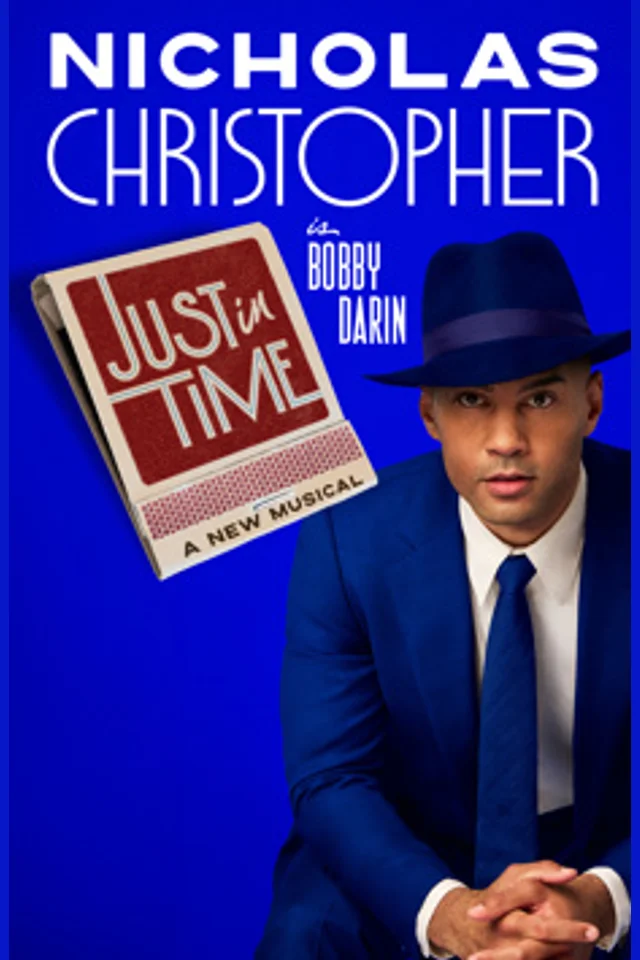
The life and career of Bobby Darin unfold in a nightclub setting, tracing his rise from a young singer to an international entertainer. Songs associated with Darin accompany a story about ambition, relationships and a career shaped by the knowledge that time may be short.
Although the Broadway production of KPOP features many of the songs and characters from the off-Broadway production, the two versions follow distinctly different plots: the Broadway production has been characterized by the creative team as being more of a "reinvention" than a transfer of the off-Broadway version. The show casts audiences as American executives touring JTM Entertainment, a K-pop music factory run by Moon and his wife Ruby, who are trying to break into the North American market with the help of a Korean American agent named Jerry. Audience members toured the multilevel, multiroom facility (in actuality the A.R.T./New York Theatres building in Hell's Kitchen) where they observe rehearsals by the bands F8 and Special K, as well as JTM's flagship star MwE. Audiences also encounter the in-house plastic surgeon Dr. Park, the vocal coach Yazmeen, and a ruthless dance instructor named Jenn. Throughout the evening, the audience observes the JTM artists as they are put through the wringer of the idol industry, from demanding rehearsals, to cultivating fandom via social media, to receiving media training, and having to confront body dysmorphia through a rhinoplasty examination to find any facial imperfections. Specific plotlines include Korean-American member Epic trying to embrace the attempt to break into American pop culture against the wishes of other members of F8, and MwE facing the possibility of being replaced as JTM's star by Sonoma, one of the younger members in the group Special K. The show is framed as a camera rehearsal for South Korean music agency RBY Entertainment’s New York debut of its stars, at Circle in the Square Theatre on Broadway. RBY’s founder and chief executive, a former K-pop singer named Ruby, discusses logistics with the director Harry as she rehearses the introduction. The two groups, RTMIS and F8, perform the opening number with the song "This is My Korea 우리 이야기." RBY’s main star, MwE, starts to perform her song "엎드려 Up Du Ryuh (Bow Down)" but becomes spooked upon seeing Ruby in the audience and flees. While Ruby goes to confront MwE, Harry has F8 rehearse their introductions to the camera, but finds their simple introductions in Korean boring. New member Brad, a mixed race Korean-American who replaced another member, tries to make his mark by coming up with a hammy intro in English, but quickly comes into conflict with the rest of the group over whether to introduce themselves in Korean or English, particularly bandleader Jun Hyuk. F8 performs their song "한국놈 Han Guk Nom (Korean Man)" but intentionally change up the choreography on Brad as revenge for his outburst. Harry begins using the cameras to spy on Ruby, MwE, and MwE’s boyfriend Juny in the dressing room. MwE reveals she thought she saw her mother in the audience, and with Juny’s encouragement voices that she wishes to quit RBY. The action flashes back to MwE’s original audition for RBY, as 9-year old Mina Kim, as she performs "Still I Love You 아직도 사랑해", explaining that she wishes to become a singer to support her mother after her father left. Ruby, the original singer of the song, sees potential in MwE and immediately signs her on. In the present, Harry sees an opportunity to turn the concert film into a documentary about the K-pop industry. He tries to get RTMIS, the girl group, to spill on their careers in B-roll as they rehearse their song "Perfect 완벽한 걸." The group refuses, as all interviews need to be vetted by Ruby, and they face severe consequences if anything they say affects the image of RBY’s brand. In another flashback, a 13-year old MwE struggles to get through a dance rehearsal for her song "Wind Up Doll 태엽인형" after her mother abandoned her on her recent birthday. Ruby encourages her to push through the pain of her home life and focus on the image she shows to the rest of the world. In the present, Brad asks Harry to redo the footage for "Han Guk Nom". Harry pushes him to spill on the rest of the group bullying him. Brad is reluctant, but eventually relates his personal experiences growing up as the child of a Korean mother and being bullied in school for his identity, and how his treatment by the rest of F8 reminds him of that. Harry has Brad perform an original song he wrote inspired by his experiences, "Halfway 중간 지점". In another flashback, backstage at a performance, 18-year old MwE confronts Ruby over the slow progress in her career and the fact that Ruby has begun recruiting for a new boy band (F8), interpreting it as Ruby gearing up to replace her. Ruby reminds her that the path to stardom takes a long time, but it will be worth it in the end. As MwE performs "슈펴스타 Super Star" she sees crowds of fans cheering for her. RTMIS performs "시간 낭비 Shi Gan Nang Bee (Waste of Time)", a song about ending relationships. Harry once again asks them about filming B-roll, only for Ruby to intervene and remind Harry it is forbidden. In a flashback to three months before the rehearsal, MwE writes a song "벙어리새 Bung Uh Ree Sae (Mute Bird)" with her childhood friend and boyfriend Juny, in response to the recent death of her mother. He encourages her to record it, as it is different from the pre-written material Ruby makes her do. A talented musician himself, Juny prefers his simple life as a music teacher to MwE’s busy touring schedules, and they are only able to meet for short periods at a time and in secrecy. MwE, desperate to keep Juny in her life, proposes to him just as Ruby walks in. A scandalized Ruby reminds MwE that she has a specific brand to follow, and Juny does not fit that brand. MwE refuses to keep working for RBY if Juny can’t be present, so Ruby reluctantly allows him to join her on tour on the condition Ruby also manages every aspect of his daily life. The tensions among F8 come to a head as they prepare to rehearse "Amerika (Checkmate) 아메리카" particularly when Harry has the cameras focus on Brad. Jun Hyuk finally explodes that he feels Brad has not earned his place among the group, most of whom have had to train for years whereas Brad was hired to replace one of their friends without going through the same training. Brad retorts that he was hired for his talent, same as the rest of the group, and that they have only excluded him because of his American identity and poor grasp on the Korean language. Jae Ik admits that Brad has a point, and points out that Jun Hyuk can’t fault Brad for being American, as several members of the group are also from America (including Jae Ik himself, hailing from Queens). The other members accuse Harry of trying to push conflict for his documentary, and encourage Jun Hyuk and Brad to make-up before they rehearse the song. In a flashback to a week before the camera rehearsal, MwE tries to get Ruby to listen to the song she wrote, but Ruby refuses to market MwE as a singer-songwriter. MwE begins expressing doubts about making her debut in New York as RTMIS arrives to rehearse. Ruby tells RTMIS that if MwE refuses to perform, the whole performance will be cancelled. Several members of RTMIS start voicing frustration that the work they have put into their careers could be thrown away so easily. One of the members, Sonoma, reminds the rest of the group how important getting to perform alongside one of their idols, MwE, will be, and that they must put in the effort to fulfill their lifelong dreams. Just as Ruby and MwE’s argument backstage hits a breaking point, they finally notice the camera operator and discover Harry’s scheme. Ruby promptly fires Harry, who protests he could have helped MwE by making her human to the rest of the world, instead of the machine Ruby has made her. Faced with what her life has become, MwE declares that she wants to quit and leave with Juny. Ruby apologizes for not being encouraging or a strong replacement for her mother, but reminds her cancelling the whole performance would jeopardize the careers of everyone at RBY, including the members of F8 and RTMIS. MwE suggests Juny could come with her, but he refuses, reiterating that he can’t live the rigorous, controlled touring life, and they will have to end the relationship if she stays with RBY. Ruby, softened by the entire ordeal, offers MwE two options on the condition that she performs at least one more time: to stay with the company, or leave and try to live a normal life with Juny. MwE’s decision is left ambiguous. Rather than film the performance, Ruby turns RBY’s planned debut in New York City into a concert, featuring performances by RTMIS ("Supergoddess 슈퍼가디스" and "Gin & Tonic 진 앤 토닉"), F8 ("Meant 2 B 멘 투 비" and "흔들어 Hun Du Ruh (Shake It)"), and MwE ("Phoenix 불사조"). Finally, all of the RBY artists come together to perform "Blast Off 발사".
Ka-Boom! was an off-Broadway musical that ran at the Carter Theatre in New York City in 1980. Directed by Godspell co-creator John-Michael Tebelak, with book and lyrics by Bruce Kluger and music by Joe Ercole, the two-act musical told the story of the five sole survivors of a nuclear holocaust that had destroyed the world, who were spared by God so that he could audition them for his new show, Creation, Part Two.
A fortune teller predicts that Joséphine will become empress. Napoleon meets and marries her after she persuades him to release her son Eugène from prison. While Napoleon is away with his troops, Joséphine remains in Paris and flirts with other men, including Hippolyte Charles. Napoleon’s jealousy damages his reputation, but the couple reconcile when he becomes France’s first consul. They are crowned emperor and empress, fulfilling the prophecy.
Kat and the Kings is a South African musical with a book and lyrics by David Kramer and music by Taliep Petersen. Set in late-1950s South Africa, it focuses on teenager Kat Diamond, who believes he's the best singer and dancer in District Six, a multi-racial slum in Cape Town.
Kathy and Stella, two murder-obsessed best friends from Beverley near Hull, are the oddball hosts of Kathy & Stella's Murder Podcast, a tiny operation broadcast weekly from the Baxters' garage to the exasperation of their disapproving families. After failing to wow their idol Felicia Taylor at a book signing, their disappointment is soon forgotten when they find themselves in an interrogation room being informed that they are two of the last people to have seen a recent murder victim. Realising that they could both become "part of the story," Kathy and Stella vow to catch the killer themselves, thus beginning a ludicrous caper around Humberside as they realise they don't know what they're doing. Tensions finally come to a head at the Birmingham Convention Centre's Murder Con, a dramatic showdown that puts Kathy and Stella's friendship to the absolute test.
Setting: Yalta, Istanbul, and Vienna shortly before the outbreak of World War I Act 1 The play opens in Yalta at a villa on the Black Sea. Reluctantly following her mother's wishes, Katinka marries Boris Strogoff, the Russian Ambassador to Austria, although she is really in love with his attaché, Ivan Dimitri, and he with her. After the wedding, Thaddeus Hopper, a wealthy American and Ivan's friend, helps her escape to Turkey. Act 2 Ivan and Boris Strogoff's servant Petrov arrive in Istanbul hoping to find Strogoff's first wife Olga, who chose to live in a harem rather than remain married to him. If she is found, Strogoff's marriage to Katinka can be annulled on grounds of bigamy, leaving her free to marry Ivan. Katinka and Thaddeus Hopper are also in the city, where she is staying in Hopper's rooms. The arrival of Hopper's wife, Helen, causes complications when she becomes suspicious of the arrangements. Hopper has arranged for Katinka to be hidden in the harem of Izzet Pasha, but Arif Bey, Pasha's warden, mistakenly carries Mrs. Hopper off to the harem instead of Katinka. Meanwhile, Herr Knopf is planning to open the Café-Turkois-in-Vienna and has come to Istanbul looking for women to work there. Helen is amongst those he takes back to Vienna. Act 3 The main characters are all in Vienna, where they have assembled at Herr Knopf's café. Olga, who had been living in Izzet Pasha's harem under the name of "Nashan", reveals her true identity. The Hoppers are reconciled, and Katinka and Ivan are reunited.
Kean is a musical with a book by Peter Stone and music and lyrics by Robert Wright and George Forrest. Using material by Jean-Paul Sartre and Alexandre Dumas, père as its source, it centers on the adventures of Edmund Kean, considered the greatest Shakespearean actor of the early 19th century…
Kelly is a musical with a book and lyrics by Eddie Lawrence and music by Moose Charlap. It was inspired by Steve Brodie, who in 1886 claimed to have jumped off the Brooklyn Bridge and survived. The story centers around Hop Kelly, a daredevil busboy. Some Bowery gamblers try to prevent him from surviving a jump from the Brooklyn Bridge. The 1965 musical is notable for having closed after its opening night performance on Broadway, becoming one of the biggest flops in Broadway history.
In 1915 New York, a wealthy mother has her daughter charged with incorrigibility after an affair with a tango dancer. Their court battle exposes conflicting ideas about desire, privilege, and women’s independence.
Kid Boots is a musical with a book by William Anthony McGuire and Otto Harbach, music by Harry Tierney, and lyrics by Joseph McCarthy. The show was staged by Edward Royce.
17 year old high school senior and sailboat enthusiast Luke returns to his small, Kansas town after an unplanned, unannounced one-year absence. Luke finds it difficult to reconnect with friends and family or to focus on school work. He experiences recurrent flashbacks of his year-long absence and the events and relationship leading up to it. Luke had been communicating on the internet with Michael; his screen name was "Kid Victory". As he tries to readjust, Luke develops a growing friendship with the town misfit, divorcee Emily. His parents, Eileen and Joseph, finally understand that to reconnect with their son, they must confront unnerving truths about his disappearance.
At an ice skating rink named "Skater Planet" in Bergen County, New Jersey, six teenagers – Kimberly Levaco, Seth Weetis, Martin Doaty, Aaron Puckett, Teresa Benton, and Delia McDaniels – express their frustrations. Kim is the new girl in town, with a disease that makes her age four and a half times as fast as normal, and a dream of visiting Six Flags Great Adventure. Seth, an employee at the rink, feels like a misfit. The four others are all pining for another member of their friend group unrequitedly (Martin for Aaron, Aaron for Delia, Delia for Teresa, and Teresa for Martin). All the teens feel as if they don't fit in, and express their desire to "be seen" ("Skater Planet"). Kim’s frequently drunk father Buddy is over three hours late picking her up; Kimberly gives him a thermos filled with coffee to sober up. Seth comes back to the rink for his tuba, which he had left inside. He asks Kim to be his partner for an upcoming biology project, and says that they could do it about her disease. Buddy retorts and says that Kimberly is researching glaucoma, and insults Seth behind his back. Buddy tells Kimberly to tell her mother, Pattie, that they were late due to car troubles. At the Levacos’ home, Pattie, pregnant and with casts on both arms, creates a video for her yet-to-be-born baby ("Hello, Darling"). When Buddy and Kim arrive home, Pattie chastises Buddy for their lateness and his drunkenness, which leads to an argument in which both parents end up having to give quarters to the family "swear jar". Buddy suggests that if they save up enough in the swear jar, they could go on a road trip, which Pattie quickly shoots down. It is also established that the family is trying to keep secret the fact that they're from Lodi, New Jersey. In her room, Kimberly writes a letter to the Make A Wish Foundation, requesting a treehouse after going back and forth between an array of wishes ("Make A Wish"). At school, Martin, Aaron, Delia, and Teresa make plans for a Dreamgirls medley for their school show choir, one that will compete with their rival West Orange's Evita medley. They reaffirm their problems with unrequited love ("Skater Planet (reprise #1)"). The group then plans on purchasing classic show choir outfits (blue dresses for the girls and turquoise suits for the boys). Kimberly agrees to be Seth's partner for the biology project, and to use her disease as their topic. Delia invites Teresa to Skater Planet, but Teresa wants to invite Martin. This results in all four members of the friend group agreeing to go to Skater Planet, after Martin invites Aaron. In the library, while studying for their project, Seth creates an anagram of Kim's name, "Cleverly Akimbo". She realizes that she likes him ("Anagram"). Debra, Kim's criminal aunt, shows up and makes crude jokes. She reveals that she has been sleeping in the school library, waiting to find Kimberly. The Levaco family moved from Lodi in a manner that made it difficult for Debra to find them, which was intentional. Debra tells Kim about an exciting new opportunity to make a lot of money, and that it is only "slightly illegal". Debra also tries to convince Martin, Aaron, Delia, and Teresa to help out ("Better"). Kim agrees, but only if she gets a say in the plan, and only if Debra agrees that nobody will get hurt. Debra is ecstatic, and tells Kimberly to leave the window and door unlocked at her house. Around midnight, at the house, Kim goes to unlock the door, but is caught by Pattie, who is awake because of the baby's kicking. Kimberly distracts her, as Debra sneaks in the window. Kim tells her mother that she reminds her of Medea. However, despite Kim's distraction efforts, Pattie catches Debra. Ignoring Pattie's protests, Debra comes into the house, and drags a mailbox into the basement. Pattie reflects on and laments her situation, before singing a lullaby that she used to sing for Kim to the new baby ("Hello, Darling (reprise)/Father Time"). At this point, it is Kim's sixteenth birthday. The life expectancy of one with her disease is sixteen years old. The next morning, Buddy is driving Kim and Seth to school, but embarrasses Kim by yelling at Seth for supposedly wanting to "get in her [Kimberly's] pants". He also throws Seth's muffin out of the car window ("Happy For Her"). Kimberly yells at her father, and tells him that she hopes he crashes the car into a tree and dies. Later, at school, Seth tells Kim that if she wanted him to kiss her, he'd do it. He also invites Kim to come to Skater Planet that night, which she agrees to. Kim reflects on her feelings for Seth ("Anagram (reprise)"). That night, at Skater Planet, Seth gives Kimberly a present of a book of anagrams. Pattie, Debra, and Buddy all show up as well, having been invited by Seth, who reveals to Kim that this is a surprise birthday party. Debra gifts Kim an extremely large pinecone, while Buddy and Pattie both promise to, respectively, stop drinking and be a better mother as their presents. Martin, Aaron, Delia, and Teresa arrive, also having been invited to the party. Delia informs the group that they won't be able to get their costumes, because the show choir has run out of money. Hearing this, Debra ropes them into her plan once more. Everybody hopes for the future ("This Time"). In Kim’s basement, Debra is teaching the six teenagers how to wash a check. It proves too complex for them, with Aaron getting his arm stuck in the mailbox (from which they are retrieving the checks), and Teresa getting a glue trap stuck to her head (which they are using to fish out the checks). However, once Debra compares them unfavorably to West Orange, they complete the task without trouble (“How to Wash a Check”). After the rest of the group is gone, Seth stands alone and reflects on how all his life he was the "good kid" and now he is involved in a check fraud scheme, before deciding "maybe a little bad could do a lot of good." ("Good Kid") At the Levaco home, Buddy is trying to distract himself, since he is not drinking, through an exercise plan he and Kim came up with. When Pattie, now with a leg brace from a skating injury at Kimberly’s birthday party, leaves her camera in the room, he makes a video for the baby. He reflects on the future that he lost when Pattie got pregnant with Kim, and tells the baby to “see the world” (“Hello, Baby”). At school, the six teens are in the library, playing UNO, just before their biology class (and their biology presentations). Seth asks about what will happen if they get caught, and all of them think about what the future holds (“Skater Planet (reprise #2)”). In class, the group does their presentations. Aaron and Martin present scurvy, Delia and Teresa present fasciolosis, and Kim and Seth present her disease. During the presentation, Kimberly gets upset, thinking about how getting older is her affliction, but getting older is the rest of the class’s cure (for adolescence). She runs out of the class (“Our Disease”). When Kim arrives at home, she finds that Buddy has cooked a meal for everybody, and they sit down for a family dinner. However, resentment soon boils over, and they begin to fight. It is revealed that Buddy paid Debra to go to the Levaco’s old neighbor, Mr. Zwicky’s house to beat him up, because Pattie had sex with him to ensure that this baby wouldn’t have the same ailment as Kim. Zwicky died of a fear-induced heart attack during the assault, resulting in the family leaving Lodi. They fight, until Kimberly collapses to the floor (“The Inevitable Turn”). Three days later, at the hospital, Kim is bedridden and asleep. Debra convinces Buddy and Pattie to leave and go home, so they can sleep and take showers. Before they leave, Pattie tells Kim (who is pretending to sleep) that the Make A Wish Foundation is going to build her a treehouse. Seth shows up, while Debra takes off to find a bedpan and pills. Seth has brought all sorts of things to help Kim feel better, but she just wants to live in a better moment and they decide to leave to participate in the check fraud scheme, which was to be done without them (“Now”). Debra reminds the group of their plan (“How to Wash a Check (reprise)”). She also reveals the kids' crushes on one another. Kim emerges from the back room disguised as a grandmother, which is a part of the plan. She demands that Martin, Aaron, Delia, Teresa, and Seth not come along, but Seth insists (he is also the one driving). They go. Later, Kim comes home with a bag of the money and tells her parents that they can finally go on their road trip, and to start packing. She then goes into her room, and sees that they have replaced her bed with a crib for the new baby. They fight, and she tells her parents to give up who they wanted her to be before she dies. She writes a new letter to Make A Wish, telling them thank you for the treehouse, but that she doesn’t need it because she is going to see the world (“Before I Go”). Kimberly and Seth are in Buddy’s car, at Six Flags Great Adventure. They are on a road trip, with the camera and their portion of the money–as well as Debra’s money, which they stole. Kim makes a video for her sister and asks Seth to make sure she gets it (“Hello, Sister”). They kiss. Martin, Aaron, Delia, and Teresa (in their show choir outfits), Debra (now working at Costco), Pattie and Buddy (with the new baby), and Kim and Seth tell the audience to live life to the fullest because "no one gets a second time around" (“Great Adventure”).
King David: A World Premiere Concert Event is a 1997 oratorio (sometimes described as a work-in-progress musical), co-produced by The Walt Disney Company and Andre Djaoui, and written by Alan Menken (music) and Tim Rice (libretto). Originally conceived by Djaoui as a grand musical performed in Jerusalem to celebrate the 3000th anniversary of the city's founding, it was eventually staged as a concert in the first production at Broadway's New Amsterdam Theater after Disney's restoration. Opening on May 18, 1997 (after three previews beginning May 15), the show ran for six performances closing May 23. King David is a song-cycle about David whom Alan Menken deems "one of the great heroes of Jewish history", and is based on Biblical tales from the Books of Samuel and 1 Chronicles, as well as text from David's Psalms. It retells the Old Testament story of the shepherd boy, David, who rises from his humble roots to become King of Israel, including the drama between him and Saul and David's trials and tribulations in the foundation of Jerusalem." At present, there are no plans for a fully staged Broadway production.
In the middle of The Great Depression in New York City, film director Carl Denham is pressured to find a leading lady for his next film ("Hunting Season"). He searches the city for a woman fitting for the role but with little success ("Sweethearts on Parade/Brother Can You Spare a Dime"). Meanwhile, Ann Darrow is also struggling to cope with life in the city ("What's It Gonna Take"). She is robbed by thugs who taunt her by tossing around her belongings ("I Wanna Be Loved by You"). Denham spots her and realises she is perfect for the role. Ann is almost arrested for trying to steal an apple but Denham is able to prevent it. He offers her a job to star in his picture which she reluctantly accepts. Ann boards his ship and meets the crew including Jack Driscoll with whom she does not get along at first. The ship leaves the port as Denham thinks about how successful his new film will be ("Colossus"). The next morning Ann is nervous about her screen test but later becomes confident as she gets ready ("Special FX"). She and Jack get to know each other a little better ("Perfect') and eventually fall in love ("Foxtrot"). The ship eventually arrives at Skull Island, the crew argue about whether to turn back or explore the island but Denham insists they go ashore. They interrupt the natives' sacrificial ritual and a fight breaks out ("Ritual"). The crew head back to the ship but Ann is abducted and offered as a sacrifice to Kong ("Ascent"). The crew go to rescue her but are too late as Kong has already taken her. Jack, however is determined to get Ann back and ventures into the jungle ("In the Face of Forever"). Meanwhile, Ann wakes up to face Kong in his cave. At first she is frightened but she builds the courage to stand up to him. Kong protects her when she is almost attacked by a giant snake and they form a special bond ("Full Moon Lullaby"). While Kong falls asleep, Jack quietly approaches and Ann reluctantly goes back with him. Kong suddenly wakes and realizes Ann is gone and chases after them ("The Chase"). Denham and the crew capture Kong using gas bombs to knock him out and Ann as bait, much to her dismay. Denham decides to present Kong to the public in New York. Now back in New York, Ann contemplates her experiences on Skull Island ("What's It Gonna Take") while Denham advertises for his show in which he intends to present a now captive Kong to the audience ("The Greatest Show on Earth"). Jack proposes to Ann and she accepts ("Dance with Me"). The couple are about to enter the theatre when Ann asks for a moment alone before joining him as she is caught between starting a new life with Jack and her affection and sympathy for Kong ("A Simple Prayer"). Denham presents Kong in chains to the audience much to their astonishment. Ann and Jack rush onto the stage causing Denham to panic as he is worried they will try to turn the public against him. Ann tries to console Kong but when Denham orders the guards to remove her, despite Jack warning them not to touch her, Kong believes they are trying to hurt her and breaks free as Jack quickly escapes with Ann. Denham sends out the Avalanches to entertain and calm down the nervous crowd ("Get Happy"). Kong rampages through the city in search of Ann and kills few look-alikes, but Ann manages to find him and calm him down. He gently picks her up and takes her to the top of the Empire State Building as the public watch in awe. Denham is arrested despite his protests "It was beauty killed the beast! Not me!" ("Rise"). Atop, Ann and Kong share a moment ("Full Moon Lullaby (Reprise)") but it is cut short when airplanes begin to shoot at Kong. Ann desperately yells for them stop but they don't hear her. Kong is fatally shot in the neck and falls to his death ("Amen, Opus 35"). Below, Jack reunites with a devastated Ann while the crowd gather around to see Kong's dead body. Ann Darrow, a girl from the countryside, comes to New York City to seek out her dream of being on Broadway ("Prologue"). She auditions for a show but does not make the cut ("Dance My Way to the Light"). Undaunted by the rejection, she tries to audition for a plethora of jobs ("Queen of New York"). After taking refuge in a diner to escape the cold New York streets, Ann meets a man named Carl Denham. Due to Denham's quick thinking, Ann is saved from being kicked out of the diner, and he reveals he is a director wanting a leading lady for a new movie, the details of which are kept secret, aside from the fact that the filming location is accessible only by boat. He promises Ann that if she takes the job, he'll make her a star. Ann agrees, and the two set off to the S.S. Wander, helmed by Captain Leviticus Englehorn and his crew ("Building the Boat"). Denham quickly gives introductions as Englehorn comments on the fact that they're being trailed by another boat, Denham trying to ignore it. He tells an extremely wary Ann that the ship is loaded with gas bombs he built, which will only be used in case of an emergency. As the ship sets sail, Denham wonders about what may be on Skull Island ("Setting Sail"). The next morning, Ann gets woken up when Denham's main cameraman, Lumpy, unexpectedly goes on board and tends to her. Ann thanks him for his kindness and, after he leaves, he wonders about the consequences of his job ("Cabin Soliloquy"). Back on the main deck, Englehorn starts to distrust Denham ("Pressure Up"). After two months on the water, Denham explains to Ann about the filming location, Skull Island, and Englehorn and his crew threaten Denham, demanding Denham to explain why they're going to Skull Island. Ann suddenly appears and threatens to blow the ship up using the gas bombs if they don't let Denham go, earning Denham's awe ("The Mutiny"). As Englehorn and his crew return to work, Ann defends her actions, saying that Denham is her ticket to getting off the streets just as the ship arrives. As everyone disembarks to explore, Denham tries to take a few shots of Ann playing with some vines until a giant ape named Kong captures her. Denham tries to film the beast but Kong swipes at him, smashing the camera in the process, grabs Ann, and carries her away ("Skull Island"). Kong brings Ann to a high cliff overlooking the forest ("The Ascent"). An enraged Denham tells the crew to leave the island and let Ann fend for herself, but upon hearing Lumpy's desire to see Kong, Denham decides to make Kong a tourist attraction. As they climb through the forest, he wonders about the opportunity and profit of capturing Kong. ("The World"). Meanwhile, Ann wakes up to face Kong in his cave. At first, she is frightened by the beast, but after having a roaring contest with him, she builds the courage to see beyond his harsh exterior. Kong protects her when she is almost attacked by a giant snake ("The Cobra Fight"), and as Ann patches his wounds, the two bond ("Full Moon Lullaby"). While Kong falls asleep, Ann quickly runs off, back into the jungle. Kong quickly realizes she's gone, prompting him to chase after her ("The Descent"). Ann bumps into Denham and Lumpy, the latter of whom is overjoyed to see her, and the former telling her that a queen would scream for Kong. Ann remorsefully complies, bringing Kong to where the rest of the ship's crew is waiting, and causing Kong to get ambushed and knocked unconscious by the gas bombs ("Kong's Capture"). ("Entr'acte: The Voyager Returns") Back in New York, Denham advertises for his show in which he intends to present a now captive Kong to audiences ("It's Man"). During rehearsal ("The Wild and Perilous Sea"), a guilt-ridden Ann abandons the rehearsal and Denham chases after her, finding her outside the theater. She explains that she can't put on a show like this due to her friendship with Kong, but Denham threatens her with being deemed as insane and jobless. Ann, horrified at Denham's behavior, decides to visit a captive Kong. She explains that she never meant for any of the past events to happen and tries to comfort him ("Last of Our Kind"). At first, Kong doesn't respond to her, but after she notices that he's effectively dying, aggressively commenting on that fact, the two rekindle their friendship. On the opening night, Ann is still unsure about Denham's show ("Last of Our Kind" (Reprise)), before going onstage and starting the performance. When it comes time for her to scream for Kong, she notices his declining health. Despite Denham's repeated demands for her to scream and wake Kong up, she defiantly refuses ("Scream for the Money"). She shouts for Kong to fight back and is quickly grabbed and dragged offstage, where she lets out a true scream. In response, Kong swiftly breaks free from his shackles as the curtain falls. Denham unsuccessfully tries to keep the audience and remaining actors onstage calm ("Dance My Way to the Light" (Reprise)) while Kong roars from behind the curtain. Kong rampages through the city in an attempt to find Ann ("Broadway Nightmare"). The two finally find each other, and Kong, with Ann climbing on his back, takes off running as the army shoots him ("NYC Chase"). Kong stops at the bottom of the half-completed Empire State Building and immediately starts climbing it ("Empire Ascent"). Back at the ruined theater, Lumpy enters to tell Denham that he's quitting, explaining that what they did wasn't right and that it isn't about the money, leaving Denham alone ("The World" (Reprise)). On top of the Empire State Building, Ann marvels over the view from there, but then notices that Kong is slowly dying and tries to reassure Kong just as Army planes arrive to shoot him down ("Air War"). Kong destroys some planes, but sustains injuries from the bullets to his body before another set of planes swoop by and finish him off, causing him to fall to the ground ("Empire Soliloquy"). Ann grieves over the loss of Kong as she manages to make her way down from the Empire State Building.
King of Cadonia is an English musical in two acts with a book by Frederick Lonsdale, lyrics by Adrian Ross and Arthur Wimperis and music by Sidney Jones and Frederick Rosse. It opened at the Prince of Wales Theatre in London on 3 September 1908, produced by Frank Curzon, and ran for 333 performances. It starred Isabel Jay, Huntley Wright, and Bertram Wallis. There was a brief Broadway production in 1910 with additional music by Jerome Kern at the Fifth Avenue Theatre and directed by Joseph W. Herbert. This was Lonsdale's first success. Famous songs included "The Wind of Love", "The Portrait" and "Disguises".
King of Hearts is a 1978 musical with a book by Joseph Stein, lyrics by Jacob Brackman, and music by Peter Link, orchestrated by Bill Brohn. It is based on the 1966 anti-war cult film of the same name.
King's Rhapsody is a musical with book and music by Ivor Novello and lyrics by Christopher Hassall. The musical was first produced at the Palace Theatre, London, on 15 September 1949 and ran for 841 performances, surviving its author, who died in 1951. It starred Novello in the title role of the heir to the throne under pressure from his long-lived mother, Queen Elana, to abdicate in favour of his infant son,
Charlie Price grows up as the fourth-generation scion in the family business, Price & Son, a shoe manufacturing company with its factory in Northampton. Another young boy, growing up in London, is as fascinated by shoes as Charlie is bored by them. But in this case, it is a pair of red women's heels that have attracted his attention, aggravating his strict father. Years pass. Charlie's father is aging and hopes Charlie will take over the business. Still, Charlie is eager to move to London with his status-conscious fiancée, Nicola, and pursue a real estate career ("The Most Beautiful Thing"). Charlie has barely made it into his new flat in London when his father dies suddenly. Charlie hurries home for the funeral, where he finds the factory near bankruptcy. The factory makes good quality men's shoes, but they're neither stylish nor affordable, and the market for them is drying up. Though Charlie has no desire to run Price & Sons, he is determined to save the factory and his father's legacy. The workers, many of whom have known Charlie his entire life, do not understand why Charlie moved away in the first place, and many are hostile and skeptical of the new management. Returning to London, Charlie meets friend and fellow shoe salesman, Harry, in a pub to ask for help. Harry can only offer a temporary solution and advises Charlie not to fight the inevitable ("Take What You Got"). Leaving the pub, Charlie witnesses a woman being accosted by two drunks. He intervenes and is knocked unconscious. He comes to in a seedy nightclub, where the woman he attempted to rescue is revealed to have been the club's drag queen headliner, Lola, who performs with his backup troupe, the "angels" ("Land of Lola"). Recuperating from his ordeal in Lola's dressing room, an uncomfortable Charlie notices that the performers' high-heeled boots are not designed to hold a man's weight. Lola explains that the costly and unreliable footwear is an essential part of any drag act. Charlie returns to the factory and begins reluctantly laying off his workers. Lauren, one of the women on the assembly line, explodes at Charlie when given her notice and stubbornly tells him that other struggling shoe factories have survived by entering an "underserved niche market." This gives Charlie an idea ("Land of Lola" {Reprise}), and he invites Lola to come to the factory to help him design a women's boot that can be comfortable for a man ("Charlie's Soliloquy"/"Step One"). Lola and the angels arrive at the factory, and he is immediately dissatisfied with Charlie's first design of the boot. Quickly getting the women of the factory on his side, Lola draws a quick design of a boot, explaining that the most important factor is by far the heel ("The Sex is in the Heel"). George, the factory manager, realizes a way to make Lola's design practical. An impressed Charlie begs Lola to stay until a prestigious footwear show in Milan in three weeks, to design a new line of "kinky boots" that could save the factory. Lola is reluctant, as he is already receiving crass comments from Don, the foreman, and some of the other workers, but is flattered by Charlie's praise, and finally agrees. Charlie announces that the factory will be moving ahead with production of the boots. He thanks Lauren for giving him the idea and offers her a promotion. She accepts and is horrified but thrilled to realize that she is falling for him ("The History of Wrong Guys"). The next day, Lola shows up in men's clothes and is mocked by Don and his friends. An upset Lola takes refuge in the bathroom, and Charlie attempts to comfort him. Lola explains that his father trained him as a boxer but disowned him when he showed up for a match in drag. The two discover their similarly complex feelings toward their fathers, and Lola introduces himself by his birth name: Simon ("Not My Father's Son"). Nicola and her boss Richard Bailey arrive from London and present Charlie with a plan for the factory that Richard has drawn up: closing it and converting it into condominiums. Charlie refuses but is shocked to discover that his father had agreed to this plan before he died, presumably because Charlie was not there to run it. He refuses to sell, and soon the workers are celebrating as the first pair of "kinky boots" is finished ("Everybody Say Yeah"). Some of the factory workers are not enthusiastic about the radical change in their product line. Some of them, especially the intimidating Don, make Lola feel very unwelcome. Lola taunts him back, enlisting the female factory workers to prove that Lola is closer to a woman's ideal than is Don ("What a Woman Wants"). Lola presents Don with a unique wager to see who is the better "man": Lola will do anything that Don specifies if Don will do the same thing for him. Don's challenge is for Lola to fight him in a boxing match at the pub. Charlie, remembering Lola's background, is horrified. Lola easily scores against Don in the ring, but ultimately lets Don win ("In This Corner"). Afterward, Don asks why Lola let him win, and Lola replies that he could not be so cruel as to humiliate Don in front of his mates. Lola then gives Don his part of the challenge: "accept someone for who they are." Charlie is pouring his own money into the factory to ensure that it will be ready in time for Milan, and he is getting frantic that the product is not right, angrily making his staff redo what he considers shoddy work. Nicola arrives, fed up with Charlie's obsession over the factory, and breaks up with him. Lola has been making some decisions about production and preparations without consulting Charlie. When Charlie discovers that Lola has decided to have his angels wear the boots on the runway rather than hiring professional models, an overwhelmed Charlie lashes out at him, humiliating him in front of the other workers. Lola storms out, and the workers go home. Alone, Charlie struggles with the weight of his father's legacy and what it means to be his own man ("Soul of a Man"). Lauren finds Charlie and tells him to come back to the factory. It is revealed Don has persuaded the workers to return to work and to sacrifice a week's pay to ensure that the boots can be finished in time for Milan. The astonished and grateful Charlie asks Don if he has paid up on his wager by accepting Lola. Lauren explains that the person that Don has accepted is Charlie himself. As he heads to the airport for Milan, Charlie leaves a heartfelt apology on Lola's voicemail. Meanwhile, Lola performs his act at a nursing home in his hometown. After he leaves the stage, he speaks to his dying father, and reaches a sense of closure ("Hold Me in Your Heart"). Charlie and Lauren arrive in Milan. But without models, Charlie is compelled to walk the runway himself. Lauren is thrilled by his dedication ("The History of Wrong Guys (Reprise)"), but the show threatens to be a disaster. Just as all seems lost, Lola and his angels arrive to save the day. Lauren and Charlie share their first kiss, and the whole company celebrates the success of the "Kinky Boots" ("Raise You Up/Just Be").
Kismet is set in a fictional Baghdad in the times of The Arabian Nights. At a mosque, an imam prays as the sun rises ("The Sands of Time"). Three beggars sit outside the temple, but the fourth, Hajj, has gone to Mecca. Crying "Rhymes! Fine Rhymes!", a poet enters to sell his verses. His beautiful daughter Marsinah joins in the sales pitch, but they have no success ("Rhymes Have I"). Marsinah is sent to steal oranges in the Bazaar for their breakfast, while her father sits down to beg. When the beggars object to the poet's taking Hajj's place, he claims to be a cousin of Hajj. The poet threatens to curse those who do not give him money and soon earns a few coins ("Fate"). Hassen-Ben, a huge man from the desert, mistakes him for Hajj and kidnaps him. The poet (who is referred to as Hajj thereafter) is taken to Jawan, a notorious brigand. Fifteen years ago, the real Hajj had placed a curse on Jawan that resulted in the disappearance of the brigand's little son. Now he wants the curse removed. The new Hajj, seeing an opportunity to make some money, promises to do so for 100 gold pieces. Jawan leaves for Baghdad to search for his son, and Hajj rejoices in his new-found riches ("Fate" (reprise)). Back in the city, the wazir of police comes through the busy bazaar ("Bazaar of the Caravans"). The evil wazir and his seductive, beautiful wife-of-wives, Lalume, discuss a loan he desperately needs. In return for the money lent from the king of Ababu, the wazir must arrange for the caliph to marry one (or all three) of the princesses of Ababu, who perform a sexy dance. Through their amah, the princesses tell Lalume that they wish to return home. Lalume convinces them that Baghdad is much more exciting than any other place on earth ("Not Since Nineveh"). Marsinah is being pursued by a fruit merchant whose wares she has stolen. Her father arrives to rescue her, giving the man money. Hajj gives his daughter half of the money and leaves. The merchants set out their finest "Baubles, Bangles and Beads" for the young lady. The young caliph and his advisor, Omar Khayyam, have been traveling incognito. He is struck by Marsinah's beauty and follows her. Elsewhere, Hajj is basking in the glow of some scantily-dressed slave girls he has just bought, when he is stopped by the police, who are checking identities because they are looking for Jawan. The Chief recognizes, on the coins, the crest of a family Jawan has robbed and arrests Hajj as a thief. Meanwhile, Marsinah has found a quaint little house with a beautiful garden to buy for her father and herself. She is admiring the garden when the Caliph slips in and, pretending to be a gardener, introduces himself to her. They fall in love on the spot ("Stranger in Paradise"). They promise to meet again in the garden at moonrise. The Caliph tells Omar that he has fallen in love, which is overheard by the princesses of Ababu; they are furious that he seems to ignore them, but the Chief Policeman reassures them that "He's in Love". At the wazir's palace, Hajj is on trial for the theft of 100 pieces of gold. The wazir has no need for evidence; he sentences Hajj to 20 lashes, and his right hand is to be cut off. The poet pleads that, as a poet and storyteller, the loss of a hand would cripple his career; it is the gesture that tells the story ("Gesticulate"). The lovely Lalume, attracted to the handsome poet, begs her husband for forgiveness, but the Wazir is not convinced and orders his guards to drag Hajj off to punishment. As Hajj curses the wazir, a guard bursts in with news that they have captured Jawan. The old brigand is brought in and asks Hajj where his son is. He sees, around the wazir's neck, a medallion that his son was wearing when he was captured. The wazir is his son! Jawan praises the power of the great magician, Hajj, a man who has the power to curse and uncurse. Jawan is thrilled to see his son, but the Wazir sentences his own father to death. "For the leading judge of Mesopotamia to have as a father the leading criminal of Mesopotamia," he says, is "a disturbing thought." As Jawan is led to his execution, the wazir realizes that the "powerful magician" has cursed him. Just when he is about to murder Hajj, the caliph enters with news that he has found a bride, a commoner, and that he will marry her tonight. The wazir is distraught: if the caliph does not marry a princess of Ababu, the wazir will be ruined. He concludes that this is a result of Hajj's curse and begs Hajj to reverse the situation, promising him a reprieve and the title of Emir. Hajj agrees. Lalume knows that the poet is no wizard, but she decides that he may be her chance out of a dull life ("Bored") and is falling in love with him; she promises to help. When the wazir returns, Hajj sings a mystic-sounding invocation to fate as the slave-girls dance wildly, distracting the wazir. Hajj jumps out of a window, leaving his coat behind him. When the wazir sees he is gone, he clutches the cloak in amazement and faints. The caliph and his wedding procession approach the house of his beloved ("Night of my Nights"). Inside, Marsinah thinks only of her gardener ("Stranger in Paradise" (reprise)). Hajj enters and tells her of his situation and says that they must flee immediately to Damascus, but Marsinah refuses to go. They argue, and he nearly strikes her before he runs off, ashamed. She departs in the opposite direction. When the caliph enters the garden, his love is not there. The wazir is informed by his spies that the caliph's bride has disappeared. He rejoices at the power he wields, by having a magician as Emir ("Was I Wazir?"). He instructs Lalume to keep his new Emir happy, and she is eager to comply ("Rahadlakum"). Hajj and Lalume are discussing a trip to a "small oasis, a week's travel by camel" when Marsinah enters the Harem. Father and daughter reconcile, and she tells him of her lover and asks him to find him. At the same time, the caliph, in the next room, orders the wazir to find his love ("And This Is My Beloved"). Hajj and Omar encounter each other and engage in a battle of wits ("The Olive Tree"). The wazir, hoping to convince the caliph that only wanting one wife is just a phase, shows him his harem through a peephole where he sees Marsinah. The caliph is horrified that his love is a member of the wazir's Harem, and the wazir, sure that Hajj has arranged the whole thing, claims that she is one of his wives. The caliph, heartbroken, agrees to choose his wife-of-wives that night during his diwan. So as not to have lied to his prince, the wazir immediately marries Marsinah, promising to visit her that night. She vows to kill herself if he does. That night, at the caliph's diwan, the candidates for his hand dance for him: Princess Zubbediya of Damascus, Princess Samaris of Bangalore, and the three Ababu princesses. The caliph is unmoved. Hajj is searching for Marsinah; the wazir thanks the "wizard" for placing the caliph's beloved in his own harem. Laughing, he tells him that he has married the pretty little Marsinah. Realizing what has happened, Hajj pulls a knife, but has a better idea. He takes a blank plaque and throws it in a pool, proclaiming that when it is retrieved, it will read the name of the caliph's fated bride. He secretly gives the wazir another tablet, this one with the name Ababu written on it, and tells him to substitute it for the tablet from the pool. When the wazir enters the pool, Hajj trips him and holds him underwater until he drowns. Hajj explains all to the caliph, who is joyfully reunited with Marsinah. The caliph is ready to pardon Hajj for his murder of a public official, but the poet requests, as his punishment, to be "banished to some dreadful oasis... at least a week's journey away by camel," and to be made to comfort the wazir's widow in her "grief". As the two couples unite, the poet reflects on the fleetingness of "The Sands of Time".
Act I The cast of a musical version of William Shakespeare's The Taming of the Shrew is rehearsing for the opening of the show that evening ("Another Op'nin', Another Show"). Egotistical Fred Graham is the director and producer and is starring as Petruchio; his movie-star ex-wife, Lilli Vanessi, is playing Katherine. The two seem to be constantly arguing, and Lilli is particularly angry that Fred is pursuing the alluring young actress Lois Lane, who is playing Bianca. After the rehearsal, Lois's boyfriend Bill appears; he is playing Lucentio, but he missed the rehearsal because he was gambling. He tells her that he signed a $10,000 IOU in Fred's name, and Lois reprimands him ("Why Can't You Behave?"). Before the opening, Fred and Lilli meet backstage, and Lilli shows off her engagement ring from Washington insider General Harrison Howell, reminding Fred that it is the anniversary of their divorce. They recall the operetta in which they met, which included "Wunderbar", a Viennese waltz; they end up fondly reminiscing, singing and dancing. Two gangsters show up to collect the $10,000 IOU, and Fred replies that he never signed it; the gangsters obligingly say they will give him time to remember it and will return later. In her dressing room, Lilli receives flowers from Fred, and she declares that she is still "So In Love" with him. Fred tries to keep Lilli from reading the card that came with the flowers, which reveals that he really intended them for Lois. However, Lilli takes the card with her onstage, saying she will read it later. The show begins ("We Open in Venice"). Baptista, Katherine and Bianca's father, will not allow his younger daughter Bianca to marry until his older daughter Katherine is married. However, she is shrewish and ill-tempered, and no man desires to marry her. Three suitors – Lucentio, Hortensio, and Gremio – try to woo Bianca, and she says that she would marry any of them ("Tom, Dick, or Harry"). Petruchio, a friend of Lucentio, expresses a desire to marry into wealth ("I've Come to Wive it Wealthily in Padua"). The suitors hatch a plan for him to marry Kate, as Baptista is rich. Kate, however, has no intentions of getting married ("I Hate Men"); Petruchio attempts to woo her ("Were Thine That Special Face"). Offstage, Lilli has an opportunity to read the card. She walks on stage off-cue and begins beating Fred, who, along with the other actors, tries to remain in character as Baptista gives Petruchio permission to marry Kate. Lilli continues to strike Fred, and he ends up spanking her onstage. Offstage, Lilli furiously declares she is leaving the show. However, the gangsters reappear, and Fred tells them that if Lilli quits, he'll have to close the show and won't be able to pay them the $10,000; the gangsters force her to stay at gunpoint. Back onstage, Bianca and Lucentio dance while the chorus performs "We Sing of Love", covering a scene change. The curtain opens, revealing the exterior of a church; Petruchio and Kate have just been married, and they exit the church; the gangsters, dressed in Shakespearean costume, are onstage to make sure that Lilli stays. Petruchio implores for Kate to kiss him, and she refuses. He lifts her over his shoulder and carries her offstage while she pummels his shoulder with her fists ("Kiss Me Kate"). Act II During the show's intermission, the cast and crew relax in the alley behind the theater, lamenting that it's "Too Darn Hot" to meet their lovers that night. The play continues, as Petruchio tries to "tame" Katherine and mourns for his now-lost bachelor life ("Where Is the Life That Late I Led?"). Offstage, Lilli's fiancé Harrison Howell is looking for her. He runs into Lois, and she recognizes him as a former lover but promises not to tell Lilli. Bill is shocked to overhear this, but Lois tells him that even if she is involved with other men, she is faithful to him in her own way ("Always True to You in My Fashion"). Lilli tries to explain to Howell that she is being forced to stay at the theatre by the gangsters, but Howell doesn't believe her and wants to discuss wedding plans. Fred insidiously points out how boring Lilli's life with Howell will be compared with the theatre. Bill sings a love song he has written for Lois ("Bianca"). The gangsters discover that their boss has been killed, so the IOU is no longer valid. Lilli leaves—without Howell—as Fred unsuccessfully tries to persuade her to stay ("So in Love" (Reprise)). The gangsters get caught on stage and improvise a comedic tribute to Shakespeare in which they explain that knowing Shakespeare is the key to romance ("Brush Up Your Shakespeare"). The company prepares for the conclusion of the play, the wedding of Bianca and Lucentio, even though they are now missing one of the main characters. However, just in time for Katherine's final speech, Lilli arrives onstage ("I Am Ashamed That Women Are So Simple"). Fred and Lilli wordlessly reconcile on stage, and the play ends ("Kiss Me Kate" (Finale)) with them, as well as Bill and Lois, kissing passionately.
Luis Alberto Molina, a gay window dresser, is in a prison in Argentina, serving his third year of an eight year sentence for corrupting a minor. He lives in a fantasy world to flee the prison life, the torture, fear and humiliation. His fantasies turn mostly around movies, particularly around a vampy diva, Aurora. He loves her in all roles, but one role scares him: the spider woman, who kills with her kiss. One day, a new man is brought into his cell: Valentin Arregui Paz, a Marxist revolutionary, already in a bad state of health after torture. Molina cares for him and tells him of Aurora. But Valentin can't stand Molina and his theatrical fantasies and draws a line on the floor to stop Molina from coming nearer to him. Molina, however, continues talking, mostly to block out the cries of the tortured prisoners, about Aurora and his mother. Valentin at last tells Molina that he (Valentin) is in love with a girl named Marta. Again, Valentin is tortured. Again, Molina has to care for him afterwards. In his fantasies, Aurora is next to him, helping him do so. The prison director announces to Molina that his mother is very ill and that Molina will be allowed to see her on one condition: he must tell them the name of Valentin's girlfriend. Molina tells Valentin about a man he loves, a waiter named Gabriel, who does not return his feelings, and the two men cautiously begin to bond. Only a short while afterwards, Molina gets hallucinations and cramps after knowingly eating poisoned food intended for Valentin. He is brought to the hospital ward, talking to his mother and to the Spider Woman. As Molina is brought back, Valentin starts suffering from the same symptoms, also from poisoned food. Molina is afraid that Valentin will be given substances that might make him talk and so protects Valentin from being taken to the hospital. As Molina nurses him, Valentin asks him to tell him about his movies. Molina is happy to do so; Valentin also shares his fantasies and hopes with Molina. Molina is allowed a short telephone conversation with his mother, and he announces to Valentin that he's going to be freed for his good behaviour the next day. Valentin begs him to make a few telephone calls for him. Molina at first refuses, but Valentin persuades him with sex. Molina is brought back the next day, heavily injured. He has been caught in the telephone call, but refuses to tell whom he has phoned. The warden draws his pistol, threatening to shoot him, if he doesn't tell. Molina confesses his love to Valentin and is shot. The scene then shifts to Molina in a heaven-like world, where all of the people in his life are watching his final "movie." The Spider Woman arrives and gives her deadly kiss as the curtain falls.
Kissing Time, and an earlier version titled The Girl Behind the Gun, are musical comedies with music by Ivan Caryll, book and lyrics by Guy Bolton and P. G. Wodehouse, and additional lyrics by Clifford Grey.
The action is narrated by 19th-century author Washington Irving, who announces his intent to write a history of the original Dutch settlement of New Amsterdam. The story opens in Manhattan in 1647, where the colony awaits the arrival of its new Governor from Holland, Peter Stuyvesant. Irving selects the young Brom Broeck as his hero. Broeck is a brave but impulsive fellow who becomes enraged if anyone tries to give him orders. The narrator and his character reflect that this independent streak is characteristic of American citizens. Brom is in love with Tina Tienhoven, whose father heads the corrupt town council. Brom knows that Tienhoven is selling brandy and firearms to the Indians—a criminal offense. Tienhoven, with the support of his cronies, arranges to have Brom convicted and hanged. Brom survives by putting the noose around his waist instead of his neck just as Stuyvesant arrives on the scene. Impressed by the young man's ingenuity, the Governor pardons him. Stuyvesant plans to marry Tina and to declare war as his first official act of governance. After many mishaps and recriminations, all ends happily when the narrator reminds Stuyvesant that history will not remember him kindly if he persists in his dictatorial actions. Brom and Tina are free to marry, and the musical ends as Stuyvesant reflects that perhaps he will make a good American, given his own independence and resistance to authority.
During a hunting visit by the young King Charles XI to Åland, fisherman’s daughter Leonora discovers a plot against the king’s life and saves him. In gratitude, the king pardons her fiancé Jonathan, who had been sentenced to death for killing one of the royal elks.
Kurt Vonnegut's God Bless You, Mr. Rosewater is a 1979 musical that marked the first collaboration of composer Alan Menken and writer Howard Ashman. Based on Kurt Vonnegut's 1965 novel of the same name, the musical tells the story of Eliot Rosewater, a millionaire who develops a social conscience and creates a foundation to improve the lives of the citizens of an impoverished Indiana town.
The son of an African tribal chief returns home after attending medical school in London and finds his modern methods conflict with his village's traditions. He also butts heads with the village's white female doctor, but he ultimately falls in love with her.
A comic five-act operetta concerning Jérôme Bonaparte, known by the nickname König Lustig, who ruled as King of Westphalia from 1807 to 1813.
Georges, the master of ceremonies, welcomes the audience to his St. Tropez drag nightclub, "La Cage aux Folles". The chorus line known as Les Cagelles appear and introduce themselves to the audience ("We Are What We Are"). Georges and his spouse, Albin, have lived happily together for many years in an apartment above La Cage with their "maid" Jacob. Albin is a drag queen and the star performer of La Cage aux Folles under the alias of "Zaza". As Albin prepares to perform ("[A Little More] Mascara"), Georges's 24 year-old son Jean-Michel (the offspring of a confused, youthful liaison with a woman named Sybil) arrives home with the news that he is engaged to Anne Dindon. Georges is reluctant to approve of Jean-Michel's engagement, but Jean-Michel assures his father that he is in love with Anne ("With Anne on My Arm"). Unfortunately, her father is head of the "Tradition, Family and Morality Party", whose stated goal is to close the local drag clubs. Anne's parents want to meet their daughter's future in-laws. Jean-Michel has lied to his fiancée, describing Georges as a retired diplomat. Jean-Michel pleads with Georges to tell Albin to absent himself (and his flamboyant behaviors) for the visit - and for Georges to redecorate the apartment in a more subdued fashion. Jean-Michel also asks Georges to invite Sybil, who has barely seen him since his birth, to dinner in Albin's stead. Albin returns from the show to greet his son when Georges suggests that they take a walk ("With You on My Arm"). Georges takes Albin to the Promenade Café, owned by Monsieur and Madame Renaud, where he attempts to soften Albin's emotions before telling him of Jean-Michel's request ("Song on the Sand"). Before Georges can break the news to him, Albin suggests that they hurry back to La Cage to make it in time for the next show. They arrive in time and Albin takes the stage once more as Zaza ("La Cage aux Folles"). While Albin is performing, Georges and Jean-Michel quickly redecorate the house. While Albin is changing for his next number, he notices the two carrying his gowns and demands to know what is going on. Georges finally tells Albin of Jean-Michel's plan and expects Albin to explode with fury, but he remains silent. Albin then re-joins Les Cagelles onstage, tells them to leave, and begins to sing alone in defiance of Jean-Michel, stating that he is proud of who he is and refuses to change for anyone ("I Am What I Am"). He throws his wig at Georges and departs in a huff. The next morning, Georges finds Albin at the Promenade Café after his abrupt departure and apologizes ("Song on the Sand [Reprise]"). He then suggests to Albin that he dress up for dinner as macho "Uncle Al". Albin is still upset, but reluctantly agrees to act like a heterosexual for Jean-Michel. With the help of Monsieur and Madame Renaud, Georges successfully teaches Albin to abandon his flamboyancy ("Masculinity"). Back at the chastely redesigned apartment, Georges shows "Uncle Al" to Jean-Michel. Jean-Michel doesn't like the idea and expresses his dislike for Albin's lifestyle. Georges angrily reminds Jean-Michel of how good of a "mother" Albin has been to him ("Look Over There"). They then receive a telegram that Jean-Michel's mother Sybil is not coming and Anne's parents arrive ("Dishes [Cocktail Counterpoint]"). Hoping to save the day, Albin appears as Jean-Michel's buxom, forty-year-old mother, in pearls and sensible shoes. The nervous Jacob burns the dinner, so a trip to a local restaurant, "Chez Jacqueline", belonging to an old friend of Albin and Georges, is quickly arranged. No one has told Jacqueline of the situation, and she asks Albin (as Zaza) for a song, to which he hesitantly agrees ("The Best of Times"). Everyone in the restaurant begins to take part in the song, causing Albin to yield to the frenzy of performance and tear off his wig at the song's climax, revealing his true identity. Back at the apartment, the Dindons plead with their daughter to abandon her fiancé, for they are appalled by his homosexual parents, but she is in love with Jean-Michel and refuses to leave him. Jean-Michel, deeply ashamed of the way he has treated Albin, asks his forgiveness ("Look Over There [Reprise]"), which is lovingly granted. The Dindons prepare to depart, but their way is blocked by Jacqueline, who has arrived with the press, ready to photograph the notorious anti-homosexual activists with Zaza. Georges and Albin have a proposal: If Anne and Jean-Michel may marry, Georges will help the Dindons escape through La Cage downstairs. Georges bids the audience farewell while Les Cagelles prepare the Dindons for the grand finale ("La Cage aux Folles [Reprise]"). Georges then introduces the Dindons, dressed in drag as members of the nightclub's revue, and they escape the paparazzi with Jean-Michel and Anne behind them. With everyone gone, Albin enters and he and Georges briefly sing of their love for each other before sharing a kiss ("Finale [With You On My Arm/La Cage aux Folles/Song on the Sand/The Best Of Times]").
La Cava is a musical with a book by Dana Broccoli, lyrics by John Claflin and Laurence O'Keefe, additional lyrics by Shaun McKenna and music by O'Keefe and Stephen Keeling.
At a convent, the monk Rafael paints an image of La Dolorosa from memories of his former love, Dolores. Perico, his helper, falls in love with Nicasia, and they prepare to marry. Dolores, abandoned by another man, seeks help; Rafael struggles between his feelings for her and his vows. With the prior’s permission, he leaves the convent, renounces his vows, and reunites with Dolores as Perico and Nicasia wed.
In Paris in 1794, florist Clairette is engaged to the gentle barber Pomponnet but loves the poet and political activist Ange Pitou. To avoid the wedding, she publicly sings Pitou’s satirical song about actress Mademoiselle Lange and the politician Barras’s circle, expecting to be arrested. Lange summons Clairette and recognizes her as an old schoolfriend. When Pitou arrives, Clairette discovers that he is also courting Lange. During a conspirators’ meeting, Hussars surround Lange’s house, but she hides the conspirators’ identifying collars and wigs, turning the gathering into an innocent-looking ball. To take revenge, Clairette arranges a ball at Les Halles and tricks Lange and Pitou into attending through forged letters. After they are exposed, Clairette reconciles with Lange and chooses faithful Pomponnet over Pitou.
The spoiled Grand Duchess falls for the soldier Fritz, rapidly promoting him until he becomes commander-in-chief. After he returns victorious, Fritz rejects her and asks to marry Wanda, prompting the Duchess to plot his death. She relents, discovers another suitor is already married, and sends Fritz off in a scheme that strips him of his rank; she marries Prince Paul, while Fritz returns to Wanda.
La La Lucille is a musical with a book by Fred Jackson, primary lyrics by Arthur J. Jackson (1893–1922) and Buddy DeSylva, additional lyrics by Lou Paley and Irving Caesar, and music by George Gershwin.
La Plume de Ma Tante is a 1955 musical comedy, written, devised, and directed by Robert Dhéry, with music by Gérard Calvi, and English lyrics by Ross Parker. The play consisted of a number of short sketches in English, French, and pantomime, satirizing French society. It first opened in 1955 at the Garrick Theatre, London, and closed after a run of two and a half years. It then transferred to the USA. On Broadway, it was nominated for the Tony Award for Best Musical, and in three other categories, winning the 1959 Special Tony Award. Pierre Olaf was one of the show's leading actors. It opened on Broadway at the Royale Theater on November 11, 1958 and closed on December 17, 1960 after a total of 835 performances. Subsequently, the show toured to Las Vegas, Los Angeles and San Francisco during 1961.
Impoverished singers La Périchole and Piquillo cannot afford a marriage licence. The Viceroy offers La Périchole a place at court, and she writes Piquillo a farewell letter. Both are plied with drink and unknowingly agree to marry each other, after which Piquillo discovers that his bride is the Viceroy’s new favourite. He is sent to prison for humiliating her publicly. La Périchole visits him, but the disguised Viceroy catches them and chains them up. They escape with help from an old prisoner, then perform their love story for the Viceroy, who forgives them and the old prisoner.
La Strada is a musical with lyrics and music by Lionel Bart, with additional lyrics by Martin Charnin and additional music by Elliot Lawrence. It is based on the 1954 film of the same name by Federico Fellini, Tullio Pinelli and Ennio Flaiano. Bart wrote the score in 1967 and made a demonstration recording, although the musical was not produced until 1969, when it was famously cancelled after just one performance. The musical's book was written by Charles K. Peck, Jr., who also produced it on Broadway.
Bettina, a farm girl and keeper of turkeys, is a mascotte whose good luck benefits those around her as long as she remains a virgin. Her arrival improves the fortunes of farmer Rocco and the unlucky Prince Laurent, who takes her to court under a false claim that she is an aristocrat. Bettina’s shepherd boyfriend Pippo follows her, but is arrested; Laurent arranges for his daughter Fiametta to marry Pippo. Bettina and Pippo escape and later join Fritellini’s army. When they marry, Rocco reveals that being a mascotte is hereditary. Fiametta and Fritellini reconcile, and happiness is restored.
Postmistress Suzanne arrives in a Loire village and rekindles the infatuation of Lebardin, who tries to make her his kept companion. She is also drawn to the local Viscount, but when Lebardin withdraws his promise of support, Suzanne leaves Paris and returns with the newly married Viscount to village life.
The penniless monks persuade Lancelot to ask his rich uncle for money, which the uncle will provide only if Lancelot marries. They plan to present a doll modeled on Alesia, daughter of puppet maker Hilarius, as Lancelot’s bride. Alesia takes the doll’s place because she loves Lancelot, and he discovers only after the wedding that he has married the real woman.
A Spanish zarzuela by Ruperto Chapí, with a libretto by José López Silva and Carlos Fernández Shaw.
Ladies First is a musical in three acts with music by A. Baldwin Sloane and both book and lyrics by Harry B. Smith. It was based on Charles H. Hoyt's 1897 play A Contented Woman. Directed by Frank Smithson and produced by Harry Frazee, it premiered at Broadway's Broadhurst Theatre on October 24, 1918. In the middle of its New York run it transferred to the Nora Bayes Theatre where it closed on March 15, 1919, after 164 performances. Ladies First was created as a starring vehicle for Nora Bayes who played the role of Betty Burt. (This song later opened the second act of Crazy for You.) Two other songs with George's music were used in tryouts of Look Who's Here: "Some Wonderful Sort of Someone" (lyrics by Schuyler Greene) and "Something about Love" (lyrics by Lou Paley).
Setting: Framlingham Castle Lady Betty, the daughter of an Earl, Lord Framlingham, is an innocent-looking but mischievous girl. Without her father's knowledge, she has invited the officers of the East Anglian Hussars to their home, Egbert Castle, for a day and night of entertainment. She forges two telegrams that send her father into town on some urgent political pretext and later his butler to follow him. Her father wisely locks her in her room during his absence, but her friend, Gwenny, and lady's maid, Susan, secures a ladder to help her to escape from the window. Although she detests wealth, Lady Betty is interested in a rich, eccentric young trooper, who calls himself Smith, and whose prowess at cricket have caught her eye. She disguises herself as a servant, and has Gwenny impersonate her, so that she can get close to Smith. Meanwhile, two men from the village, attracted by the Earl's advertisement for a rich man to court his daughter, arrive at the castle and mistake each of Gwenny and Susan for Lady Betty; they are both impostors pretending to be wealthy. Betty flirts with Smith and persuades him to pretend to be the butler, which he does, donning the butler's uniform. Class distinctions disappear that evening at the servants' ball as the officers enjoy the entertainment and company of servants and gentry alike. Betty continues her flirtations with Smith and is well-pleased with the progress of her elaborate mischief. Lord Framlingham returns angrily but is soothed that his daughter's suitor is, at least, rich. The impostors are discovered, and all ends happily.
Liza Elliott finds herself constantly plagued by indecision in her professional and personal life. She is courted by two men, the already-married publisher Kendall Nesbitt who is trying to divorce his wife for Liza, and the film star Randy Curtis, and cannot decide whom to choose. When she begins seeing a psychologist, she delves into her dreams and memories of her unhappy childhood, and is haunted by the melody of a song she cannot recall. In one dream, she believes she is being put on trial for her indecision in a circus setting, with her marketing manager Charley Johnson acting as prosecutor, Kendall as chief witness, and Randy as her defense attorney, in which she defends her refusal to make up her mind ("The Saga of Jenny"). She eventually comes to realize that the root of her trauma is having been repeatedly rejected in her youth due to her plain appearance; as she makes this breakthrough, she remembers the mysterious song ("My Ship"). She realizes that Kendall and Randy both relate to her only on a superficial level, and finds true partnership with Charley, who sees her as an equal.
Showing 601–720 of 1,634 shows
Load more shows